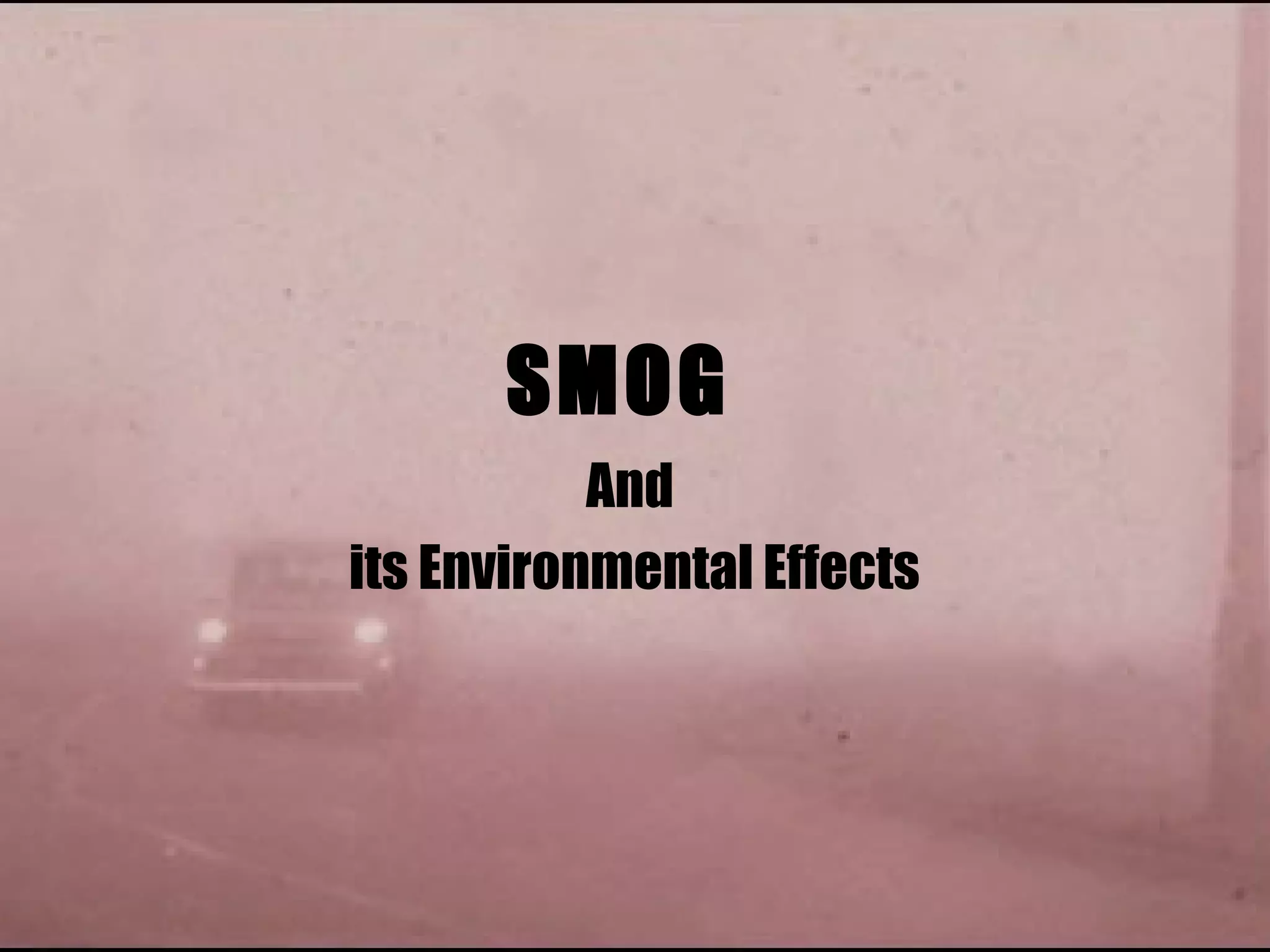
SMOG
And
its Environmental Effects
History of Smog
• Name comes from a mix of “Smoke”
and “Fog”
• First observed in London during the
industrial revolution
• There are 2 types of smog: Industrial
Smog (London) and Photochemical
Smog (Los Angeles)
Industrial Smog (Reducing)
• Source: Pollution from the burning of coal and oil that
contains sulfur
• Consists mainly of: Sulfur Dioxide, Sulfur Trioxide,
soot and ash (particulate matter) and sulfuric acid
• It can cause breathing difficulties in humans, plus
acid rain damage to plants, aquatic systems, and
metal or stone objects
• London and Chicago have problems with industrial
smog.
• Methods of reducing this smog: Alkaline Scrubbers
reduce SO2 and SO3 levels; electrostatic precipitators
reduce particulates.
Photochemical Smog (Oxidizing)
• Source: Mainly automobile pollution
• Contains: Nitrogen Oxides, Ozone, Alkanals,
Peroxyacyl Nitrates (PANs), plus hundreds of other
substances
• Effects: PANs cause eyes to water and can damage
plants, O3 irritates eyes and deteriorates rubber and
plants, NOx causes acid rain.
• First observed in LA in the 1940s, Manila and Mexico
City also experience this kind of smog
• Catalytic Converters change NO to N2, Lean burning
engines reduce Nox, but create more CO and
Hydrocarbons.
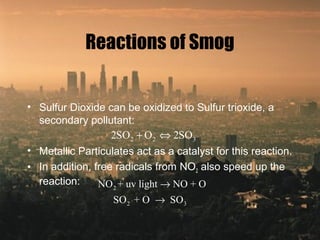
Reactions of Smog
• Sulfur Dioxide can be oxidized to Sulfur trioxide, a
secondary pollutant:
• Metallic Particulates act as a catalyst for this reaction.
• In addition, free radicals from NO2 also speed up the
reaction:
2 2 32SO O 2SO+ ⇔
2
2 3
NO + uv light NO + O
SO + O SO
→
→
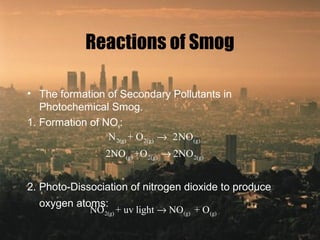
Reactions of Smog
• The formation of Secondary Pollutants in
Photochemical Smog.
1. Formation of NOx:
2. Photo-Dissociation of nitrogen dioxide to produce
oxygen atoms:
2(g) 2(g) (g)
(g) 2(g) 2(g)
N + O 2NO
2NO +O 2NO
→
→
2(g) (g) (g)NO + uv light NO + O→
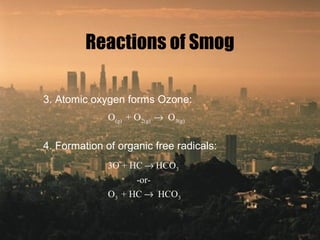
Reactions of Smog
3. Atomic oxygen forms Ozone:
4. Formation of organic free radicals:
(g) 2(g) 3(g)O + O O→
3
3 3
3O + HC HCO
-or-
O + HC HCO
→
→
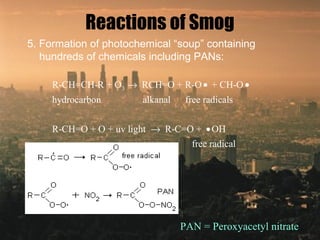
Reactions of Smog
5. Formation of photochemical “soup” containing
hundreds of chemicals including PANs:
3R-CH=CH-R + O RCH=O + R-O + CH-O
hydrocarbon alkanal free radicals
R-CH=O + O + uv light R-C=O + OH
free radical
→ • •
→ •
PAN = Peroxyacetyl nitrate
Thermal Inversions
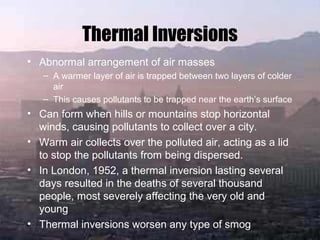
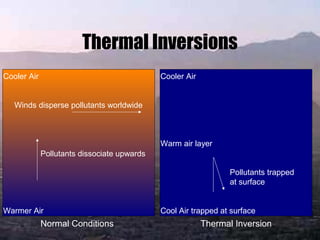
• Abnormal arrangement of air masses
– A warmer layer of air is trapped between two layers of colder
air
– This causes pollutants to be trapped near the earth’s surface
• Can form when hills or mountains stop horizontal
winds, causing pollutants to collect over a city.
• Warm air collects over the polluted air, acting as a lid
to stop the pollutants from being dispersed.
• In London, 1952, a thermal inversion lasting several
days resulted in the deaths of several thousand
people, most severely affecting the very old and
young
• Thermal inversions worsen any type of smog
Thermal Inversions
Normal Conditions
Cooler Air
Winds disperse pollutants worldwide
Warmer Air
Pollutants dissociate upwards
Thermal Inversion
Cooler Air
Warm air layer
Cool Air trapped at surface
Pollutants trapped
at surface
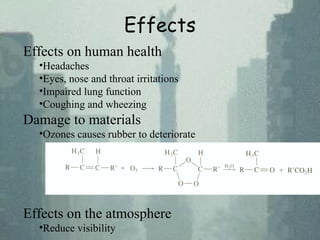
Effects
Effects on human health
•Headaches
•Eyes, nose and throat irritations
•Impaired lung function
•Coughing and wheezing
Damage to materials
•Ozones causes rubber to deteriorate
Effects on the atmosphere
•Reduce visibility
THANK YOU

My smog

  • 1.
  • 2.
    History of Smog •Name comes from a mix of “Smoke” and “Fog” • First observed in London during the industrial revolution • There are 2 types of smog: Industrial Smog (London) and Photochemical Smog (Los Angeles)
  • 3.
    Industrial Smog (Reducing) •Source: Pollution from the burning of coal and oil that contains sulfur • Consists mainly of: Sulfur Dioxide, Sulfur Trioxide, soot and ash (particulate matter) and sulfuric acid • It can cause breathing difficulties in humans, plus acid rain damage to plants, aquatic systems, and metal or stone objects • London and Chicago have problems with industrial smog. • Methods of reducing this smog: Alkaline Scrubbers reduce SO2 and SO3 levels; electrostatic precipitators reduce particulates.
  • 4.
    Photochemical Smog (Oxidizing) •Source: Mainly automobile pollution • Contains: Nitrogen Oxides, Ozone, Alkanals, Peroxyacyl Nitrates (PANs), plus hundreds of other substances • Effects: PANs cause eyes to water and can damage plants, O3 irritates eyes and deteriorates rubber and plants, NOx causes acid rain. • First observed in LA in the 1940s, Manila and Mexico City also experience this kind of smog • Catalytic Converters change NO to N2, Lean burning engines reduce Nox, but create more CO and Hydrocarbons.
  • 5.
    Reactions of Smog •Sulfur Dioxide can be oxidized to Sulfur trioxide, a secondary pollutant: • Metallic Particulates act as a catalyst for this reaction. • In addition, free radicals from NO2 also speed up the reaction: 2 2 32SO O 2SO+ ⇔ 2 2 3 NO + uv light NO + O SO + O SO → →
  • 6.
    Reactions of Smog •The formation of Secondary Pollutants in Photochemical Smog. 1. Formation of NOx: 2. Photo-Dissociation of nitrogen dioxide to produce oxygen atoms: 2(g) 2(g) (g) (g) 2(g) 2(g) N + O 2NO 2NO +O 2NO → → 2(g) (g) (g)NO + uv light NO + O→
  • 7.
    Reactions of Smog 3.Atomic oxygen forms Ozone: 4. Formation of organic free radicals: (g) 2(g) 3(g)O + O O→ 3 3 3 3O + HC HCO -or- O + HC HCO → →
  • 8.
    Reactions of Smog 5.Formation of photochemical “soup” containing hundreds of chemicals including PANs: 3R-CH=CH-R + O RCH=O + R-O + CH-O hydrocarbon alkanal free radicals R-CH=O + O + uv light R-C=O + OH free radical → • • → • PAN = Peroxyacetyl nitrate
  • 9.
    Thermal Inversions • Abnormalarrangement of air masses – A warmer layer of air is trapped between two layers of colder air – This causes pollutants to be trapped near the earth’s surface • Can form when hills or mountains stop horizontal winds, causing pollutants to collect over a city. • Warm air collects over the polluted air, acting as a lid to stop the pollutants from being dispersed. • In London, 1952, a thermal inversion lasting several days resulted in the deaths of several thousand people, most severely affecting the very old and young • Thermal inversions worsen any type of smog
  • 10.
    Thermal Inversions Normal Conditions CoolerAir Winds disperse pollutants worldwide Warmer Air Pollutants dissociate upwards Thermal Inversion Cooler Air Warm air layer Cool Air trapped at surface Pollutants trapped at surface
  • 11.
    Effects Effects on humanhealth •Headaches •Eyes, nose and throat irritations •Impaired lung function •Coughing and wheezing Damage to materials •Ozones causes rubber to deteriorate Effects on the atmosphere •Reduce visibility
  • 12.