Topic 6
Atmospheric Systems and Societies
6.3 Photochemical Smog
http://www.youtube.com/watch?v=
UtdKRvWC1yQ
Tropospheric Ozone
• CO, CO2, SOx NOx and volatile organic compounds
(VOCs) are released from the burning of fossil
fuels (especially in car engines)
• NOx and VOCs release oxygen atoms under the
action of UV light which combine with O2 in the
troposphere to form ozone
• This is accelerated by high temperatures and
sunny conditions – therefore the problems are
exacerbated in conurbations close to the equator
• Smog can also be caused by the burning of trees
as part of deforestation
Effects of Tropospheric Ozone
• Ozone damages plants and in humans causes
eye and skin irritation and breathing problems
• It is very reactive and attacks man-made fibres
• In large urban areas (like Mexico City) ,
tropospheric ozone is less of a problem, since
ozone reacts with NO from car exhausts to
form NO2 – however this causes separate
pollution problems (photochemical smog)
http://www.youtube.com/watch?v=JVcFps_gWpk
http://www.youtube.com/watch?v=r6L_7QvJr64
Photochemical Smog
• Caused by a mixture of ozone, NOx and VOCs
• It is a problem in cities where pollutants are not swept
away by winds (either due to low pressure or the existence
of a thermocline)
• Summer smog occurs in sunny areas where photochemical
activity causes ozone formation
• Winter smog occurs due to thermal inversion and the
increased combustion of fossil fuels in cold conditions
• Often smog problems are worse in areas surrounding city
centres since:
– Ozone forms relatively slowly allowing polluted air to drift away
from where it was formed
– Nox levels are higher in city centres and react with ozone
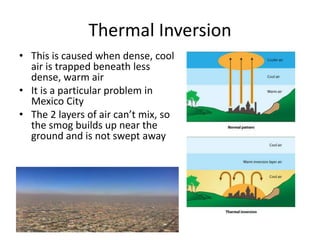
Thermal Inversion
• This is caused when dense, cool
air is trapped beneath less
dense, warm air
• It is a particular problem in
Mexico City
• The 2 layers of air can’t mix, so
the smog builds up near the
ground and is not swept away
Management Strategies
• Reduced use of private vehicles and trucks
• Introduction of more efficient engines
• Encouraging car-pooling and use of public
transport
• Switch from road to rail haulage
• Change to more efficient and less polluting
fuels
Questions
1. State the sources and effects of tropospheric
ozone
2. Outline the formation of photochemical
smog
3. Describe the effects of photochemical smog
4. Describe and evaluate strategies to control
urban air pollution

Summary of topic 6.3

  • 1.
    Topic 6 Atmospheric Systemsand Societies 6.3 Photochemical Smog http://www.youtube.com/watch?v= UtdKRvWC1yQ
  • 2.
    Tropospheric Ozone • CO,CO2, SOx NOx and volatile organic compounds (VOCs) are released from the burning of fossil fuels (especially in car engines) • NOx and VOCs release oxygen atoms under the action of UV light which combine with O2 in the troposphere to form ozone • This is accelerated by high temperatures and sunny conditions – therefore the problems are exacerbated in conurbations close to the equator • Smog can also be caused by the burning of trees as part of deforestation
  • 3.
    Effects of TroposphericOzone • Ozone damages plants and in humans causes eye and skin irritation and breathing problems • It is very reactive and attacks man-made fibres • In large urban areas (like Mexico City) , tropospheric ozone is less of a problem, since ozone reacts with NO from car exhausts to form NO2 – however this causes separate pollution problems (photochemical smog) http://www.youtube.com/watch?v=JVcFps_gWpk http://www.youtube.com/watch?v=r6L_7QvJr64
  • 4.
    Photochemical Smog • Causedby a mixture of ozone, NOx and VOCs • It is a problem in cities where pollutants are not swept away by winds (either due to low pressure or the existence of a thermocline) • Summer smog occurs in sunny areas where photochemical activity causes ozone formation • Winter smog occurs due to thermal inversion and the increased combustion of fossil fuels in cold conditions • Often smog problems are worse in areas surrounding city centres since: – Ozone forms relatively slowly allowing polluted air to drift away from where it was formed – Nox levels are higher in city centres and react with ozone
  • 5.
    Thermal Inversion • Thisis caused when dense, cool air is trapped beneath less dense, warm air • It is a particular problem in Mexico City • The 2 layers of air can’t mix, so the smog builds up near the ground and is not swept away
  • 6.
    Management Strategies • Reduceduse of private vehicles and trucks • Introduction of more efficient engines • Encouraging car-pooling and use of public transport • Switch from road to rail haulage • Change to more efficient and less polluting fuels
  • 7.
    Questions 1. State thesources and effects of tropospheric ozone 2. Outline the formation of photochemical smog 3. Describe the effects of photochemical smog 4. Describe and evaluate strategies to control urban air pollution