Mobile Phone Antennas Design
Nazem Alsmadi & Khalid Saif
nazemalsmadi@hotmail.com khaled_s_23@yahoo.com
Presentation goals
• To investigate a single band PIFA antenna structure which can
be integrated in today mobile phones.
• To investigate and design a wideband PIFA antenna which
cover the range from 1800MHz to 2600MHz.
Presentation contains:
•Introduction
•Background
•Design of mobile phones antennas
•Problems of mobile phones antennas
Introduction
• The huge development of the mobile phones have grown
up rapidly in the last years leads to minimized the mobile
phones sizes thus the antennas become smaller.
• Electrically small antenna:
It is a passive device which used in mobile terminals to send
and receive signals, this passive devices are excited by AC
feeding with certain frequency to force the antenna to radiate.
The development of mobile phone antennas
• External antenna
http://mashable.com/2014/03/13/first-cellphone-on-sale/ http://tech-kid.com/nokia-phone.html http://www.northstandchat.com/showthread.php?289468-Your-first-ever-Mobile -Phone-and-what-make- and-model-was-it-!/page3
Motorola
DynaTAC8000X with
Sleeve dipole antenna.
Nokia 1011
supports only
GSM900 single
band
Motorola m300 support
only GSM1800 single
band
The development of mobile phone antenna
• Internal antenna
http://www.mondomobileblog.com/2010/03/31/codici-segreti-nokia-6630
Nokia 3210 and its internal
antenna which is installed to
the top left of the back view of
the mobile phone.
Nokia6630 mobile and with
dual mode tri-band,
GSM900/1800/1900 and
UMTS 2100.
Background
• Parameters
- Radiation pattern
- VSWR =(1+|ᴦ|)/(1-| ᴦ | )
- Antenna gain 𝑮 = 𝜺 𝑹 𝑫
- Antenna efficiency 𝜺 𝑹 =
𝑷 𝒓
𝑷 𝒊𝒏
- Bandwidth 𝑩𝑾% =
𝒇 𝒎𝒂𝒙−𝒇 𝒎𝒊𝒏
𝒇 𝑪𝒆𝒏𝒕𝒆𝒓
× 𝟏𝟎𝟎
http://www.radio-electronics.com/info/antennas/dipole/feed//
Background
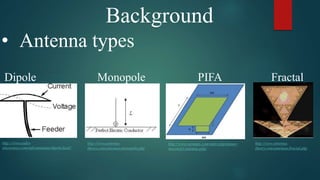
• Antenna types
Dipole Monopole PIFA Fractal
http://www.radio-
electronics.com/info/antennas/dipole/feed//
http://www.antenna-
theory.com/antennas/monopole.php
http://www.raymaps.com/index.php/planar-
inverted-f-antenna-pifa/
http://www.antenna-
theory.com/antennas/fractal.php
Design
Mobile phone antenna design:
• Single band PIFA antenna.
• Wideband PIFA antenna.
NOTE: the both PIFA antennas models are simulated in
COMSOL Multiphysics
Design
Single band PIFA antenna
Model description:
- The desired bandwidth is a single frequency 1.575 GHz.
- Omni-directional receive only mode antenna.
- The gain should be between -3dB to 0dB.
Material Dielectric constant ( 𝝐 𝒓)
Air 1
FR-4 4.5
Nylon 3.8*
Glass (quartz) 4.2
Silicon 11.7
PTEF 2.1
* The Dielectric constant of Nylon accordinghttp://www.professionalplastics.com/professionalplastics/
ElectricalPropertiesofPlastics.pdf
Design
Calculations
The antenna to the left and its dimensions 𝐿1 = 20𝑚𝑚, 𝐿2 = 10𝑚𝑚,
𝑤 = 2𝑚𝑚 , ℎ = 4𝑚𝑚 𝜖 𝑟 = 3.8, Δ = 0.2𝑚𝑚 to the right the casing’s
dimensions have length =119mm, width =60mm.
The resonant wavelength of a
PIFA antenna can be calculated
as following:
𝑳 𝟏 + 𝑳 𝟐 − 𝑾 =
𝝀 𝟎
𝟒
, 𝜆0 = 112 mm
The relation between the
resonant wavelength and the
resonant frequency can be
determined by the equation:
𝒇 𝟎 =
𝒄 𝟎
𝝀 𝟎 𝝐 𝒓
, 𝒇 𝟎 = 𝟏. 𝟑𝟕𝟒 𝐆𝐇𝐳
Design
Simulations
- The materials are inserted in each domain.
- The outer shell of the casing is simulated
with PTFE material.
- A 50 Ω lumped port is used to excite the
antenna and determine the input impedance.
- A sphere with radius 100mm, material air has a five perfect matched layers
in order for the radiation to be able to travel anywhere.
- The metal part of the antenna element at frequency 1.575 GHz can be
modeled using perfect electric conductor boundaries
Design
Result and Analysis
The plot shows that the electric field is strong at
one of the top metallic surface shell far from the
feeding point. This looks alike the E-field
distribution of a quarter wavelength monopole
antenna, which the PIFA derived from.
The antenna gain on xy-plane varies from about
-6dBi to 1.5dBi. The azimuthal radiation pattern
is not Omni-directional any more, since the
antenna is mounted on the ground plane and
miniaturized.
Design
Result and Analysis
S-parameters (S11) measurements indicate that at
1.575GHz is -13dB which means that the reflected
power is 5%. This describes how well the antenna input
impedance is matched to the 50 Ω reference impedance.
Antenna’s bandwidth regarding figure 3.1.7 is
a narrow bandwidth:
𝐵𝑎𝑛𝑑𝑤𝑖𝑑𝑡ℎ ≈
1.577 − 1.557
1.570
× 100 = 1.2%
The wide bandwidth for GPS antenna is not
required. So the bandwidth above is sufficient.
𝑳 𝟏 𝑳 𝟐 𝑾 𝑯
𝒇 𝟎
Effect of geometric dimensions on resonant frequency.
Conclusion
Design
Wideband antenna design
Model description
- PIFA antenna design using slot, with a desired range of
frequency from 1800MHz to 2600MHz. This important
range cover GSM (1800MHz & 1900MHz), UMTS
(2100MHz), Bluetooth and Wi-Fi (2.4GHz), and LTE
system (2.3GHz, 2.5GHz, and 2.6GHz).
- The model consists of the same materials which are
used in pervious design except the dielectric material
between the PIFA and the ground plane which is air
with (𝜖 𝑟) equals to 1.
Design
Calculations
The illustration dimensions of the PIFA 𝐿1 = 24𝑚𝑚 ,
𝐿2 = 10𝑚𝑚 , ℎ = 4𝑚𝑚 , 𝑊 = 2𝑚𝑚 and the ground plane
with its slot dimension 𝑑 𝑠 = 5𝑚, 𝐿𝑠 = 28𝑚𝑚 , 𝑊𝑠 = 2𝑚𝑚.
24 + 10 − 2 =
𝜆0
4
, 𝜆0 = 128mm
𝑓0 =
3×10⁸
128×10−3×√1
= 2.343𝐺𝐻𝑧
The desired bandwidth percentage:
𝑓𝑐𝑒𝑛𝑡𝑒𝑟 =
2600+1800
2
= 2200𝑀𝐻𝑧
𝐵𝑎𝑛𝑑𝑤𝑖𝑑𝑡ℎ% =
2600−1800
2200
× 100 = 36.36%
If the bandwidth percentage higher than 20%,
that’s bandwidth is considered as a wide
bandwidth.
Design
Simulations
1800MHz 1900MHz 2100MHz 2300MHz
2400MHz 2500MHz 2600MHz
Design
Result and Analysis
- The resonant frequency is 2.4GHz with -40dB and
return loss of the range from
1800MHz to 2500MHz is ≤ −10𝑑𝐵.
- By including 2.6GHz we have a wide bandwidth
equal to 36.36%
- The resonant frequency is 2GHz with
return loss -10dB.
- 𝐵𝑎𝑛𝑑𝑤𝑖𝑑𝑡ℎ% ≈
2.01−1.99
2
= 1%
Return loss with slot Return loss without slot
Design
Result and Analysis
Techniques which are used to increase the Bandwidth for proposed PIFA:
• Bandwidth depends very much on the size of the ground plane.
• Using slotted ground plane: using a slot with proper length to get other resonant
frequencies.
• Using Air as a dielectric material between the PIFA element and the ground plane this
technique improves the Bandwidth and enhances the gain.
Conclusion
A wideband PIFA antenna has been designed and presented. The proposed PIFA antenna
occupies a compact envelope dimension of 24 × 10 × 4𝑚𝑚3
while covering the required
wide band with a sufficient impedance matching (S11 ≤ -10 dB) covering GSM (1800MHz
&1900MHz), UMTS (2100MHz), Bluetooth & Wi-Fi (2.4GHz), and LTE system (2.3GHz,
2.5GHz, and 2.6GHz).
Specification absorption rate
SAR
How to measure the SAR? How to reduce the SAR?
http://en.wikipedia.org/wiki/Electromagnetic_shielding
Problems of mobile phone
antennas
• Efficiencies of mobile phone antennas.
• Tradeoff between size and performance.
• Bandwidth.
• Mutual coupling antennas to antenna loss.
• The hand-held environment problem.
Reference
[1] Mobile Antenna Systems Handbook page 17-19
[2] http://www.businessinsider.com/complete-visual-history-of-cell-phones-2011-5?op=1&IR=T
[3] C. Chiau, “Study of diversity antenna array for MIMO wireless communication systems,” Ph.D. dissertation, Queen
Mary University of London, UK, April 2006.
[4] http://www.antenna-theory.com/
[5] http://classes.yale.edu/fractals/panorama/ManuFractals/FractalAntennas/FractalAntennas.html
[6] Mandelbrot, B. B., the Fractal Geometry of Nature, W.H. Freeman and Company, New York, 1983.
[7] http://www.iject.org/vol4/spl3/c0113.pdf
[8] http://www.ijstr.org/final-print/may2014/Response-Of-Planar-Inverted-F-Antenna-Over-Different-Dielectric-
Substrates.pdf
[9] http://www.slideshare.net/NaveenKumar11/thesis-viva-presentation?related=1
[10] http://www.raymaps.com/index.php/planar-inverted-f-antenna-pifa/
[11] http://www.ece.msstate.edu/~donohoe/ece4990notes2.pdf
[12] http://www.s21.com/sar.htm
[13] http://sarvalues.com/what-is-sar-and-what-is-all-the-fuss-about/
[14] http://citeseerx.ist.psu.edu/viewdoc/download?doi=10.1.1.206.2791&rep=rep1&type=pdf
[15] http://www.ijrte.academypublisher.com/vol02/no05/ijrte02055862.pdf
[16] http://telecom.hellodirect.com/docs/Tutorials/HeadsetBenefits.1.110200.asp
[17] Mobile-phone antenna design, Author: ROWELL, CR; Lam, EYM, Issued Date 2012 URL:
http://hdl.handle.net/10722/185908 Rights: IEEEE Antennas and Propagation Magazine. Copyright © IEEE.
[18] H. A. Wheeler, “The radiansphere around a small antenna”, Proceedings of the IRE, pp. 1325-1331, August1959.
Reference[19] T. Taga and K. Tsunekawa, “Performance analysis of a built-in planar inverted F antenna for 800 MHz band portable radio
units,” IEEE J.Select. Areas Commun, vol. SAC-5, pp. 921–929, June 1987.
[20] K. Sato, K. Matsumoto, K. Fujimoto, and K. Hirasawa, “Characteristics of a planar inverted-F antenna on a rectangular
conducting body,” Electron. Commun. Japan, pt. 1, vol. 72, pp. 43–51, 1989.
[21] T. Taga, “Analysis of planar inverted-F antennas and antenna design for portable radio equipment,” in Analysis, Design, and
Measurement of Small and Low-Profile Antennas, K. Hirasawa and M. Haneishi,Eds. Norwood, MA: Artech House, 1992, pp.
161–180.
[22] P. Vainikainen, J. Ollikainen, O. Kivekäs, and I. Kelander, “Resonator- based analysis of the combination of mobile handset
antenna and chassis,” IEEE Trans. Antennas Propagat., vol. 50, pp. 1433–1444, Oct. 2002.
[23] http://scholar.lib.vt.edu/theses/available/etd-7697-21043/unrestricted/CH1_2.PDF
[24]Chuang, H. R. “Human Operator Coupling Effects on Radiation Characteristics of a Portable
Communication Dipole Antenna”., IEEE Transactions on Antennas and Propagation, v. 42, n. 4,
April 1994, pp. 556-560.
[25] http://en.wikipedia.org/wiki/IPhone_4
[26] The Annual Workshop and Feder Award Ceremony 2010. Speaker: Prof. Raphael Kastner, Tel Aviv University.
[27] Research Article: Novel Wideband MIMO Antennas That Can Cover the Whole LTE Spectrum in Handsets and Portable
Computers, Mohamed Sanad1 and Noha Hassan2
[28] Balanis, Constantine A. "Antenna Theory - Analysis and Design", 2005, 3rd Edition, John Wiley & Sons ///page 80.
[29] IEEE Antennas and Propagation Magazine, Vol. 54, No. 4, August 2012.
[30] http://ecee.colorado.edu/~bart/ecen6355/app-04.pdf

Thesis presentation

  • 1.
    Mobile Phone AntennasDesign Nazem Alsmadi & Khalid Saif nazemalsmadi@hotmail.com khaled_s_23@yahoo.com
  • 2.
    Presentation goals • Toinvestigate a single band PIFA antenna structure which can be integrated in today mobile phones. • To investigate and design a wideband PIFA antenna which cover the range from 1800MHz to 2600MHz.
  • 3.
    Presentation contains: •Introduction •Background •Design ofmobile phones antennas •Problems of mobile phones antennas
  • 4.
    Introduction • The hugedevelopment of the mobile phones have grown up rapidly in the last years leads to minimized the mobile phones sizes thus the antennas become smaller. • Electrically small antenna: It is a passive device which used in mobile terminals to send and receive signals, this passive devices are excited by AC feeding with certain frequency to force the antenna to radiate.
  • 5.
    The development ofmobile phone antennas • External antenna http://mashable.com/2014/03/13/first-cellphone-on-sale/ http://tech-kid.com/nokia-phone.html http://www.northstandchat.com/showthread.php?289468-Your-first-ever-Mobile -Phone-and-what-make- and-model-was-it-!/page3 Motorola DynaTAC8000X with Sleeve dipole antenna. Nokia 1011 supports only GSM900 single band Motorola m300 support only GSM1800 single band
  • 6.
    The development ofmobile phone antenna • Internal antenna http://www.mondomobileblog.com/2010/03/31/codici-segreti-nokia-6630 Nokia 3210 and its internal antenna which is installed to the top left of the back view of the mobile phone. Nokia6630 mobile and with dual mode tri-band, GSM900/1800/1900 and UMTS 2100.
  • 7.
    Background • Parameters - Radiationpattern - VSWR =(1+|ᴦ|)/(1-| ᴦ | ) - Antenna gain 𝑮 = 𝜺 𝑹 𝑫 - Antenna efficiency 𝜺 𝑹 = 𝑷 𝒓 𝑷 𝒊𝒏 - Bandwidth 𝑩𝑾% = 𝒇 𝒎𝒂𝒙−𝒇 𝒎𝒊𝒏 𝒇 𝑪𝒆𝒏𝒕𝒆𝒓 × 𝟏𝟎𝟎 http://www.radio-electronics.com/info/antennas/dipole/feed//
  • 8.
    Background • Antenna types DipoleMonopole PIFA Fractal http://www.radio- electronics.com/info/antennas/dipole/feed// http://www.antenna- theory.com/antennas/monopole.php http://www.raymaps.com/index.php/planar- inverted-f-antenna-pifa/ http://www.antenna- theory.com/antennas/fractal.php
  • 9.
    Design Mobile phone antennadesign: • Single band PIFA antenna. • Wideband PIFA antenna. NOTE: the both PIFA antennas models are simulated in COMSOL Multiphysics
  • 10.
    Design Single band PIFAantenna Model description: - The desired bandwidth is a single frequency 1.575 GHz. - Omni-directional receive only mode antenna. - The gain should be between -3dB to 0dB. Material Dielectric constant ( 𝝐 𝒓) Air 1 FR-4 4.5 Nylon 3.8* Glass (quartz) 4.2 Silicon 11.7 PTEF 2.1 * The Dielectric constant of Nylon accordinghttp://www.professionalplastics.com/professionalplastics/ ElectricalPropertiesofPlastics.pdf
  • 11.
    Design Calculations The antenna tothe left and its dimensions 𝐿1 = 20𝑚𝑚, 𝐿2 = 10𝑚𝑚, 𝑤 = 2𝑚𝑚 , ℎ = 4𝑚𝑚 𝜖 𝑟 = 3.8, Δ = 0.2𝑚𝑚 to the right the casing’s dimensions have length =119mm, width =60mm. The resonant wavelength of a PIFA antenna can be calculated as following: 𝑳 𝟏 + 𝑳 𝟐 − 𝑾 = 𝝀 𝟎 𝟒 , 𝜆0 = 112 mm The relation between the resonant wavelength and the resonant frequency can be determined by the equation: 𝒇 𝟎 = 𝒄 𝟎 𝝀 𝟎 𝝐 𝒓 , 𝒇 𝟎 = 𝟏. 𝟑𝟕𝟒 𝐆𝐇𝐳
  • 12.
    Design Simulations - The materialsare inserted in each domain. - The outer shell of the casing is simulated with PTFE material. - A 50 Ω lumped port is used to excite the antenna and determine the input impedance. - A sphere with radius 100mm, material air has a five perfect matched layers in order for the radiation to be able to travel anywhere. - The metal part of the antenna element at frequency 1.575 GHz can be modeled using perfect electric conductor boundaries
  • 13.
    Design Result and Analysis Theplot shows that the electric field is strong at one of the top metallic surface shell far from the feeding point. This looks alike the E-field distribution of a quarter wavelength monopole antenna, which the PIFA derived from. The antenna gain on xy-plane varies from about -6dBi to 1.5dBi. The azimuthal radiation pattern is not Omni-directional any more, since the antenna is mounted on the ground plane and miniaturized.
  • 14.
    Design Result and Analysis S-parameters(S11) measurements indicate that at 1.575GHz is -13dB which means that the reflected power is 5%. This describes how well the antenna input impedance is matched to the 50 Ω reference impedance. Antenna’s bandwidth regarding figure 3.1.7 is a narrow bandwidth: 𝐵𝑎𝑛𝑑𝑤𝑖𝑑𝑡ℎ ≈ 1.577 − 1.557 1.570 × 100 = 1.2% The wide bandwidth for GPS antenna is not required. So the bandwidth above is sufficient. 𝑳 𝟏 𝑳 𝟐 𝑾 𝑯 𝒇 𝟎 Effect of geometric dimensions on resonant frequency. Conclusion
  • 15.
    Design Wideband antenna design Modeldescription - PIFA antenna design using slot, with a desired range of frequency from 1800MHz to 2600MHz. This important range cover GSM (1800MHz & 1900MHz), UMTS (2100MHz), Bluetooth and Wi-Fi (2.4GHz), and LTE system (2.3GHz, 2.5GHz, and 2.6GHz). - The model consists of the same materials which are used in pervious design except the dielectric material between the PIFA and the ground plane which is air with (𝜖 𝑟) equals to 1.
  • 16.
    Design Calculations The illustration dimensionsof the PIFA 𝐿1 = 24𝑚𝑚 , 𝐿2 = 10𝑚𝑚 , ℎ = 4𝑚𝑚 , 𝑊 = 2𝑚𝑚 and the ground plane with its slot dimension 𝑑 𝑠 = 5𝑚, 𝐿𝑠 = 28𝑚𝑚 , 𝑊𝑠 = 2𝑚𝑚. 24 + 10 − 2 = 𝜆0 4 , 𝜆0 = 128mm 𝑓0 = 3×10⁸ 128×10−3×√1 = 2.343𝐺𝐻𝑧 The desired bandwidth percentage: 𝑓𝑐𝑒𝑛𝑡𝑒𝑟 = 2600+1800 2 = 2200𝑀𝐻𝑧 𝐵𝑎𝑛𝑑𝑤𝑖𝑑𝑡ℎ% = 2600−1800 2200 × 100 = 36.36% If the bandwidth percentage higher than 20%, that’s bandwidth is considered as a wide bandwidth.
  • 17.
    Design Simulations 1800MHz 1900MHz 2100MHz2300MHz 2400MHz 2500MHz 2600MHz
  • 18.
    Design Result and Analysis -The resonant frequency is 2.4GHz with -40dB and return loss of the range from 1800MHz to 2500MHz is ≤ −10𝑑𝐵. - By including 2.6GHz we have a wide bandwidth equal to 36.36% - The resonant frequency is 2GHz with return loss -10dB. - 𝐵𝑎𝑛𝑑𝑤𝑖𝑑𝑡ℎ% ≈ 2.01−1.99 2 = 1% Return loss with slot Return loss without slot
  • 19.
    Design Result and Analysis Techniqueswhich are used to increase the Bandwidth for proposed PIFA: • Bandwidth depends very much on the size of the ground plane. • Using slotted ground plane: using a slot with proper length to get other resonant frequencies. • Using Air as a dielectric material between the PIFA element and the ground plane this technique improves the Bandwidth and enhances the gain. Conclusion A wideband PIFA antenna has been designed and presented. The proposed PIFA antenna occupies a compact envelope dimension of 24 × 10 × 4𝑚𝑚3 while covering the required wide band with a sufficient impedance matching (S11 ≤ -10 dB) covering GSM (1800MHz &1900MHz), UMTS (2100MHz), Bluetooth & Wi-Fi (2.4GHz), and LTE system (2.3GHz, 2.5GHz, and 2.6GHz).
  • 20.
    Specification absorption rate SAR Howto measure the SAR? How to reduce the SAR? http://en.wikipedia.org/wiki/Electromagnetic_shielding
  • 21.
    Problems of mobilephone antennas • Efficiencies of mobile phone antennas. • Tradeoff between size and performance. • Bandwidth. • Mutual coupling antennas to antenna loss. • The hand-held environment problem.
  • 22.
    Reference [1] Mobile AntennaSystems Handbook page 17-19 [2] http://www.businessinsider.com/complete-visual-history-of-cell-phones-2011-5?op=1&IR=T [3] C. Chiau, “Study of diversity antenna array for MIMO wireless communication systems,” Ph.D. dissertation, Queen Mary University of London, UK, April 2006. [4] http://www.antenna-theory.com/ [5] http://classes.yale.edu/fractals/panorama/ManuFractals/FractalAntennas/FractalAntennas.html [6] Mandelbrot, B. B., the Fractal Geometry of Nature, W.H. Freeman and Company, New York, 1983. [7] http://www.iject.org/vol4/spl3/c0113.pdf [8] http://www.ijstr.org/final-print/may2014/Response-Of-Planar-Inverted-F-Antenna-Over-Different-Dielectric- Substrates.pdf [9] http://www.slideshare.net/NaveenKumar11/thesis-viva-presentation?related=1 [10] http://www.raymaps.com/index.php/planar-inverted-f-antenna-pifa/ [11] http://www.ece.msstate.edu/~donohoe/ece4990notes2.pdf [12] http://www.s21.com/sar.htm [13] http://sarvalues.com/what-is-sar-and-what-is-all-the-fuss-about/ [14] http://citeseerx.ist.psu.edu/viewdoc/download?doi=10.1.1.206.2791&rep=rep1&type=pdf [15] http://www.ijrte.academypublisher.com/vol02/no05/ijrte02055862.pdf [16] http://telecom.hellodirect.com/docs/Tutorials/HeadsetBenefits.1.110200.asp [17] Mobile-phone antenna design, Author: ROWELL, CR; Lam, EYM, Issued Date 2012 URL: http://hdl.handle.net/10722/185908 Rights: IEEEE Antennas and Propagation Magazine. Copyright © IEEE. [18] H. A. Wheeler, “The radiansphere around a small antenna”, Proceedings of the IRE, pp. 1325-1331, August1959.
  • 23.
    Reference[19] T. Tagaand K. Tsunekawa, “Performance analysis of a built-in planar inverted F antenna for 800 MHz band portable radio units,” IEEE J.Select. Areas Commun, vol. SAC-5, pp. 921–929, June 1987. [20] K. Sato, K. Matsumoto, K. Fujimoto, and K. Hirasawa, “Characteristics of a planar inverted-F antenna on a rectangular conducting body,” Electron. Commun. Japan, pt. 1, vol. 72, pp. 43–51, 1989. [21] T. Taga, “Analysis of planar inverted-F antennas and antenna design for portable radio equipment,” in Analysis, Design, and Measurement of Small and Low-Profile Antennas, K. Hirasawa and M. Haneishi,Eds. Norwood, MA: Artech House, 1992, pp. 161–180. [22] P. Vainikainen, J. Ollikainen, O. Kivekäs, and I. Kelander, “Resonator- based analysis of the combination of mobile handset antenna and chassis,” IEEE Trans. Antennas Propagat., vol. 50, pp. 1433–1444, Oct. 2002. [23] http://scholar.lib.vt.edu/theses/available/etd-7697-21043/unrestricted/CH1_2.PDF [24]Chuang, H. R. “Human Operator Coupling Effects on Radiation Characteristics of a Portable Communication Dipole Antenna”., IEEE Transactions on Antennas and Propagation, v. 42, n. 4, April 1994, pp. 556-560. [25] http://en.wikipedia.org/wiki/IPhone_4 [26] The Annual Workshop and Feder Award Ceremony 2010. Speaker: Prof. Raphael Kastner, Tel Aviv University. [27] Research Article: Novel Wideband MIMO Antennas That Can Cover the Whole LTE Spectrum in Handsets and Portable Computers, Mohamed Sanad1 and Noha Hassan2 [28] Balanis, Constantine A. "Antenna Theory - Analysis and Design", 2005, 3rd Edition, John Wiley & Sons ///page 80. [29] IEEE Antennas and Propagation Magazine, Vol. 54, No. 4, August 2012. [30] http://ecee.colorado.edu/~bart/ecen6355/app-04.pdf