The document discusses the phases of competition in sport: pre-season, in-season, and post-season. Pre-season focuses on improving fitness, skills, and strategies 8-12 weeks before competition. In-season maintains fitness while increasing intensity and focusing on tactics. Post-season allows for physical and mental recovery while maintaining some fitness to prevent losses from the prior phases.
THE PHASES Itis not uncommon for athletes to train all year round. Even though some sports are summer sports EG: Cricket, they still train through winter months. This is done to maintain fitness and in some cases skill levels. The total training program can be broken down into three distinct phases. These phases include: Pre- season (Pre) In season (During) Post season (Post) The dividing of a program into phases is called periodisation . Subtle and important differences in training exist in each of these three stages.
3.
PRE COMPETITION (Preparation Period) Pre-season training usually occurs 8-12 weeks before the start of season or a competition. The predominant energy systems used in the sport are increased to maximum capacities. Sport specific skill training is also intensified. If specific components of fitness or skill are required, significant time should be allocated to practising these in pre-season. The basic aim of the preparation phase is to: Improve all aspects of fitness Develop technique Improve performance Introduce strategies and familiarise players with them Teach appropriate mental skills These aims are best achieved through programs that focus on endurance, strength and skill in a variety of environments. Important fitness components such as speed, strength and flexibility need to receive specific attention. Towards the end of this phase, the level of physical condition and quality of skill performance should be high.
4.
DURING COMPETITION (CompetitionPeriod) The competition phase will vary in duration, depending on the sport. During this phase, maintaining fitness developed in the preparation phase is continued. However, a general increase in intensity is matched by a corresponding decrease in volume. The main aims during this period include: - Maintain the fitness, strength and skills developed during the pre-season Maintain stamina Practice and improve tactics and strategies Perfect skill execution There is an increased emphasis on game-like skills, strategic development and practice involving opposition. Practice should still be of sufficient volume and intensity to maintain strength and endurance throughout the season. The involvement of the athletes in actual games and game-like practices allows less emphasis on aerobic capacity and strength-conditioning at training. Drills with components of game-skills and fitness are important. The only exception is athletes who don’t get much game time. They might need to engage in alternative high-intensity conditioning or skill practice during the week for three days.
5.
POST COMPETITION (Transitionperiod) This phase is one of physical and mental recovery from training and competition. It provides time for general refreshment, allowing both mental and physical abilities to recuperate. If an athlete does not participate in post season training it will lead to loss of the immense gains made during training and make the pre-season preparation more difficult and protracted. This further highlights the importance of post-season training. Post season or off-season training varies from sport to sport but, has the following general aims : - To prevent weight gain - To maintain aerobic fitness base (low intensity) To maintain strength (increase endurance, strength and power) To maintain a reasonable sports skill level (participate in games) To repair injuries and to recuperate physically and mentally Regardless of the sport, variety is the key to post-season training programs. Post-season training is usually low intensity but of high volume. This phase also allows athletes to concentrate on areas of weakness.
6.
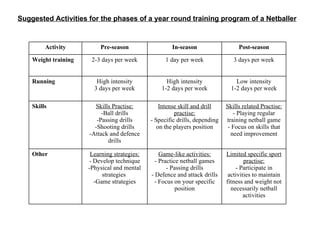
Suggested Activities forthe phases of a year round training program of a Netballer Game-like activities: - Practice netball games - Passing drills - Defence and attack drills - Focus on your specific position Intense skill and drill practise: - Specific drills, depending on the players position High intensity 1-2 days per week 1 day per week In-season Learning strategies: - Develop technique Physical and mental strategies Game strategies Skills Practise: Ball drills Passing drills Shooting drills Attack and defence drills High intensity 3 days per week 2-3 days per week Pre-season Limited specific sport practise: - Participate in activities to maintain fitness and weight not necessarily netball activities Other Skills related Practise: - Playing regular training netball game - Focus on skills that need improvement Skills Low intensity 1-2 days per week Running 3 days per week Weight training Post-season Activity
7.
BIBLIOGRAPHY Browne, S.et al (2000) PDHPE application and inquiry HSC Course. OXFORD: Australia Buchanan, D.and Nemec, M. (2003) HSC Personal Development, Health and Physical Education . Macquarie revision guides: Australia Ruskin, R., Proctor, K and Neeves, D. (2007). Outcomes 2, Third Edition, HSC Course, Personal Development, Health and Physical Education. John Wiley & Sons Australia, Ltd, Queensland By Amelia Small