Prof. Dr. A.MAHABOOBJAN
Bharathidasan University,
Tiruchirappalli, Tamilnadu, India.
Endurance is the ability to resist fatigue.
It is an ability to do the activity for longer
duration without undue fatigue.
Ability which enables the sports men to do
a sports activity effectively without getting
tired and to recover quickly form fatigue
during and after activity.
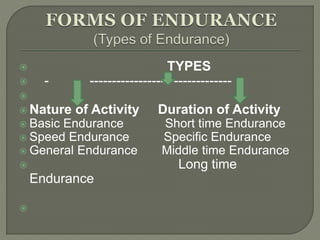
 TYPES
 - --------------------------------

 Nature of Activity Duration of Activity
 Basic Endurance Short time Endurance
 Speed Endurance Specific Endurance
 General Endurance Middle time Endurance
 Long time
Endurance

 Ability to resist fatigue caused by
movement activities done at slow to
moderate pace for prolonged time.
Eg: Walking, Jogging, swimming, cycling. It
depends more than 90% on the aerobic
capacity.
Ability to resist fatigue caused by various
types of activities may be aerobic or
anaerobic or combination of both for longer
time.
Eg: A sportsmen can able to play all games to
do various types of movements with higher
or lower intensity for sufficient long period
without much fatigue.
Ability to resist fatigue caused by sports
movements of particular sports.
It is an ability to resist fatigue caused by a
specific sports activity.
Eg: 10000 mts to cover this distance in
minimum time under competitive
conditions.
It is the ability to resist fatigue in
activities lasting up to 45 seconds.
Eg: 400 mts run, 50 mts free style in
swimming, ball games.
It is the ability to resist fatigue in
activities lasting from 45 sec to 2
minutes.
Eg: 800 mts run
It is the ability to resist fatigue in
activities lasting from 2 minutes to 11
minutes.
Eg: 1500 mts and 3000 mts Steeple chase.
It is the ability to resist fatigue in
activities lasting from more than 11
minutes.
Eg: Marathons, 1500 mts, Swimming.
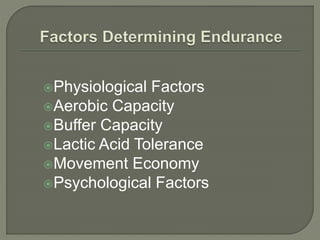
Physiological Factors
Aerobic Capacity
Buffer Capacity
Lactic Acid Tolerance
Movement Economy
Psychological Factors
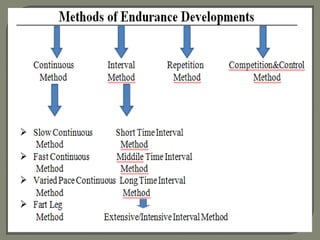
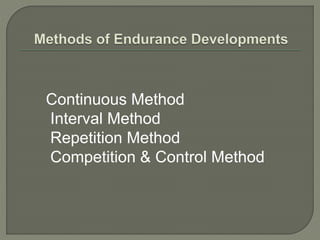
Continuous Method
Interval Method
Repetition Method
Competition & Control Method
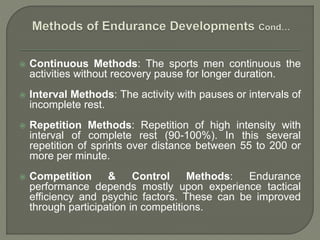
 Continuous Methods: The sports men continuous the
activities without recovery pause for longer duration.
 Interval Methods: The activity with pauses or intervals of
incomplete rest.
 Repetition Methods: Repetition of high intensity with
interval of complete rest (90-100%). In this several
repetition of sprints over distance between 55 to 200 or
more per minute.
 Competition & Control Methods: Endurance
performance depends mostly upon experience tactical
efficiency and psychic factors. These can be improved
through participation in competitions.
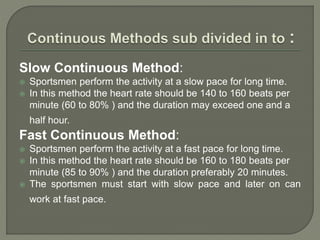
Slow Continuous Method:
 Sportsmen perform the activity at a slow pace for long time.
 In this method the heart rate should be 140 to 160 beats per
minute (60 to 80% ) and the duration may exceed one and a
half hour.
Fast Continuous Method:
 Sportsmen perform the activity at a fast pace for long time.
 In this method the heart rate should be 160 to 180 beats per
minute (85 to 90% ) and the duration preferably 20 minutes.
 The sportsmen must start with slow pace and later on can
work at fast pace.
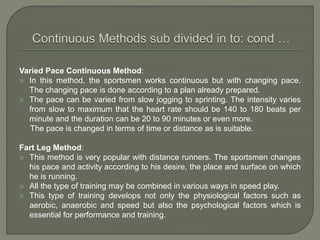
Varied Pace Continuous Method:
 In this method, the sportsmen works continuous but with changing pace.
The changing pace is done according to a plan already prepared.
 The pace can be varied from slow jogging to sprinting. The intensity varies
from slow to maximum that the heart rate should be 140 to 180 beats per
minute and the duration can be 20 to 90 minutes or even more.
The pace is changed in terms of time or distance as is suitable.
Fart Leg Method:
 This method is very popular with distance runners. The sportsmen changes
his pace and activity according to his desire, the place and surface on which
he is running.
 All the type of training may be combined in various ways in speed play.
 This type of training develops not only the physiological factors such as
aerobic, anaerobic and speed but also the psychological factors which is
essential for performance and training.
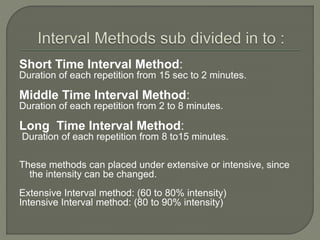
Short Time Interval Method:
Duration of each repetition from 15 sec to 2 minutes.
Middle Time Interval Method:
Duration of each repetition from 2 to 8 minutes.
Long Time Interval Method:
Duration of each repetition from 8 to15 minutes.
These methods can placed under extensive or intensive, since
the intensity can be changed.
Extensive Interval method: (60 to 80% intensity)
Intensive Interval method: (80 to 90% intensity)

Mean and Methods of Endurance Development

  • 1.
    Prof. Dr. A.MAHABOOBJAN BharathidasanUniversity, Tiruchirappalli, Tamilnadu, India.
  • 2.
    Endurance is theability to resist fatigue. It is an ability to do the activity for longer duration without undue fatigue. Ability which enables the sports men to do a sports activity effectively without getting tired and to recover quickly form fatigue during and after activity.
  • 3.
     TYPES  ---------------------------------   Nature of Activity Duration of Activity  Basic Endurance Short time Endurance  Speed Endurance Specific Endurance  General Endurance Middle time Endurance  Long time Endurance 
  • 4.
     Ability toresist fatigue caused by movement activities done at slow to moderate pace for prolonged time. Eg: Walking, Jogging, swimming, cycling. It depends more than 90% on the aerobic capacity.
  • 5.
    Ability to resistfatigue caused by various types of activities may be aerobic or anaerobic or combination of both for longer time. Eg: A sportsmen can able to play all games to do various types of movements with higher or lower intensity for sufficient long period without much fatigue.
  • 6.
    Ability to resistfatigue caused by sports movements of particular sports. It is an ability to resist fatigue caused by a specific sports activity. Eg: 10000 mts to cover this distance in minimum time under competitive conditions.
  • 7.
    It is theability to resist fatigue in activities lasting up to 45 seconds. Eg: 400 mts run, 50 mts free style in swimming, ball games.
  • 8.
    It is theability to resist fatigue in activities lasting from 45 sec to 2 minutes. Eg: 800 mts run
  • 9.
    It is theability to resist fatigue in activities lasting from 2 minutes to 11 minutes. Eg: 1500 mts and 3000 mts Steeple chase.
  • 10.
    It is theability to resist fatigue in activities lasting from more than 11 minutes. Eg: Marathons, 1500 mts, Swimming.
  • 11.
    Physiological Factors Aerobic Capacity BufferCapacity Lactic Acid Tolerance Movement Economy Psychological Factors
  • 13.
    Continuous Method Interval Method RepetitionMethod Competition & Control Method
  • 14.
     Continuous Methods:The sports men continuous the activities without recovery pause for longer duration.  Interval Methods: The activity with pauses or intervals of incomplete rest.  Repetition Methods: Repetition of high intensity with interval of complete rest (90-100%). In this several repetition of sprints over distance between 55 to 200 or more per minute.  Competition & Control Methods: Endurance performance depends mostly upon experience tactical efficiency and psychic factors. These can be improved through participation in competitions.
  • 15.
    Slow Continuous Method: Sportsmen perform the activity at a slow pace for long time.  In this method the heart rate should be 140 to 160 beats per minute (60 to 80% ) and the duration may exceed one and a half hour. Fast Continuous Method:  Sportsmen perform the activity at a fast pace for long time.  In this method the heart rate should be 160 to 180 beats per minute (85 to 90% ) and the duration preferably 20 minutes.  The sportsmen must start with slow pace and later on can work at fast pace.
  • 16.
    Varied Pace ContinuousMethod:  In this method, the sportsmen works continuous but with changing pace. The changing pace is done according to a plan already prepared.  The pace can be varied from slow jogging to sprinting. The intensity varies from slow to maximum that the heart rate should be 140 to 180 beats per minute and the duration can be 20 to 90 minutes or even more. The pace is changed in terms of time or distance as is suitable. Fart Leg Method:  This method is very popular with distance runners. The sportsmen changes his pace and activity according to his desire, the place and surface on which he is running.  All the type of training may be combined in various ways in speed play.  This type of training develops not only the physiological factors such as aerobic, anaerobic and speed but also the psychological factors which is essential for performance and training.
  • 17.
    Short Time IntervalMethod: Duration of each repetition from 15 sec to 2 minutes. Middle Time Interval Method: Duration of each repetition from 2 to 8 minutes. Long Time Interval Method: Duration of each repetition from 8 to15 minutes. These methods can placed under extensive or intensive, since the intensity can be changed. Extensive Interval method: (60 to 80% intensity) Intensive Interval method: (80 to 90% intensity)