Understanding Epilepsy.. ~Signs & Symptoms ~What is epilepsy? ~Management of the Condition
A common neurological condition affecting around 1-2% of the population.   More likely to be diagnosed in childhood or senior years However, not specified to any one age group, sex or race. 70% of people diagnosed become seizure free taking medication. Important for family, friends and carers of epileptic people to understand different aspects of epilepsy to better improve their chances of gaining control over seizures when they do occur. Including medication and a sensible lifestyle, a full, active life is possible.
Epilepsy is a disruption of the normal electrochemical activity of the brain that results in seizures.  Under different, certain situations and different circumstances, anyone can have a seizure.  Epilepsy is diagnosed when there is a tendency to have re-occurring seizures. What is Epilepsy?
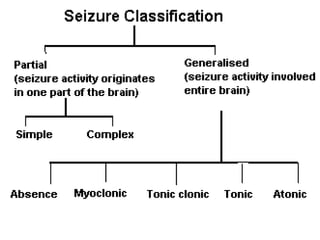
SEIZURES There are approximately 40 different types of seizures however, they can be divided into two major groups; Partial  seizures Generalised  seizures
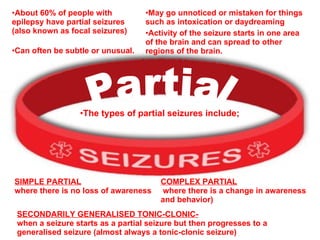
SECONDARILY GENERALISED TONIC-CLONIC-   when a seizure starts as a partial seizure but then progresses to a generalised seizure (almost always a tonic-clonic seizure) Partial About 60% of people with epilepsy have partial seizures (also known as focal seizures) Can often be subtle or unusual. May go unnoticed or mistaken for things such as intoxication or daydreaming   Activity of the seizure starts in one area of the brain and can spread to other regions of the brain. The types of partial seizures include; SIMPLE PARTIAL   where there is no loss of awareness COMPLEX PARTIAL where there is a change in awareness and behavior)
 
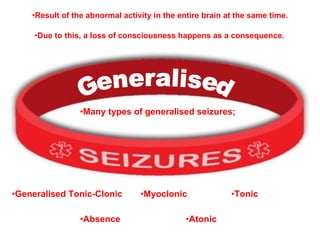
Generalised Many types of generalised seizures; Result of the abnormal activity in the entire brain at the same time. Due to this, a loss of consciousness happens as a consequence. Absence Myoclonic Tonic Atonic Generalised Tonic-Clonic
 
Signs & Symptoms
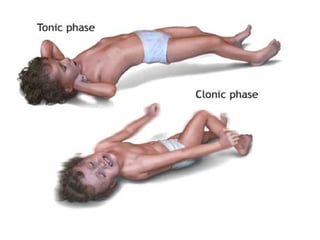
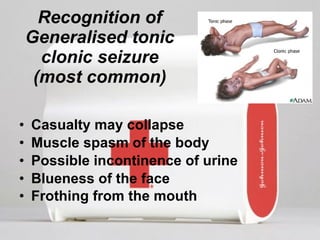
Recognition of Generalised tonic clonic seizure (most common) Casualty may collapse  Muscle spasm of the body Possible incontinence of urine Blueness of the face Frothing from the mouth
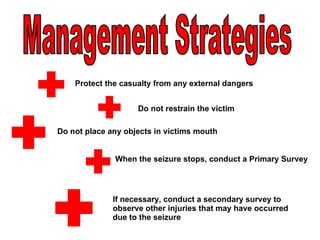
Management Strategies  If necessary, conduct a secondary survey to observe other injuries that may have occurred due to the seizure Protect the casualty from any external dangers Do not restrain the victim Do not place any objects in victims mouth When the seizure stops, conduct a Primary Survey
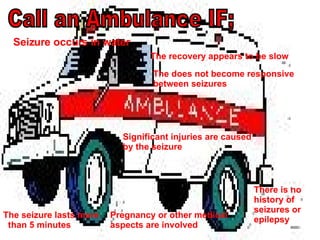
Call an Ambulance IF; The seizure lasts more  than 5 minutes The does not become responsive between seizures There is no history of seizures or epilepsy Pregnancy or other medical aspects are involved Significant injuries are caused by the seizure   Seizure occurs in water The recovery appears to be slow
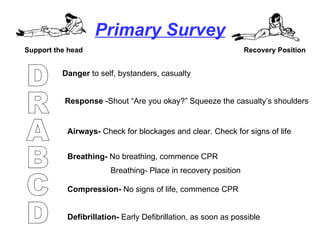
Primary Survey Support the head Recovery Position DRABCD Danger  to self, bystanders, casualty Response  -Shout “Are you okay?” Squeeze the casualty’s shoulders Airways-  Check for blockages and clear. Check for signs of life Breathing-  No breathing, commence CPR   Breathing- Place in recovery position Compression-  No signs of life, commence CPR Defibrillation-  Early Defibrillation, as soon as possible
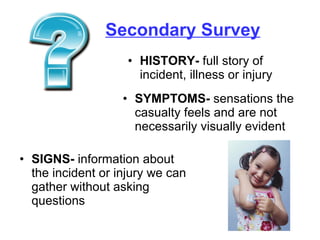
Secondary Survey HISTORY-  full story of incident, illness or injury SYMPTOMS-  sensations the casualty feels and are not necessarily visually evident SIGNS-  information about the incident or injury we can gather without asking questions
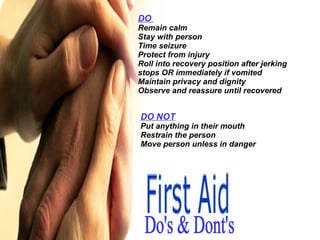
Do's & Dont's DO  Remain calm Stay with person Time seizure Protect from injury Roll into recovery position after jerking stops OR immediately if vomited Maintain privacy and dignity Observe and reassure until recovered DO NOT Put anything in their mouth Restrain the person Move person unless in danger
By Samantha Spackman Bibliography Epilepsy Action Australia (no date)  All About Epilepsy and Seizures  http://www.epilepsy.org.au/index.asp   Date retrieved 1.9.2008 The Epicentre (no date)  What causes Epilepsy? http://137.172.248.46/epilepsy.htm   Date retrieved 1.9.2008 Lippmann.J & Natoli.D  First Aid  (Published J.L Publications 2006) First Aid : 2 Unit Personal Health Development and Physical Education (AP Publishing ; 2003)

Epilepsy

  • 1.
    Understanding Epilepsy.. ~Signs& Symptoms ~What is epilepsy? ~Management of the Condition
  • 2.
    A common neurologicalcondition affecting around 1-2% of the population. More likely to be diagnosed in childhood or senior years However, not specified to any one age group, sex or race. 70% of people diagnosed become seizure free taking medication. Important for family, friends and carers of epileptic people to understand different aspects of epilepsy to better improve their chances of gaining control over seizures when they do occur. Including medication and a sensible lifestyle, a full, active life is possible.
  • 3.
    Epilepsy is adisruption of the normal electrochemical activity of the brain that results in seizures. Under different, certain situations and different circumstances, anyone can have a seizure. Epilepsy is diagnosed when there is a tendency to have re-occurring seizures. What is Epilepsy?
  • 4.
    SEIZURES There areapproximately 40 different types of seizures however, they can be divided into two major groups; Partial seizures Generalised seizures
  • 5.
    SECONDARILY GENERALISED TONIC-CLONIC- when a seizure starts as a partial seizure but then progresses to a generalised seizure (almost always a tonic-clonic seizure) Partial About 60% of people with epilepsy have partial seizures (also known as focal seizures) Can often be subtle or unusual. May go unnoticed or mistaken for things such as intoxication or daydreaming Activity of the seizure starts in one area of the brain and can spread to other regions of the brain. The types of partial seizures include; SIMPLE PARTIAL where there is no loss of awareness COMPLEX PARTIAL where there is a change in awareness and behavior)
  • 6.
  • 7.
    Generalised Many typesof generalised seizures; Result of the abnormal activity in the entire brain at the same time. Due to this, a loss of consciousness happens as a consequence. Absence Myoclonic Tonic Atonic Generalised Tonic-Clonic
  • 8.
  • 9.
  • 10.
    Recognition of Generalisedtonic clonic seizure (most common) Casualty may collapse Muscle spasm of the body Possible incontinence of urine Blueness of the face Frothing from the mouth
  • 11.
    Management Strategies If necessary, conduct a secondary survey to observe other injuries that may have occurred due to the seizure Protect the casualty from any external dangers Do not restrain the victim Do not place any objects in victims mouth When the seizure stops, conduct a Primary Survey
  • 12.
    Call an AmbulanceIF; The seizure lasts more than 5 minutes The does not become responsive between seizures There is no history of seizures or epilepsy Pregnancy or other medical aspects are involved Significant injuries are caused by the seizure Seizure occurs in water The recovery appears to be slow
  • 13.
    Primary Survey Supportthe head Recovery Position DRABCD Danger to self, bystanders, casualty Response -Shout “Are you okay?” Squeeze the casualty’s shoulders Airways- Check for blockages and clear. Check for signs of life Breathing- No breathing, commence CPR Breathing- Place in recovery position Compression- No signs of life, commence CPR Defibrillation- Early Defibrillation, as soon as possible
  • 14.
    Secondary Survey HISTORY- full story of incident, illness or injury SYMPTOMS- sensations the casualty feels and are not necessarily visually evident SIGNS- information about the incident or injury we can gather without asking questions
  • 15.
    Do's & Dont'sDO Remain calm Stay with person Time seizure Protect from injury Roll into recovery position after jerking stops OR immediately if vomited Maintain privacy and dignity Observe and reassure until recovered DO NOT Put anything in their mouth Restrain the person Move person unless in danger
  • 16.
    By Samantha SpackmanBibliography Epilepsy Action Australia (no date) All About Epilepsy and Seizures http://www.epilepsy.org.au/index.asp Date retrieved 1.9.2008 The Epicentre (no date) What causes Epilepsy? http://137.172.248.46/epilepsy.htm Date retrieved 1.9.2008 Lippmann.J & Natoli.D First Aid (Published J.L Publications 2006) First Aid : 2 Unit Personal Health Development and Physical Education (AP Publishing ; 2003)