Conversion to Power
• The final phase of the classical periodization
model before maintenance and active recovery
phases.
• Power is defined as the ability of the
neuromuscular system to produce the greatest
possible force in the shortest possible amount of
time.
• An athlete can be very strong, but but unable to
produce a large force in a short amount of time.
Power training
• Power training “trains” the CNS.
• Plyometrics and power related activity don’t
do a whole lot to assist in muscular
hypertrophy, although they can complement
weightlifting activities in the goal of achieving
increased functional cross-sectional area of
muscle.
Methods of power development in
power training
• Isometric Method: weights lifted quickly
• Ballistic Method: medicine ball throws
• Power Resisting Method: accumulate/release
weightlifting
• Plyometric Method: plyometric and shock
work
Power training: Lifting
• During power training, lifting weights is still
employed, but the weightlifting is performed as
fast as possible.
• Few exercises are chosen, so that more time can
be spent on technical and tactical aspects of that
sport.
• Although the book gives some different
examples, just a couple of olympic lifts
performed in the 6x3 range will suffice for this
phase.
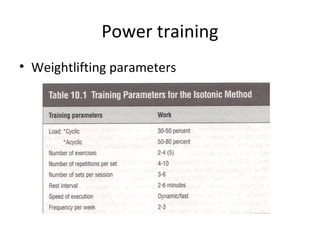
Power training
• Weightlifting parameters
Power training and the ballistic
method
• Ballistic training involves the use of thrown
objects, such as medicine balls and shot puts.
• The difference between throwing medicine
balls and doing weightlifting exercises, aside
from the speed, is that, during weightlifting
exercises, the bar must be decelerated at the
top of the lift. In a medicine ball (and most
sporting movements, acceleration must be
provided all the way through the movement).
The ballistic method
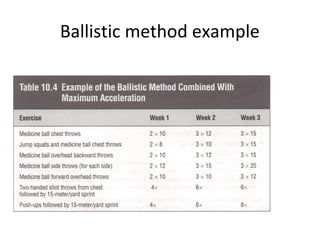
• Typically, the ballistic method is not used as
the primary part of the training session.
• It is usually used, either directly after the
warmup, or at the tail end of the workout.
Ballistic method example
Power resisted method
• In the power/resisted method, lifts are done with
the use of partners to cause maximal tension and
then release it.
• An example would be the following: An athlete
squats down to parallel with 40% of his 1RM
squat on the bar. Two teammates push down on
the bar at the bottom and the athlete will push
up as hard as possible for 2-3 seconds(the bar
does not go anywhere). Then the teammates
suddenly release and the athlete pushes up as
fast as possible.
Power resisting method
• This works in a similar manner to the “finger
snap” example we learned earlier in class.
• In this type of exercise, the maximal amount
of actin/myosin cross bridges are activated,
allowing lots of tension to be built up in the
muscle, and then suddenly released in a
powerful motion.
• 2-4 Exercises might be used in this type of
workout.
Power resisting example
• Parallel Squats: 5 sets of 3 with 40% 1RM
• Bench Press Throw (smith machine): 5 sets of
3 with 40% 1RM
• Rack Pulls: 5 sets of 3 with 40% 1RM 5x3
• Flying Pullups (band assist): 5x3 with 40% 5x3
• This wouldn’t be done more than 2x a week.
Power/Resistance and oscillatory
isometrics
• Oscillatory isometrics are a close relative to
the power release method.
• In OI’s, the athlete will generate maximal
isometric tension on their own, and then
completely relax and allow the muscle group
to act reflexively.
• Examples
Plyometric method
• We have already learned much of plyometrics
in class.
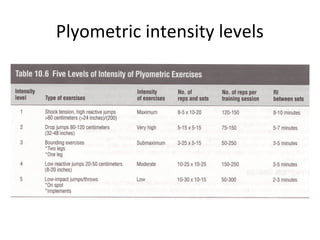
• For this lecture we will cover the intensity
level of a few different types of plyometric
activities.
Plyometric intensity levels
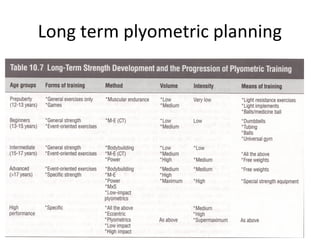
Long term plyometric planning
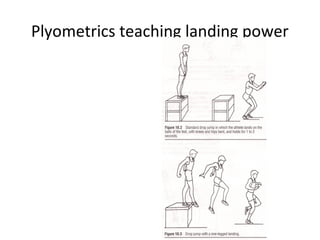
Plyometrics teaching landing power
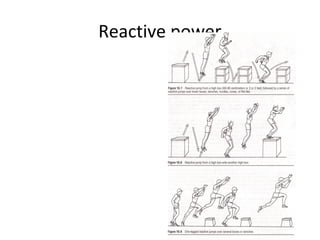
Reactive power
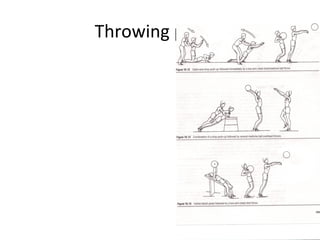
Throwing power
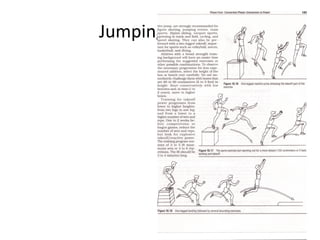
Jumping power
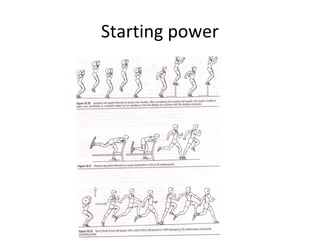
Starting power
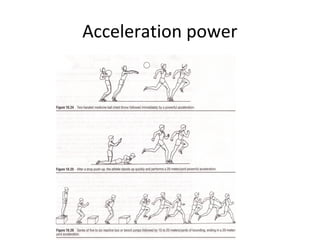
Acceleration power

Bompa's Periodization for Sports Training

  • 2.
    Conversion to Power •The final phase of the classical periodization model before maintenance and active recovery phases. • Power is defined as the ability of the neuromuscular system to produce the greatest possible force in the shortest possible amount of time. • An athlete can be very strong, but but unable to produce a large force in a short amount of time.
  • 3.
    Power training • Powertraining “trains” the CNS. • Plyometrics and power related activity don’t do a whole lot to assist in muscular hypertrophy, although they can complement weightlifting activities in the goal of achieving increased functional cross-sectional area of muscle.
  • 4.
    Methods of powerdevelopment in power training • Isometric Method: weights lifted quickly • Ballistic Method: medicine ball throws • Power Resisting Method: accumulate/release weightlifting • Plyometric Method: plyometric and shock work
  • 5.
    Power training: Lifting •During power training, lifting weights is still employed, but the weightlifting is performed as fast as possible. • Few exercises are chosen, so that more time can be spent on technical and tactical aspects of that sport. • Although the book gives some different examples, just a couple of olympic lifts performed in the 6x3 range will suffice for this phase.
  • 6.
  • 7.
    Power training andthe ballistic method • Ballistic training involves the use of thrown objects, such as medicine balls and shot puts. • The difference between throwing medicine balls and doing weightlifting exercises, aside from the speed, is that, during weightlifting exercises, the bar must be decelerated at the top of the lift. In a medicine ball (and most sporting movements, acceleration must be provided all the way through the movement).
  • 8.
    The ballistic method •Typically, the ballistic method is not used as the primary part of the training session. • It is usually used, either directly after the warmup, or at the tail end of the workout.
  • 9.
  • 10.
    Power resisted method •In the power/resisted method, lifts are done with the use of partners to cause maximal tension and then release it. • An example would be the following: An athlete squats down to parallel with 40% of his 1RM squat on the bar. Two teammates push down on the bar at the bottom and the athlete will push up as hard as possible for 2-3 seconds(the bar does not go anywhere). Then the teammates suddenly release and the athlete pushes up as fast as possible.
  • 11.
    Power resisting method •This works in a similar manner to the “finger snap” example we learned earlier in class. • In this type of exercise, the maximal amount of actin/myosin cross bridges are activated, allowing lots of tension to be built up in the muscle, and then suddenly released in a powerful motion. • 2-4 Exercises might be used in this type of workout.
  • 12.
    Power resisting example •Parallel Squats: 5 sets of 3 with 40% 1RM • Bench Press Throw (smith machine): 5 sets of 3 with 40% 1RM • Rack Pulls: 5 sets of 3 with 40% 1RM 5x3 • Flying Pullups (band assist): 5x3 with 40% 5x3 • This wouldn’t be done more than 2x a week.
  • 13.
    Power/Resistance and oscillatory isometrics •Oscillatory isometrics are a close relative to the power release method. • In OI’s, the athlete will generate maximal isometric tension on their own, and then completely relax and allow the muscle group to act reflexively. • Examples
  • 14.
    Plyometric method • Wehave already learned much of plyometrics in class. • For this lecture we will cover the intensity level of a few different types of plyometric activities.
  • 15.
  • 16.
  • 17.
  • 18.
  • 19.
  • 20.
  • 21.
  • 22.