

Intro to Periodisation
Models
Jamie knight
October 2019
What is periodization?
‘…inclusion of pre-planned, systematic variations in
training specificity, intensity and volume organized in
periods or cycles within an overall program’
- First conceptualized by Matveyev (1964)
- 1980’s criticisms of entrenched theories
- 1990’s western scientists suggest alternative
methods
- ACSM (2002) endorse use of periodization for both
elite & recreational performers
Why
periodize?
Why periodize?
• Identify periods for overloading
• Reduction of overtraining & injury potential
• Maximise adaptations to training
• Enhance an athlete’s performance at the right times
• Avoidance of stagnation
Why periodize?
• Identify periods for overloading
• Reduction of overtraining & injury potential
• Maximise adaptations to training
• Enhance an athlete’s performance at the right times
• Avoidance of stagnation
Achieved by manipulating;
• Volume
• Intensity
• Exercise selection
General Adaptation
Syndrome
Hans Sele (1936)
• Adequate recovery time
• Subsequent training session
should be timed to occur at
the point of maximal
adaptation – not delayed to
where the adaptation has
started to decline
Repeated bouts of the stress-adaptation cycle
Periodised vs. Non-
periodized Approach
• The Novice: Anything works, but some
more than others?
• The Intermediate: semi-structured
periodization?
• The Advanced : Precise periodization
Hierarchy of
Periodised
Training Cycles
• Issurin (2008)
Training period Time duration Mode of planning
Quadrennial cycle Four years (Olympic
cycle)
Long term
Macrocycle 1 year or several
months
Mesocycle Several weeks Medium term
Microcycle 1 week or several
days
Short term
Workout or training
session
Several hours
Training exercise Several minutes
Mesocycle Classifications
Type (name) Typical duration Objectives
General Almost any • General education
• Develop basic fitness
Basic sport specific Approx. 6 weeks • Develop specific fitness and skills for sport
Preparatory Approx. 6 weeks • Training for competitive preparedness
• Sub-max to max loads
Immediate
preparatory
Approx. 2 weeks • Recovery and peaking for intermediate competition/ testing
Stabilisation Approx. 4 weeks • Perfecting technique and eliminating errors
• Stabilise fitness gains
Build up Approx. 3 weeks • Build-up of training load to enhance foundation skill or fitness during preparatory
• General training and conditioning
Pre-competitive Approx. 6 weeks • Develop optimal expression of skill and fitness
• Specialised training to bring athlete to peak
Competition build up Approx. 3 weeks • Focus on restoring and maintaining fitness during long periods of competition
Competitive Approx. 2-6 weeks • Special emphasis on achieving peak for specific competition
Recovery Approx. 1-4 weeks • Recovery and rehabilitation
• Generally follows major peak/ competition
Adapted from Stone et al., 2007. p.9
Models of Periodisation
• Linear
• Phase potentiation
• Block
• Undulating
• Concurrent
• Conjugated
Linear
Sequential blocks of concentrated mesocycles
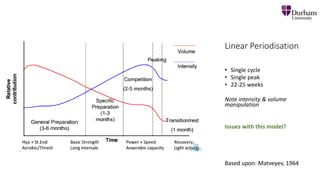
Linear Periodisation
• Single cycle
• Single peak
• 22-25 weeks
Note intensity & volume
manipulation
Issues with this model?
Based upon: Matveyev, 1964
Block
Sequential blocks of concentrated mesocycles
Issurin(2007)
Block (Issurin)
Main characteristics Accumulation Transmutation Realisation
Targets specific motor
& technical abilities
Basic abilities;
aerobic endurance;
muscular strength;
basic coordination
Sport-specific abilities;
special endurance,
strength endurance,
proper technique
Integrative
preparedness;
model performances,
maximum speed,
event specific tactics
Volume- intensity High volume, reduced
intensity
Reduced volume,
increased intensity
Low-medium volume,
high intensity
Fatigue- restoration Reasonable restoration
to provide
morphological
adaptation
Not possible to provide
full restoration, fatigue
accumulated
Full restoration,
athletes should be well
rested
Follow-up Monitoring the level of
basic abilities
Monitoring the level of
sport-specific abilities
Monitoring maximum
speed, event specific
strategy etc.
Advantages Disadvantages
Multi-peak design accounts for multiple competitions
across the season/ year
Potential for detraining in bio-motor abilities
Reduced no. of abilities trained per mesocycle Accumulation of fatigue
Nutrition & restorative plans can be modified
according to the predominant type of training
Suitable for ‘specialized’ sports
Suitable for novice athletes?
Auto-regulation
Concurrent
Training several competing qualities such as endurance and strength during one mesocycle
Advantages Disadvantages
Potentially a good option for the injured athlete Interference effect
Can be used within team sports (long competition
period)
Not suitable for novice athletes
Ability to train several competing qualities during one
mesocycle
Not suitable for advanced athletes
Sports requiring frequent competition
Can be more engaging for the athlete
Increased variety
Conjugate
Training several complimentary physical qualities such as power and strength during one period
Verkoshansky (1985)
Training several qualities but maximizing
intensity in only one of those physical
qualities per mesocycle
Week 1 Week 2 Week 3
Max Strength
Explosive Strength
Speed Strength
Explosive Strength
Max Strength
Speed Strength
Speed Strength
Explosive Strength
Max Strength
Primary focus:
Sub focus:
Sub focus:
Repeating these mesocycles would facilitate longer-term development of all 3 strength
qualities without inducing unnecessary fatigue.
Advantages Disadvantages
Ability to develop several physical attributes during
one training period
Not suitable for novice athletes – must have a
sufficient training age/ ability to tolerate high
intensities
You stay close to your peak due to the intensity
prescription meaning you’re close to peaking within a
few weeks
Lack of mastery
Flexibility through ability for autoregulation as this
method has no strict set/ rep schemes – takes into
consideration current fatigue state of athlete
Bang for your buck?
Undulating
Fluctuations in volume & intensity across days or weeks, developing multiple physical
abilities during a cycle
Daily undulating
• Short-term modelling
• How the loading is delivered
through the week
• Fluctuation in loading
(metabolic & neural)
• A complex parallel method >
all bio-motor abilities at once
Linear model in the long term?
Complex parallel?
Fluctuating
stress
• Different methods
• Additional factors to consider; stress from skills training.
• Does your ‘high stress’ period match with the skill’s coach? Same with
restorative periods
So how do you choose?
Annual Level
• Competitive structure
• Developmental focus
Meso Level
• Achieving planned fluctuating stress
• Control of fatigue
• Stimulus interaction
Micro Level
• Achieving planned fluctuating stress
• Control of fatigue
• Stimulus interaction
Planning continued
Diminishing returns (requirement for progressive overload)
Stimulus for adaptation
How big/ varied a hit is necessary?
Preserve stimuli
Safe working limits
(how little can you stress an athlete without breaking them?)
Rising baselines
Long term performance potentiation
Fitness-Fatigue
Cost-benefit ratio for a specific stimulus
Is the fatigue effect specific or central?
The more central it is, the worse the ratio will be
This may mean you take out the exercise that provides the most adaption!!! Save
it for later
What do you think?
Linear Block Concurrent Conjugate Undulating
Field sport
Track sport
Multi-event
sports
Individual sport
Beginner athlete
Intermediate
athlete
Advanced
athlete
Our thoughts….
Linear Block Concurrent Conjugate Undulating
Field sport x x x x
Track sport x x x x x
Multi-event
sports
x x x
Individual sport x x x x x
Beginner athlete x x x
Intermediate
athlete
x x x
Advanced
athlete
x x x
Changes in your
periodization?
“Our periodization strategies should evolve over time”…Jon
Goodwin
• Advances in understanding physiology of stress &
adaptation
• Developmental progression of the athlete
• The sport you are working in
• Advances in understanding of sport demands
• Changes in the nature of sport generally

Periodisation models

  • 1.
  • 2.
    What is periodization? ‘…inclusionof pre-planned, systematic variations in training specificity, intensity and volume organized in periods or cycles within an overall program’ - First conceptualized by Matveyev (1964) - 1980’s criticisms of entrenched theories - 1990’s western scientists suggest alternative methods - ACSM (2002) endorse use of periodization for both elite & recreational performers
  • 3.
  • 4.
    Why periodize? • Identifyperiods for overloading • Reduction of overtraining & injury potential • Maximise adaptations to training • Enhance an athlete’s performance at the right times • Avoidance of stagnation
  • 5.
    Why periodize? • Identifyperiods for overloading • Reduction of overtraining & injury potential • Maximise adaptations to training • Enhance an athlete’s performance at the right times • Avoidance of stagnation Achieved by manipulating; • Volume • Intensity • Exercise selection
  • 6.
    General Adaptation Syndrome Hans Sele(1936) • Adequate recovery time • Subsequent training session should be timed to occur at the point of maximal adaptation – not delayed to where the adaptation has started to decline
  • 7.
    Repeated bouts ofthe stress-adaptation cycle
  • 8.
    Periodised vs. Non- periodizedApproach • The Novice: Anything works, but some more than others? • The Intermediate: semi-structured periodization? • The Advanced : Precise periodization
  • 9.
    Hierarchy of Periodised Training Cycles •Issurin (2008) Training period Time duration Mode of planning Quadrennial cycle Four years (Olympic cycle) Long term Macrocycle 1 year or several months Mesocycle Several weeks Medium term Microcycle 1 week or several days Short term Workout or training session Several hours Training exercise Several minutes
  • 10.
    Mesocycle Classifications Type (name)Typical duration Objectives General Almost any • General education • Develop basic fitness Basic sport specific Approx. 6 weeks • Develop specific fitness and skills for sport Preparatory Approx. 6 weeks • Training for competitive preparedness • Sub-max to max loads Immediate preparatory Approx. 2 weeks • Recovery and peaking for intermediate competition/ testing Stabilisation Approx. 4 weeks • Perfecting technique and eliminating errors • Stabilise fitness gains Build up Approx. 3 weeks • Build-up of training load to enhance foundation skill or fitness during preparatory • General training and conditioning Pre-competitive Approx. 6 weeks • Develop optimal expression of skill and fitness • Specialised training to bring athlete to peak Competition build up Approx. 3 weeks • Focus on restoring and maintaining fitness during long periods of competition Competitive Approx. 2-6 weeks • Special emphasis on achieving peak for specific competition Recovery Approx. 1-4 weeks • Recovery and rehabilitation • Generally follows major peak/ competition Adapted from Stone et al., 2007. p.9
  • 11.
    Models of Periodisation •Linear • Phase potentiation • Block • Undulating • Concurrent • Conjugated
  • 12.
    Linear Sequential blocks ofconcentrated mesocycles
  • 13.
    Linear Periodisation • Singlecycle • Single peak • 22-25 weeks Note intensity & volume manipulation Issues with this model? Based upon: Matveyev, 1964
  • 14.
    Block Sequential blocks ofconcentrated mesocycles
  • 15.
  • 16.
  • 17.
    Main characteristics AccumulationTransmutation Realisation Targets specific motor & technical abilities Basic abilities; aerobic endurance; muscular strength; basic coordination Sport-specific abilities; special endurance, strength endurance, proper technique Integrative preparedness; model performances, maximum speed, event specific tactics Volume- intensity High volume, reduced intensity Reduced volume, increased intensity Low-medium volume, high intensity Fatigue- restoration Reasonable restoration to provide morphological adaptation Not possible to provide full restoration, fatigue accumulated Full restoration, athletes should be well rested Follow-up Monitoring the level of basic abilities Monitoring the level of sport-specific abilities Monitoring maximum speed, event specific strategy etc.
  • 18.
    Advantages Disadvantages Multi-peak designaccounts for multiple competitions across the season/ year Potential for detraining in bio-motor abilities Reduced no. of abilities trained per mesocycle Accumulation of fatigue Nutrition & restorative plans can be modified according to the predominant type of training Suitable for ‘specialized’ sports Suitable for novice athletes? Auto-regulation
  • 19.
    Concurrent Training several competingqualities such as endurance and strength during one mesocycle
  • 20.
    Advantages Disadvantages Potentially agood option for the injured athlete Interference effect Can be used within team sports (long competition period) Not suitable for novice athletes Ability to train several competing qualities during one mesocycle Not suitable for advanced athletes Sports requiring frequent competition Can be more engaging for the athlete Increased variety
  • 21.
    Conjugate Training several complimentaryphysical qualities such as power and strength during one period
  • 22.
    Verkoshansky (1985) Training severalqualities but maximizing intensity in only one of those physical qualities per mesocycle Week 1 Week 2 Week 3 Max Strength Explosive Strength Speed Strength Explosive Strength Max Strength Speed Strength Speed Strength Explosive Strength Max Strength Primary focus: Sub focus: Sub focus: Repeating these mesocycles would facilitate longer-term development of all 3 strength qualities without inducing unnecessary fatigue.
  • 23.
    Advantages Disadvantages Ability todevelop several physical attributes during one training period Not suitable for novice athletes – must have a sufficient training age/ ability to tolerate high intensities You stay close to your peak due to the intensity prescription meaning you’re close to peaking within a few weeks Lack of mastery Flexibility through ability for autoregulation as this method has no strict set/ rep schemes – takes into consideration current fatigue state of athlete Bang for your buck?
  • 24.
    Undulating Fluctuations in volume& intensity across days or weeks, developing multiple physical abilities during a cycle
  • 25.
    Daily undulating • Short-termmodelling • How the loading is delivered through the week • Fluctuation in loading (metabolic & neural) • A complex parallel method > all bio-motor abilities at once Linear model in the long term?
  • 26.
  • 27.
    Fluctuating stress • Different methods •Additional factors to consider; stress from skills training. • Does your ‘high stress’ period match with the skill’s coach? Same with restorative periods
  • 28.
    So how doyou choose?
  • 29.
    Annual Level • Competitivestructure • Developmental focus Meso Level • Achieving planned fluctuating stress • Control of fatigue • Stimulus interaction Micro Level • Achieving planned fluctuating stress • Control of fatigue • Stimulus interaction
  • 30.
    Planning continued Diminishing returns(requirement for progressive overload) Stimulus for adaptation How big/ varied a hit is necessary? Preserve stimuli Safe working limits (how little can you stress an athlete without breaking them?) Rising baselines Long term performance potentiation Fitness-Fatigue Cost-benefit ratio for a specific stimulus Is the fatigue effect specific or central? The more central it is, the worse the ratio will be This may mean you take out the exercise that provides the most adaption!!! Save it for later
  • 31.
    What do youthink? Linear Block Concurrent Conjugate Undulating Field sport Track sport Multi-event sports Individual sport Beginner athlete Intermediate athlete Advanced athlete
  • 32.
    Our thoughts…. Linear BlockConcurrent Conjugate Undulating Field sport x x x x Track sport x x x x x Multi-event sports x x x Individual sport x x x x x Beginner athlete x x x Intermediate athlete x x x Advanced athlete x x x
  • 34.
    Changes in your periodization? “Ourperiodization strategies should evolve over time”…Jon Goodwin • Advances in understanding physiology of stress & adaptation • Developmental progression of the athlete • The sport you are working in • Advances in understanding of sport demands • Changes in the nature of sport generally

Editor's Notes

  • #3 Pre-plan training into periods of time whereby each period has a differing focus/ objective. Manipulating training modalities and the variables of these modalities. Brining an athlete to their best at the appropriate time.