Sprints (100m, 200m, 400m) 
Shelia Burrell 
Sprints, Hurdles, 
Jumps Coach 
GEORGETOWN 
UNIVERSITY 
Washington, DC
Acknowledgements 
• Cliff Rovelto – Head Coach Kansas State University 
• Gary Winkler – Former Head Coach University of Illinois 
• Tony Wells – Colorado Flyers Track Club 
• Bob Kersee – Former Head Coach UCLA, Olympic Coach 
• Tudor Bompa – Periodization: Theory and Methodology of Training 
• Todd Henson – Former Coach Olympic Silver Medalist in Pole Vault, Toby 
Stevenson. Currently Director of Athletic Development in Germany 
• Vince Anderson – Assistant Coach Texas A & M University 
• Ralph Mann – The Mechanics of Sprinting and Hurdling
YOU MUST HAVE A PLAN 
• A bad plan is better than no plan at all….. At least you are 
going in a direction. 
– “people perish for lack of vision” 
• With no plan you go no where…. 
– “those who know why will always be victorious over those who 
only know how” 
• Sound training principles and good intuition will make up 
for places of faulty planning. 
– “in all your getting get an understanding” 
• Know what works for you… Continually tweak and develop 
your own system that fits your coaching style. 
– “eat the fish and spit out the bones”
My Philosophy 
• Those who know WHY will always be 
victorious over those who only know 
HOW 
• If you are going to run fast…. Then 
run fast.
Training Inventory
Training Inventory
Types of Sprinters 
SPEED TYPES 
(100m,200m) 
STRENGTH TYPES 
(200m,400m, 800m)
• Speed has TWO and ONLY two components 
» Stride Length 
» Stride Frequency 
To improve speed, one or both of these components must increase. 
Find the athletes optimal stride length and stride frequency. Because 
of Anthropometric difference (height, leg length, body build) you 
have to decide which component will give you the most bang for 
your buck. 
It is possible to improve one at the expense of the other and still see 
significant improvement. 
All efforts of improve stride length and stride frequency must be 
taught within the parameter of sound technique. 
***Never let training stray away from your pursuit of happiness, i.e. 
SPEED and more SPEED. 
You don’t run slow to run fast, your run fast to run faster!
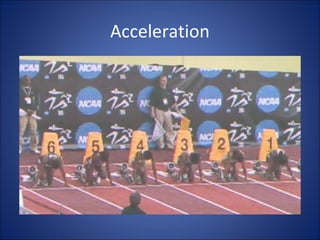
Acceleration 
• I agree with Vince Anderson that it is very important to teach all 
athletes how to run 100m even if they will never run the 100m. 
• In the 2004 Olympic Games, Pole Vault Silver Medalist Toby 
Stevenson spent the previous year improving his acceleration 
mechanics and max speed. 
• All acceleration activities in the sprints, hurdles and jumps are a 
variation of the 100m pattern.** 
• Acceleration mechanics and power development go together. The 
more powerfully an athlete can apply force to the track the better 
their acceleration will be. 
» Acceleration is POWERFUL not “quick”. As most developing athletes are learning 
how to accelerate they always say “but that feels slower.” 
» To accelerate optimally, the athlete must learn how to powerfully extend 
completely from the hips through the shoulders. 
» Make your athletes STRONGER and you will improve their ability to accelerate. 
Both specific strength and overall strength is necessary.
Acceleration 
• Posture and Rhythm – Always enforce good 
posture and teach a sense of rhythm. 
• Even as your athletes get stronger and more 
powerful their rhythm and body position 
during the acceleration phase never change. 
» For example as they start covering more ground in the 
first 0 – 5 steps the rhythm should remain the same. 
» An efficient high school athlete vs. Walter Dix, both of 
their rhythms can be the same but Dix covers more 
distance with each step therefore runs faster.
One way to teach good Acceleration 
Mechanics 
• The only acceleration pattern chart that 
allows you to train at lower intensities and 
models progressive acceleration rhythms is 
Vince Anderson’s Chart for Progressive 
Acceleration. 
» Distances are competition specific ranging from a 13 
second 100m rhythm to a 10.10 second rhythm. 
» Acceleration Rhythm for Long Jump (17’0” feet to 28’6” 
feet) and Pole Vault (16’6” feet to 19’6” feet) are also 
outlined. 
» Charts are Available during Clinic
Acceleration
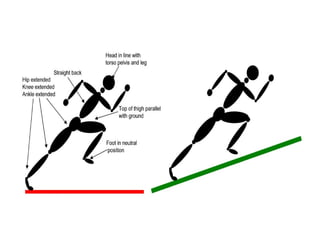
What to Look For 
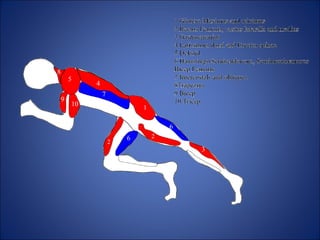
• Full extension of knee, hip and shoulder (Hip 
Extension) 
• Front shin angle as it relates to body angle. 
You want to see a straight line from support 
leg to head. 
• Recovering shin angle should be less than 
parallel to ground for first 3 steps 
• Cue – “ push push push” “bomp bomp bomp”
Posture
How to develop Strength & Power for 
Acceleration 
• Specifics- Acceleration is determined by the strength qualities of 
the prime movers and the angle of the body in relation to the track. 
• To develop explosive muscular strength, the most important quality 
to possess is high levels of maximal strength. There is no conflict 
between the possession of maximal strength and the application of 
dynamic strength. A higher level of max strength allows an athlete 
to readily obtain dynamic strength. 
• 1. Short Hills (10m-40m) 
• 2. Sled Pulls or Drags 
• 3. Weight Training - Develop max strength in the prime movers. 
• 4. Standing Long Jumps 
• 5. Sprints (10-60m) 
• 6. Box Jumps 
• 7. Speed Squats 
• 8. Limited Depth Jumps (Timing important)
Max Speed 
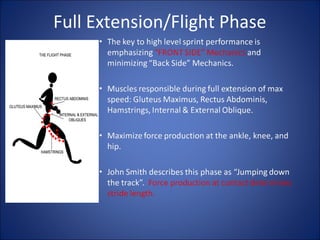
In maximum speed sprinting the following muscles are 
responsible for hip extension: the gluteal muscles, the 
adductor muscles, the hamstrings. 
Max Speed Mechanics 
Toe-up 
Heel up 
Thigh up 
Hips Tall 
Step over the opposite knee
Drills 
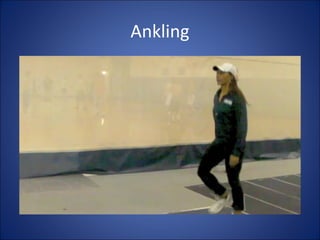
• Ankling “Toe Up” 
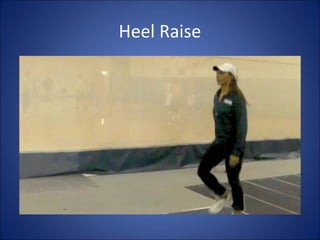
• Heel Raise “Heel Up” 
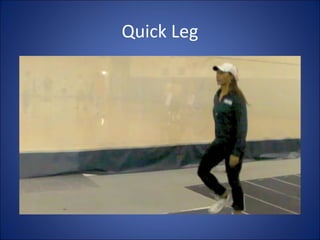
• Quick Leg “Thigh Up” 
– Single 
– Alternating 
– Double 
– Continuous 
• Shorter Than Drill “Hips up” 
• Longer Than Drill “Full extension” 
• Straight Leg Bounds “Force Production” 
• Speed Bounds “Recovery Speed”
Training Principle 
• Use Drills and exercises that utilize the same 
muscles and forces used in the actual event
Ankling
Heel Raise
Quick Leg
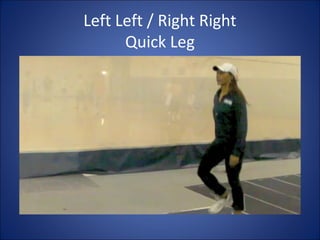
Left Left / Right Right 
Quick Leg
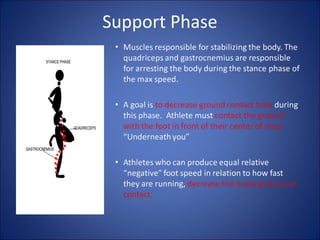
Support Phase
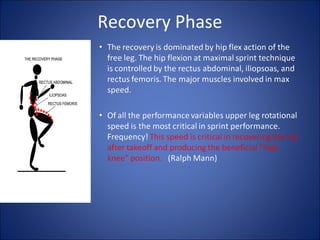
Recovery Phase
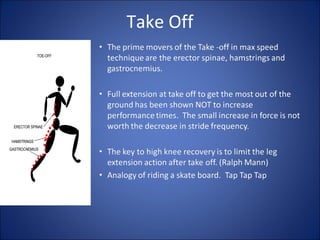
Take Off
Full Extension/Flight Phase
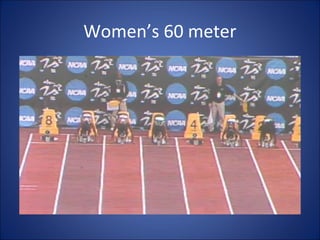
Women’s 60 meter
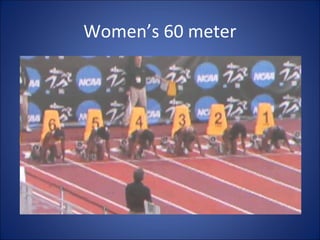
Women’s 60 meter
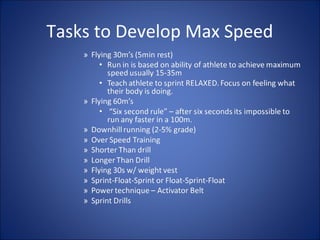
Tasks to Develop Max Speed
Speed Endurance 
(200m-400m) 
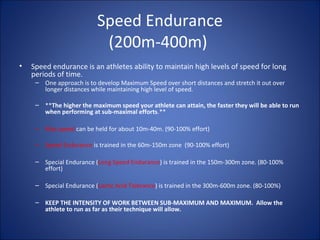
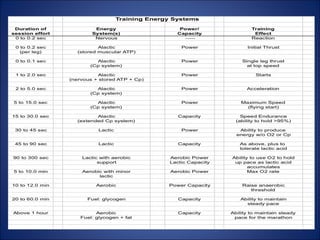
• Speed endurance is an athletes ability to maintain high levels of speed for long 
periods of time. 
– One approach is to develop Maximum Speed over short distances and stretch it out over 
longer distances while maintaining high level of speed. 
– **The higher the maximum speed your athlete can attain, the faster they will be able to run 
when performing at sub-maximal efforts.** 
– Max speed can be held for about 10m-40m. (90-100% effort) 
– Speed Endurance is trained in the 60m-150m zone (90-100% effort) 
– Special Endurance (Long Speed Endurance) is trained in the 150m-300m zone. (80-100% 
effort) 
– Special Endurance (Lactic Acid Tolerance) is trained in the 300m-600m zone. (80-100%) 
– KEEP THE INTENSITY OF WORK BETWEEN SUB-MAXIMUM AND MAXIMUM. Allow the 
athlete to run as far as their technique will allow.
Examples of Speed Endurance 
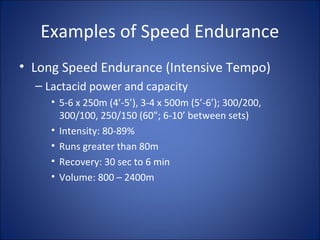
• Long Speed Endurance (Intensive Tempo) 
– Lactacid power and capacity 
• 5-6 x 250m (4’-5’), 3-4 x 500m (5’-6’); 300/200, 
300/100, 250/150 (60”; 6-10’ between sets) 
• Intensity: 80-89% 
• Runs greater than 80m 
• Recovery: 30 sec to 6 min 
• Volume: 800 – 2400m
Examples of Speed Endurance 
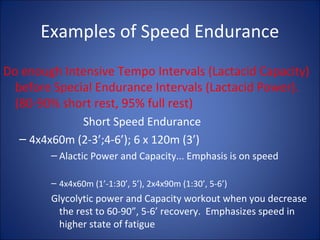
Do enough Intensive Tempo Intervals (Lactacid Capacity) 
before Special Endurance Intervals (Lactacid Power). 
(80-90% short rest, 95% full rest) 
Short Speed Endurance 
– 4x4x60m (2-3’;4-6’); 6 x 120m (3’) 
– Alactic Power and Capacity... Emphasis is on speed 
– 4x4x60m (1’-1:30’, 5’), 2x4x90m (1:30’, 5-6’) 
Glycolytic power and Capacity workout when you decrease 
the rest to 60-90”, 5-6’ recovery. Emphasizes speed in 
higher state of fatigue
Pay Attention 
• When mechanics fail, the quality of speed 
endurance running will not be enhanced
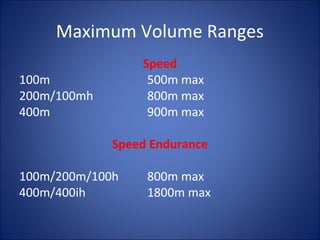
Maximum Volume Ranges 
Speed 
100m 500m max 
200m/100mh 800m max 
400m 900m max 
Speed Endurance 
100m/200m/100h 800m max 
400m/400ih 1800m max
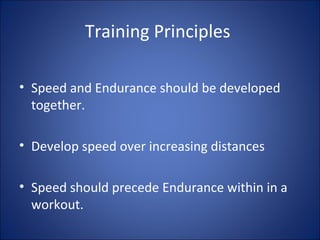
Training Principles 
• Speed and Endurance should be developed 
together. 
• Develop speed over increasing distances 
• Speed should precede Endurance within in a 
workout.
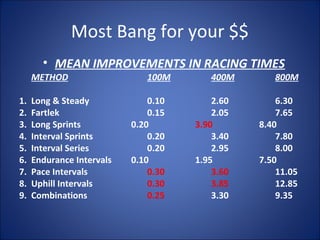
Most Bang for your $$ 
• MEAN IMPROVEMENTS IN RACING TIMES 
METHOD 100M 400M 800M 
1. Long & Steady 0.10 2.60 6.30 
2. Fartlek 0.15 2.05 7.65 
3. Long Sprints 0.20 3.90 8.40 
4. Interval Sprints 0.20 3.40 7.80 
5. Interval Series 0.20 2.95 8.00 
6. Endurance Intervals 0.10 1.95 7.50 
7. Pace Intervals 0.30 3.60 11.05 
8. Uphill Intervals 0.30 3.85 12.85 
9. Combinations 0.25 3.30 9.35
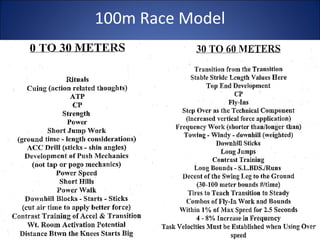
100m Race Model
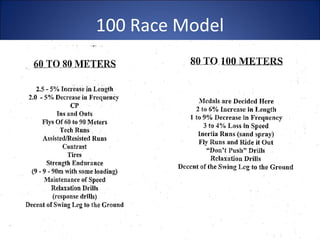
100 Race Model
200m Race Model 
• 0 – 60m Accelerate “Get out” take 
advantage of 6-7 secs of ATP 
• 60-90m Transition “Relax/Maintain” but 
don’t slow down. Take a breath 
• 90 – 150m Accelerate “Surge” off the turn. 
Open up increase stride length, 
cover ground, relax upper body, take 
a breath 
• 150-200m Short and quick, increase 
frequency, drive elbows back, stay 
forward.
Task Specific Drills 
• Specific Drills 
– Straight Leg Bounds to dynamically strengthen gluteus and upper hamstrings 
as it relates to actual sprint cycle - 
– Speed Bounds to develop Hip/Flexor and Hip Extensor Strength and teaches 
correct cycling – Dynamic Strength 
– Shorter Than Drill to develop stride frequency and front side mechanics 
– Longer Than Drill to develop stride length and teach how to push from track 
to get stride length WITHOUT overextension 
– Lunges (LOTS OF LUNGES) contributes to Acceleration, flexibility, stride length, 
strength/muscular endurance, hip mobility/flexibility – Static Strength 
– Long Hills/Stairs Workouts help in developing strength endurance and/or 
power development, ground contact time - Dynamic Strength 
– Strength Circuits use in general preparation as part of general conditioning. 
Be sure to include exercises that condition specific muscles involved in 
sprinting.
Task Specific Drills 
Specific Drills 
- Short Hills/Sled Pulls/ Bullet Belt helps teach and develop acceleration mechanics, hip flexor and extensor 
strength 
- Hurdle Hops/Straight Leg Hurdle Hops, Single leg hurdle hops develop hip flexor and extensor strength, 
ground contact, 
- Sand Routines (barefoot) excellent for developing foot strength, lower leg endurance, elasticity and stability, 
power, acceleration, muscular endurance 
- Multiple Throws (A MUST) helps with power development and serves as a low level plyometric exercise. 
Teaches motor firing patterns, 
- Multiple Jumps : ex) Skip for height, skip for distance, double leg hops fwd and bkwd, single hops, LLRR, 
Lunge exchange. Explosive Strength, Acceleration 
- Balance Stability/ Core/ Physioball – If not incorporating core in your training programs start now! 
Contributes to athletes ability to hold positions and correct posture. Good core strength clears pathway for 
force application. Corrects imbalances and some biomechanical weaknesses. 
- Ins and Outs, Sprint –Float – Sprint – Helps with breathing techniques and teaching how to run relaxed while 
focusing on mechanics.

Sprint power point

  • 1.
    Sprints (100m, 200m,400m) Shelia Burrell Sprints, Hurdles, Jumps Coach GEORGETOWN UNIVERSITY Washington, DC
  • 2.
    Acknowledgements • CliffRovelto – Head Coach Kansas State University • Gary Winkler – Former Head Coach University of Illinois • Tony Wells – Colorado Flyers Track Club • Bob Kersee – Former Head Coach UCLA, Olympic Coach • Tudor Bompa – Periodization: Theory and Methodology of Training • Todd Henson – Former Coach Olympic Silver Medalist in Pole Vault, Toby Stevenson. Currently Director of Athletic Development in Germany • Vince Anderson – Assistant Coach Texas A & M University • Ralph Mann – The Mechanics of Sprinting and Hurdling
  • 3.
    YOU MUST HAVEA PLAN • A bad plan is better than no plan at all….. At least you are going in a direction. – “people perish for lack of vision” • With no plan you go no where…. – “those who know why will always be victorious over those who only know how” • Sound training principles and good intuition will make up for places of faulty planning. – “in all your getting get an understanding” • Know what works for you… Continually tweak and develop your own system that fits your coaching style. – “eat the fish and spit out the bones”
  • 4.
    My Philosophy •Those who know WHY will always be victorious over those who only know HOW • If you are going to run fast…. Then run fast.
  • 5.
  • 6.
  • 7.
    Types of Sprinters SPEED TYPES (100m,200m) STRENGTH TYPES (200m,400m, 800m)
  • 8.
    • Speed hasTWO and ONLY two components » Stride Length » Stride Frequency To improve speed, one or both of these components must increase. Find the athletes optimal stride length and stride frequency. Because of Anthropometric difference (height, leg length, body build) you have to decide which component will give you the most bang for your buck. It is possible to improve one at the expense of the other and still see significant improvement. All efforts of improve stride length and stride frequency must be taught within the parameter of sound technique. ***Never let training stray away from your pursuit of happiness, i.e. SPEED and more SPEED. You don’t run slow to run fast, your run fast to run faster!
  • 9.
    Acceleration • Iagree with Vince Anderson that it is very important to teach all athletes how to run 100m even if they will never run the 100m. • In the 2004 Olympic Games, Pole Vault Silver Medalist Toby Stevenson spent the previous year improving his acceleration mechanics and max speed. • All acceleration activities in the sprints, hurdles and jumps are a variation of the 100m pattern.** • Acceleration mechanics and power development go together. The more powerfully an athlete can apply force to the track the better their acceleration will be. » Acceleration is POWERFUL not “quick”. As most developing athletes are learning how to accelerate they always say “but that feels slower.” » To accelerate optimally, the athlete must learn how to powerfully extend completely from the hips through the shoulders. » Make your athletes STRONGER and you will improve their ability to accelerate. Both specific strength and overall strength is necessary.
  • 10.
    Acceleration • Postureand Rhythm – Always enforce good posture and teach a sense of rhythm. • Even as your athletes get stronger and more powerful their rhythm and body position during the acceleration phase never change. » For example as they start covering more ground in the first 0 – 5 steps the rhythm should remain the same. » An efficient high school athlete vs. Walter Dix, both of their rhythms can be the same but Dix covers more distance with each step therefore runs faster.
  • 11.
    One way toteach good Acceleration Mechanics • The only acceleration pattern chart that allows you to train at lower intensities and models progressive acceleration rhythms is Vince Anderson’s Chart for Progressive Acceleration. » Distances are competition specific ranging from a 13 second 100m rhythm to a 10.10 second rhythm. » Acceleration Rhythm for Long Jump (17’0” feet to 28’6” feet) and Pole Vault (16’6” feet to 19’6” feet) are also outlined. » Charts are Available during Clinic
  • 12.
  • 14.
    What to LookFor • Full extension of knee, hip and shoulder (Hip Extension) • Front shin angle as it relates to body angle. You want to see a straight line from support leg to head. • Recovering shin angle should be less than parallel to ground for first 3 steps • Cue – “ push push push” “bomp bomp bomp”
  • 15.
  • 16.
    How to developStrength & Power for Acceleration • Specifics- Acceleration is determined by the strength qualities of the prime movers and the angle of the body in relation to the track. • To develop explosive muscular strength, the most important quality to possess is high levels of maximal strength. There is no conflict between the possession of maximal strength and the application of dynamic strength. A higher level of max strength allows an athlete to readily obtain dynamic strength. • 1. Short Hills (10m-40m) • 2. Sled Pulls or Drags • 3. Weight Training - Develop max strength in the prime movers. • 4. Standing Long Jumps • 5. Sprints (10-60m) • 6. Box Jumps • 7. Speed Squats • 8. Limited Depth Jumps (Timing important)
  • 17.
    Max Speed Inmaximum speed sprinting the following muscles are responsible for hip extension: the gluteal muscles, the adductor muscles, the hamstrings. Max Speed Mechanics Toe-up Heel up Thigh up Hips Tall Step over the opposite knee
  • 18.
    Drills • Ankling“Toe Up” • Heel Raise “Heel Up” • Quick Leg “Thigh Up” – Single – Alternating – Double – Continuous • Shorter Than Drill “Hips up” • Longer Than Drill “Full extension” • Straight Leg Bounds “Force Production” • Speed Bounds “Recovery Speed”
  • 19.
    Training Principle •Use Drills and exercises that utilize the same muscles and forces used in the actual event
  • 20.
  • 21.
  • 22.
  • 23.
    Left Left /Right Right Quick Leg
  • 25.
  • 26.
  • 27.
  • 28.
  • 29.
  • 30.
  • 31.
  • 32.
    Speed Endurance (200m-400m) • Speed endurance is an athletes ability to maintain high levels of speed for long periods of time. – One approach is to develop Maximum Speed over short distances and stretch it out over longer distances while maintaining high level of speed. – **The higher the maximum speed your athlete can attain, the faster they will be able to run when performing at sub-maximal efforts.** – Max speed can be held for about 10m-40m. (90-100% effort) – Speed Endurance is trained in the 60m-150m zone (90-100% effort) – Special Endurance (Long Speed Endurance) is trained in the 150m-300m zone. (80-100% effort) – Special Endurance (Lactic Acid Tolerance) is trained in the 300m-600m zone. (80-100%) – KEEP THE INTENSITY OF WORK BETWEEN SUB-MAXIMUM AND MAXIMUM. Allow the athlete to run as far as their technique will allow.
  • 33.
    Examples of SpeedEndurance • Long Speed Endurance (Intensive Tempo) – Lactacid power and capacity • 5-6 x 250m (4’-5’), 3-4 x 500m (5’-6’); 300/200, 300/100, 250/150 (60”; 6-10’ between sets) • Intensity: 80-89% • Runs greater than 80m • Recovery: 30 sec to 6 min • Volume: 800 – 2400m
  • 34.
    Examples of SpeedEndurance Do enough Intensive Tempo Intervals (Lactacid Capacity) before Special Endurance Intervals (Lactacid Power). (80-90% short rest, 95% full rest) Short Speed Endurance – 4x4x60m (2-3’;4-6’); 6 x 120m (3’) – Alactic Power and Capacity... Emphasis is on speed – 4x4x60m (1’-1:30’, 5’), 2x4x90m (1:30’, 5-6’) Glycolytic power and Capacity workout when you decrease the rest to 60-90”, 5-6’ recovery. Emphasizes speed in higher state of fatigue
  • 35.
    Pay Attention •When mechanics fail, the quality of speed endurance running will not be enhanced
  • 36.
    Maximum Volume Ranges Speed 100m 500m max 200m/100mh 800m max 400m 900m max Speed Endurance 100m/200m/100h 800m max 400m/400ih 1800m max
  • 37.
    Training Principles •Speed and Endurance should be developed together. • Develop speed over increasing distances • Speed should precede Endurance within in a workout.
  • 39.
    Most Bang foryour $$ • MEAN IMPROVEMENTS IN RACING TIMES METHOD 100M 400M 800M 1. Long & Steady 0.10 2.60 6.30 2. Fartlek 0.15 2.05 7.65 3. Long Sprints 0.20 3.90 8.40 4. Interval Sprints 0.20 3.40 7.80 5. Interval Series 0.20 2.95 8.00 6. Endurance Intervals 0.10 1.95 7.50 7. Pace Intervals 0.30 3.60 11.05 8. Uphill Intervals 0.30 3.85 12.85 9. Combinations 0.25 3.30 9.35
  • 40.
  • 41.
  • 42.
    200m Race Model • 0 – 60m Accelerate “Get out” take advantage of 6-7 secs of ATP • 60-90m Transition “Relax/Maintain” but don’t slow down. Take a breath • 90 – 150m Accelerate “Surge” off the turn. Open up increase stride length, cover ground, relax upper body, take a breath • 150-200m Short and quick, increase frequency, drive elbows back, stay forward.
  • 43.
    Task Specific Drills • Specific Drills – Straight Leg Bounds to dynamically strengthen gluteus and upper hamstrings as it relates to actual sprint cycle - – Speed Bounds to develop Hip/Flexor and Hip Extensor Strength and teaches correct cycling – Dynamic Strength – Shorter Than Drill to develop stride frequency and front side mechanics – Longer Than Drill to develop stride length and teach how to push from track to get stride length WITHOUT overextension – Lunges (LOTS OF LUNGES) contributes to Acceleration, flexibility, stride length, strength/muscular endurance, hip mobility/flexibility – Static Strength – Long Hills/Stairs Workouts help in developing strength endurance and/or power development, ground contact time - Dynamic Strength – Strength Circuits use in general preparation as part of general conditioning. Be sure to include exercises that condition specific muscles involved in sprinting.
  • 44.
    Task Specific Drills Specific Drills - Short Hills/Sled Pulls/ Bullet Belt helps teach and develop acceleration mechanics, hip flexor and extensor strength - Hurdle Hops/Straight Leg Hurdle Hops, Single leg hurdle hops develop hip flexor and extensor strength, ground contact, - Sand Routines (barefoot) excellent for developing foot strength, lower leg endurance, elasticity and stability, power, acceleration, muscular endurance - Multiple Throws (A MUST) helps with power development and serves as a low level plyometric exercise. Teaches motor firing patterns, - Multiple Jumps : ex) Skip for height, skip for distance, double leg hops fwd and bkwd, single hops, LLRR, Lunge exchange. Explosive Strength, Acceleration - Balance Stability/ Core/ Physioball – If not incorporating core in your training programs start now! Contributes to athletes ability to hold positions and correct posture. Good core strength clears pathway for force application. Corrects imbalances and some biomechanical weaknesses. - Ins and Outs, Sprint –Float – Sprint – Helps with breathing techniques and teaching how to run relaxed while focusing on mechanics.

Editor's Notes

  • #9 Of all the performance variables upper leg rotational speed is the most critical in sprint performance. Frequency! This speed is critical in recovering the leg after takeoff and producing the beneficial “high knee” position.
  • #10 **Vince Anderson, Assistant Coach Texas A&M University
  • #13 NCAA Indoor Championships, 1st heat of prelims
  • #18 Must develop speed and enforce max speed mechanics all year.
  • #19 Activator Belt
  • #21 www.speedquest.com
  • #28 Make note of importance of developing specific strength.
  • #30 2009 NCAA prelims
  • #32 Reference Sprint Chart
  • #33 Discuss
  • #37 Approx. ranges
  • #40 Tony Wells
  • #41 Men = 0 to 40meters, 40 – 70meters, 70-90meters, 90-100meters