Learning Competencies:
• discusses the nature of the different sports
activity(PEH11FH-IIa-18es);
• engages in a moderate to vigorous physical
activities(MVPAs) for at least 60 minutes most
days of the week in a variety of settings in-
and-out of school(PEH11FH-IIa-t-8);
• demonstrate proper etiquette and safety in
the use of facilities and equipment(PEH11FH-
IIa-t-12).
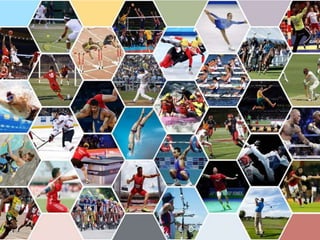
What is your idea on the picture
collage?
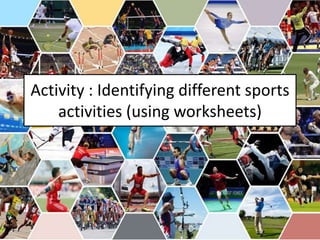
Activity : Identifying different sports
activities (using worksheets)
What are some of the sports you identified?
How do you describe them?
What are the skills needed in order to play
sports?
Why do we play sports?
How do you know that they are classified as
sports?
What are the values you can get in playing
sports?
What is Sports?
a structured physical activity,
usually competitive, that requires
complex skills and a high level of
individual commitment and
motivation
Structured physical activity
-organised
-set rules
-arrange events
-physical preparation
Competitive
-competitive element, either
between individual and team.
-fighting spirit to win
Requires complex skills
-skills have to be learned for an
individual to become a performer.
High level of individual
commitment and motivation
- training for long hours
- sacrifices
Functions of Sports
• form of recreation
• preparation for war or the hunt
• substitute for war
• Fitness and health
Common Features of Sport
• Competition between individual or team
• Physical activity
• Winners and losers ( in some sports you
can have a draw)
• Rules to ensure fair competition
• A special place to play ( e.g., a pitch,
court, or ring)
• Special equipment
• Sport can provide the basis for a
lifelong participation in regular
exercise, and the development of
mental and moral qualities,
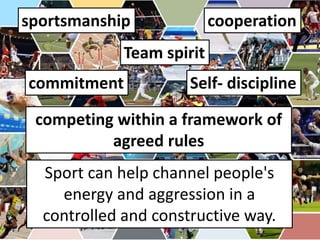
sportsmanship
Team spirit
Self- discipline
cooperation
competing within a framework of
agreed rules
commitment
Sport can help channel people's
energy and aggression in a
controlled and constructive way.
Group Activity:
Create a schedule of your sports
activities performing MVPAs of
your chosen sports in at least
three (3) times a week.
Quiz
A. Name at least 15 sports and classify
them according to the headings Number
of Players; Playing Venue; and the How
the Game is won by the Player.
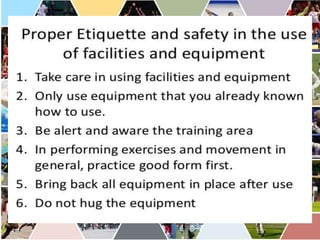
A. Give at least 5 proper etiquette and safety
in the use of facilities and equipment.
Assignment
Search:
How to optimize the energy
systems for safe and improved
performance?

Grade 11 2nd sem 1st

  • 2.
    Learning Competencies: • discussesthe nature of the different sports activity(PEH11FH-IIa-18es); • engages in a moderate to vigorous physical activities(MVPAs) for at least 60 minutes most days of the week in a variety of settings in- and-out of school(PEH11FH-IIa-t-8); • demonstrate proper etiquette and safety in the use of facilities and equipment(PEH11FH- IIa-t-12).
  • 4.
    What is youridea on the picture collage?
  • 5.
    Activity : Identifyingdifferent sports activities (using worksheets)
  • 6.
    What are someof the sports you identified? How do you describe them? What are the skills needed in order to play sports? Why do we play sports? How do you know that they are classified as sports? What are the values you can get in playing sports?
  • 7.
    What is Sports? astructured physical activity, usually competitive, that requires complex skills and a high level of individual commitment and motivation
  • 8.
    Structured physical activity -organised -setrules -arrange events -physical preparation
  • 9.
    Competitive -competitive element, either betweenindividual and team. -fighting spirit to win
  • 10.
    Requires complex skills -skillshave to be learned for an individual to become a performer.
  • 11.
    High level ofindividual commitment and motivation - training for long hours - sacrifices
  • 12.
    Functions of Sports •form of recreation • preparation for war or the hunt • substitute for war • Fitness and health
  • 13.
  • 14.
    • Competition betweenindividual or team • Physical activity • Winners and losers ( in some sports you can have a draw) • Rules to ensure fair competition • A special place to play ( e.g., a pitch, court, or ring) • Special equipment
  • 15.
    • Sport canprovide the basis for a lifelong participation in regular exercise, and the development of mental and moral qualities,
  • 16.
    sportsmanship Team spirit Self- discipline cooperation competingwithin a framework of agreed rules commitment Sport can help channel people's energy and aggression in a controlled and constructive way.
  • 19.
    Group Activity: Create aschedule of your sports activities performing MVPAs of your chosen sports in at least three (3) times a week.
  • 20.
    Quiz A. Name atleast 15 sports and classify them according to the headings Number of Players; Playing Venue; and the How the Game is won by the Player. A. Give at least 5 proper etiquette and safety in the use of facilities and equipment.
  • 21.
    Assignment Search: How to optimizethe energy systems for safe and improved performance?

Editor's Notes

  • #9 All sports have governing bodies that set rules and arrange events. It also requires physical preparation to some extent.
  • #10 all sport have a competitive element
  • #11 Basic skills have to be learned first, which are later developed into more complex skills.
  • #12 top athletes get to where they are by training for long hours for many years and often have to make sacrifices. This of course leads to rewards, such as winning, a sense of achievement, prize money or wages, which make all the hard work worthwhile.
  • #13 Throughout history, sport has played a variety of important function in society: as a form of recreation, as a preparation for war or the hunt; or later as a substitute for war. Some sports such as wrestling, date back thousands of years, others have arisen and being adapted from other activities. Today there are hundreds of different sports and the job of defining what a sport becomes very difficult. However, a number of characteristics that are shared by all sports can be identified.
  • #16 Sport can provide the basis for a lifelong participation in regular exercise, and the development of mental and moral qualities, including team spirit, sportsmanship, self-discipline, cooperation, commitment, and competing within a framework of agreed rules. Sport can help channel people's energy and aggression in a controlled and constructive way.