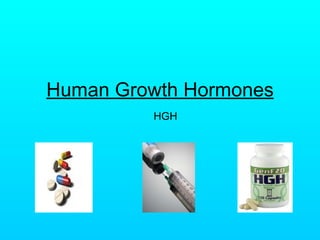
Human Growth Hormones   HGH
Part A Drug Research
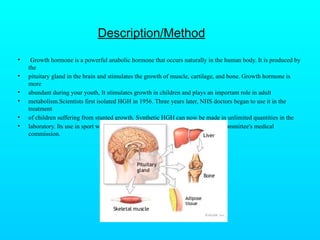
Description/Method   Growth hormone is a powerful anabolic hormone that occurs naturally in the human body. It is produced by the  pituitary gland in the brain and stimulates the growth of muscle, cartilage, and bone. Growth hormone is more  abundant during your youth, It stimulates growth in children and plays an important role in adult  metabolism.Scientists first isolated HGH in 1956. Three years later, NHS doctors began to use it in the treatment  of children suffering from stunted growth. Synthetic HGH can now be made in unlimited quantities in the  laboratory. Its use in sport was banned in 1989 by the International Olympic Committee's medical commission.
HGH affects the human body by increasing muscle size. Because there is a correlation between muscle size and strength, competitors in events that require power and short bursts of explosive strength would be most likely to benefit. HGH allows the muscle to recover quicker allowing you to train harder and more often. Endurance athletes tend to keep away from HGH and lean more toward EPO because it increases one's oxygen-carrying capacity and thus stamina.  How does HGH affect the human body?
Why is HGH used byathletes to enhance performance?   Athletes which uses HGH mainly participate in sports which require short bursts of energy and power such as  baseball And weightlifting the use of HGH to increase muscle size and also to allows tired muscles to recover  quicker allowing you to train harder and more often.
In which sports is HGH most commonly used?   Sports where the substance HGH is used include sports that require short explosive movements such as weight lifting and baseball. To induce HGH you can take them orally or inject HGH although the most effective way is Injection, when applied by sub-cutaneous or intramuscular injection.
What are the side effects/dangers associated with using HGH? Excess HGH in the body can cause acromegaly, a disease where the hands become spade-like in  appearance as they get bigger. Growth of the facial bones causes the face to change shape too. The jaw  becomes larger, with spaces appearing between the teeth because of this, and the eyebrows become more  prominent. The tongue enlarges and the skin becomes coarse and oily. Organs like the heart, liver and kidneys  will also undergo excessive growth, leading to potentially life-threatening problems - one of which is  cardiomyopathy, a disease of the heart muscle. The heart loses its ability to pump blood and, in some instances,  heart rhythm is disturbed, leading to irregular heartbeats There is also an increased risk of cancers due to the  abnormal growth of cells.
3 Questions 1. Where is the growth hormone produced? And what does it stimulate? 2. What sports is HGH more likely to be used? And why? 3. when was HGH first banned from sports?

HGH

  • 1.
  • 2.
    Part A DrugResearch
  • 3.
    Description/Method Growth hormone is a powerful anabolic hormone that occurs naturally in the human body. It is produced by the pituitary gland in the brain and stimulates the growth of muscle, cartilage, and bone. Growth hormone is more abundant during your youth, It stimulates growth in children and plays an important role in adult metabolism.Scientists first isolated HGH in 1956. Three years later, NHS doctors began to use it in the treatment of children suffering from stunted growth. Synthetic HGH can now be made in unlimited quantities in the laboratory. Its use in sport was banned in 1989 by the International Olympic Committee's medical commission.
  • 4.
    HGH affects thehuman body by increasing muscle size. Because there is a correlation between muscle size and strength, competitors in events that require power and short bursts of explosive strength would be most likely to benefit. HGH allows the muscle to recover quicker allowing you to train harder and more often. Endurance athletes tend to keep away from HGH and lean more toward EPO because it increases one's oxygen-carrying capacity and thus stamina. How does HGH affect the human body?
  • 5.
    Why is HGHused byathletes to enhance performance? Athletes which uses HGH mainly participate in sports which require short bursts of energy and power such as baseball And weightlifting the use of HGH to increase muscle size and also to allows tired muscles to recover quicker allowing you to train harder and more often.
  • 6.
    In which sportsis HGH most commonly used? Sports where the substance HGH is used include sports that require short explosive movements such as weight lifting and baseball. To induce HGH you can take them orally or inject HGH although the most effective way is Injection, when applied by sub-cutaneous or intramuscular injection.
  • 7.
    What are theside effects/dangers associated with using HGH? Excess HGH in the body can cause acromegaly, a disease where the hands become spade-like in appearance as they get bigger. Growth of the facial bones causes the face to change shape too. The jaw becomes larger, with spaces appearing between the teeth because of this, and the eyebrows become more prominent. The tongue enlarges and the skin becomes coarse and oily. Organs like the heart, liver and kidneys will also undergo excessive growth, leading to potentially life-threatening problems - one of which is cardiomyopathy, a disease of the heart muscle. The heart loses its ability to pump blood and, in some instances, heart rhythm is disturbed, leading to irregular heartbeats There is also an increased risk of cancers due to the abnormal growth of cells.
  • 8.
    3 Questions 1.Where is the growth hormone produced? And what does it stimulate? 2. What sports is HGH more likely to be used? And why? 3. when was HGH first banned from sports?