PERIODIZATION
BY
CHANDRAKANT BARIK
NIS COACH
KALINGA STADIUM COMPLEX IN-CHARGE
Periodization
 Periodization is the distribution of years training into
different periods with the aim of preparing sportsman
towards an optimum performance in a decisive competition
Periodization is the systematic formulation of the training
process in a training cycle {macro cycle} or in a year for the
purpose of achieving top form in the main competition
TYPES OF PERIODISATION
1. SINGLE PERIODISATION
2. MULTIPLE PERIODISATION
A. DOUBLE PERIODISATION
B. TRIPLE PERIODISATION
IMPORTANCE OF PERIODIZATION
1. Achieve top form in the main competition
2. Maintain the top performance
3. Improve all the performance factors.
4. Utilization of all the resources and time available.
5. Systematic and continuous development of sports performance.
6. Proper regulation and evaluation of sports training.
7. To control load dynamic
SINGLE PERIODISATION:
1. One Preparatory
2. One Competition
3. One Transition
 Development of top form takes place in three
Phases
 Single periodisation is advisable for:
 lower level sportsman
 Endurance sports.
 New technique
 In case of highly advanced sportsmen single periodisation is
used after two to three years of multiple Periodisation.
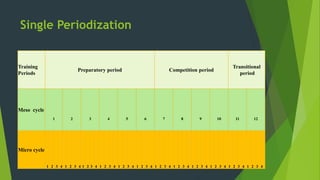
Single Periodization
Training
Periods
Preparatory period Competition period
Transitional
period
Meso cycle
1 2 3 4 5 6 7 8 9 10 11 12
Micro cycle
1 2 3 4 1 2 3 4 1 2 3 4 1 2 3 4 1 2 3 4 1 2 3 4 1 2 3 4 1 2 3 4 1 2 3 4 1 2 3 4 1 2 3 4 1 2 3 4
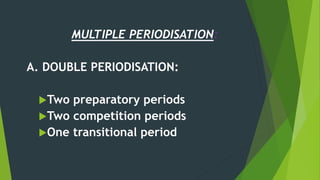
MULTIPLE PERIODISATION:
A. DOUBLE PERIODISATION:
Two preparatory periods
Two competition periods
One transitional period
 Double Periodisation is more suitable for sports like
Sprints, throws, weightlifting, Jumps, Free flow ,
Rhytmic And Artistic Pair etc.
 Double Periodisation is used for those sportsmen
who posses a high training state.
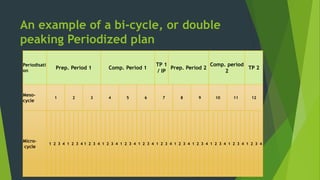
An example of a bi-cycle, or double
peaking Periodized plan
Periodisati
on
Prep. Period 1 Comp. Period 1
TP 1
/ IP
Prep. Period 2
Comp. period
2
TP 2
Meso-
cycle
1 2 3 4 5 6 7 8 9 10 11 12
Micro-
cycle
1 2 3 4 1 2 3 4 1 2 3 4 1 2 3 4 1 2 3 4 1 2 3 4 1 2 3 4 1 2 3 4 1 2 3 4 1 2 3 4 1 2 3 4 1 2 3 4
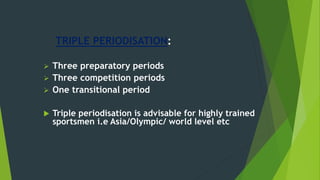
TRIPLE PERIODISATION:
 Three preparatory periods
 Three competition periods
 One transitional period
 Triple periodisation is advisable for highly trained
sportsmen i.e Asia/Olympic/ world level etc
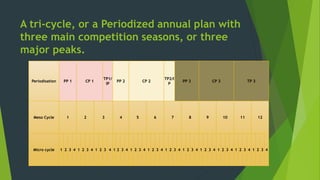
A tri-cycle, or a Periodized annual plan with
three main competition seasons, or three
major peaks.
Periodisation PP 1 CP 1
TP1/
IP
PP 2 CP 2
TP2/I
P
PP 3 CP 3 TP 3
Meso Cycle 1 2 3 4 5 6 7 8 9 10 11 12
Micro cycle 1 2 3 4 1 2 3 4 1 2 3 4 1 2 3 4 1 2 3 4 1 2 3 4 1 2 3 4 1 2 3 4 1 2 3 4 1 2 3 4 1 2 3 4 1 2 3 4
AIMS AND CONTENTS OF VARIOUS PERIODS
PREPARATORY PERIOD- 1:-
AIMS:-
 To develop general base for future performance
 To regain previous training state
 To increase load taking ability
 Training is more general in nature.
 Those abilities are stressed which are not
directly related to sports performance.
 Volume is increased sharply and intensity is
increased gradually
TRAINING CONTENTS:-
TRAINING CONTENTS IN PP-1:-
 General motor abilities are improved ( Anatomical
adaptation, general strength, basic endurance, general
flexibility, and general coordinative abilities)
 Learning of new techniques are emphasized.
 No automatisation of technique.
 Very less work on tactics.
AIMS AND CONTENTS OF P.P–2:-
AIMS:-
1. Maintenance of previously developed training state.
2. Goal oriented improvement of training state.
3. Preparation of sportsman for the competition period.
TRAINING CONTENTS OF PP-2
 Those factors are developed which are directly related to
sports performance.
 Strength, speed and endurance are developed related to
sports.
 Volume is increased and then kept constant and then
gradually volume is reduced and intensity is increased.
TRAINING CONTENTS OF PP-2 CONT..
 Techniques are learned under different and tactical
situation (Comp. Specific situation)
 Team preparation starts in team game
 Exposure to competitions
 Removal of weakness and correction of errors.
 Theoretical knowledge about the rules, tactics, game
situations, strategy etc.
AIMS AND CONTENTS OF P.P-3:
AIMS:-
 To unite the components part or foundation of
training into harmoniously whole.
 Preparation of sportsman for the competition
period.
TRAINING CONTENTS OF PP3:-
 Integration of all performance factors.
 Volume gradually decreased and intensity increased.
 Volume of competitive exercises increased.
 Skills are practiced as whole.
 Automatization is achieved.
 Theoretical session continues.
 Volume of team tactics considerably increased.
 Practice matches are emphasized
AIMS AND CONTENTS OF COMPETITION PERIODS:
AIMS:
To achieve top form and to maintain it as long
as it is required.
TRAINING CONTENTS OF COMPETITION PERIOD
Training:-
 Very high specific training means are used
 Specific sports or event fitness are maintained.
 Complex sports performance are improved (Conversion of all
performance factors into event/ game))
 Intensity is sharply increased and volume is reduced.
TRAINING CONTENTS OF COMPETITION PERIOD:
 Mastery of skills under competition and difficult conditions.
 Skills are practiced from tactical aspect (tactical training)
 High frequency of competition according to nature of sports.
 Training for direct preparation for competition.
 Strategical and theoretical preparations sessions continue.
 If long C.P - intermediate phase (2-4 weeks) is necessary.
AIMS AND CONTENTS OF TRANSITIONAL PERIOD:
AIMS:-
 To recover and recuperate from fatigue.
 Transition from C.P to next preparatory period.
TRAINING CONTENTS OF TRANSITIONAL PERIOD:-
 It is the phase of active rest.
 General exercises are used
 Volume and intensity are reduced
 Participating in recreational activities for mental recovery.
 Competition should be avoided.
 Gradually start preparing for the next P.P
 Nature Of Sports
 For endurance sports- Longer cycles
 For speed, explosive strength-Shorter cycles.
 Technical sports like Gymnastics/ diving -shorter cycle
DURATION OF TRAINING CYCLE AND ITS PERIODS
DURATION OF PREPARATORY PERIOD:
(6 WEEKS TO 7 MONTHS)
Duration of PP depends upon:
 Duration of training cycle.
 Means and methods used in preparatory period.
 Nature of sports.
 Training state and age of sportsman.
 Aim of training cycle.
DURATION OF TRAINING CYCLE AND ITS PERIODS
DURATION OF TRANSITIONAL PERIOD:
(4 weeks to 6 weeks)
Duration depends upon:
 Nature and extent of work done in PP and CP
 Aim and objective of next training cycle
STEPS IN FORMULATION OF ANNUAL PLAN
 Each expert plan in a different way
 Planning is different in different sports
 But still there are some common points
1. PERFORMANCE PROGNOSIS AND DETERMINATION
OF PERFORMANCE STRUCTURE:
 Performance prognoses: Future Target
 Performance Structure: A coach must know which factors should be
improved and to what extent, in order to achieve world level
performance.
 To determine the performance structure, the international
performances must be analyzed and evaluated.
2. DETERMINATION OF GOAL AND SUB GOALS:
While making a yearly plan Goal and Sub Goals should be realistic. Following
factors should be considered: -
1. Analysis of performance at present
2. Analysis of training in the past
3. Present training state
4. Talent
5. Time period available for training
6. Type of periodization to be used
7. Nature of sport and degree of trainability of performance factors.
8. Age of the sportsman
2. DETERMINATION OF GOAL AND SUB GOALS:
9. Training facilities available
10. Scientific support available
11. Number of competitions.
12. Personal qualities of sportsperson and other demand on him by
his family, profession, living conditions etc.
3. DETERMINATION OF VOLUME OF TRAINING
NEEDED FOR PERFORMANCE FACTORS:
 The total volume of training/total time period/total training
sessions needed for the improvement of each performance
factor to the required level depends upon:
1. Trainability of the performance factors
2. The level to which the performance factors have to be improved.
. DETERMINATION OF DATES OF TESTS AND
COMPETITIONS:
 Date of general fitness tests.
 Date of specific fitness tests
 Planning and evaluation should go side by side
 Dates of other tests like physiology, psychology, anthropometry
etc.
 Date of competitions should be fixed.
5. DETERMINATION OF SEQUENCE OF IMPROVEMENT
OF VARIOUS PERFORMANCE FACTORS:
 Depending upon the nature of sports, all performance factors
have to develop in a definite sequence.
 This sequence is different in different sports
 As a rule general abilities are to be tackled first and the specific
abilities are to be tackled later.
6. DETERMINATION OF LOAD DYNAMICS:
 The intensity and volume for the whole period should be determined
in quantitative manners.
 It is advised to prepare figure ,graphs, diagram etc showing load
indices for different periods and meso-cycles.
 General training, special training , conditioning, technical and
tactical training are also worked out.

PERIODIZATION ppt.pptx

  • 1.
  • 2.
    Periodization  Periodization isthe distribution of years training into different periods with the aim of preparing sportsman towards an optimum performance in a decisive competition Periodization is the systematic formulation of the training process in a training cycle {macro cycle} or in a year for the purpose of achieving top form in the main competition
  • 3.
    TYPES OF PERIODISATION 1.SINGLE PERIODISATION 2. MULTIPLE PERIODISATION A. DOUBLE PERIODISATION B. TRIPLE PERIODISATION
  • 4.
    IMPORTANCE OF PERIODIZATION 1.Achieve top form in the main competition 2. Maintain the top performance 3. Improve all the performance factors. 4. Utilization of all the resources and time available. 5. Systematic and continuous development of sports performance. 6. Proper regulation and evaluation of sports training. 7. To control load dynamic
  • 5.
    SINGLE PERIODISATION: 1. OnePreparatory 2. One Competition 3. One Transition  Development of top form takes place in three Phases
  • 6.
     Single periodisationis advisable for:  lower level sportsman  Endurance sports.  New technique  In case of highly advanced sportsmen single periodisation is used after two to three years of multiple Periodisation.
  • 7.
    Single Periodization Training Periods Preparatory periodCompetition period Transitional period Meso cycle 1 2 3 4 5 6 7 8 9 10 11 12 Micro cycle 1 2 3 4 1 2 3 4 1 2 3 4 1 2 3 4 1 2 3 4 1 2 3 4 1 2 3 4 1 2 3 4 1 2 3 4 1 2 3 4 1 2 3 4 1 2 3 4
  • 8.
    MULTIPLE PERIODISATION: A. DOUBLEPERIODISATION: Two preparatory periods Two competition periods One transitional period
  • 9.
     Double Periodisationis more suitable for sports like Sprints, throws, weightlifting, Jumps, Free flow , Rhytmic And Artistic Pair etc.  Double Periodisation is used for those sportsmen who posses a high training state.
  • 10.
    An example ofa bi-cycle, or double peaking Periodized plan Periodisati on Prep. Period 1 Comp. Period 1 TP 1 / IP Prep. Period 2 Comp. period 2 TP 2 Meso- cycle 1 2 3 4 5 6 7 8 9 10 11 12 Micro- cycle 1 2 3 4 1 2 3 4 1 2 3 4 1 2 3 4 1 2 3 4 1 2 3 4 1 2 3 4 1 2 3 4 1 2 3 4 1 2 3 4 1 2 3 4 1 2 3 4
  • 11.
    TRIPLE PERIODISATION:  Threepreparatory periods  Three competition periods  One transitional period  Triple periodisation is advisable for highly trained sportsmen i.e Asia/Olympic/ world level etc
  • 12.
    A tri-cycle, ora Periodized annual plan with three main competition seasons, or three major peaks. Periodisation PP 1 CP 1 TP1/ IP PP 2 CP 2 TP2/I P PP 3 CP 3 TP 3 Meso Cycle 1 2 3 4 5 6 7 8 9 10 11 12 Micro cycle 1 2 3 4 1 2 3 4 1 2 3 4 1 2 3 4 1 2 3 4 1 2 3 4 1 2 3 4 1 2 3 4 1 2 3 4 1 2 3 4 1 2 3 4 1 2 3 4
  • 13.
    AIMS AND CONTENTSOF VARIOUS PERIODS PREPARATORY PERIOD- 1:- AIMS:-  To develop general base for future performance  To regain previous training state  To increase load taking ability
  • 14.
     Training ismore general in nature.  Those abilities are stressed which are not directly related to sports performance.  Volume is increased sharply and intensity is increased gradually TRAINING CONTENTS:-
  • 15.
    TRAINING CONTENTS INPP-1:-  General motor abilities are improved ( Anatomical adaptation, general strength, basic endurance, general flexibility, and general coordinative abilities)  Learning of new techniques are emphasized.  No automatisation of technique.  Very less work on tactics.
  • 16.
    AIMS AND CONTENTSOF P.P–2:- AIMS:- 1. Maintenance of previously developed training state. 2. Goal oriented improvement of training state. 3. Preparation of sportsman for the competition period.
  • 17.
    TRAINING CONTENTS OFPP-2  Those factors are developed which are directly related to sports performance.  Strength, speed and endurance are developed related to sports.  Volume is increased and then kept constant and then gradually volume is reduced and intensity is increased.
  • 18.
    TRAINING CONTENTS OFPP-2 CONT..  Techniques are learned under different and tactical situation (Comp. Specific situation)  Team preparation starts in team game  Exposure to competitions  Removal of weakness and correction of errors.  Theoretical knowledge about the rules, tactics, game situations, strategy etc.
  • 19.
    AIMS AND CONTENTSOF P.P-3: AIMS:-  To unite the components part or foundation of training into harmoniously whole.  Preparation of sportsman for the competition period.
  • 20.
    TRAINING CONTENTS OFPP3:-  Integration of all performance factors.  Volume gradually decreased and intensity increased.  Volume of competitive exercises increased.  Skills are practiced as whole.  Automatization is achieved.  Theoretical session continues.  Volume of team tactics considerably increased.  Practice matches are emphasized
  • 21.
    AIMS AND CONTENTSOF COMPETITION PERIODS: AIMS: To achieve top form and to maintain it as long as it is required.
  • 22.
    TRAINING CONTENTS OFCOMPETITION PERIOD Training:-  Very high specific training means are used  Specific sports or event fitness are maintained.  Complex sports performance are improved (Conversion of all performance factors into event/ game))  Intensity is sharply increased and volume is reduced.
  • 23.
    TRAINING CONTENTS OFCOMPETITION PERIOD:  Mastery of skills under competition and difficult conditions.  Skills are practiced from tactical aspect (tactical training)  High frequency of competition according to nature of sports.  Training for direct preparation for competition.  Strategical and theoretical preparations sessions continue.  If long C.P - intermediate phase (2-4 weeks) is necessary.
  • 24.
    AIMS AND CONTENTSOF TRANSITIONAL PERIOD: AIMS:-  To recover and recuperate from fatigue.  Transition from C.P to next preparatory period.
  • 25.
    TRAINING CONTENTS OFTRANSITIONAL PERIOD:-  It is the phase of active rest.  General exercises are used  Volume and intensity are reduced  Participating in recreational activities for mental recovery.  Competition should be avoided.  Gradually start preparing for the next P.P
  • 26.
     Nature OfSports  For endurance sports- Longer cycles  For speed, explosive strength-Shorter cycles.  Technical sports like Gymnastics/ diving -shorter cycle DURATION OF TRAINING CYCLE AND ITS PERIODS
  • 27.
    DURATION OF TRAININGCYCLE AND ITS PERIODS DURATION OF PREPARATORY PERIOD: (6 WEEKS TO 7 MONTHS) Duration of PP depends upon:  Duration of training cycle.  Means and methods used in preparatory period.  Nature of sports.  Training state and age of sportsman.  Aim of training cycle.
  • 28.
    DURATION OF TRAININGCYCLE AND ITS PERIODS DURATION OF TRANSITIONAL PERIOD: (4 weeks to 6 weeks) Duration depends upon:  Nature and extent of work done in PP and CP  Aim and objective of next training cycle
  • 29.
    STEPS IN FORMULATIONOF ANNUAL PLAN  Each expert plan in a different way  Planning is different in different sports  But still there are some common points
  • 30.
    1. PERFORMANCE PROGNOSISAND DETERMINATION OF PERFORMANCE STRUCTURE:  Performance prognoses: Future Target  Performance Structure: A coach must know which factors should be improved and to what extent, in order to achieve world level performance.  To determine the performance structure, the international performances must be analyzed and evaluated.
  • 31.
    2. DETERMINATION OFGOAL AND SUB GOALS: While making a yearly plan Goal and Sub Goals should be realistic. Following factors should be considered: - 1. Analysis of performance at present 2. Analysis of training in the past 3. Present training state 4. Talent 5. Time period available for training 6. Type of periodization to be used 7. Nature of sport and degree of trainability of performance factors. 8. Age of the sportsman
  • 32.
    2. DETERMINATION OFGOAL AND SUB GOALS: 9. Training facilities available 10. Scientific support available 11. Number of competitions. 12. Personal qualities of sportsperson and other demand on him by his family, profession, living conditions etc.
  • 33.
    3. DETERMINATION OFVOLUME OF TRAINING NEEDED FOR PERFORMANCE FACTORS:  The total volume of training/total time period/total training sessions needed for the improvement of each performance factor to the required level depends upon: 1. Trainability of the performance factors 2. The level to which the performance factors have to be improved.
  • 34.
    . DETERMINATION OFDATES OF TESTS AND COMPETITIONS:  Date of general fitness tests.  Date of specific fitness tests  Planning and evaluation should go side by side  Dates of other tests like physiology, psychology, anthropometry etc.  Date of competitions should be fixed.
  • 35.
    5. DETERMINATION OFSEQUENCE OF IMPROVEMENT OF VARIOUS PERFORMANCE FACTORS:  Depending upon the nature of sports, all performance factors have to develop in a definite sequence.  This sequence is different in different sports  As a rule general abilities are to be tackled first and the specific abilities are to be tackled later.
  • 36.
    6. DETERMINATION OFLOAD DYNAMICS:  The intensity and volume for the whole period should be determined in quantitative manners.  It is advised to prepare figure ,graphs, diagram etc showing load indices for different periods and meso-cycles.  General training, special training , conditioning, technical and tactical training are also worked out.