PERIODIZATION
Kit Wong, MKin, CSCS
John Abreu, BSc, CSCS
January 27th, 2016
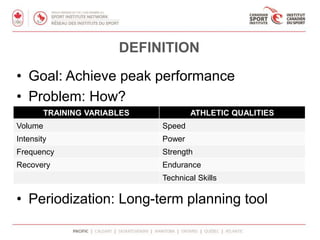
• Goal: Achieve peak performance
• Problem: How?
• Periodization: Long-term planning tool
DEFINITION
TRAINING VARIABLES ATHLETIC QUALITIES
Volume Speed
Intensity Power
Frequency Strength
Recovery Endurance
Technical Skills
DEFINITION
• Established in the 1960’s
• Divides annual plan into manageable
pieces
– Macrocycle
– Mesocycles
– Microcycles
• Management of overload and recovery 
adaptation + peaking
GENERAL ADAPTATION SYNDROME
Derek M. Hansen, 2014
• Overload Principle
• Volume: Amount of Work
• Intensity: Degree of Demand
GENERAL ADAPTATION SYNDROME
• More is not
always better
• Requires
optimal load
and sufficient
recovery
Derek M. Hansen, 2014
GENERAL ADAPTATION SYNDROME
Derek M. Hansen, 2014
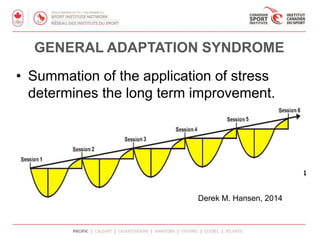
• Summation of the application of stress
determines the long term improvement.
Derek M. Hansen, 2014
• Approximately 1 year
• Start with important dates
(competitions/training camps)
• Determine the amount of preparation time
• Distribution of time contingent on athlete’s
history, needs, and goals
MACROCYCLE
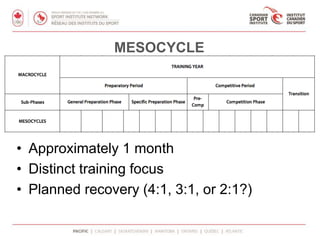
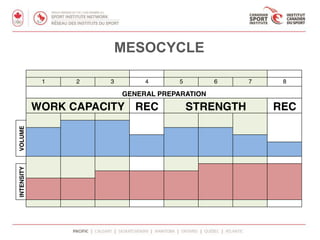
• Approximately 1 month
• Distinct training focus
• Planned recovery (4:1, 3:1, or 2:1?)
MESOCYCLE
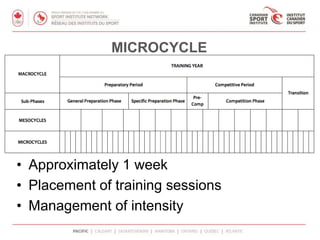
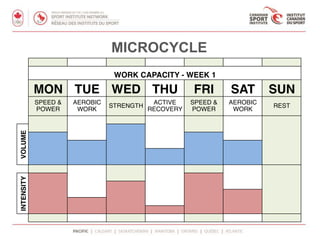
• Approximately 1 week
• Placement of training sessions
• Management of intensity
MICROCYCLE
Efficacy
• Periodized > Non-Periodized Planning (Rhea &
Alderman, 2004).
Limitations
• Decisions based on assumptions
• Not “one-size fits all”
• Be adaptable!
DOES IT WORK?
TRAINING LESSONS FROM:
MACROCYCLE
MACROCYCLE
More susceptible to perturbations
• What – Phase focus
• Why/Who/When – Need to adapt?
MESOCYCLE
MESOCYCLE
Much more sensitive
• When – Distribution of work (Life?)
• Deviations have much smaller impact on
LT plan
MICROCYCLE
MICROCYCLE
• Rely on your 5 W’s
• Planning + Application = Art + Science
• Don’t get hung up on exercises
• “Many roads lead to Rome”
HOW?
1. Don’t lose sight of the main goal when
planning/applying
2. Be aware of the importance of planned
recovery
3. Be flexible – Don’t be afraid to deviate when
needed
4. Put yourself/your athletes in positions to
succeed
5. Don’t be stubborn
ULTIMATELY
THANK YOU!
jabreu@csipacific.ca
@realcoachjohn
kwong@csipacific.ca
@KitWong89
@csipacific
www.csipacific.ca/athletes/performance-points/

Periodization

Editor's Notes

  • #3 The goal of athletes is to peak physiologically and psychologically for a specific event be it provincials, nationals, world championships/cups and ultimately the Olympics. In pursuit of this goal, athletes need to develop qualities such as speed, power, endurance and sport-specific technical skills (to varying degrees). Training variables, then, must be manipulated to achieve optimal development. But how do you piece everything together and organize your training to ensure this? This is where periodization comes in. Periodization is a long-term planning tool that enables a coach to prioritize training elements and manipulate training variables to provide the right type and amount of training stimulus, at the right time, for the athlete to adapt optimally and peak in important competitions. Furthermore, this allows for the management of fatigue, and mitigation of plateauing or overtraining (Plisk & Stone, 2003).
  • #4 Periodization was originally establish in the 1960’s based on the experiences of high-level athletes in Russia (Issurin, 2010), There are now various types and versions of periodization; however the basic premise of organizing training through layered levels of cycles is consistent. Periodization planning is done top down (so from the big picture to the small) This is through planning in cycles called macrocycles, mesocycles, and microcycles and adding layers of detail within each. Through this process, training load and recovery can be planned in order for the athlete to adapt and peak. Central to understanding this is General Adaptation Syndrome theory…
  • #5 How do we adapt or get better? The overload principle states that in order adapt there needs to be a stress or trainingstimulus above what is normal. You have to challenge yourself, you don’t get better at something by doing something that is easy, right? This overload can be induced through volume (which is the amount of work) and intensity (which is the degree of demand be it speed, weight, skill/task complexity) According to the GAS, when presented with overload the body undergoes four phases: 1) the stressor or overload is experienced and acute fatigue resulting in a temporary decline in performance occurs. 2) denotes a period of fatigue and, if adequate recovery measures are taken, performance increases back to pre-stressor levels. 3) performance surpasses original levels and ultimately reaches an apex. This rebound is known as supercompensation. 4) sometimes referred to as maladaptation, represents a state in which performance drops from the apex and back down to pre-stressor levels due to overtraining (Brown & Greenwood, 2005; Issurin 2010). Therefore, “a systematic plan of periodization can be created by manipulating GAS to enhance performance and to prevent overtraining,” (Brown & Greenwood, 2005, p. 80).
  • #6 Here is a depiction of what occurs with different levels of overload. As you can see, an excessive or sudden large increases overload results in more fatigue, a longer recovery duration, and sub-optimal supercompensation (or adaptation) It is necessary that overload is applied gradually and progressively. It is also important to note that even if an optimal load is used, insufficient recovery can be just as detrimental to the adaptation process. In this scenario the athlete may not have even returned to pre-stressor levels before the subsequent load is prescribed which perpetuates fatigue and can result in overtraining.
  • #7 If applied properly, the result of each overload and supercompensation is long-term improvement. This applies not only to between each session, but between each training cycle and each year.
  • #8 The macrocycle is an annual plan that works towards preparing for a peak competition(s). This is a broad overview of the training plan. In this part of the planning we want to figure out how much time we have for: the preparatory period, which can also be referred to as the off-season, the competitive period, which revolves around the athletes races or games, and the transition period, which serves as a two to four week break that allows the athletes to recover mentally and physically from the season. As the athlete progresses through the Macrocycle volume will decrease, intensity will increase, and the amount of work done on sport skills will increase. Important dates such as training camps, competitions, and testing should be incorporated into the plan here. The athlete’s training age, history, needs, and goals will help dictate how much time needs to be dedicated to each period. Doing this allows you to conceptualize the year and begins the planning process for the progression of the athlete.
  • #9 Mesocycles depict various training phases that last approximately 2-6 weeks and are interspersed with tactical placement of periods of recovery. During each of these cycles the training will emphasize a distinct training focus, for example strength or power. The emphasis of each mesocycle will be contingent on its place within the macrocycle as well as the goals and needs of the athlete. With regards to planning recovery, the density of high-intensity work can dictate how many weeks of loading occurs before a week of de-loading or recovery is required.
  • #10 Microcycles are essentially 1 week long and are concerned with how training intensities and elements are structured in relation to one another within the week. Considerations include the athlete’s schedule, number of training sessions, types of training sessions, the placement of these training sessions in relation to one another, heavy vs. light days, and exercise selections.
  • #11 It has been shown that purposefully planning athletes training using this strategy results in superior training adaptations than a non-periodized program due to the ability to train at higher volumes and intensities without overtraining and the actual variation of the training variables Periodization has limitations with regard to accuracy because future training decisions have to be based on assumptions For example, to plan a mesocycle in the competitive period you assumptions must be made about how an athlete has adapted to previous cycles and the training state that they will be in. However, training doesn’t always go as planned and outside stressors including school, relationships, and work all play a part in how we adapt and respond to training. Furthermore, different athletes will respond to different training stimuli in different ways and even same athlete at different stages of development may have a different response so it remains imperative that although going through the planning process that you remain adaptable. There is no one size fits all version of periodization and the successful implementation of this planning tool is contingent on accounting for each individual athlete’s circumstances including age (physiological and psychological), training history, sport, and competition schedule.
  • #14 Microcycles are essentially weeks and are concerned with how training intensities and elements are structured in relation to one another within the week. Considerations include the athlete’s schedule, number of training sessions, types of training sessions, the placement of these training sessions in relation to one another, heavy vs. light days, and exercise selections.
  • #15 Microcycles are essentially weeks and are concerned with how training intensities and elements are structured in relation to one another within the week. Considerations include the athlete’s schedule, number of training sessions, types of training sessions, the placement of these training sessions in relation to one another, heavy vs. light days, and exercise selections.
  • #16 Microcycles are essentially weeks and are concerned with how training intensities and elements are structured in relation to one another within the week. Considerations include the athlete’s schedule, number of training sessions, types of training sessions, the placement of these training sessions in relation to one another, heavy vs. light days, and exercise selections.
  • #17 Microcycles are essentially weeks and are concerned with how training intensities and elements are structured in relation to one another within the week. Considerations include the athlete’s schedule, number of training sessions, types of training sessions, the placement of these training sessions in relation to one another, heavy vs. light days, and exercise selections.
  • #18 Microcycles are essentially weeks and are concerned with how training intensities and elements are structured in relation to one another within the week. Considerations include the athlete’s schedule, number of training sessions, types of training sessions, the placement of these training sessions in relation to one another, heavy vs. light days, and exercise selections.
  • #19 Microcycles are essentially weeks and are concerned with how training intensities and elements are structured in relation to one another within the week. Considerations include the athlete’s schedule, number of training sessions, types of training sessions, the placement of these training sessions in relation to one another, heavy vs. light days, and exercise selections.
  • #20 Microcycles are essentially weeks and are concerned with how training intensities and elements are structured in relation to one another within the week. Considerations include the athlete’s schedule, number of training sessions, types of training sessions, the placement of these training sessions in relation to one another, heavy vs. light days, and exercise selections.
  • #21 Microcycles are essentially weeks and are concerned with how training intensities and elements are structured in relation to one another within the week. Considerations include the athlete’s schedule, number of training sessions, types of training sessions, the placement of these training sessions in relation to one another, heavy vs. light days, and exercise selections.
  • #22 Microcycles are essentially weeks and are concerned with how training intensities and elements are structured in relation to one another within the week. Considerations include the athlete’s schedule, number of training sessions, types of training sessions, the placement of these training sessions in relation to one another, heavy vs. light days, and exercise selections.
  • #23 Microcycles are essentially weeks and are concerned with how training intensities and elements are structured in relation to one another within the week. Considerations include the athlete’s schedule, number of training sessions, types of training sessions, the placement of these training sessions in relation to one another, heavy vs. light days, and exercise selections.