Technical College Of Engineering
Petroleum and Energy Engineering Department
Chemistry Laboratory
1st
stage
(2016-2017)
Lab # (second semester)
(Simple distillation)
Prepare By:Zanyar nawzad hama ali
Date : 18/6/2017
Group : A
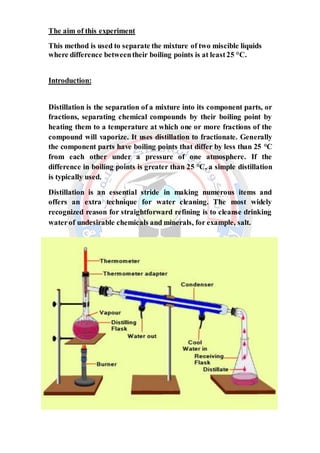
The aim of this experiment
This method is used to separate the mixture of two miscible liquids
where difference betweentheir boiling points is at least25 °C.
Introduction:
Distillation is the separation of a mixture into its component parts, or
fractions, separating chemical compounds by their boiling point by
heating them to a temperature at which one or more fractions of the
compound will vaporize. It uses distillation to fractionate. Generally
the component parts have boiling points that differ by less than 25 °C
from each other under a pressure of one atmosphere. If the
difference in boiling points is greater than 25 °C, a simple distillation
is typically used.
Distillation is an essential stride in making numerous items and
offers an extra technique for water cleaning. The most widely
recognized reason for straightforward refining is to cleanse drinking
waterof undesirable chemicals and minerals, for example, salt.
Theoretical
Vapor Pressure
 According to Kinetic Theory, the molecules in a liquid are in a
constant state of thermal motion and some of these molecules
are moving fast enough to escape from the liquid forming a
vapor above the liquid. This vapor exerts a pressure on the
surface of the liquid, i.e., Vapor Pressure.
 The Vapor Pressure of a liquid increases, generally
exponentially, with temperature.
 As a liquid is heated, the vapor pressure of the liquid increases
to the point at which it just equals the applied pressure -
usually atmospheric pressure. The liquid now begins to bubble
(boil).
 Liquids with high vapor pressures (Volatile compounds)
require relatively little energy (heat) to increase the vapor
pressure to match the applied (atmospheric) pressure, and
thus, boil, i.e. they have low boiling points.
 Liquids with low vapor pressures require considerably more
energy to increase the vapor pressure to the point where it
matches the applied pressure, thus, they have relatively high
boiling points.
Boiling point
 The Boiling Point is the temperature at which internal vapor
pressure of the liquid is equal to the pressure exerted by its
surroundings
Liquid/ liquid mixtures
 Miscible and non miscible liquid mixtures
 Miscible liquid mixture is also calledas solution
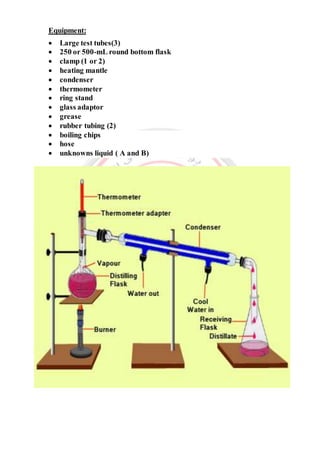
Equipment:
 Large test tubes(3)
 250 or 500-mL round bottom flask
 clamp (1 or 2)
 heating mantle
 condenser
 thermometer
 ring stand
 glass adaptor
 grease
 rubber tubing (2)
 boiling chips
 hose
 unknowns liquid ( A and B)
Procedure:
1. Fill the distillation flask and put pieces of boiling chips. ...
2. Check the calibration of the thermometer that is to be used. ...put the
thermometer in the distillation flask.
3. Boiling flask (round-bottom flask) attached to an adapter holding a
thermometer (to determine the boiling temperature of the liquid).
The adapter connects to a condenser into which cold water is
constantly passedthrough.
4. Keep a beakerat the outlet of the condenser.
5. Heat the distillation flask slowly until the liquid begins to boil.
6. As the distillate begins to drop from the condenser, the temperature
observedon the thermometer should be changing steadily.
Notes:
 The process of heating a liquid mixture to form vapor and then
cooling that vapor to get a liquid is called simple distillation.
 Simple distillation involves a single equilibration between the
liquid and vapor.
 Distilling flask should be filled not less than 1/3 filled or more
than 2/3 full.
 If a mixture distilled rapidly, the separation of its compound is
poorer than if the mixture is distilled slowly.
 Boiling chips should be placed in the distillation flask for two
reasons: they will prevent superheating of the liquid being
distilled and they will cause a more controlled boil, eliminating
the possibility that the liquid in the distillation flask will bump
into the condenser.
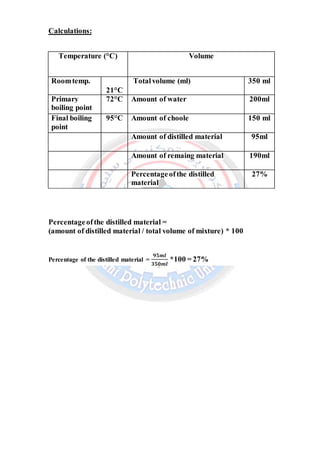
Calculations:
Temperature (°C) Volume
Roomtemp.
21°C
Totalvolume (ml) 350 ml
Primary
boiling point
72°C Amount of water 200ml
Final boiling
point
95°C Amount of choole 150 ml
Amount of distilled material 95ml
Amount of remaing material 190ml
Percentageofthe distilled
material
27%
Percentageofthe distilled material =
(amount of distilled material / total volume of mixture) * 100
Percentage of the distilled material =
𝟗𝟓𝒎𝒍
𝟑𝟓𝟎𝒎𝒍
*100 = 27%
Discussion:
Distillation is one of the oldest and still most common methods for
both the purification and the identification of organic liquids. It is a
physical process usedto separate chemicals from a mixture by the
difference in how easilythey vaporize. As the mixture is heated, the
temperature rises until it reaches the temperature of the lowest
boiling substance in the mixture, while the other components of the
mixture remain in their original phase in the mixture. The resultant
hot vapor passes into a condenserand is convertedto the liquid,
which is then collectedin a receiverflask. The other components of
the mixture remain in their originalphase until the most volatile
substance has all boiled off. Only then does the temperature of the
gas phase rises againuntil it reaches the boiling point of a second
component in the mixture, and so on.The boiling point of a
substance—determinedby distillation—is a useful physical property
for the characterizationof pure compounds. At any given
temperature a liquid is in equilibrium with its vapor. This
equilibrium is described by the vapor pressure of the liquid. The
vapor pressure is the pressure that the molecules atthe surface of the
liquid exert againstthe external pressure, which is usually the
atmospheric pressure. The vapor pressure is a very sensitive function
of temperature. It does not increase linearly but in factincreases
exponentially with temperature. The vapor pressure of a substance
roughly doubles for every increase in 10 °C, Figure 1.
When the vapor pressure of the liquid equals the applied pressure,
the liquid boils. Thus, the boiling point of a liquid is the temperature
at which the vapor pressure equals the applied pressure. The normal
boiling point of a liquid is the temperature at which the vapor.
pressure of a liquid equals atmospheric pressure (1 atm)The boiling
point of a liquid is a measure of its volatility.
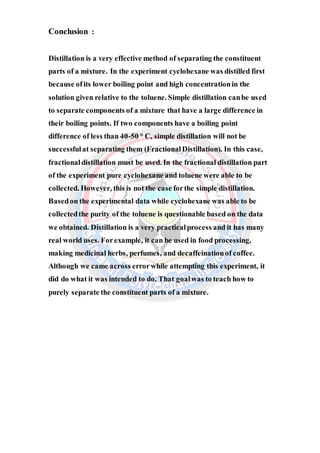
Conclusion :
Distillation is a very effective method of separating the constituent
parts of a mixture. In the experiment cyclohexane was distilled first
because ofits lower boiling point and high concentrationin the
solution given relative to the toluene. Simple distillation canbe used
to separate components of a mixture that have a large difference in
their boiling points. If two components have a boiling point
difference of less than 40-50 ° C, simple distillation will not be
successfulat separating them (FractionalDistillation). In this case,
fractionaldistillation must be used. In the fractional distillation part
of the experiment pure cyclohexane and toluene were able to be
collected. However, this is not the case forthe simple distillation.
Basedon the experimental data while cyclohexane was able to be
collectedthe purity of the toluene is questionable based on the data
we obtained. Distillation is a very practicalprocess and it has many
real world uses. Forexample, it can be used in food processing,
making medicinal herbs, perfumes, and decaffeinationof coffee.
Although we came across errorwhile attempting this experiment, it
did do what it was intended to do. That goalwas to teach how to
purely separate the constituent parts of a mixture.
Reference :
 https://en.wikipedia.org/wiki/Distillation
 http://www.chemforlife.org/experiments/distillation/default.ht
m
 https://www.coursehero.com/file/p5quboa/Conclusion-
Distillation-is-a-very-effective-method-of-separating-the/


Simple distillation

  • 1.
    Technical College OfEngineering Petroleum and Energy Engineering Department Chemistry Laboratory 1st stage (2016-2017) Lab # (second semester) (Simple distillation) Prepare By:Zanyar nawzad hama ali Date : 18/6/2017 Group : A
  • 2.
    The aim ofthis experiment This method is used to separate the mixture of two miscible liquids where difference betweentheir boiling points is at least25 °C. Introduction: Distillation is the separation of a mixture into its component parts, or fractions, separating chemical compounds by their boiling point by heating them to a temperature at which one or more fractions of the compound will vaporize. It uses distillation to fractionate. Generally the component parts have boiling points that differ by less than 25 °C from each other under a pressure of one atmosphere. If the difference in boiling points is greater than 25 °C, a simple distillation is typically used. Distillation is an essential stride in making numerous items and offers an extra technique for water cleaning. The most widely recognized reason for straightforward refining is to cleanse drinking waterof undesirable chemicals and minerals, for example, salt.
  • 3.
    Theoretical Vapor Pressure  Accordingto Kinetic Theory, the molecules in a liquid are in a constant state of thermal motion and some of these molecules are moving fast enough to escape from the liquid forming a vapor above the liquid. This vapor exerts a pressure on the surface of the liquid, i.e., Vapor Pressure.  The Vapor Pressure of a liquid increases, generally exponentially, with temperature.  As a liquid is heated, the vapor pressure of the liquid increases to the point at which it just equals the applied pressure - usually atmospheric pressure. The liquid now begins to bubble (boil).  Liquids with high vapor pressures (Volatile compounds) require relatively little energy (heat) to increase the vapor pressure to match the applied (atmospheric) pressure, and thus, boil, i.e. they have low boiling points.  Liquids with low vapor pressures require considerably more energy to increase the vapor pressure to the point where it matches the applied pressure, thus, they have relatively high boiling points. Boiling point  The Boiling Point is the temperature at which internal vapor pressure of the liquid is equal to the pressure exerted by its surroundings Liquid/ liquid mixtures  Miscible and non miscible liquid mixtures  Miscible liquid mixture is also calledas solution
  • 4.
    Equipment:  Large testtubes(3)  250 or 500-mL round bottom flask  clamp (1 or 2)  heating mantle  condenser  thermometer  ring stand  glass adaptor  grease  rubber tubing (2)  boiling chips  hose  unknowns liquid ( A and B)
  • 5.
    Procedure: 1. Fill thedistillation flask and put pieces of boiling chips. ... 2. Check the calibration of the thermometer that is to be used. ...put the thermometer in the distillation flask. 3. Boiling flask (round-bottom flask) attached to an adapter holding a thermometer (to determine the boiling temperature of the liquid). The adapter connects to a condenser into which cold water is constantly passedthrough. 4. Keep a beakerat the outlet of the condenser. 5. Heat the distillation flask slowly until the liquid begins to boil. 6. As the distillate begins to drop from the condenser, the temperature observedon the thermometer should be changing steadily. Notes:  The process of heating a liquid mixture to form vapor and then cooling that vapor to get a liquid is called simple distillation.  Simple distillation involves a single equilibration between the liquid and vapor.  Distilling flask should be filled not less than 1/3 filled or more than 2/3 full.  If a mixture distilled rapidly, the separation of its compound is poorer than if the mixture is distilled slowly.  Boiling chips should be placed in the distillation flask for two reasons: they will prevent superheating of the liquid being distilled and they will cause a more controlled boil, eliminating the possibility that the liquid in the distillation flask will bump into the condenser.
  • 6.
    Calculations: Temperature (°C) Volume Roomtemp. 21°C Totalvolume(ml) 350 ml Primary boiling point 72°C Amount of water 200ml Final boiling point 95°C Amount of choole 150 ml Amount of distilled material 95ml Amount of remaing material 190ml Percentageofthe distilled material 27% Percentageofthe distilled material = (amount of distilled material / total volume of mixture) * 100 Percentage of the distilled material = 𝟗𝟓𝒎𝒍 𝟑𝟓𝟎𝒎𝒍 *100 = 27%
  • 7.
    Discussion: Distillation is oneof the oldest and still most common methods for both the purification and the identification of organic liquids. It is a physical process usedto separate chemicals from a mixture by the difference in how easilythey vaporize. As the mixture is heated, the temperature rises until it reaches the temperature of the lowest boiling substance in the mixture, while the other components of the mixture remain in their original phase in the mixture. The resultant hot vapor passes into a condenserand is convertedto the liquid, which is then collectedin a receiverflask. The other components of the mixture remain in their originalphase until the most volatile substance has all boiled off. Only then does the temperature of the gas phase rises againuntil it reaches the boiling point of a second component in the mixture, and so on.The boiling point of a substance—determinedby distillation—is a useful physical property for the characterizationof pure compounds. At any given temperature a liquid is in equilibrium with its vapor. This equilibrium is described by the vapor pressure of the liquid. The vapor pressure is the pressure that the molecules atthe surface of the liquid exert againstthe external pressure, which is usually the atmospheric pressure. The vapor pressure is a very sensitive function of temperature. It does not increase linearly but in factincreases exponentially with temperature. The vapor pressure of a substance roughly doubles for every increase in 10 °C, Figure 1. When the vapor pressure of the liquid equals the applied pressure, the liquid boils. Thus, the boiling point of a liquid is the temperature at which the vapor pressure equals the applied pressure. The normal boiling point of a liquid is the temperature at which the vapor. pressure of a liquid equals atmospheric pressure (1 atm)The boiling point of a liquid is a measure of its volatility.
  • 8.
    Conclusion : Distillation isa very effective method of separating the constituent parts of a mixture. In the experiment cyclohexane was distilled first because ofits lower boiling point and high concentrationin the solution given relative to the toluene. Simple distillation canbe used to separate components of a mixture that have a large difference in their boiling points. If two components have a boiling point difference of less than 40-50 ° C, simple distillation will not be successfulat separating them (FractionalDistillation). In this case, fractionaldistillation must be used. In the fractional distillation part of the experiment pure cyclohexane and toluene were able to be collected. However, this is not the case forthe simple distillation. Basedon the experimental data while cyclohexane was able to be collectedthe purity of the toluene is questionable based on the data we obtained. Distillation is a very practicalprocess and it has many real world uses. Forexample, it can be used in food processing, making medicinal herbs, perfumes, and decaffeinationof coffee. Although we came across errorwhile attempting this experiment, it did do what it was intended to do. That goalwas to teach how to purely separate the constituent parts of a mixture.
  • 9.
    Reference :  https://en.wikipedia.org/wiki/Distillation http://www.chemforlife.org/experiments/distillation/default.ht m  https://www.coursehero.com/file/p5quboa/Conclusion- Distillation-is-a-very-effective-method-of-separating-the/ 