PHARYNGITIS
          DEPT OF
   OTORHINOLARYNGOLOGY
          JJM M C
       DAVANAGERE
Pharyngitis
ACUTE:
•very common condition encountered in medicine.

•One of the poorly understood condition.

•Many have no scientific basis.

•Several questions remain unanswered

 Do viral infections predispose to bacterial

infection?
Do viral infections involve pharyngeal lymphoid

tissue without involving tonsils?
Pharyngitis
   Is there a condition like chronic tonsillitis?
   Is there a infective condition like chronic
    pharyngitis?
   Why are some patients susceptible to acute
    pharyngitis/tonsillitis?
   Does the tonsil become irreversibly diseased
    after many episodes of acute tonsillitis?
   Does removal of tonsils predispose for more
    frequent episodes of pharyngitis?
Pharyngitis
   There is poor co-relation between surface culture swabs
    from core culture.
   Presence of organisms in throat culture does not mean that it
    is pathogenic or vice versa is also true for streptococci,
    haemophilus influenza (aerobic) therefore suggested that
    may be caused by anaerobes.
   Size of the tonsil is not directly related to their infective
    state,infact sunken tonsils are immunologically
    incompetent.
   Parenchymatous tonsillitis, chronic tonsillitis, streptococcal
    pharyngitis and chronic hypertrophic pharyngitis are non
    proven category.
Pharyngitis-aetiology
   Viral (42%)- a) Adenovirus (most common 31%)
           b) Epstein –Barr virus(6%)
           c) Influenza virus(5%)
   Bacterial –Mixed infection common(48%)
               -beta-hemolytic streptococci(38%)
               -H. influenza
               -staphylococcus aureus
               -diphtheria
               -gonococcus
               -anaerobes remain uncertain.
   Fungal –Candida albicans.
Pharyngitis-clinical features
   Mild infection-discomfort ,malaise ,low grade
    fever ,congested ,no lymphadenopathy.
   Moderate-pain, dysphagia, headache, high fever.
               -congested, oedematous, exudates.
                  -enlarged tonsils, lymphoid follicles of
                    posterior pharyngeal wall.
                -lymph nodes palpable and tender.
    viral infection mild-associated with rhinorrhoea.
   Voice change-severe bacterial infection.
   Gonococcal pharyngitis-mild or even symptomless.
Pharyngitis-diagnosis &treatment
   Diagnosis-culture & sensitivity-may be helpful.
   Treatment –general measures-bed rest ,fluids ,warm
                   saline gargle, analgesics.
               -specific-penicillin g-oral or injection.
                         -if sensitive- macrolides.
Chronic Pharyngitis
   Characterized by hypertrophy of mucosal
    seromucinous glands, sub epithelial lymphoid
    tissue, even muscular coat.


   Two types-a) catarrhal (mucosal)
             -b) hypertrophic
Chronic Pharyngitis- aetiology
   Persistent infections- chronic rhinosinusitis with
    post nasal drip, chronic tonsillitis, dental sepsis
   Mouth breathing-nasal polyp, DNS with Hit's,
    allergic/vasomotor rhinitis, nasopharyngeal
    adenoids, tumours.
         -with mouth breathing air is not filtered,
    humidified and temperature conditioned.
   Chronic irritants-smoking, tobacco chewing,
    alcohol, highly spicy food.
Chronic Pharyngitis- aetiology
   Environmental-smoke, dust, chemicals,
    occupational fumes.


   Faulty voice production- misuse/over use
Chronic Pharyngitis- symptoms
1)    Discomfort, pain-more during morning.

2)    Foreign body sensation-constant desire to
      swallow or clear throat.

3)    Voice tiredness.

4)    cough
Chronic Pharyngitis- signs
   Catarrhal- congestion, vascular engogement,
    increased secretions.
   Hypertrophic-pharyngeal wall thick,
     edematous, congested mucosa and dilated
    vessels.
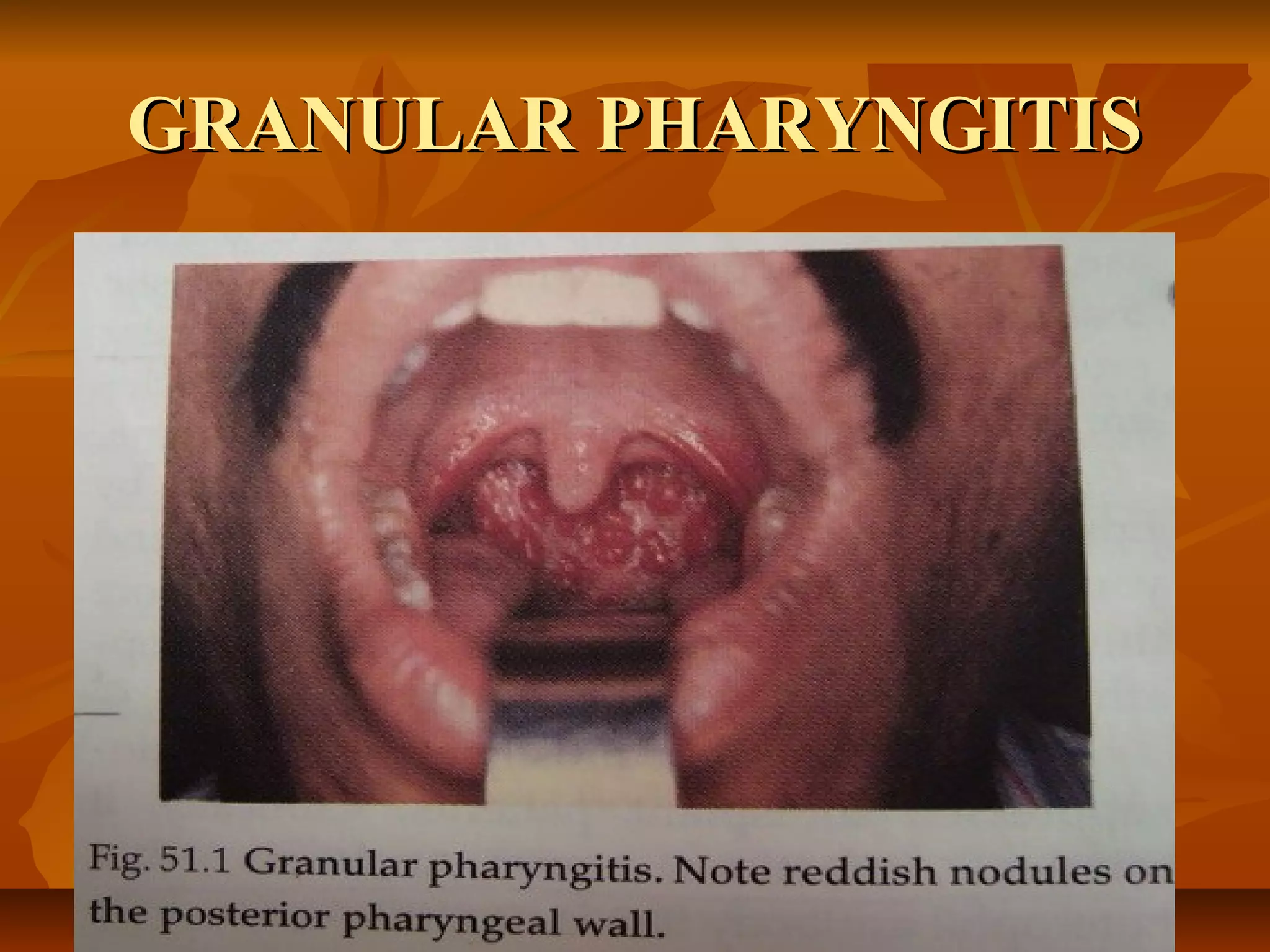
      -posterior pharyngeal wall studded with reddish
    nodules-(granular pharyngitis) due to sub epithelial
    lymphoid follicle hypertrophy.
       -uvula congested and elongated.
Chronic Pharyngitis-treatment
   Etiological factor sought and eradicated.

   Voice rest –speech therapy.

   Warm saline gargle.

   Severe granular type-chemical or diathermy
    cautery done.
GRANULAR PHARYNGITIS
Chronic Pharyngitis-treatment
Atrophic pharyngitis
   All the layers become atrophied.
   Secondary to atrophic rhinitis.
   Clinical features: dryness, discomfort,
    hawking-dry cough.
   Signs: dry glazed pharygeal mucosa often
    covered with crusting.
   Treatment: treat the primary nasal cause, saline
    gargle.
    -potassium iodide(325mg orally) promote
    secretions.
Keratosis pharyngitis
   Benign condition characterized by horny
    white/yellow excrescences on the surface of
    the tonsils, pharyngeal wall, lingual tonsils-
    Result of hypertrophy & keratinisation of
    epithelium.
   Firmly adherent, cannot be wiped off.
   No accompanying inflammation.
   Spontaneous regression, does not require any
    treatment.
   Assurance.
Keratosis pharyngitis
Chronic specific pharyngitis
   Syphilitic
   Tuberculosis
   Leprosy
   Toxoplasmosis
   Scleroma

Pharyngitis

  • 1.
    PHARYNGITIS DEPT OF OTORHINOLARYNGOLOGY JJM M C DAVANAGERE
  • 2.
    Pharyngitis ACUTE: •very common conditionencountered in medicine. •One of the poorly understood condition. •Many have no scientific basis. •Several questions remain unanswered  Do viral infections predispose to bacterial infection? Do viral infections involve pharyngeal lymphoid tissue without involving tonsils?
  • 3.
    Pharyngitis  Is there a condition like chronic tonsillitis?  Is there a infective condition like chronic pharyngitis?  Why are some patients susceptible to acute pharyngitis/tonsillitis?  Does the tonsil become irreversibly diseased after many episodes of acute tonsillitis?  Does removal of tonsils predispose for more frequent episodes of pharyngitis?
  • 4.
    Pharyngitis  There is poor co-relation between surface culture swabs from core culture.  Presence of organisms in throat culture does not mean that it is pathogenic or vice versa is also true for streptococci, haemophilus influenza (aerobic) therefore suggested that may be caused by anaerobes.  Size of the tonsil is not directly related to their infective state,infact sunken tonsils are immunologically incompetent.  Parenchymatous tonsillitis, chronic tonsillitis, streptococcal pharyngitis and chronic hypertrophic pharyngitis are non proven category.
  • 5.
    Pharyngitis-aetiology  Viral (42%)- a) Adenovirus (most common 31%) b) Epstein –Barr virus(6%) c) Influenza virus(5%)  Bacterial –Mixed infection common(48%) -beta-hemolytic streptococci(38%) -H. influenza -staphylococcus aureus -diphtheria -gonococcus -anaerobes remain uncertain.  Fungal –Candida albicans.
  • 6.
    Pharyngitis-clinical features  Mild infection-discomfort ,malaise ,low grade fever ,congested ,no lymphadenopathy.  Moderate-pain, dysphagia, headache, high fever. -congested, oedematous, exudates. -enlarged tonsils, lymphoid follicles of posterior pharyngeal wall. -lymph nodes palpable and tender.  viral infection mild-associated with rhinorrhoea.  Voice change-severe bacterial infection.  Gonococcal pharyngitis-mild or even symptomless.
  • 7.
    Pharyngitis-diagnosis &treatment  Diagnosis-culture & sensitivity-may be helpful.  Treatment –general measures-bed rest ,fluids ,warm saline gargle, analgesics. -specific-penicillin g-oral or injection. -if sensitive- macrolides.
  • 8.
    Chronic Pharyngitis  Characterized by hypertrophy of mucosal seromucinous glands, sub epithelial lymphoid tissue, even muscular coat.  Two types-a) catarrhal (mucosal) -b) hypertrophic
  • 9.
    Chronic Pharyngitis- aetiology  Persistent infections- chronic rhinosinusitis with post nasal drip, chronic tonsillitis, dental sepsis  Mouth breathing-nasal polyp, DNS with Hit's, allergic/vasomotor rhinitis, nasopharyngeal adenoids, tumours. -with mouth breathing air is not filtered, humidified and temperature conditioned.  Chronic irritants-smoking, tobacco chewing, alcohol, highly spicy food.
  • 10.
    Chronic Pharyngitis- aetiology  Environmental-smoke, dust, chemicals, occupational fumes.  Faulty voice production- misuse/over use
  • 11.
    Chronic Pharyngitis- symptoms 1) Discomfort, pain-more during morning. 2) Foreign body sensation-constant desire to swallow or clear throat. 3) Voice tiredness. 4) cough
  • 12.
    Chronic Pharyngitis- signs  Catarrhal- congestion, vascular engogement, increased secretions.  Hypertrophic-pharyngeal wall thick, edematous, congested mucosa and dilated vessels. -posterior pharyngeal wall studded with reddish nodules-(granular pharyngitis) due to sub epithelial lymphoid follicle hypertrophy. -uvula congested and elongated.
  • 13.
    Chronic Pharyngitis-treatment  Etiological factor sought and eradicated.  Voice rest –speech therapy.  Warm saline gargle.  Severe granular type-chemical or diathermy cautery done.
  • 14.
  • 15.
  • 16.
    Atrophic pharyngitis  All the layers become atrophied.  Secondary to atrophic rhinitis.  Clinical features: dryness, discomfort, hawking-dry cough.  Signs: dry glazed pharygeal mucosa often covered with crusting.  Treatment: treat the primary nasal cause, saline gargle. -potassium iodide(325mg orally) promote secretions.
  • 17.
    Keratosis pharyngitis  Benign condition characterized by horny white/yellow excrescences on the surface of the tonsils, pharyngeal wall, lingual tonsils- Result of hypertrophy & keratinisation of epithelium.  Firmly adherent, cannot be wiped off.  No accompanying inflammation.  Spontaneous regression, does not require any treatment.  Assurance.
  • 18.
  • 19.
    Chronic specific pharyngitis  Syphilitic  Tuberculosis  Leprosy  Toxoplasmosis  Scleroma