RHINITIS
DEPARTMENT OF SURGERY
By d.Gautam
contents
• Definition
• Classification
• Clinical features
• Signs
• Investigation
• Complication
• treatment
RHINITIS
• It is the inflammation of the nasal mucous
membrane
rhinitis
infected
Acute
bacterial viral
chroni
c
specific
Non
specific
Atrophic
rhinitis
Simple
chronic
rhinitis
Hypertroph
ic rhinitis
Rhinitis
sicca
Rhinitis
caseosa
Granuloma
tous rhiitis
Non
infected
allergic
seasonal perinial
vasomoto
r
specific
syphilis
leprosy
Tuberculosi
rhinosporidiosis
Rhino
scleroma
Fungal
infection
leishmaniosis
Coryza
• It is an acute non specific infective rhinitis.
• Also known as “common cold”.
Aetiology
• Causative organism: virus and may be either
influenza virus rhinovirus or adenovirus etc.
• Spread : is by air borne droplet infection or by
direct contact.
• Secondary infection by bacteria may occur
streptococcus staphylococcus pneumococcus
etc.
Pathology
• Viral infection of the nasal mucosa
• Acute generalised hyperaemia of the nasal
mucosa
• Engorgement of the secretory gland and
goblet cells
• Profuse secretion involvement of sinus
• sinusitis
• Involvement of Eustachian tube opening
• ASOM &SOM
CLINICAL FEATURES
• Incubation period:1-3 days
• Four stages
– Ischaemic stage
– Hyperaemic stage
– Stage of secondary inflammation
– Stage of resolution
ISCHAEMIC STAGE
• Raw sensation & irritation in the pharynx.
• Irritation & dryness in the nose.
• Sneezing attack.
• Malaise with chills.
•
HYPEREMIC STAGE
• Profuse watery rhinorrhea
• Anosmia
• Blocking of nose
• Fever and malaise with chills.
• Congested nasal mucosa
• Headache and otalgia
STAGE OF SECONDARY INFECTION
• Nasal discharge becomes thicker and
yellowish and greenish.
• Fever & malaise with chill.
• Headache
• Otalgia
• Congested nasal mucosa
COMPLICATION
• Sinusitis
• Acute otitis media.
• Pharyngitis.
• Pneumonia.
• Laryngitis.
STAGE OF RESOLUTION
• Resolution of uncomplicated cases occurs
within 6 -10 days.
Treatment
• Antibiotics
• Analgesics
• Antipyretics
• Antihistamine
• Vitamin C
• Rest and warm
• Give high protein diet
• Nasal decongestants locally
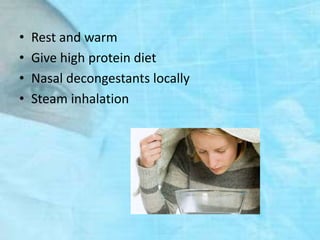
• Steam inhalation
CHRONIC SIMPLE RHINITIS
• Aetiology
• Predisposing factors
• Vasomotor rhinitis
• DNS
• Nasal polypi
• Tonsillitis
• Sinusitis
• Smoking and alcoholism
Clinical feature
• Rhinorrhoea-mucopurulent
• Headache
• Nasal obstruction
• Anosmia
SIGNS
• Hyperemic mucosa with oedema.
• Post nasal drip .
• Thick viscid mucopurulent nasal secreation.
• Pharyngitis.
TREATMENT
• Alkaline nasal douching.
• Treat the indisposing factors if present.
• Stop smoking &alcohol.
Chronic hypertrophic rhinitis
• Etiology
• Usually it result from recurrent attack from acute
rhinitis.
• Predisposing factors:
• sinusitis
• Pollution
• Dust
• Smoke
• Tonsilitis
• Nasal polyp
• Overuse of nasal drops
• Vitamin deficiency
CLINICAL FEATURE
• Nasal obstruction
• Rhinorrhoea
• Anosmia
• Dull headache
• Otalgia
• Sore throat due to pharyngitis
SIGNS
• Anterior rhinoscopy: Hypertrophy of inferior
nasal turbinates.
• Posterior rhinoscopy:Mullbery like appearance
TREATMENT
• Removal or treatment of predisposing factors
• Local nasal decongestants drops
• Antihistamine
• Surgical management for turbinate
hypertrophy
• Partial turbinectomy
ATROPHIC RHINITIS
• Synonym:ozeana
• It is a chronic inflammatory disease of the
nasal mucosa which characterised by
progressive atrophy of the mucosa and
turbinates', formation of crust and foul smell
from the nose known as ozaena.
CLASSIFICATION
• Unilateral or bilateral
• Primary or secondary
AETIOLOGY
• Primary:
• Exact aetiology not known but predisposing
factor include:
• Age : common between 15-40 yrs occurs
usually at puberty.
• Sex : more common in female.
• Heredity
• familial
• Environmental
• Nutritional
• Hormonal
• Vitamin a deficiency
• Infection
• Secondary :
• Chronic specific infection
• Extensive surgery
• Chronic sinusitis
• DNS
PATHOLOGY
• It is a condition characterised by atrophic
changes in all the nasal tissues.
• Mucosa undergoes atrophy and metaplasia
• Cilia and secretory glands also undergo
atrophy with a resultant pale , dry, thin
mucosa with thick scanty secretion dry to
form crust which may bleed on removal.
• Secondary infection usually results in foul
foetid smelling
• Turbinates' undergo atrophy resulting in loss
of anatomical landmarks on the nose and a
roomy nasal cavity.
• Blood vessels undergo periarteritis & endaritis
resulting in ischemia .
• Sensory nerves undergo atrophy and hence
the patients may complain of nasal
obstruction as he does not feels the air
passing through the nose.
• Atrophy of the olfactory nerve ending
resulting in anosmia
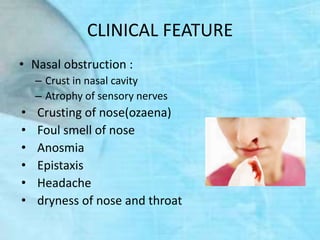
CLINICAL FEATURE
• Nasal obstruction :
– Crust in nasal cavity
– Atrophy of sensory nerves
• Crusting of nose(ozaena)
• Foul smell of nose
• Anosmia
• Epistaxis
• Headache
• dryness of nose and throat
SIGNS
• External nasal examination:
– Bridge of nose may be depressed ( saddle shaped)
• Anterior rhinoscopy
– Nasal cavity is roomy
– Causative factors like DNS
– Mucosa is pale shiny dry and atrophy
– Crust are seen
• Posterior rhinoscopy
– Diminished sensation of the mucosa due to the
atrophy of sensory nerve ending
COMPLICATION
• Sinusitis
• Middle ear infection
• Atrophic pharyngitis
• Maggots
INVESTIGATION
• X-ray of nose/sinus
• VDRL test
• Complete haemogram
• Dermatographical examination
• XRAY chest
• Nasal smear for leprosy and T.B
• Biopsy
TREATMENT
• Primary cause should be treated
• Nasal drops:
– 25% glycerine drops
– Chloramphenicol drops
– Streptomycin drops
• Placental extract
• Antibiotics
• Nutritional improvement vitamin A,B,B6
• vasodilators
Surgical treatment
• Narrowing of nasal cavity
• Submucosal grafting
• Partial closure
• Cervical sympathectomy
Rhinitis caseosa
• synonym;cholesteatoma.
It is a condition characterized by accumulation
of
a caseosa (cheesy) material in the nasal cavity
&maxillary sinus .
Aetiology
• The exact etiology is not known.
• Associated with inflammation and granulation
of the lining mucosa.
• There may be erosion of lateral nasal wall
Clinical feature
• Nasal obstruction
• Foul smell
• Headache
• Thick viscid rhinorrhoea
SIGNS
• Thick cheesy or caseous material
• Foetid odor
• Involvement of maxillary sinus
TREATMENT
• Caldwell luc operation
RHINITIS SICCA
• It is a disease of nose characterised by drying
and crusting affecting only the anterior
portion of the nasal cavity.
Aetiology
• Seen in person working dry hot dusty
environment like rubber factory worker bottle
factory workers.
CLINICAL FEATURE
• Crusting
• Drying
• Nasal obstruction
• Irritation
• Epistaxis
• Ulceration
• Septal perforation
SIGNS
• Anterior rhinoscopy: dry dark red mucosa
ulceration
• Posterior rhinoscopy: nasal mucosa normal
• No any crust or drying
TREATMENT
• Lubrication of nose-vaseline,oil
• Alkaline nasal douching
• Change of environment /job
DIPHTHERETIC RHINITIS
• Also known as nasal diptheria.
• It is a form of acute infective rhinitis.
Aetiology
• Causative organism: corynebacterium
diphtheria.
• Age :common in children.
• It is of two types
– Primary
– Secondary
Primary
• It may affect the nose first without
involvement of other tissues.
Secondary
• It may affect the nose secondary to faucial
diphtheria.
CLINICAL FEATURES
• Blood stained watery rhinorrhoea.
• Skin near the nasal vestibule may show
excoriation due to continuous nasal discharge.
• Nasal obstruction
• Greyish white membrane is seen on the
turbinate's or nasal septum, it is difficult to
remove.
• Constitutional symptoms such as fever
malaise etc.
Investigation
• Swab culture may show diphtheria bacilli
Treatment
• Patient is hospitalised and isolated.
• Antitoxin serum are given after a skin
sensitivity test.
• Penicillin and ampicillin.
ALLERGIC RHINITIS
• Allergic rhinitis is a common disorder which is
usually characterized by spasmodic attack of
severe sneezing and rhinorrhea.
Aetiology
• Age:all age
• Sex: both sex
• Predisposing factors:
• Hereditary
• Harmonasl
• Climate
• Emotional
• Precipatating factor(allergens)
• inhalents
• Ingestants
• Contactants
• Cosmetic powder
• Drugs
• Irritants
• Infection
• Intestinal helmenthis
TYPES
• Two types
• Seasonal
• Perinial
SYMPTOMS
• Irriritants
• Paroxysmal sneezing
• Rhinorrhoea
• Nasal obstruction
• Anosmia
• Headache
SIGNS
• Mucosa
–Acute stage :pale
Chronic stage :bluish purple
– Infection:present
– Polyp :present
– Allergic salute(tip of nose salute like)
– dorrer’s line (crease on dorsum of nose)
INVESTIGATION
• Nasal secretion : eosinophilia
• Haemogram
• Stool examination
• History about allergy
• Skin test by intradermal injection
• Inhalation of allergens
• Elimination test for food
• RAST (radio allergosorbant test)
TREATMENT
• Avoidance of allergen
• Desensitisation
• Symptomatic:
• antihistamine
• Steroids
• General:
• Vitamin c
• Calcium
LOCAL TREATMENT
• Hydrocortison injection
• Zinc ionisation
• Cryosurgery
• Laser therapy
SURGICAL
• Nasal obstruction
• Infection
• Vidian neurectomy
CORRELATION WITH MIASM
• Rhinitis covers all the three
miasm, psora and syphilis &
sycosis.
PSORA
• Psora-functional changes
• Rhinitis covers the psora miasm; psora leads
to functional disturbances; i.e. in rhinitis there
is inflammation of mucus membrane of nose
leading to ischemic conditions and burning,
irritation like symptoms.
• Sensation of dryness in the nose troublesome
even when the air passes freely.
• Epistaxis more or less profusely more or less
frequently.
• Ulcerated nostrils
• Nostrils as if it were stuffed up.
• Disagreeble sensation of dryness in the nose.
SYPHILIS
• It also covers the syphilis miasm because of
the nasal discharge.
• Loss of smell.
• Snuffle children.
• The bones of the nose are destroyed.
• Syphilis produce ulceration
• The crust of syphilis are dark greenish black or
brown,thick and not always offensive
SYCOTIC
• It also covers the sycotic miasm because t
leads to nasal destruction.
• Sense of smell loss.
• Sycotic has a red nose with prominent
cappilaries
• There is often nasal stoppage due thickening
of the membrane ,there is enlarged turbinated
bones.
• New babies of sycotic patient often get
snuffles nose dry stuffed up frequently in
Childs.
• Screams with anger in its attempt with
breathe with its mouth closed
Rhinitis

Rhinitis