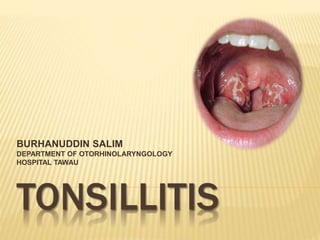
TONSILLITIS
BURHANUDDIN SALIM
DEPARTMENT OF OTORHINOLARYNGOLOGY
HOSPITAL TAWAU
OUTLINE
 Anatomy
 Acute Tonsilitis
 Faucial Diphteria
 Chronic Tonsilitis
 Indications for surgery
 Summary
ANATOMY
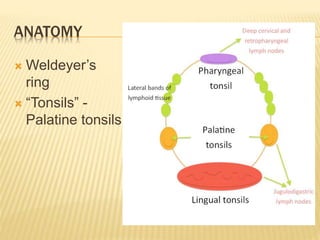
 Weldeyer’s
ring
 “Tonsils” -
Palatine tonsils
ANATOMY
ANATOMY
ANATOMY
ANATOMY
ACUTE TONSILITIS
 Affects school-going children and adults.
Rare in infants and above 50 yo
 Types of acute tonsilitis
 Acute superficial tonsitilits
 Acute follicular tonsilitis
 Acute parenchymatous tonsilitis
 Acute membraneous tonsilitis
ACUTE TONSILITIS
 Acute superficial tonsilitis
ACUTE TONSILITIS
 Acute follicular tonsilitis
 Acute membranous tonsilitis
ACUTE TONSILITIS - AETIOLOGY
 Haemolytic streptococcus
 Staphylococci, pneumococci, H.influenza
ACUTE TONSILITIS - SYMPTOMS
 Sore throat
 Odynophagia
 Fever – may be only symptom in a child
 Earache
 Constitutional symptoms
ACUTE TONSILITIS - SIGNS
 Foetid breath
 Hyperaemia of anterior pillar, uvula, soft
palate
 Coated tongue
 Red, swollen tonsils
 Tender jugulodigastric lymph nodes
ACUTE TONSILITIS - TREATMENT
 Bed rest
 Fluid intake
 Analgesics
 Antimicrobial – penicillin group, 7-10 days
 Admission if unable to take orally
ACUTE TONSILITIS - COMPLICATIONS
 Chronic tonsilitis
 Peritonsillar abscess
 Parapharyngeal abscess
 Cervical abscess
 Acute otitis media
 Rare: rheumatic fever, AGN, SBE
ACUTE TONSILITIS - COMPLICATIONS
FAUCIAL DIPHTERIA
 Caused by Corynebacterium diphteriae
 Rare
 Often in non-immunised children
 Between 2-10 years of age
 Organisms multiply in throat causing toxin
 Greyish-white adherent membrane over
tonsils, spreads to soft palate and PPW
FAUCIAL DIPHTERIA
 Patients usually ill, refuses to eat
 Cervical lymphadenopathy
 Investigations: throat swab, Schick’s test
 Management
 Secure airway if larynx involved
 Treat with antitoxin and antibiotics
 Isolation
FAUCIAL DIPHTERIA
CHRONIC TONSILITIS - AETIOLOGY
 Acute tonsilitis
 Subclinical tonsil infections
 Chronic sinusitis
 Chronic odontogenic infection
CHRONIC TONSILITIS – CLINICAL FEATURES
 Recurrent sore throats or acute tonsilitis
 Chronic cough
 Halitosis
 Thick speech
 Difficulty swallowing
 Choking spells at night
CHRONIC TONSILITIS - EXAMINATION
 Tonsils may be enlarged – kissing tonsils
 Yellowish beads of pus
 Flushing of anterior pillars
 Enlargement of jugulodigastric nodes
CHRONIC TONSILITIS - TREATMENT
 General – diet, oral hygiene, treatment of co-
existent infections
 Tonsillectomy
CHRONIC TONSILITIS - COMPLICATIONS
 Peritonsillar abscess
 Parapharyngeal abscess
 Intratonsillar abscess
 Tosilloliths
 Tonsilar cysts
CHRONIC TONSILITIS - COMPLICATIONS
INDICATIONS FOR SURGERY
 Absolute
 Relative
 Part of another operation
ABSOLUTE INDICATIONS
 Recurrent tonsilitis
 ≥ 7 episodes in 1 year
 ≥ 5 episodes per year for 2 years
 ≥ 3 episodes per year for 3 years
 ≥ 2 weeks of lost school/work days in a year
 Peritonsillar abscess
 After 1 episode in children
 After 2nd episode in adults
ABSOLUTE INDICATIONS
 Febrile seizures
 Symptomatic hypertrophy of tonsils
 Airway obstruction (OSA)
 Difficulty in degluttition
 Interference with speech
 Suspicion of malignancy
 Unilateral tonsillar hypertrophy (lymphoma,
epidermoid carcinoma)
RELATIVE INDICATIONS
 Diphteria carriers
 Streptococcal carriers
 Chronic tonsilitis with halitosis or
unresponsive to medical treatment
 Recurrent streptococcal tonsilitis in a patient
with valvular disease
AS PART OF OTHER PROCEDURES
 Palatopharyngoplasty for OSA
 Glossopharyngeal neurectomy
 Removal of styloid process
SUMMARY
 Common condition
 Medical treatment mainstay of management
 Think about diphteria in the non-immunised
child
 Indications for tonsillectomy – hence ENT
referral!
THANK YOU!!

Tonsilitis

  • 1.
    TONSILLITIS BURHANUDDIN SALIM DEPARTMENT OFOTORHINOLARYNGOLOGY HOSPITAL TAWAU
  • 2.
    OUTLINE  Anatomy  AcuteTonsilitis  Faucial Diphteria  Chronic Tonsilitis  Indications for surgery  Summary
  • 3.
  • 4.
  • 5.
  • 6.
  • 7.
  • 8.
    ACUTE TONSILITIS  Affectsschool-going children and adults. Rare in infants and above 50 yo  Types of acute tonsilitis  Acute superficial tonsitilits  Acute follicular tonsilitis  Acute parenchymatous tonsilitis  Acute membraneous tonsilitis
  • 9.
    ACUTE TONSILITIS  Acutesuperficial tonsilitis
  • 10.
    ACUTE TONSILITIS  Acutefollicular tonsilitis  Acute membranous tonsilitis
  • 11.
    ACUTE TONSILITIS -AETIOLOGY  Haemolytic streptococcus  Staphylococci, pneumococci, H.influenza
  • 12.
    ACUTE TONSILITIS -SYMPTOMS  Sore throat  Odynophagia  Fever – may be only symptom in a child  Earache  Constitutional symptoms
  • 14.
    ACUTE TONSILITIS -SIGNS  Foetid breath  Hyperaemia of anterior pillar, uvula, soft palate  Coated tongue  Red, swollen tonsils  Tender jugulodigastric lymph nodes
  • 15.
    ACUTE TONSILITIS -TREATMENT  Bed rest  Fluid intake  Analgesics  Antimicrobial – penicillin group, 7-10 days  Admission if unable to take orally
  • 16.
    ACUTE TONSILITIS -COMPLICATIONS  Chronic tonsilitis  Peritonsillar abscess  Parapharyngeal abscess  Cervical abscess  Acute otitis media  Rare: rheumatic fever, AGN, SBE
  • 17.
    ACUTE TONSILITIS -COMPLICATIONS
  • 18.
    FAUCIAL DIPHTERIA  Causedby Corynebacterium diphteriae  Rare  Often in non-immunised children  Between 2-10 years of age  Organisms multiply in throat causing toxin  Greyish-white adherent membrane over tonsils, spreads to soft palate and PPW
  • 19.
    FAUCIAL DIPHTERIA  Patientsusually ill, refuses to eat  Cervical lymphadenopathy  Investigations: throat swab, Schick’s test  Management  Secure airway if larynx involved  Treat with antitoxin and antibiotics  Isolation
  • 20.
  • 21.
    CHRONIC TONSILITIS -AETIOLOGY  Acute tonsilitis  Subclinical tonsil infections  Chronic sinusitis  Chronic odontogenic infection
  • 22.
    CHRONIC TONSILITIS –CLINICAL FEATURES  Recurrent sore throats or acute tonsilitis  Chronic cough  Halitosis  Thick speech  Difficulty swallowing  Choking spells at night
  • 23.
    CHRONIC TONSILITIS -EXAMINATION  Tonsils may be enlarged – kissing tonsils  Yellowish beads of pus  Flushing of anterior pillars  Enlargement of jugulodigastric nodes
  • 25.
    CHRONIC TONSILITIS -TREATMENT  General – diet, oral hygiene, treatment of co- existent infections  Tonsillectomy
  • 26.
    CHRONIC TONSILITIS -COMPLICATIONS  Peritonsillar abscess  Parapharyngeal abscess  Intratonsillar abscess  Tosilloliths  Tonsilar cysts
  • 27.
    CHRONIC TONSILITIS -COMPLICATIONS
  • 28.
    CHRONIC TONSILITIS -COMPLICATIONS
  • 29.
    INDICATIONS FOR SURGERY Absolute  Relative  Part of another operation
  • 30.
    ABSOLUTE INDICATIONS  Recurrenttonsilitis  ≥ 7 episodes in 1 year  ≥ 5 episodes per year for 2 years  ≥ 3 episodes per year for 3 years  ≥ 2 weeks of lost school/work days in a year  Peritonsillar abscess  After 1 episode in children  After 2nd episode in adults
  • 31.
    ABSOLUTE INDICATIONS  Febrileseizures  Symptomatic hypertrophy of tonsils  Airway obstruction (OSA)  Difficulty in degluttition  Interference with speech  Suspicion of malignancy  Unilateral tonsillar hypertrophy (lymphoma, epidermoid carcinoma)
  • 32.
    RELATIVE INDICATIONS  Diphteriacarriers  Streptococcal carriers  Chronic tonsilitis with halitosis or unresponsive to medical treatment  Recurrent streptococcal tonsilitis in a patient with valvular disease
  • 33.
    AS PART OFOTHER PROCEDURES  Palatopharyngoplasty for OSA  Glossopharyngeal neurectomy  Removal of styloid process
  • 34.
    SUMMARY  Common condition Medical treatment mainstay of management  Think about diphteria in the non-immunised child  Indications for tonsillectomy – hence ENT referral!
  • 35.

Editor's Notes

  • #2 Assalamualaikum and good afternoon, my name is burhan, MO from ENT and today I will be talking about tonsillitis
  • #3 We will start with an overview of the anatomy of the tonsils, followed by a walkthrough of acute and chronic tonsilitis, we will also touch on faucal diphteria which is especially important in the paediatric population, and we will also talk about when surgery is warranted, whch also means, when should an ENT referral be done
  • #4 The tonsils are located in the pharynx, and actually are a group of lymphoid tissue scattered in the pharynx. They form what is known as the Weldeyer’s ring. As u can see, what we normally refer to as the tonsils are acgtually the palatine tonsils, theres also the lingual tonsils, the pharyngeal tonsils or also known as the adenoid, and other bands of tissue. Palatine tonsils drain to the JD nodes so you alsmost always get a tender LN with tonsilitis.
  • #5 This are the tonsils as seen from a throat examination, bounded anteriorly by the ant pillar or the palatoglossal arch, and posteriorly by the posterior pillar or the palatopharyngeal arch. What u see is actualy only a part of the palatine tonsils, because as u can see it extendes upwards to the soft palate, downwards to the base of tongue, and anteriorly along the palatoglossal arch.
  • #6 This is a cross section of the right palatine tonsil. Medial wall is made of stratified squamous epithelieum, which dips into the substance of the tonsils as crypts. Inside these crypts are the lymphoid tissues.These can be filled with debris and cheesy material. The lateral wall is actually a fibrous capsule, inside of which are loose areolar tissue, which can be affected by infection causing peritonsillar and parapharygeal abscess, both of which area complications of tonsilitis.
  • #7 The bed of the tonsil is what we see after the tonsil is removed. As u can see there are many structures related the tonsillar bed. Of interest are the glossopharyngeal nerve and the styloid process, both of which can be surgically approached after removal of tonsils.
  • #8 Blood supply of the tonsil is via 5 arteries, main one being the tonsillar artery from the facial artery. Other are the dorsal linguae,…. That’s why bleeding can be disastrouous in tonsil surgery
  • #9 Surface epithelieum in continuity with oropharyngeal lining, crypts, and the lymphoid tissues.
  • #19 This is a very rare condition these days considering the effectiveness of the universally administered vaccinations under the immunization schedule.