GRANULOMATOUS
CONDITIONS OF LARYNX

     DEPT OF OTORHINOLARYNGOLOGY
                JJM M C
              DAVANAGERE
TUBERCULOSIS OF
          LARYNX
• Almost always associated with open
  pulmonary Tuberculosis
• Due to contamination of sputum
  containing acid fast bacilli
• May rarely develop by blood borne
  infections which causes extensive
  ulceration of mucosa
• Common age group : 20-40 yrs
• Incidence increasing due to emergence
  of AIDS
TUBERCULOSIS OF LARYNX-
       PATHOLOGY
• Posterior part of larynx affected than anterior
• Formation of submucosal tubercles which later
  may caseate and ulcerate producing
  undermined ulcers
• There may be infiltration of epiglottis and
  arytenoids
• Self limiting to some extent –> heals with
  fibrosis-> stenosis of larynx
• With reparative process tumor like swellings are
  found called Tuberculomas
• there may be diffuse oedematous reaction
  consistent to allergic response to AFB
TUBERCULOSIS OF LARYNX-
       SYMPTOMS

• Throat pain
• Referred otalgia
• Hoarseness with weakness of voice
  (earliest symptom)
• Painful speech
• dysphagia
TUBERCULOSIS OF LARYNX-
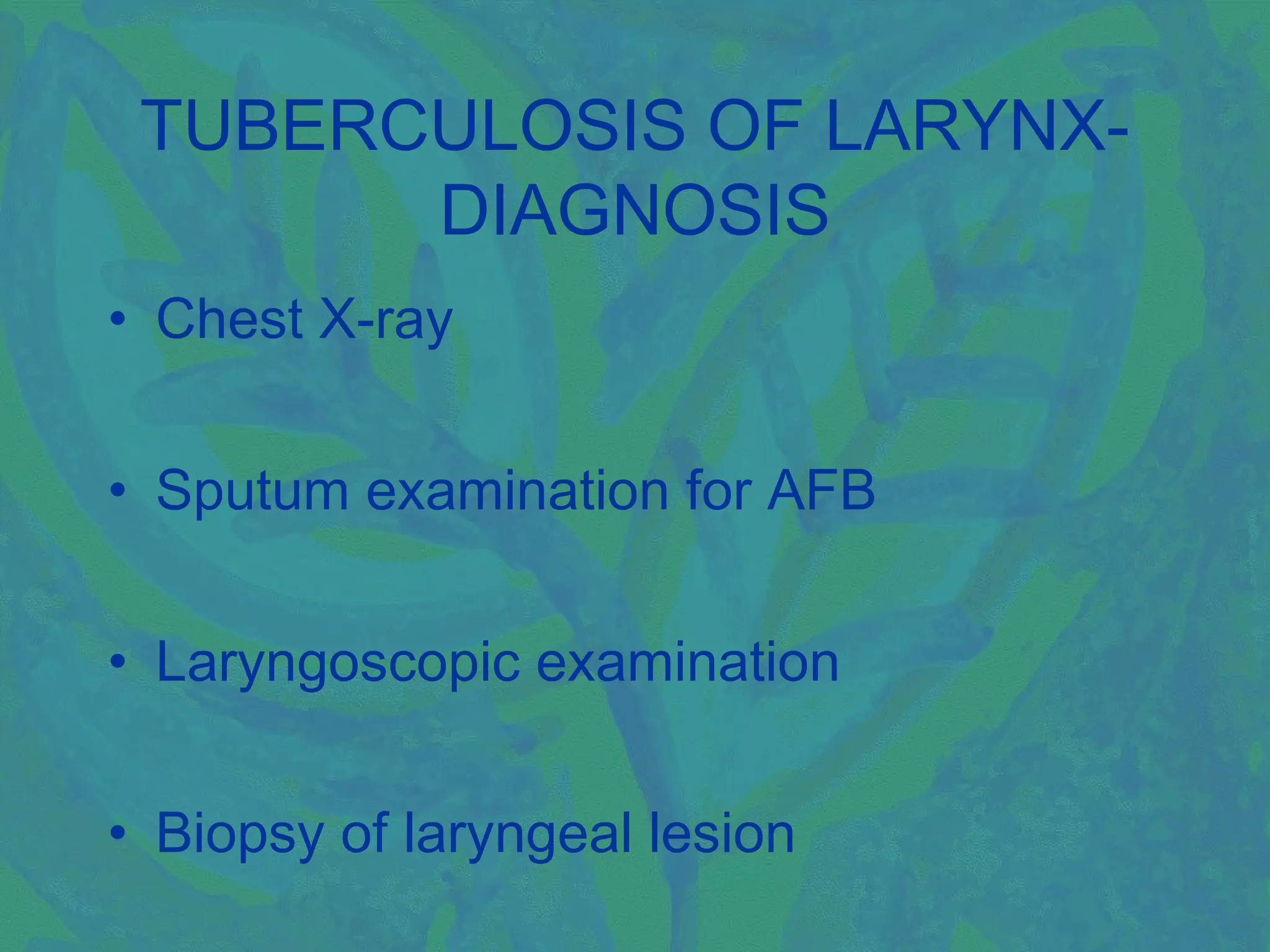
         SIGNS
• Mucosal hyperemia and oedema
• Inter-arytenoid mamillations
• Undermined ulcers- mouse nibbled
  appearance
• Turban epiglottis
• Ragged ulcerations on arytenoids and inter-
  arytenoid region
• Granulation tissue in inter-arytenoid region
• Pale laryngeal mucosa
TUBERCULOSIS OF LARYNX-
       DIAGNOSIS
• Chest X-ray


• Sputum examination for AFB


• Laryngoscopic examination


• Biopsy of laryngeal lesion
TUBERCULOSIS OF LARYNX-
       TREATMENT
• Anti tubercular drug regimen


• Vocal rest


• Nutritional supplements
SCLEROMA OF LARYNX
• Klebsiella rhinoscleromatis is the
  causative organism
• Laryngeal involvement is seen with or
  without nasal lesion
• Subglottic region is commonly involved
SCLEROMA OF LARYNX-
    SYMPTOMS AND SIGNS
• Non specific symptoms as seen in other
  chronic laryngeal infections like
  hoarseness, wheeze
• Dyspnoea may be presenting symptom
  in addition to nasal lesion
• Presents as smooth red swelling in
  subglottic region
SCLEROMA OF LARYNX-
         DIAGNOSIS
• Biopsy of the lesion
• Histopathology -> specimen shows
  Mikulicz cells, Russell bodies, gram
  negative organism within the Mikulicz
  cell
• Culture of organism from biopsy
  material
SCLEROMA OF LARYNX-
        TREATMENT
•  Medical  combination of an
   aminoglycoside such as gentamycin with an
   anti-metabolite such as tetracyclin
• Steroids to reduce fibrosis
• Surgical
1. Endoscopic removal of granulomatous
   tissue
2. Mild stenosis  dilatation
3. Severe subglottic stenosis tracheostomy
SYPHILIS OF LARYNX
• Now rarely seen
• All stages can manifest in larynx
• Primary lesion described rarely
• Tertiary stage is most important
  gamma are seen
• Peri arterial infiltration and obliterative
  endarteritis
• Prediliction for anterior part of larynx 
  epiglottis and AE folds
SYPHILIS OF LARYNX
• Oedematous mucosa with infiltration of
  plasma cells, lymphocytes and giant
  cells
• Deep ulceration with central sloughing
• Abundant necrotic tissue reaches and
  penetrates laryngeal cartilages
• Considerable destruction after healing
  leaves deformity of larynx and often
  stenosis
SYPHILIS OF LARYNX-
   CLINICAL FEATURES AND
        MANAGEMENT
• Hoarseness, sometimes dysphagia, pain is
  rare
• Oedema of mucosa leading to stridor
• Diagnosis only on biopsy and serological
  tests
• Treatment Prolonged treatment with high
  doses of penicillin
• Local treatment by inhalation
• Endoscopic removal of necrotic tissue to
  maintain airway
• tracheostomy
LEPROSY OF LARYNX
• Caused by mycobacterium leprae (Hansen's
  bacillus)
• Both lepromatous and tuberculoid can arise in
  larynx
• Epiglottis and AE fold most commonly
  affected
• Granulomatous swelling and often ulceration
  and destruction in supraglottic region
• Epiglottis may be curled
• Mucosa may be studded with nodules
• Virchow cells ( foamy histiocytes) and
  mucosal thickening seen on HPE
LEPROSY OF LARYNX-
         TREATMENT

• Medical Dapsone, Clofazimine,
  Rifampicin
• Surgical tracheostomy in cases of
  stenosis
WEGENER’S
         GRANULOMATOSIS
• Diffuse systemic disease of unknown cause
• Includes triad of necrotizing granulomatous lesion
  in upper and lower respiratory tract (sinusitis,
  rhinitis), vasculitis involving pulmonary arteries
  and veins and necrotizing glomerulonephritis
• Larynx is rarely source of primary manifestation
• Lesion usually lies in subglottis laryngeal
  obstruction
• Edematous mucosa with granular appearance
  which bleeds easily and sometimes ulcerates
• If untreated can be rapidly fatal
• Immunosuppressive drugs especially
  cyclophosphamide are very active
• Steroids should be started early
SARCOIDOSIS OF LARYNX
• Chronic idiopathic granulomatous disease
  also called Besnier-Boeck disease
• Head and neck manifestations in 10% of
  whom only minor proportion have laryngeal
  disease
• Disease is usually self limiting
• Pathology non specific granuloma later
  fibrosis and hyalinization
• Main site involved is supraglottis
SARCOIDOSIS OF LARYNX- CLINICAL
  FEATURES AND MANAGEMENT

• Hoarseness, dysphagia and dyspnoea
• Epiglottis and false vocal cords are swollen
  and pale
• True cords and subglottis rarely affected
• Lesion can progress rapidly leading to life
  threatening airway obstruction
• Diagnosis biopsy
• Positive Kveim’s test, elevated serum
  angiotensin converting enzyme is highly
  suggestive
• Treatment high dose corticosteroids,
  tracheostomy
LUPUS OF LARYNX
• Indolent tubercular infection associated with
  lupus of nose and pharynx
• Involves anterior part of larynx.
• Epiglottis is involved first and may be
  completely destroyed. disease spreads to AE
  fold and ventricular bands.
• Painless asymptomatic condition may be
  discovered incidentally
• Prognosis is good
• Treatment is anti tubercular drugs
MYCOSIS OF LARYNX
•    Following mycosis can occur in the larynx
1.   Candidiasis
2.   Coccidioidmycosis
3.   Paracoccidioidmycosis
4.   Histoplasmosis
5.   Blastomycosis
6.   Cryptococcosis
7.   aspergillosis

Granulomatous conditions of larynx

  • 1.
    GRANULOMATOUS CONDITIONS OF LARYNX DEPT OF OTORHINOLARYNGOLOGY JJM M C DAVANAGERE
  • 2.
    TUBERCULOSIS OF LARYNX • Almost always associated with open pulmonary Tuberculosis • Due to contamination of sputum containing acid fast bacilli • May rarely develop by blood borne infections which causes extensive ulceration of mucosa • Common age group : 20-40 yrs • Incidence increasing due to emergence of AIDS
  • 3.
    TUBERCULOSIS OF LARYNX- PATHOLOGY • Posterior part of larynx affected than anterior • Formation of submucosal tubercles which later may caseate and ulcerate producing undermined ulcers • There may be infiltration of epiglottis and arytenoids • Self limiting to some extent –> heals with fibrosis-> stenosis of larynx • With reparative process tumor like swellings are found called Tuberculomas • there may be diffuse oedematous reaction consistent to allergic response to AFB
  • 4.
    TUBERCULOSIS OF LARYNX- SYMPTOMS • Throat pain • Referred otalgia • Hoarseness with weakness of voice (earliest symptom) • Painful speech • dysphagia
  • 5.
    TUBERCULOSIS OF LARYNX- SIGNS • Mucosal hyperemia and oedema • Inter-arytenoid mamillations • Undermined ulcers- mouse nibbled appearance • Turban epiglottis • Ragged ulcerations on arytenoids and inter- arytenoid region • Granulation tissue in inter-arytenoid region • Pale laryngeal mucosa
  • 7.
    TUBERCULOSIS OF LARYNX- DIAGNOSIS • Chest X-ray • Sputum examination for AFB • Laryngoscopic examination • Biopsy of laryngeal lesion
  • 8.
    TUBERCULOSIS OF LARYNX- TREATMENT • Anti tubercular drug regimen • Vocal rest • Nutritional supplements
  • 9.
    SCLEROMA OF LARYNX •Klebsiella rhinoscleromatis is the causative organism • Laryngeal involvement is seen with or without nasal lesion • Subglottic region is commonly involved
  • 10.
    SCLEROMA OF LARYNX- SYMPTOMS AND SIGNS • Non specific symptoms as seen in other chronic laryngeal infections like hoarseness, wheeze • Dyspnoea may be presenting symptom in addition to nasal lesion • Presents as smooth red swelling in subglottic region
  • 11.
    SCLEROMA OF LARYNX- DIAGNOSIS • Biopsy of the lesion • Histopathology -> specimen shows Mikulicz cells, Russell bodies, gram negative organism within the Mikulicz cell • Culture of organism from biopsy material
  • 12.
    SCLEROMA OF LARYNX- TREATMENT • Medical  combination of an aminoglycoside such as gentamycin with an anti-metabolite such as tetracyclin • Steroids to reduce fibrosis • Surgical 1. Endoscopic removal of granulomatous tissue 2. Mild stenosis  dilatation 3. Severe subglottic stenosis tracheostomy
  • 13.
    SYPHILIS OF LARYNX •Now rarely seen • All stages can manifest in larynx • Primary lesion described rarely • Tertiary stage is most important gamma are seen • Peri arterial infiltration and obliterative endarteritis • Prediliction for anterior part of larynx  epiglottis and AE folds
  • 14.
    SYPHILIS OF LARYNX •Oedematous mucosa with infiltration of plasma cells, lymphocytes and giant cells • Deep ulceration with central sloughing • Abundant necrotic tissue reaches and penetrates laryngeal cartilages • Considerable destruction after healing leaves deformity of larynx and often stenosis
  • 15.
    SYPHILIS OF LARYNX- CLINICAL FEATURES AND MANAGEMENT • Hoarseness, sometimes dysphagia, pain is rare • Oedema of mucosa leading to stridor • Diagnosis only on biopsy and serological tests • Treatment Prolonged treatment with high doses of penicillin • Local treatment by inhalation • Endoscopic removal of necrotic tissue to maintain airway • tracheostomy
  • 16.
    LEPROSY OF LARYNX •Caused by mycobacterium leprae (Hansen's bacillus) • Both lepromatous and tuberculoid can arise in larynx • Epiglottis and AE fold most commonly affected • Granulomatous swelling and often ulceration and destruction in supraglottic region • Epiglottis may be curled • Mucosa may be studded with nodules • Virchow cells ( foamy histiocytes) and mucosal thickening seen on HPE
  • 17.
    LEPROSY OF LARYNX- TREATMENT • Medical Dapsone, Clofazimine, Rifampicin • Surgical tracheostomy in cases of stenosis
  • 18.
    WEGENER’S GRANULOMATOSIS • Diffuse systemic disease of unknown cause • Includes triad of necrotizing granulomatous lesion in upper and lower respiratory tract (sinusitis, rhinitis), vasculitis involving pulmonary arteries and veins and necrotizing glomerulonephritis • Larynx is rarely source of primary manifestation • Lesion usually lies in subglottis laryngeal obstruction • Edematous mucosa with granular appearance which bleeds easily and sometimes ulcerates • If untreated can be rapidly fatal • Immunosuppressive drugs especially cyclophosphamide are very active • Steroids should be started early
  • 19.
    SARCOIDOSIS OF LARYNX •Chronic idiopathic granulomatous disease also called Besnier-Boeck disease • Head and neck manifestations in 10% of whom only minor proportion have laryngeal disease • Disease is usually self limiting • Pathology non specific granuloma later fibrosis and hyalinization • Main site involved is supraglottis
  • 20.
    SARCOIDOSIS OF LARYNX-CLINICAL FEATURES AND MANAGEMENT • Hoarseness, dysphagia and dyspnoea • Epiglottis and false vocal cords are swollen and pale • True cords and subglottis rarely affected • Lesion can progress rapidly leading to life threatening airway obstruction • Diagnosis biopsy • Positive Kveim’s test, elevated serum angiotensin converting enzyme is highly suggestive • Treatment high dose corticosteroids, tracheostomy
  • 21.
    LUPUS OF LARYNX •Indolent tubercular infection associated with lupus of nose and pharynx • Involves anterior part of larynx. • Epiglottis is involved first and may be completely destroyed. disease spreads to AE fold and ventricular bands. • Painless asymptomatic condition may be discovered incidentally • Prognosis is good • Treatment is anti tubercular drugs
  • 22.
    MYCOSIS OF LARYNX • Following mycosis can occur in the larynx 1. Candidiasis 2. Coccidioidmycosis 3. Paracoccidioidmycosis 4. Histoplasmosis 5. Blastomycosis 6. Cryptococcosis 7. aspergillosis