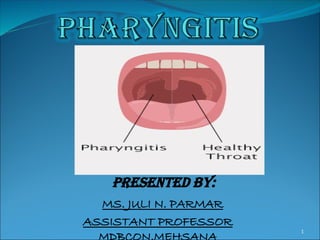
Presented by:
MS. JULI N. PARMAR
ASSISTANT PROFESSOR
1
OUTLINE OF THE TOPIC
 INTRODUCTION,
 DEFINITION,
 PHARYNGITIS APPEARS IN THREE FORM,
 ETIOLOGY AND RISK FACTORS,
 PATHO-PHYSIOLOGY,
 TYPES OF PHARYNGITIS,
 CLINICAL MANIFISTATION/SIGN & SYMPTOMS,
DIGNOSTIC EVALUATION,
 MEDICAL MANAGEMENT,
 NURSING MANAGEMENT AND
 PREVENTION OF PHARYNGITIS
2
INTRODUCTION
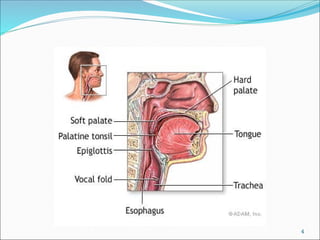
Pharyngitis often simply
referred to as a sore throat is
inflammation of the pharynx, the
portion of the throat that lies just
beyond the back of the roof of the
mouth & stretches to the Adam’s
apple ( Pharynx ). It usually occurs
when viruses ( or sometimes
bacteria ) from a cold, flu or sinus3
4
DEFINTION
 Pharyngitis often simply referred
to as a sore throat is inflammation
of the pharynx.
5
PHARYNGITIS APPEARS IN
THREE FORMS
 Pharyngitis is very common but rarely
serious.
 Mast cases clear up on their own after
three to ten days and require no
therapy other than pain relievers to
ease the discomfort.
 Rarely , though , tissues may swell
considerably and obstruct breathing a
life-threatening condition. 6
•Pharyngitis appears in three forms
– non exudative , exudative and
ulcerative.
• Non- exudative pharyngitis :-
although group A streptococci may
cause non- exudative pharyngitis
viruses are by far the most common
causative agents of this group.
7
 Exudative pharyngitis :-
coxsackievirus A and herpes virus
are the most common cause of
ulcerative pharyngitis.
 Vincent’s angina due to
fusobacteria and poor oral hygiene
may also cause ulcerative
pharyngitis that is associated with
malaise and low grade fever.
 The most common finding is a
unilateral tonsillar ulceration with a
8
ETILOGY &RISK FACTORS
1] Bacterial pharyngitis:-
 A number of different bacteria can
inflect the human throat.
 The most common bacterial agent
is streptococcus.
 It causes about 15-30% of cases of
pharyngitis.
 However other include:- 9
 Carynebacterium diptheriae
 Neisseria gonorrhoeae
 Arcanobacterium ( corynebacterium )
haemolytic
 Chlamydophila pneumonia
 Mycoplasma pneumonia
2] Viral pharyngitis:-
 These comprise about 40-80% of
all infectious cases and can be a 10
Many different types of viral
infections.
 Viruses that can cause and can be
a feature sore throat include the
common cold, Adenovirus ,
orthomyxoviridae , Herpes simplex
virus , Measles, Coxsackieviruses A
and B , Epstein-Barr virus ,
Cytomegalovirus , HIV infection and
infectious mononucleosis. 11
3] Other causes of pharyngitis:-
 It may be common in young
children and presents with whitish
plaques in the oropharynx.
o Sore throat
o Smoking
o Exposure to secondhand smoke
o Exposure to chemical irritants
o Gastro esophageal reflux disease 12
o Neoplasia
o Poor hygiene
o Lowered immunity
13
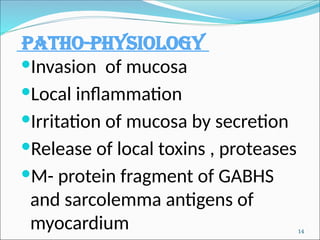
Patho-physiology
14
Invasion of mucosa
Local inflammation
Irritation of mucosa by secretion
Release of local toxins , proteases
M- protein fragment of GABHS
and sarcolemma antigens of
myocardium
Antigen – antibodies complex
deposition in glomeruli
15
Types of pharyngitis
1) Acute pharyngitis:-
Is common and is usually caused by a viral
infection that causes the common cold.
 The symptoms of acute pharyngitis usually
last for a week or less. Often referred to as a
sore throat.
Acute pharyngitis is a painful inflammation
of the pharynx in the throat region.
16
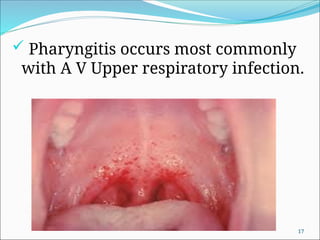
 Pharyngitis occurs most commonly
with A V Upper respiratory infection.
17
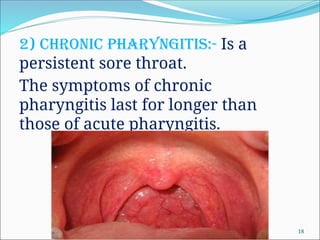
2) Chronic pharyngitis:- Is a
persistent sore throat.
The symptoms of chronic
pharyngitis last for longer than
those of acute pharyngitis.
18
Three types of chronic
pharyngitis are recognized :-
1
)
Hypertrophic: a general
thickening and congestion of the
pharyngeal
.
2
)
Atrophic: a late stage of the type
( the membrane is thin, whitish,
glistening, and at times wrinkled )
.
19
3
)
Chronic granular :
characterized by numerous
swollen, lymph follicles on the
pharyngeal wall
.
20
Clinical manifestations
• Sore or red throat
• Lump in throat feeling
• Fever
• Headache
• Earache
• Swollen glands
• Swollen neck lymph glands 21
 Tender neck lymph glands
 Difficulty speaking or swallowing
 Pain swallowing
 Breathing difficulty
22
DIAGNOSTIC EVALUATION
• Throat swab culture
• Airway compromise
• CT scan
23
Medical management
 Antibiotics therapy:- Pharyngitis
cause by viruses clears up on its
own antibiotics are not effective
against viral infections . So
treatment is aimed at easing
symptoms.
 Ex: Erythromycin, Azithomycin
24
Corticosteroids
Antifungal agents
Pain management , ex NSATDS
25
Nursing management
Increase fluid intake , fluid such as
water ,juice tea and warm scup help
replace fluid lost during mucus
production .
Gargle with warm salt water ,mix ½
teaspoon of salt in a full glass of warm
water gargle and then spit the water
out . 26
This will soothe throat and clear it
of mucus.
Humidify the air
Avoid smoking
Rest your voice
27
nursing management
1. acute pain related to
inflammation of the throat.
2. Ineffective airway clearance
related to thick secretion
characterized by difficulty in
breathing
28
3. Imbalance nutrition less than
body requirements related to
difficulty swallowing
4. Knowledge deficit related to not
familiar with the sources of
information.
29
prevention
Avoid sharing
cups ,eating ,glasses , napkin,
food or towels with anyone who
has a sore throat
Wash your hands frequently
Avoid touching public phone or
drinking fountains with your 30
 cough or sneeze into a tissue and
then throw it away
Do not smoke and avoid exposure
Avoid close contact with people
who are sick
31
32

PHARYNGITIS FOR BSC NSG, GNM,MSC NURSING

  • 1.
    Presented by: MS. JULIN. PARMAR ASSISTANT PROFESSOR 1
  • 2.
    OUTLINE OF THETOPIC  INTRODUCTION,  DEFINITION,  PHARYNGITIS APPEARS IN THREE FORM,  ETIOLOGY AND RISK FACTORS,  PATHO-PHYSIOLOGY,  TYPES OF PHARYNGITIS,  CLINICAL MANIFISTATION/SIGN & SYMPTOMS, DIGNOSTIC EVALUATION,  MEDICAL MANAGEMENT,  NURSING MANAGEMENT AND  PREVENTION OF PHARYNGITIS 2
  • 3.
    INTRODUCTION Pharyngitis often simply referredto as a sore throat is inflammation of the pharynx, the portion of the throat that lies just beyond the back of the roof of the mouth & stretches to the Adam’s apple ( Pharynx ). It usually occurs when viruses ( or sometimes bacteria ) from a cold, flu or sinus3
  • 4.
  • 5.
    DEFINTION  Pharyngitis oftensimply referred to as a sore throat is inflammation of the pharynx. 5
  • 6.
    PHARYNGITIS APPEARS IN THREEFORMS  Pharyngitis is very common but rarely serious.  Mast cases clear up on their own after three to ten days and require no therapy other than pain relievers to ease the discomfort.  Rarely , though , tissues may swell considerably and obstruct breathing a life-threatening condition. 6
  • 7.
    •Pharyngitis appears inthree forms – non exudative , exudative and ulcerative. • Non- exudative pharyngitis :- although group A streptococci may cause non- exudative pharyngitis viruses are by far the most common causative agents of this group. 7
  • 8.
     Exudative pharyngitis:- coxsackievirus A and herpes virus are the most common cause of ulcerative pharyngitis.  Vincent’s angina due to fusobacteria and poor oral hygiene may also cause ulcerative pharyngitis that is associated with malaise and low grade fever.  The most common finding is a unilateral tonsillar ulceration with a 8
  • 9.
    ETILOGY &RISK FACTORS 1]Bacterial pharyngitis:-  A number of different bacteria can inflect the human throat.  The most common bacterial agent is streptococcus.  It causes about 15-30% of cases of pharyngitis.  However other include:- 9
  • 10.
     Carynebacterium diptheriae Neisseria gonorrhoeae  Arcanobacterium ( corynebacterium ) haemolytic  Chlamydophila pneumonia  Mycoplasma pneumonia 2] Viral pharyngitis:-  These comprise about 40-80% of all infectious cases and can be a 10
  • 11.
    Many different typesof viral infections.  Viruses that can cause and can be a feature sore throat include the common cold, Adenovirus , orthomyxoviridae , Herpes simplex virus , Measles, Coxsackieviruses A and B , Epstein-Barr virus , Cytomegalovirus , HIV infection and infectious mononucleosis. 11
  • 12.
    3] Other causesof pharyngitis:-  It may be common in young children and presents with whitish plaques in the oropharynx. o Sore throat o Smoking o Exposure to secondhand smoke o Exposure to chemical irritants o Gastro esophageal reflux disease 12
  • 13.
    o Neoplasia o Poorhygiene o Lowered immunity 13
  • 14.
    Patho-physiology 14 Invasion of mucosa Localinflammation Irritation of mucosa by secretion Release of local toxins , proteases M- protein fragment of GABHS and sarcolemma antigens of myocardium
  • 15.
    Antigen – antibodiescomplex deposition in glomeruli 15
  • 16.
    Types of pharyngitis 1)Acute pharyngitis:- Is common and is usually caused by a viral infection that causes the common cold.  The symptoms of acute pharyngitis usually last for a week or less. Often referred to as a sore throat. Acute pharyngitis is a painful inflammation of the pharynx in the throat region. 16
  • 17.
     Pharyngitis occursmost commonly with A V Upper respiratory infection. 17
  • 18.
    2) Chronic pharyngitis:-Is a persistent sore throat. The symptoms of chronic pharyngitis last for longer than those of acute pharyngitis. 18
  • 19.
    Three types ofchronic pharyngitis are recognized :- 1 ) Hypertrophic: a general thickening and congestion of the pharyngeal . 2 ) Atrophic: a late stage of the type ( the membrane is thin, whitish, glistening, and at times wrinkled ) . 19
  • 20.
    3 ) Chronic granular : characterizedby numerous swollen, lymph follicles on the pharyngeal wall . 20
  • 21.
    Clinical manifestations • Soreor red throat • Lump in throat feeling • Fever • Headache • Earache • Swollen glands • Swollen neck lymph glands 21
  • 22.
     Tender necklymph glands  Difficulty speaking or swallowing  Pain swallowing  Breathing difficulty 22
  • 23.
    DIAGNOSTIC EVALUATION • Throatswab culture • Airway compromise • CT scan 23
  • 24.
    Medical management  Antibioticstherapy:- Pharyngitis cause by viruses clears up on its own antibiotics are not effective against viral infections . So treatment is aimed at easing symptoms.  Ex: Erythromycin, Azithomycin 24
  • 25.
  • 26.
    Nursing management Increase fluidintake , fluid such as water ,juice tea and warm scup help replace fluid lost during mucus production . Gargle with warm salt water ,mix ½ teaspoon of salt in a full glass of warm water gargle and then spit the water out . 26
  • 27.
    This will soothethroat and clear it of mucus. Humidify the air Avoid smoking Rest your voice 27
  • 28.
    nursing management 1. acutepain related to inflammation of the throat. 2. Ineffective airway clearance related to thick secretion characterized by difficulty in breathing 28
  • 29.
    3. Imbalance nutritionless than body requirements related to difficulty swallowing 4. Knowledge deficit related to not familiar with the sources of information. 29
  • 30.
    prevention Avoid sharing cups ,eating,glasses , napkin, food or towels with anyone who has a sore throat Wash your hands frequently Avoid touching public phone or drinking fountains with your 30
  • 31.
     cough orsneeze into a tissue and then throw it away Do not smoke and avoid exposure Avoid close contact with people who are sick 31
  • 32.