Atrophic Rhinitis
Dr. Krishna Koirala
 Defined as chronic inflammation of nose characterized
by progressive atrophy of nasal mucosa, including the
glands, turbinate bones and the nerve elements
supplying the nose
 Characterized by formation of scanty viscid secretion &
greenish crusts which emit a foul odour (ozaena)
 Removal of crusts reveals roomy nasal cavity
 Types
 Primary
 Secondary
Primary Atrophic Rhinitis
Etiology
 Hereditary
 Developmental
 Endocrine
 Racial
 Nutritional deficiency
 Infection
 Autoimmune
 Autonomic Imbalance
 Surfactant deficiency in nasal secretion
 Hereditary
 30% cases autosomal inheritance (67% =
Dominant, 33% = Recessive)
 Developmental
 Congenitally spacious nasal cavity
 Poor pneumatization of maxillary antrum
 Endocrine
 Seen during puberty, menopause, menstruation
(symptoms aggravate due to estrogen deficiency)
 Racial
 More in American Negroes & Latin (yellow race)
 Nutritional deficiency
 Iron, Vitamin A, Vitamin D
 Infection
 Klebsiella ozaenae (Perez & Abel bacillus),
Coccobacillus foetides ozaena, Bacillus
mucosus, Diphtheroids, Haemophilus influenzae
 Autoimmune
 Viral infection / malnutrition / immune deficiency
 trigger destructive autoimmune process on
nasal mucosa
 Autonomic Imbalance
 Reflex Sympathetic Dystrophy Syndrome (R.S.D.S.)
causes vasodilatation & hyperemic decalcification
of turbinates followed by vasoconstriction
 Surfactant deficiency in nasal secretion
 Ciliary dysfunction + stasis of nasal secretions
Secondary Atrophic Rhinitis
• Long-standing purulent sinusitis
• Iatrogenic: Radical turbinectomy, post- RT
• Tuberculosis, Syphilis, Leprosy
• Rhinoscleroma
• Deviated nasal septum (atrophy in wider nasal
cavity)
Symptoms
 Nasal obstruction
 Greenish -yellow nasal discharge
 Offensive smell (ozaena) due to anaerobic infection,
experienced by relatives
 Merciful anosmia present in the patient
 Bleeding on crust removal
Signs
• Roomy nasal cavity with atrophy of mucosa &
turbinates
• Greenish-yellow nasal discharge with crust
formation (begins from posteriorly)
• Foul smell (fetor)
• Nasal Myiasis may be present
Nasal crusting
Turbinate atrophy & roomy nasal cavity
D/D for ozaena D/D for dry nose
1. Atrophic rhinitis 1. Atrophic rhinitis
2. Purulent sinusitis 2. Rhinitis sicca
3. Nasal foreign body 3. Radiotherapy
4. Rhinitis caseosa 4. Sjogren’s syndrome
5. Malignancy
Causes of Anosmia
1. Loss of olfactory neural elements
2. Thick secretion & crusts over olfactory area
3. Degeneration of secretary glands  scanty mucus
for dissolving odoriferous materials
Causes of nasal obstruction
1. Blunting of sensory nerve endings
2. Crust formation
3. Lack of eddy current formation in roomy cavity
Pathology
• Accumulation of lymphocytes & plasma cells
• Metaplasia from ciliated columnar to squamous
epithelium
• Ciliary destruction & decrease in number & size of
nasal glands
• Bone resorption
• Type I: Endarteritis & periarteritis of terminal arterioles
Benefit from vasodilator effect of estrogen therapy
• Type II: Dilated capillaries worsened by estrogen
Specific Investigations
 Saccharine test
 ed nasal muco- ciliary clearance time
 Serum iron & protein levels: malnutrition
 Culture & sensitivity of nasal discharge
 X-ray P.N.S. : maxillary sinusitis
C.T. Scan Nose and P.N.S.
 Mucosal thickening
 Resorption of ethmoid bulla
& uncinate process
 Hypoplasia of maxillary
sinuses
 Roomy nasal cavities
 Erosion & bowing of lateral
nasal wall
 Atrophy of turbinates
Chest X-ray: T.B., bronchiectasis, lung abscess
Serology for syphilis: V.D.R.L., T.P.H.A., T.P.I.
Sputum for AFB, Mantoux test: T.B.
Nasal smear study: leprosy
Complement fixation test & biopsy: Rhinoscleroma
Medical Treatment
 Douching  alkaline nasal douche
 Oestradiol nasal spray (1%)
 Glucose (25%) in glycerin nasal drops
 Streptomycin injection
 Placental extract injection
 Autogenous vaccines
 Rifampicin tablet
 Kemicetine anti-ozaena nasal solution
 Mandl’s nasal paint (Potassium Iodide & estradiol)
 Potassium Iodide orally
Alkaline Nasal Douche
Sodium bicarbonate (28.4g)  loosens nasal crusts
Sodium biborate (28.4g)  Antiseptic
Sodium chloride (56.7g)  makes soln isotonic
• Mixed in 280 ml of warm water to make the solution
• 6” long rubber tubing fitted in 20 ml plastic syringe
• Syringe nasal cavity while pt bends forward & keeps
saying K, K, K … to close nasopharyngeal isthmus
• Done twice daily till all crusts disappear
Surgical Treatment
 Young’s operation: Only 1 nostril closed
completely by raising 2 circumferential flaps
(inner mucosal & outer cutaneous) in nasal
vestibule & suturing them in midline
 Modified Young’s operation done by similar
way but keeping a 3 mm opening on both
sides
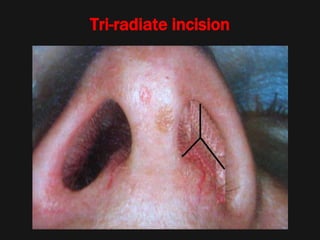
 Recanalisation done after 12-18 month with
a tri-radiate (Mercedes Benz) incision
Pre-operative
Mucosal flaps sutured
Cutaneous flap sutured
Post-operative healed flaps
Tri-radiate incision
Modified Young’s operation
Advantages of Modified Young
 Progress of disease can be monitored with 2.7 mm
nasal endoscope
 Glucose in glycerine drops can be instilled
 Both nostrils can be operated at one sitting
 Nasal breathing preserved
 No complaints of de-nasal voice
 Better cosmetic result
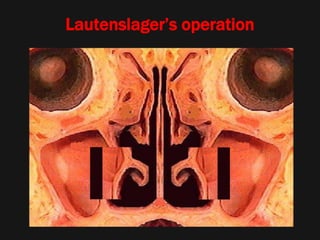
 Lautenslager’s operation: Fracture & medial
displacement of lateral nasal wall
 Wilson’s operation: submucosal injection of Teflon
paste
 Antral mucosal transplantation into nasal cavity
through intranasal antrostomy
 Vestibuloplasty: raising a lateral shelf from nasal
vestibular flap to cover the turbinates
Pre-operative
Lautenslager’s operation
Submucosal Teflon paste
Antral mucosal transplant
Vestibuloplasty
 Sympathectomy
 Stellate ganglion block /cervical chain block
 Sublabial implantation
 Placental bits, bone, cartilage, fat, acrylic resin,
Teflon, Silastic
 Parotid duct implantation into maxillary
sinus : Wittmack’s operation
Aim of Surgery
 Decrease trauma of air turbulence
 Young , Modified Young ,Lautenslager's ,Wilson
,Sublabial implants ,Vestibuloplasty
 Increase nasal secretions
 Parotid duct implantation into maxillary sinus
 Increase vascularity of nasal mucosa
 Cervical sympathectomy
 Nasal implantation of maxillary sinus mucosa
Action of Placental extract
 Progesterone leads to hyperplasia of nasal mucosa &
glandular secretion
 Estrogen leads to vasodilatation
 Biogenic stimulator of metabolic & regenerative
process
 Intra-placental serum boosts up immunity
 Mechanical narrowing of nasal passage

Atrophic rhinitis

  • 1.
  • 2.
     Defined aschronic inflammation of nose characterized by progressive atrophy of nasal mucosa, including the glands, turbinate bones and the nerve elements supplying the nose  Characterized by formation of scanty viscid secretion & greenish crusts which emit a foul odour (ozaena)  Removal of crusts reveals roomy nasal cavity  Types  Primary  Secondary
  • 3.
  • 4.
    Etiology  Hereditary  Developmental Endocrine  Racial  Nutritional deficiency  Infection  Autoimmune  Autonomic Imbalance  Surfactant deficiency in nasal secretion
  • 5.
     Hereditary  30%cases autosomal inheritance (67% = Dominant, 33% = Recessive)  Developmental  Congenitally spacious nasal cavity  Poor pneumatization of maxillary antrum  Endocrine  Seen during puberty, menopause, menstruation (symptoms aggravate due to estrogen deficiency)
  • 6.
     Racial  Morein American Negroes & Latin (yellow race)  Nutritional deficiency  Iron, Vitamin A, Vitamin D  Infection  Klebsiella ozaenae (Perez & Abel bacillus), Coccobacillus foetides ozaena, Bacillus mucosus, Diphtheroids, Haemophilus influenzae
  • 7.
     Autoimmune  Viralinfection / malnutrition / immune deficiency  trigger destructive autoimmune process on nasal mucosa  Autonomic Imbalance  Reflex Sympathetic Dystrophy Syndrome (R.S.D.S.) causes vasodilatation & hyperemic decalcification of turbinates followed by vasoconstriction  Surfactant deficiency in nasal secretion  Ciliary dysfunction + stasis of nasal secretions
  • 8.
    Secondary Atrophic Rhinitis •Long-standing purulent sinusitis • Iatrogenic: Radical turbinectomy, post- RT • Tuberculosis, Syphilis, Leprosy • Rhinoscleroma • Deviated nasal septum (atrophy in wider nasal cavity)
  • 9.
    Symptoms  Nasal obstruction Greenish -yellow nasal discharge  Offensive smell (ozaena) due to anaerobic infection, experienced by relatives  Merciful anosmia present in the patient  Bleeding on crust removal
  • 10.
    Signs • Roomy nasalcavity with atrophy of mucosa & turbinates • Greenish-yellow nasal discharge with crust formation (begins from posteriorly) • Foul smell (fetor) • Nasal Myiasis may be present
  • 11.
  • 12.
    Turbinate atrophy &roomy nasal cavity
  • 13.
    D/D for ozaenaD/D for dry nose 1. Atrophic rhinitis 1. Atrophic rhinitis 2. Purulent sinusitis 2. Rhinitis sicca 3. Nasal foreign body 3. Radiotherapy 4. Rhinitis caseosa 4. Sjogren’s syndrome 5. Malignancy
  • 14.
    Causes of Anosmia 1.Loss of olfactory neural elements 2. Thick secretion & crusts over olfactory area 3. Degeneration of secretary glands  scanty mucus for dissolving odoriferous materials Causes of nasal obstruction 1. Blunting of sensory nerve endings 2. Crust formation 3. Lack of eddy current formation in roomy cavity
  • 15.
    Pathology • Accumulation oflymphocytes & plasma cells • Metaplasia from ciliated columnar to squamous epithelium • Ciliary destruction & decrease in number & size of nasal glands • Bone resorption • Type I: Endarteritis & periarteritis of terminal arterioles Benefit from vasodilator effect of estrogen therapy • Type II: Dilated capillaries worsened by estrogen
  • 16.
    Specific Investigations  Saccharinetest  ed nasal muco- ciliary clearance time  Serum iron & protein levels: malnutrition  Culture & sensitivity of nasal discharge  X-ray P.N.S. : maxillary sinusitis
  • 17.
    C.T. Scan Noseand P.N.S.  Mucosal thickening  Resorption of ethmoid bulla & uncinate process  Hypoplasia of maxillary sinuses  Roomy nasal cavities  Erosion & bowing of lateral nasal wall  Atrophy of turbinates
  • 18.
    Chest X-ray: T.B.,bronchiectasis, lung abscess Serology for syphilis: V.D.R.L., T.P.H.A., T.P.I. Sputum for AFB, Mantoux test: T.B. Nasal smear study: leprosy Complement fixation test & biopsy: Rhinoscleroma
  • 19.
  • 20.
     Douching alkaline nasal douche  Oestradiol nasal spray (1%)  Glucose (25%) in glycerin nasal drops  Streptomycin injection  Placental extract injection  Autogenous vaccines  Rifampicin tablet  Kemicetine anti-ozaena nasal solution  Mandl’s nasal paint (Potassium Iodide & estradiol)  Potassium Iodide orally
  • 21.
    Alkaline Nasal Douche Sodiumbicarbonate (28.4g)  loosens nasal crusts Sodium biborate (28.4g)  Antiseptic Sodium chloride (56.7g)  makes soln isotonic • Mixed in 280 ml of warm water to make the solution • 6” long rubber tubing fitted in 20 ml plastic syringe • Syringe nasal cavity while pt bends forward & keeps saying K, K, K … to close nasopharyngeal isthmus • Done twice daily till all crusts disappear
  • 22.
  • 23.
     Young’s operation:Only 1 nostril closed completely by raising 2 circumferential flaps (inner mucosal & outer cutaneous) in nasal vestibule & suturing them in midline  Modified Young’s operation done by similar way but keeping a 3 mm opening on both sides  Recanalisation done after 12-18 month with a tri-radiate (Mercedes Benz) incision
  • 24.
  • 25.
  • 26.
  • 27.
  • 28.
  • 29.
  • 30.
    Advantages of ModifiedYoung  Progress of disease can be monitored with 2.7 mm nasal endoscope  Glucose in glycerine drops can be instilled  Both nostrils can be operated at one sitting  Nasal breathing preserved  No complaints of de-nasal voice  Better cosmetic result
  • 31.
     Lautenslager’s operation:Fracture & medial displacement of lateral nasal wall  Wilson’s operation: submucosal injection of Teflon paste  Antral mucosal transplantation into nasal cavity through intranasal antrostomy  Vestibuloplasty: raising a lateral shelf from nasal vestibular flap to cover the turbinates
  • 32.
  • 33.
  • 34.
  • 35.
  • 36.
  • 37.
     Sympathectomy  Stellateganglion block /cervical chain block  Sublabial implantation  Placental bits, bone, cartilage, fat, acrylic resin, Teflon, Silastic  Parotid duct implantation into maxillary sinus : Wittmack’s operation
  • 38.
    Aim of Surgery Decrease trauma of air turbulence  Young , Modified Young ,Lautenslager's ,Wilson ,Sublabial implants ,Vestibuloplasty  Increase nasal secretions  Parotid duct implantation into maxillary sinus  Increase vascularity of nasal mucosa  Cervical sympathectomy  Nasal implantation of maxillary sinus mucosa
  • 39.
    Action of Placentalextract  Progesterone leads to hyperplasia of nasal mucosa & glandular secretion  Estrogen leads to vasodilatation  Biogenic stimulator of metabolic & regenerative process  Intra-placental serum boosts up immunity  Mechanical narrowing of nasal passage