Laryngiti
   s
Presented by:-
  Jay Rami
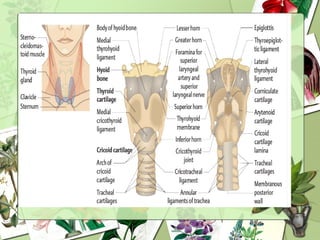
ANATOMY OF THE LARYNX
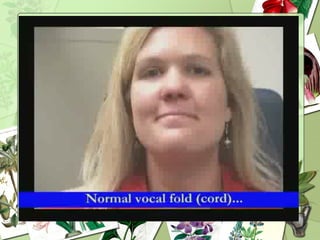
• First we will see the   vocal folds
  movement during the     different-
  different speech
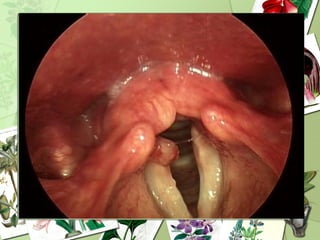
Laryngitis
• inflammation of the larynx
  or voice box, caused by
  chemical or mechanical
  irritation or bacterial
  infection.
Etiology
• Voice abuse or misuse  —
 This means talking too much or too
 loudly. It can be an ongoing problem
 for people whose jobs depend on their
 voices, including singers, actors,
 telephone operators, lawyers,
 teachers, referees, coaches and
 anyone who must shout over loud
 noise at work (construction workers,
 personnel in airports and train
 stations, factory workers).
• Smoking  — Cigarette smoke irritates
 the larynx, causing swelling and
 inflammation that thickens the vocal
 cords. This thickening can lower the pitch
 of the voice or make it sound raspy and
 harsh.
• Viral infection - common cause of acute
  laryngitis
• Allergies
• Larynx cancer
• Tumor


• Drinking alcohol
  heavily     — 

 Alcohol causes a chemical irritation
 of the larynx that produces changes
 similar to those seen in smokers.
• Gastro esophageal reflux
  disease (GERD)  — GERD is a
 disorder in which acidic fluids from the
 stomach flow backward (reflux) into the
 esophagus and throat, irritating the
 larynx. Because acid reflux usually is
 worse when lying down, the hoarseness
 caused by GERD often is most noticeable
 in the morning right after awakening. 
• Work-related exposure to
  irritating chemicals or dusts  — 
 Many industrial products are suspected
 of causing chronic laryngitis and other
 respiratory problems. The U.S.
 Department of Labor monitors many of
 these products and provides safety
 guidelines for handling and exposure
 through the Occupational Safety and
 Health Administration (OSHA).
Symptoms
• The most common symptom is
  hoarseness.
• A low, raspy voice
• A voice that tires easily, “breaks” or
  “cracks”
• The sensation of a lump in the throat
  or a dry throat.
• Difficulty swallowing
• Coughing
• Difficulty breathing
• A constant urge to clear the throat


• Heavy mucus in the throat


• Chronic cough or postnasal drip


• Discomfort during swallowing
Diagnosis
• The most common sign of laryngitis is
  hoarseness. Changes in your voice can
  vary with the degree of infection or
  irritation, ranging from mild hoarseness
  to almost total loss of your voice.
• If you   have chronic hoarseness, your
  doctor   may want to listen to your voice
  and to   examine your vocal cords, and he
  or she   may refer you to an ear, nose and
  throat   specialist.
• These techniques sometimes are used to help

  diagnose laryngitis:

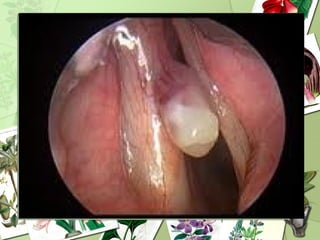
• Laryngoscope :-Your doctor can
  visually examine your vocal cords in a
  procedure called laryngoscope, by using a
  light and a tiny mirror to look into the back
  of your throat. Or your doctor may use
  fiber-optic laryngoscope.
• This involves inserting a thin, flexible tube
  (endoscope) with a tiny camera and light
  through your nose or mouth and into the
  back of your throat.
• Then your doctor can watch the
  motion of your vocal cords as you
  speak.

• Biopsy :- If your doctor sees a
 suspicious area, he or she may do a
 biopsy — taking a sample of tissue
 for examination under a microscope.
Types
Acute
laryngitis
DEFINITION
o It is the acute inflammation of
larynx leading to oedema of laryngeal
mucosa and underlying structures.

o Acute laryngitis is an inflammation
of the vocal fold mucosa and larynx
that lasts less than 3 weeks. 
                        weeks.
ACUTE VIRAL
          LARYNGITIS
• Frequently caused by “Rhinovirus”
• Other causes:
   – Parainfluenza
   – respiratory syncytial virus
   – Adenovirus
Symptoms
•   Hoarseness or change in voice.
•   Husky, high pitched voice.
•   Discomfort in throat, pain.
•   Body aches.
•   Dysphagia, Dysphonea..
•   Dry irritating paroxysmal cough.
•   Fever, Malaise.
ETIOLOGY
• vocal misuse


• exposure to noxious


• infectious agents leading to upper
  respiratory tract infections The
  infectious agents are most often viral
  but sometimes bacterial.
•  
• Frank aphonia
Treatment
• Inhaling humidified air promotes
  moisture of the upper airway, helping
  to clear secretions and exudate.


• Complete voice rest is suggested,
  although this recommendation is
  nearly impossible to follow.
• If the patient must speak, soft
  sighing phonation is best. Avoidance
  of whispering is best, as whispering
  promotes hyper functioning of the
  larynx.


• Prevailing data do not support the use
  of antihistamines and corticosteroids
Chronic
laryngitis
Definition
• Chronic laryngitis is a more
  persistent disorder that produces
  lingering hoarseness and other voice
  changes. It usually is painless and
  has no significant sign of infection.
ETIOLOGY
• Vocal misuse


• Exposure to noxious agents


• Infectious agents leading to upper
  respiratory tract infections. The
  infectious agents are most often viral
  but sometimes bacterial.

INFECTIOUS:
              Viral
              Bacterial
NON INFECTIOUS
              Inhaled fumes

              Allergy
              Polluted atmospheric
 conditions
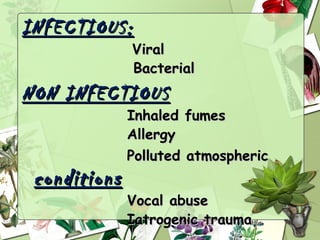
              Vocal abuse
              Iatrogenic trauma
Differential
 Diagnosis
• Acute epiglottitis


• Acute laryngotracheo bronchitis.


• Laryngeal perichondritis


• Laryngeal oedema


• Laryngeal diphtheria
• Reinke’s oedema
PAEDIATRIC
 CONCERNS
• Lacks firm cartilaginous skeleton.


• Flabby , easily collapses.


• Glottis aperture , relatively smaller.
• Mucosa swells up rapidly in response
  to slightest trauma or infection.
• Stridor is the most noticeable
  presentation.
TREATMENT
SUPPORTIVE
•   Voice rest.
•   Steam inhalation.
•   Cough suppressants.
•   Avoid smoking and cold.
•   Fluid intake.
•   Consider short course of corticosteroids
•   voice rehabilitation
•   Humidification
DEFINITIVE

• ANTIBIOTICS
• STEROIDS
• ANALGESICS
•Treatment 4
 hoarse voice
Voice Therapy
• Voice therapy is an approach to
  treating voice disorders that involves
  vocal and physical exercises coupled
  with behavioral changes.

• The purpose of voice therapy is to
  help attain the best possible voice
  and the most relief from the vocal
  symptoms that are bothering the
  patient
Duration of voice
    therapy
 The length of each individual voice therapy
  session usually ranges from ½ to 1 hour.

 The sessions are weekly.

 However, for some types of voice
  disorders, two or more sessions per week
  are best for the first few weeks, tapering
  down as the therapy progresses.
 The duration of the entire voice
  therapy program is highly individual.

 The program can be as short as just
 a few sessions, or as long as 12
 weeks or more.
The voice quality in
     laryngitis
Thank
 you

Laryngitis

  • 1.
    Laryngiti s Presented by:- Jay Rami
  • 2.
  • 4.
    • First wewill see the vocal folds movement during the different- different speech
  • 6.
    Laryngitis • inflammation ofthe larynx or voice box, caused by chemical or mechanical irritation or bacterial infection.
  • 7.
  • 8.
    • Voice abuseor misuse  — This means talking too much or too loudly. It can be an ongoing problem for people whose jobs depend on their voices, including singers, actors, telephone operators, lawyers, teachers, referees, coaches and anyone who must shout over loud noise at work (construction workers, personnel in airports and train stations, factory workers).
  • 10.
    • Smoking  — Cigarettesmoke irritates the larynx, causing swelling and inflammation that thickens the vocal cords. This thickening can lower the pitch of the voice or make it sound raspy and harsh. • Viral infection - common cause of acute laryngitis • Allergies • Larynx cancer
  • 11.
    • Tumor • Drinkingalcohol heavily   —  Alcohol causes a chemical irritation of the larynx that produces changes similar to those seen in smokers.
  • 12.
    • Gastro esophagealreflux disease (GERD)  — GERD is a disorder in which acidic fluids from the stomach flow backward (reflux) into the esophagus and throat, irritating the larynx. Because acid reflux usually is worse when lying down, the hoarseness caused by GERD often is most noticeable in the morning right after awakening. 
  • 13.
    • Work-related exposureto irritating chemicals or dusts  —  Many industrial products are suspected of causing chronic laryngitis and other respiratory problems. The U.S. Department of Labor monitors many of these products and provides safety guidelines for handling and exposure through the Occupational Safety and Health Administration (OSHA).
  • 14.
  • 15.
    • The mostcommon symptom is hoarseness. • A low, raspy voice • A voice that tires easily, “breaks” or “cracks” • The sensation of a lump in the throat or a dry throat. • Difficulty swallowing • Coughing • Difficulty breathing
  • 16.
    • A constanturge to clear the throat • Heavy mucus in the throat • Chronic cough or postnasal drip • Discomfort during swallowing
  • 17.
  • 18.
    • The mostcommon sign of laryngitis is hoarseness. Changes in your voice can vary with the degree of infection or irritation, ranging from mild hoarseness to almost total loss of your voice. • If you have chronic hoarseness, your doctor may want to listen to your voice and to examine your vocal cords, and he or she may refer you to an ear, nose and throat specialist.
  • 19.
    • These techniquessometimes are used to help diagnose laryngitis: • Laryngoscope :-Your doctor can visually examine your vocal cords in a procedure called laryngoscope, by using a light and a tiny mirror to look into the back of your throat. Or your doctor may use fiber-optic laryngoscope. • This involves inserting a thin, flexible tube (endoscope) with a tiny camera and light through your nose or mouth and into the back of your throat.
  • 20.
    • Then yourdoctor can watch the motion of your vocal cords as you speak. • Biopsy :- If your doctor sees a suspicious area, he or she may do a biopsy — taking a sample of tissue for examination under a microscope.
  • 21.
  • 23.
  • 24.
    DEFINITION o It isthe acute inflammation of larynx leading to oedema of laryngeal mucosa and underlying structures. o Acute laryngitis is an inflammation of the vocal fold mucosa and larynx that lasts less than 3 weeks.  weeks.
  • 25.
    ACUTE VIRAL LARYNGITIS • Frequently caused by “Rhinovirus” • Other causes: – Parainfluenza – respiratory syncytial virus – Adenovirus
  • 26.
  • 27.
    Hoarseness or change in voice. • Husky, high pitched voice. • Discomfort in throat, pain. • Body aches. • Dysphagia, Dysphonea.. • Dry irritating paroxysmal cough. • Fever, Malaise.
  • 28.
  • 29.
    • vocal misuse •exposure to noxious • infectious agents leading to upper respiratory tract infections The infectious agents are most often viral but sometimes bacterial. •   • Frank aphonia
  • 30.
  • 31.
    • Inhaling humidifiedair promotes moisture of the upper airway, helping to clear secretions and exudate. • Complete voice rest is suggested, although this recommendation is nearly impossible to follow.
  • 32.
    • If thepatient must speak, soft sighing phonation is best. Avoidance of whispering is best, as whispering promotes hyper functioning of the larynx. • Prevailing data do not support the use of antihistamines and corticosteroids
  • 34.
  • 35.
    Definition • Chronic laryngitisis a more persistent disorder that produces lingering hoarseness and other voice changes. It usually is painless and has no significant sign of infection.
  • 36.
  • 37.
    • Vocal misuse •Exposure to noxious agents • Infectious agents leading to upper respiratory tract infections. The infectious agents are most often viral but sometimes bacterial.
  • 38.
    INFECTIOUS: Viral Bacterial NON INFECTIOUS Inhaled fumes Allergy Polluted atmospheric conditions Vocal abuse Iatrogenic trauma
  • 39.
  • 40.
    • Acute epiglottitis •Acute laryngotracheo bronchitis. • Laryngeal perichondritis • Laryngeal oedema • Laryngeal diphtheria • Reinke’s oedema
  • 41.
  • 42.
    • Lacks firmcartilaginous skeleton. • Flabby , easily collapses. • Glottis aperture , relatively smaller. • Mucosa swells up rapidly in response to slightest trauma or infection. • Stridor is the most noticeable presentation.
  • 43.
  • 44.
    SUPPORTIVE • Voice rest. • Steam inhalation. • Cough suppressants. • Avoid smoking and cold. • Fluid intake. • Consider short course of corticosteroids • voice rehabilitation • Humidification
  • 45.
  • 48.
  • 50.
  • 51.
    • Voice therapyis an approach to treating voice disorders that involves vocal and physical exercises coupled with behavioral changes. • The purpose of voice therapy is to help attain the best possible voice and the most relief from the vocal symptoms that are bothering the patient
  • 52.
  • 53.
     The lengthof each individual voice therapy session usually ranges from ½ to 1 hour.  The sessions are weekly.  However, for some types of voice disorders, two or more sessions per week are best for the first few weeks, tapering down as the therapy progresses.
  • 54.
     The durationof the entire voice therapy program is highly individual.  The program can be as short as just a few sessions, or as long as 12 weeks or more.
  • 55.
    The voice qualityin laryngitis
  • 57.