pH and Conductivity
Measurement
ER. FARUK BIN POYEN
FARUK.POYEN@GMAIL.COM
Content:
 Definition of pH
 Nernst Equation
 Half Cell Potential
 Conductivity
 Conductance
 Buffer
2
pH - Definition:
 A numeric value between 0 and 14, expressing the acidity or alkalinity
of a solution on a logarithmic scale on which 7 is neutral, < 7 are acidic
and > 7 are alkaline.
 The pH is equal to − log10 𝑐, where c is the hydrogen ion concentration
in moles per litre.
𝑝𝐻 = log10
1
[𝐻+]
= − log[𝐻+
]
3
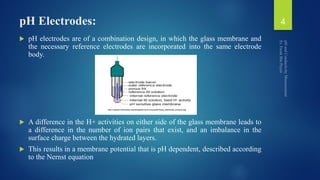
pH Electrodes:
 pH electrodes are of a combination design, in which the glass membrane and
the necessary reference electrodes are incorporated into the same electrode
body.
 A difference in the H+ activities on either side of the glass membrane leads to
a difference in the number of ion pairs that exist, and an imbalance in the
surface charge between the hydrated layers.
 This results in a membrane potential that is pH dependent, described according
to the Nernst equation
4
pH Electrode Types:
 Glass Electrode
 Reference Electrode (Hg – HgCl; Ag – AgCl)
 Ion Selective Electrode
5
pH Meter:
 pH meter is an electric device used to measure hydrogen-ion activity
(acidity or alkalinity) in solution.
pH meter consists of a voltmeter attached to a pH-responsive electrode and
a reference (unvarying) electrode.
The pH-responsive electrode is usually glass, and the reference is usually a
Hg–HgCl (calomel) electrode, although an Ag-AgCl electrode is
sometimes used.
When the two electrodes are immersed in a solution, they act as a battery.
The glass electrode develops an electric potential (charge) that is directly
related to the hydrogen-ion activity in the solution (59.2 millivolts per pH
unit at 25 °C [77 °F]), and the voltmeter measures the potential difference
between the glass and reference electrodes.
6
Nernst Equation:
 Nernst equation is an equation that relates the reduction potential of an
electrochemical reaction to the standard electrode potential, temperature,
and activities of the chemical species undergoing reduction and
oxidation.
𝐸0
= 𝐸𝑟𝑒𝑑𝑢𝑐𝑡𝑖𝑜𝑛
0
− 𝐸 𝑜𝑥𝑖𝑑𝑎𝑡𝑖𝑜𝑛
0
𝐸 = 𝐸0 −
𝑅𝑇
𝑛𝐹
ln 𝑄 = 𝐸0 −
2.303 𝑅𝑇
𝑛𝐹
log10 𝑄
At T = 298 K; R (gas constant) = 8.3144 J-mol/K; F = 96485.3 C/mol
𝐸 = 𝐸0 −
0.592
𝑛
log10 𝑄
7
Half Cell Potential:
 Half-cell potential refers to the potential developed at the electrode of
each half cell in an electrochemical cell.
 In an electrochemical cell, the overall potential is the total potential
calculated from the potentials of two half cells.
 Q is the thermodynamic reaction quotient.
𝑎𝐴 + 𝑏𝐵 ↔ 𝑐𝐶 + 𝑑𝐷
𝑄 =
[𝐶] 𝑐[𝐷] 𝑑
[𝐴] 𝑎[𝐵] 𝑏
𝐸 = 𝐸0 −
0.592
𝑛
log10 𝑄
8
Thermodynamic Reaction Quotient Q:
 The reaction quotient ( Q ) measures the relative amounts of products
and reactants present during a reaction at a particular point in time.
 The reaction quotient aids in figuring out which direction a reaction is
likely to proceed, given either the pressures or the concentrations of the
reactants and the products.
 The Q value can be compared to the Equilibrium Constant, K , to
determine the direction of the reaction that is taking place.
9
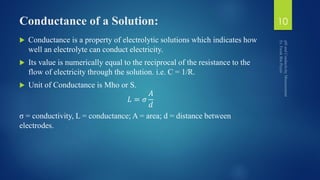
Conductance of a Solution:
 Conductance is a property of electrolytic solutions which indicates how
well an electrolyte can conduct electricity.
 Its value is numerically equal to the reciprocal of the resistance to the
flow of electricity through the solution. i.e. C = 1/R.
 Unit of Conductance is Mho or S.
𝐿 = 𝜎
𝐴
𝑑
σ = conductivity, L = conductance; A = area; d = distance between
electrodes.
10
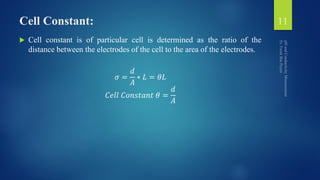
Cell Constant:
 Cell constant is of particular cell is determined as the ratio of the
distance between the electrodes of the cell to the area of the electrodes.
𝜎 =
𝑑
𝐴
∗ 𝐿 = 𝜃𝐿
𝐶𝑒𝑙𝑙 𝐶𝑜𝑛𝑠𝑡𝑎𝑛𝑡 𝜃 =
𝑑
𝐴
11
Buffer Solution:
 A buffer solution is one which resists changes in pH when small
quantities of an acid or an alkali are added to it.
 Acidic buffer solutions: An acidic buffer solution is simply one which
has a pH less than 7. Acidic buffer solutions are commonly made from a
weak acid and one of its salts - often a sodium salt.
 An alkaline buffer solution has a pH greater than 7. Alkaline buffer
solutions are commonly made from a weak base and one of its salts. A
frequently used example is a mixture of ammonia solution and
ammonium chloride solution.
 A buffer solution has to contain things which will remove any hydrogen
ions or hydroxide ions that might be added to it - otherwise the pH will
change.
12

pH and Conductivity Measurement

  • 1.
    pH and Conductivity Measurement ER.FARUK BIN POYEN FARUK.POYEN@GMAIL.COM
  • 2.
    Content:  Definition ofpH  Nernst Equation  Half Cell Potential  Conductivity  Conductance  Buffer 2
  • 3.
    pH - Definition: A numeric value between 0 and 14, expressing the acidity or alkalinity of a solution on a logarithmic scale on which 7 is neutral, < 7 are acidic and > 7 are alkaline.  The pH is equal to − log10 𝑐, where c is the hydrogen ion concentration in moles per litre. 𝑝𝐻 = log10 1 [𝐻+] = − log[𝐻+ ] 3
  • 4.
    pH Electrodes:  pHelectrodes are of a combination design, in which the glass membrane and the necessary reference electrodes are incorporated into the same electrode body.  A difference in the H+ activities on either side of the glass membrane leads to a difference in the number of ion pairs that exist, and an imbalance in the surface charge between the hydrated layers.  This results in a membrane potential that is pH dependent, described according to the Nernst equation 4
  • 5.
    pH Electrode Types: Glass Electrode  Reference Electrode (Hg – HgCl; Ag – AgCl)  Ion Selective Electrode 5
  • 6.
    pH Meter:  pHmeter is an electric device used to measure hydrogen-ion activity (acidity or alkalinity) in solution. pH meter consists of a voltmeter attached to a pH-responsive electrode and a reference (unvarying) electrode. The pH-responsive electrode is usually glass, and the reference is usually a Hg–HgCl (calomel) electrode, although an Ag-AgCl electrode is sometimes used. When the two electrodes are immersed in a solution, they act as a battery. The glass electrode develops an electric potential (charge) that is directly related to the hydrogen-ion activity in the solution (59.2 millivolts per pH unit at 25 °C [77 °F]), and the voltmeter measures the potential difference between the glass and reference electrodes. 6
  • 7.
    Nernst Equation:  Nernstequation is an equation that relates the reduction potential of an electrochemical reaction to the standard electrode potential, temperature, and activities of the chemical species undergoing reduction and oxidation. 𝐸0 = 𝐸𝑟𝑒𝑑𝑢𝑐𝑡𝑖𝑜𝑛 0 − 𝐸 𝑜𝑥𝑖𝑑𝑎𝑡𝑖𝑜𝑛 0 𝐸 = 𝐸0 − 𝑅𝑇 𝑛𝐹 ln 𝑄 = 𝐸0 − 2.303 𝑅𝑇 𝑛𝐹 log10 𝑄 At T = 298 K; R (gas constant) = 8.3144 J-mol/K; F = 96485.3 C/mol 𝐸 = 𝐸0 − 0.592 𝑛 log10 𝑄 7
  • 8.
    Half Cell Potential: Half-cell potential refers to the potential developed at the electrode of each half cell in an electrochemical cell.  In an electrochemical cell, the overall potential is the total potential calculated from the potentials of two half cells.  Q is the thermodynamic reaction quotient. 𝑎𝐴 + 𝑏𝐵 ↔ 𝑐𝐶 + 𝑑𝐷 𝑄 = [𝐶] 𝑐[𝐷] 𝑑 [𝐴] 𝑎[𝐵] 𝑏 𝐸 = 𝐸0 − 0.592 𝑛 log10 𝑄 8
  • 9.
    Thermodynamic Reaction QuotientQ:  The reaction quotient ( Q ) measures the relative amounts of products and reactants present during a reaction at a particular point in time.  The reaction quotient aids in figuring out which direction a reaction is likely to proceed, given either the pressures or the concentrations of the reactants and the products.  The Q value can be compared to the Equilibrium Constant, K , to determine the direction of the reaction that is taking place. 9
  • 10.
    Conductance of aSolution:  Conductance is a property of electrolytic solutions which indicates how well an electrolyte can conduct electricity.  Its value is numerically equal to the reciprocal of the resistance to the flow of electricity through the solution. i.e. C = 1/R.  Unit of Conductance is Mho or S. 𝐿 = 𝜎 𝐴 𝑑 σ = conductivity, L = conductance; A = area; d = distance between electrodes. 10
  • 11.
    Cell Constant:  Cellconstant is of particular cell is determined as the ratio of the distance between the electrodes of the cell to the area of the electrodes. 𝜎 = 𝑑 𝐴 ∗ 𝐿 = 𝜃𝐿 𝐶𝑒𝑙𝑙 𝐶𝑜𝑛𝑠𝑡𝑎𝑛𝑡 𝜃 = 𝑑 𝐴 11
  • 12.
    Buffer Solution:  Abuffer solution is one which resists changes in pH when small quantities of an acid or an alkali are added to it.  Acidic buffer solutions: An acidic buffer solution is simply one which has a pH less than 7. Acidic buffer solutions are commonly made from a weak acid and one of its salts - often a sodium salt.  An alkaline buffer solution has a pH greater than 7. Alkaline buffer solutions are commonly made from a weak base and one of its salts. A frequently used example is a mixture of ammonia solution and ammonium chloride solution.  A buffer solution has to contain things which will remove any hydrogen ions or hydroxide ions that might be added to it - otherwise the pH will change. 12