Electrical conductivity meter
Presented to:
Sir Faheem
Course code:
FMP-402
Course tittle:
Degree:
Agricultural Engineering & Technology
Contents:
 Electrical conductivity
 Need of measure of electrical conductivity?
 Electrical conductivity meter
 Working principle
 Measurement of conductivity of different engineering
materials
Electrical conductivity:
Electrical conductivity is the ability of a material to carry the
flow of an electric current (a flow of electrons)
Current flow in metals is different from liquids
 Reciprocal of restivity.
 Units are:
1. µS/cm
2. mS/cm
 Highly depend upon temperature
The early studies of electrical conduction in metals were done in the eighteenth and early
nineteenth centuries. Benjamin Franklin (1706-1790) in his experiments with lightning (leading
to his invention of the lightning rod), reasoned that the charge would travel along the
metallic rod
History
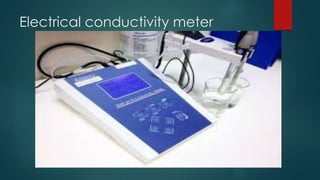
Electrical conductivity meter
 Instrument used to measure the conductivity of the
require/desired material is called the conductivity meter.
 It is commonly used in hydroponics, aquaculture and
freshwater systems to monitor the amount of nutrients,
salts or impurities in the water.
Working principal
The common laboratory conductivity meters employ a
potentiometric method and four electrodes. Often, the
electrodes are cylindrical and arranged concentrically. The
electrodes are usually made of platinum metal. An alternating
current is applied to the outer pair of the electrodes. The
potential between the inner pair is measured. Conductivity
could in principle be determined using the distance between
the electrodes and their surface area using the Ohm's law but
generally, for accuracy, a calibration is employed using
electrolytes of well-known conductivity.
Conductivity of metals:
 The electrical conductivity meter can be used to test the
conductivity of aluminum, copper and other non-ferrous magnetic
metal in the processing industry
 Quick and convenient measurement
 purity grades of materials
 Material resistivity
 Material thermal performance
 Material separate
 Quality control
Continue…
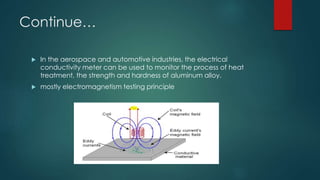
 In the aerospace and automotive industries, the electrical
conductivity meter can be used to monitor the process of heat
treatment, the strength and hardness of aluminum alloy.
 mostly electromagnetism testing principle
Technical parameters
 Measurement technology
 operating frequency
 display screen
 instrument case
 weight
 Measuring range
 Measuring accuracy
 Language
Examples
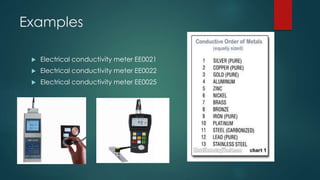
 Electrical conductivity meter EE0021
 Electrical conductivity meter EE0022
 Electrical conductivity meter EE0025
Result
 Electrical conductivity meter is used in manufacture industry and
maintenance field where conductivity measurement are used t
verify proper alloy, temperature, or detect heat damaged
components.
 To determine purity of precious metals such as gold coins.
electrical conductivity meter

electrical conductivity meter

  • 2.
    Electrical conductivity meter Presentedto: Sir Faheem Course code: FMP-402 Course tittle: Degree: Agricultural Engineering & Technology
  • 3.
    Contents:  Electrical conductivity Need of measure of electrical conductivity?  Electrical conductivity meter  Working principle  Measurement of conductivity of different engineering materials
  • 4.
    Electrical conductivity: Electrical conductivityis the ability of a material to carry the flow of an electric current (a flow of electrons) Current flow in metals is different from liquids  Reciprocal of restivity.  Units are: 1. µS/cm 2. mS/cm  Highly depend upon temperature
  • 5.
    The early studiesof electrical conduction in metals were done in the eighteenth and early nineteenth centuries. Benjamin Franklin (1706-1790) in his experiments with lightning (leading to his invention of the lightning rod), reasoned that the charge would travel along the metallic rod History
  • 6.
  • 7.
    Electrical conductivity meter Instrument used to measure the conductivity of the require/desired material is called the conductivity meter.  It is commonly used in hydroponics, aquaculture and freshwater systems to monitor the amount of nutrients, salts or impurities in the water.
  • 9.
    Working principal The commonlaboratory conductivity meters employ a potentiometric method and four electrodes. Often, the electrodes are cylindrical and arranged concentrically. The electrodes are usually made of platinum metal. An alternating current is applied to the outer pair of the electrodes. The potential between the inner pair is measured. Conductivity could in principle be determined using the distance between the electrodes and their surface area using the Ohm's law but generally, for accuracy, a calibration is employed using electrolytes of well-known conductivity.
  • 10.
    Conductivity of metals: The electrical conductivity meter can be used to test the conductivity of aluminum, copper and other non-ferrous magnetic metal in the processing industry  Quick and convenient measurement  purity grades of materials  Material resistivity  Material thermal performance  Material separate  Quality control
  • 11.
    Continue…  In theaerospace and automotive industries, the electrical conductivity meter can be used to monitor the process of heat treatment, the strength and hardness of aluminum alloy.  mostly electromagnetism testing principle
  • 12.
    Technical parameters  Measurementtechnology  operating frequency  display screen  instrument case  weight  Measuring range  Measuring accuracy  Language
  • 13.
    Examples  Electrical conductivitymeter EE0021  Electrical conductivity meter EE0022  Electrical conductivity meter EE0025
  • 14.
    Result  Electrical conductivitymeter is used in manufacture industry and maintenance field where conductivity measurement are used t verify proper alloy, temperature, or detect heat damaged components.  To determine purity of precious metals such as gold coins.