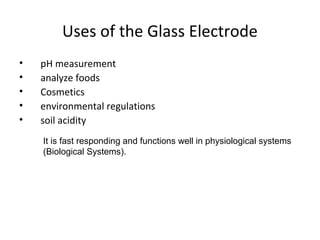
pH Glass Electrode
Uses of the Glass Electrode
•   pH measurement
•   analyze foods
•   Cosmetics
•   environmental regulations
•   soil acidity
    It is fast responding and functions well in physiological systems
    (Biological Systems).
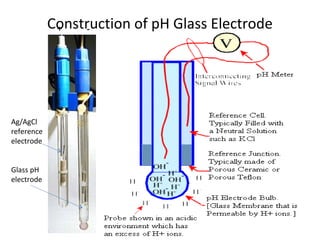
Construction of pH Glass Electrode
             +   -


Ag/AgCl
reference
electrode


Glass pH
electrode
Two Electrode System
The Gel Layer
• The glass has a lithium
  silicate skeleton that forms
  a thin hydrated layer on
  both sides of the
  membrane.
• Ions can penetrate this thin
  layer and alter the
  electrochemical potential.
• Without the hydrated layer
  no pH measurements would
  be possible
• The structure of the glass
  has been optimised so that
  virtually only H+ ions can
  enter the gel layer
Principle
• H+ ion selective electrode
• Nernst Equation
                                             log( aH + )
                                     2.303RT
                               E=E −0

                                        nF
• the electrode measures
  the activity of hydrogen
  ions and that pH is the E = E 0 + 0.0591 pH @ 25o C
  negative log of the
  activity of hydrogen ions

• The Nernst equation
  predicts that for every
  decade change in H+ ion
  activity (1 unit change in
  pH) the potential will
  change by about 60 mV
THE END