MEMS
Sensors, Transducers & Actuator
Contents
1. MEMS Sensors Domains
2. MEMS Transducers
3. MEMS Actuators
4. MEMS Fabrication Materials
5. MEMS Fabrication Material Properties
6. MEMS Substrate
7. Die Per Wafer (DPW)
Micro-Electro Mechanical Systems 2
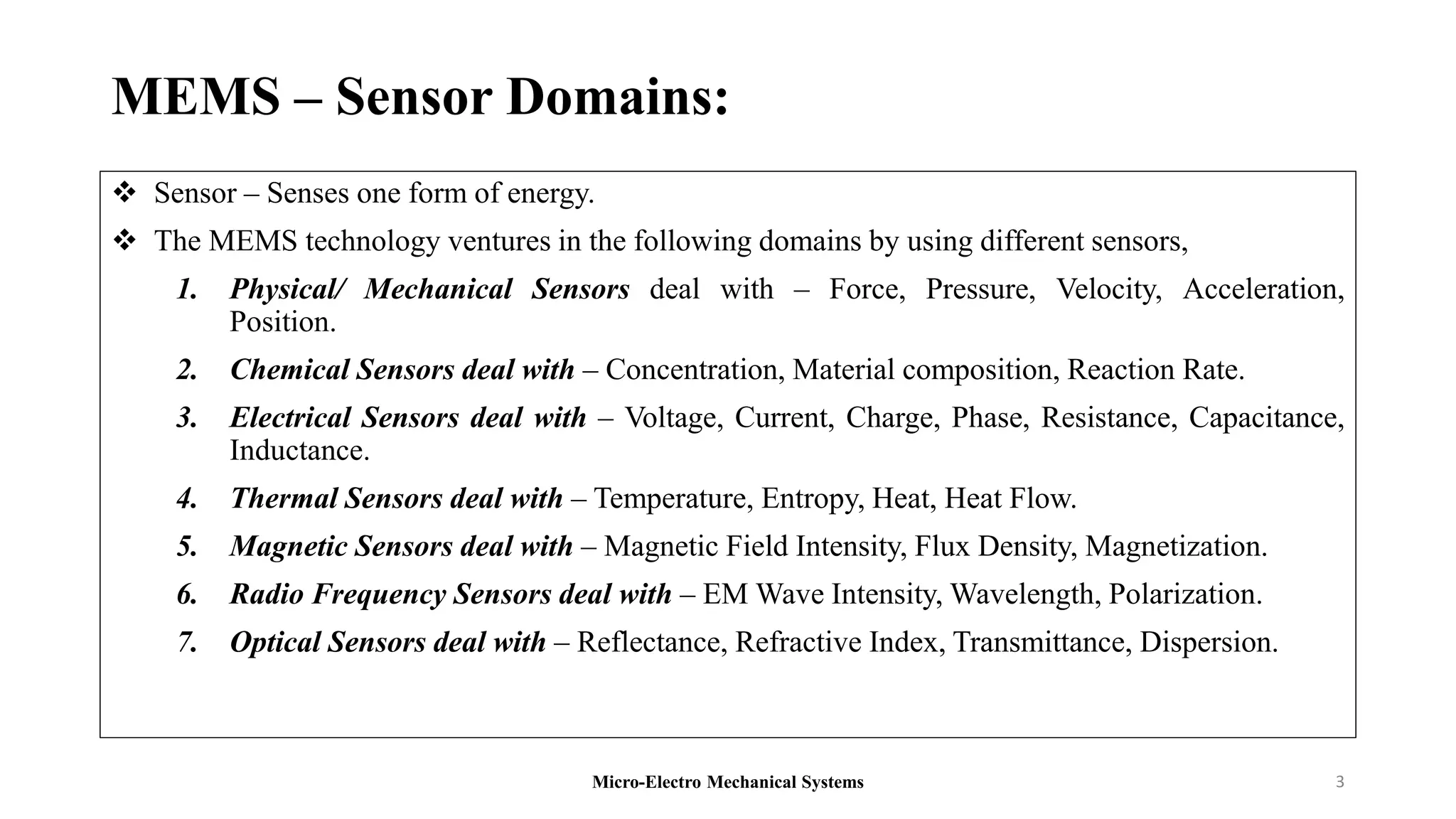
MEMS – Sensor Domains:
 Sensor – Senses one form of energy.
 The MEMS technology ventures in the following domains by using different sensors,
1. Physical/ Mechanical Sensors deal with – Force, Pressure, Velocity, Acceleration,
Position.
2. Chemical Sensors deal with – Concentration, Material composition, Reaction Rate.
3. Electrical Sensors deal with – Voltage, Current, Charge, Phase, Resistance, Capacitance,
Inductance.
4. Thermal Sensors deal with – Temperature, Entropy, Heat, Heat Flow.
5. Magnetic Sensors deal with – Magnetic Field Intensity, Flux Density, Magnetization.
6. Radio Frequency Sensors deal with – EM Wave Intensity, Wavelength, Polarization.
7. Optical Sensors deal with – Reflectance, Refractive Index, Transmittance, Dispersion.
Micro-Electro Mechanical Systems 3
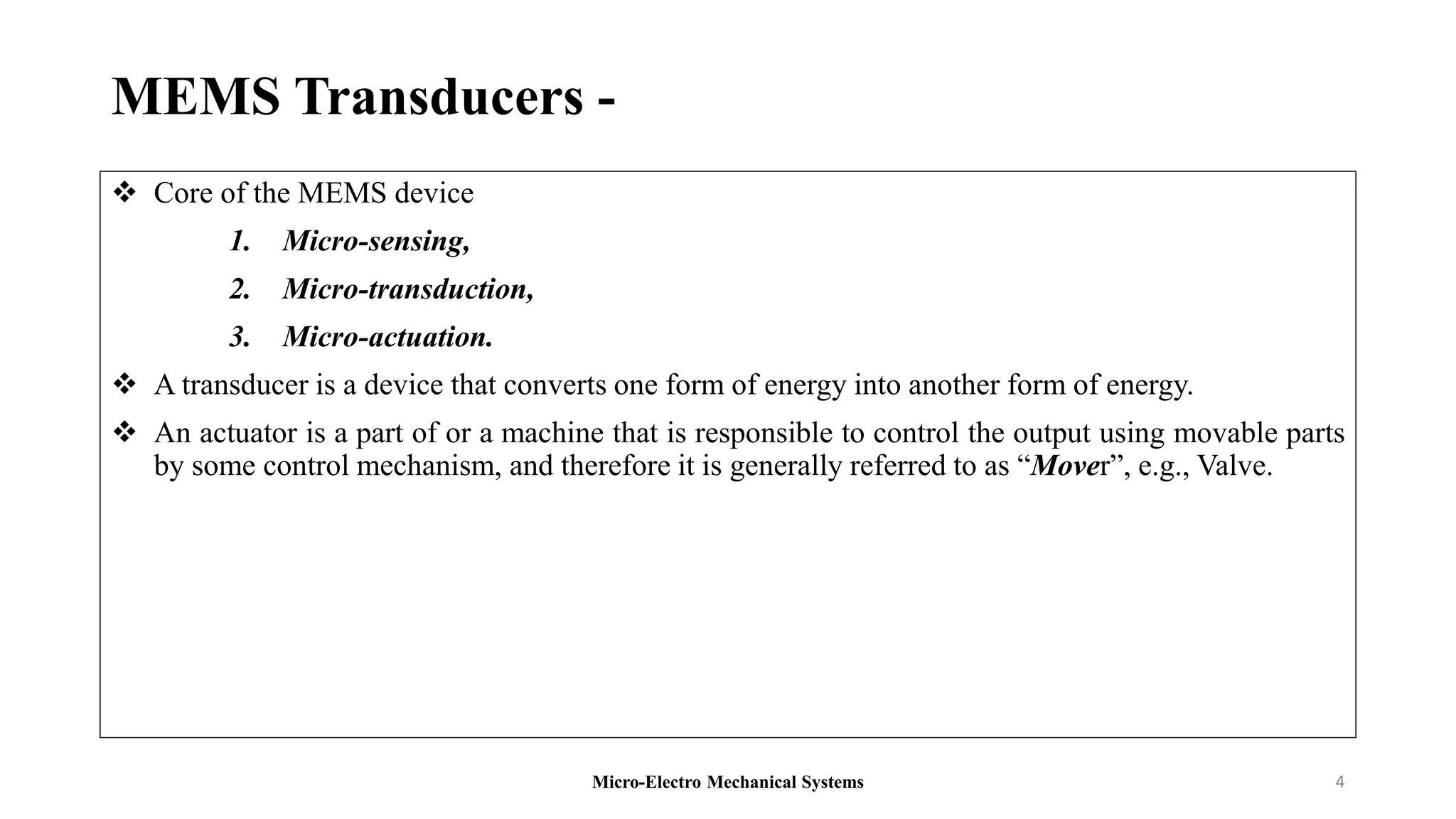
MEMS Transducers -
 Core of the MEMS device
1. Micro-sensing,
2. Micro-transduction,
3. Micro-actuation.
 A transducer is a device that converts one form of energy into another form of energy.
 An actuator is a part of or a machine that is responsible to control the output using movable parts
by some control mechanism, and therefore it is generally referred to as “Mover”, e.g., Valve.
Micro-Electro Mechanical Systems 4
MEMS Transducers -
 The current MEMS-based technology is operational with the following transduction.
1. Tribo-electric – Glass (𝑆𝑖𝑂4), Silk, Hard rubber ( 𝐶5𝐻8 𝑛), fur.
2. Electrostatic – Amber Rod (𝐶10𝐻16𝑂).
3. Piezoelectric – Quartz (𝑆𝑖𝑂2), Lead Zirconate Titanate (𝑃𝑍𝑇), Polyvinylidene Fluoride
(𝑃𝑉𝐷𝐹), Zinc Oxide (𝑍𝑛𝑂), Bone, DNA.
4. Ferroelectric – Barium Titanate (𝐵𝑎𝑇𝑖𝑂3), Lead Titanate (𝑃𝑏𝑇𝑖𝑂3) Lead Zirconate Titanate
(PZT) and Rochelle salt (i.e. Potassium Sodium Tartrate Tetra-hydrate
(𝐾𝑁𝑎𝐶4𝐻4𝑂6. 4𝐻2𝑂))
5. Magnetostrictive – Cobalt Ferrite ( C𝑜𝐹𝑒2𝑂4 𝐶𝑜𝑂. 𝐹𝑒2𝑂3 ), Alloys like Terfenol-D
[Terbium-Iron-Dysprosium (𝑇𝑏𝑥𝐷𝑦1−𝑥𝐹𝑒2 )], Galfenol (Gallium-Iron), Metglas 2605SC
[Metallic Glass]
6. Magnetic – Iron, Steel, Nickel, Cobalt.
Micro-Electro Mechanical Systems 5
MEMS Transducers -
7. Electromagnetic Acoustic Transducer (EMAT) – Magnet, and Electric Coil.
8. Radio-frequency – Short range device frequency 315 MHz to 868 MHz.
9. Thermal – Metallic Oxides, Semiconductors, Platinum.
10. Optical – Smart polymers, metal, metal oxide and semiconductor materials LED, Light
Modulators.
11. Chemical (micro-fluidics) – Calorimetric transducers, Chemi-capacitors, Chemi-resistors,
Chemo-mechanical sensors.
12. Biological and biomedical – Bio-receptors viz. Enzymes, Ligands, Nucleic Acids, DNA.
Micro-Electro Mechanical Systems 6
MEMS Actuators -
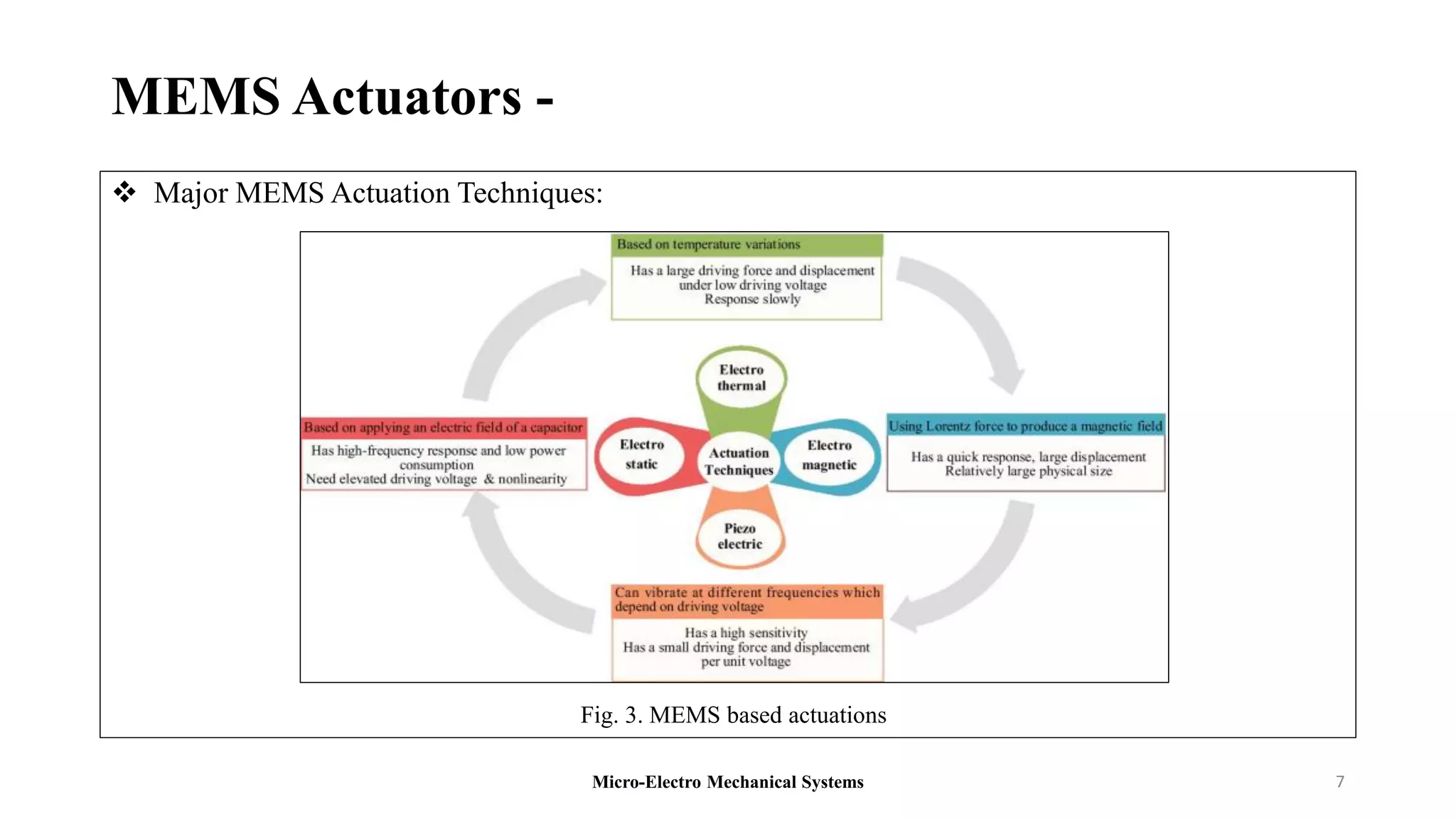
 Major MEMS Actuation Techniques:
Micro-Electro Mechanical Systems 7
Fig. 3. MEMS based actuations
MEMS Actuators -
 Widely used MEMS actuators:
1. Electrostatic Actuator – Parallel-plate actuator, Comb-drive actuator (inter-digitated finger
structure).
2. Piezoelectric Actuator – Stack Actuators (multiple-layered piezo element) and Stripe
Actuators (bi-laminar flexing element).
3. Electro-Magnetic Actuator – Solenoid actuator (electromagnetic), Moving-coil actuator.
4. Electro-Thermal Actuator – V-type, hot arm/U-type, and bimorph (double-layered
cantilever).
5. Optical Actuator – Charge-coupled Devices (CCD) (integrated circuit linked capacitors).
6. Physical Actuators - Shape Memory Alloy (SMA) Actuator (elastically deformable).
7. Chemical Actuator – Microelectrodes (bio-compatible).
Micro-Electro Mechanical Systems 8
MEMS – Fabrication Materials:
 The materials that are widely used in MEMS device manufacturing are,
1. Non-metals/Metalloid – Silicon, Germanium, Gallium Arsenide (𝐺𝑎𝐴𝑠).
2. Polymer (long, repeating chains of molecules) – SU8 (Bisphenol A Novolac 8-epoxy),
Polyamide (𝑛 − (𝐶𝑂 − 𝑁𝐻)))
3. Ceramic – Diamond, Silicon Carbide (𝑆𝑖𝐶), Silicon Dioxide (𝑆𝑖𝑂2), Silicon Nitride (𝑆𝑖3𝑁4).
4. Metal – Nickel, Aluminium, Copper, Titanium, Tungsten.
Micro-Electro Mechanical Systems 9
MEMS Fabrication Materials –
 The Polymer materials used in MEMS fabrication process are
1. SU-8, epoxy based negative photoresist,
2. Polyimide (imide group (= 𝑁𝐻)) which are high performance plastics,
3. Parylene (𝑃𝑎𝑟𝑎 − 𝑥𝑦𝑙𝑒𝑛𝑒 𝐶8𝐻10 , 𝑝𝑎𝑟𝑎 − 𝑏𝑒𝑛𝑧𝑒𝑛𝑒𝑑𝑖𝑦𝑙 𝑟𝑖𝑛𝑔𝑠 (𝐶6𝐻4)),
4. Poly-dimethyl-siloxane (𝑃𝐷𝑀𝑆) (polymeric organosilicon (𝐶 − 𝑆𝑖) compounds),
5. Liquid Crystal Polymers (𝐿𝐶𝑃𝑠),
6. Cyclic Olefin Polymers (𝐶𝑂𝑃𝑠),
7. Poly-methyl Methacrylate (𝑃𝑀𝑀𝐴 𝑜𝑟 𝑝𝑙𝑒𝑥𝑖 − 𝑔𝑙𝑎𝑠𝑠),
8. Polycarbonate (𝑃𝐶) (𝑂𝐶 𝑂𝐶 2 𝑐𝑜𝑟𝑒),
9. Polystyrene (𝑃𝑆) (𝑝𝑜𝑙𝑦 − 𝐶6𝐻5𝐶𝐻 = 𝐶𝐻2)
10. Poly-Vinylidene Fluoride (𝑃𝑉𝐷𝐹) (𝑝𝑜𝑙𝑦 − 𝐶2𝐻2𝐹2).
Micro-Electro Mechanical Systems 10
MEMS – Fabrication Materials Properties:
 The properties which are looked up carefully before choosing the material for fabrication are,
1. Elastic Properties – Young’s Modulus (elasticity) and Poisson’s Ratio (deformation).
2. Inelastic Properties – Plastic deformation, Fatigue (break-point stress).
3. Strength Properties – Tensile Strength (breaking resistance), Fracture Strength, Flexural
Strength (rupture modulus) and Yield Strength (elastic-behavior limit).
Micro-Electro Mechanical Systems 11
MEMS Substrate -
 Substrate (wafer or slice) - Base upon which a design and processing is carried out.
 It is a thin semiconductor slice.
 It produces new films, or material layers like deposited coatings.
 Commonly used substrate materials - Crystalline Silicon (𝑐 − 𝑆𝑖), Electronic-grade Silicon
(𝐸𝐺𝑆).
 EGS is exceptionally pure polycrystalline Silicon (impurity in few ppb).
 The (𝑐 − 𝑆𝑖) can be polycrystalline Silicon (𝑝𝑜𝑙𝑦 − 𝑆𝑖 𝑜𝑓 𝑠𝑚𝑎𝑙𝑙 𝑐𝑟𝑦𝑠𝑡𝑎𝑙), or mono-crystalline
Silicon (𝑚𝑜𝑛𝑜 − 𝑆𝑖 𝑜𝑓 𝑐𝑜𝑛𝑡𝑖𝑛𝑢𝑜𝑢𝑠 𝑐𝑟𝑦𝑠𝑡𝑎𝑙).
Micro-Electro Mechanical Systems 12
MEMS Substrate -
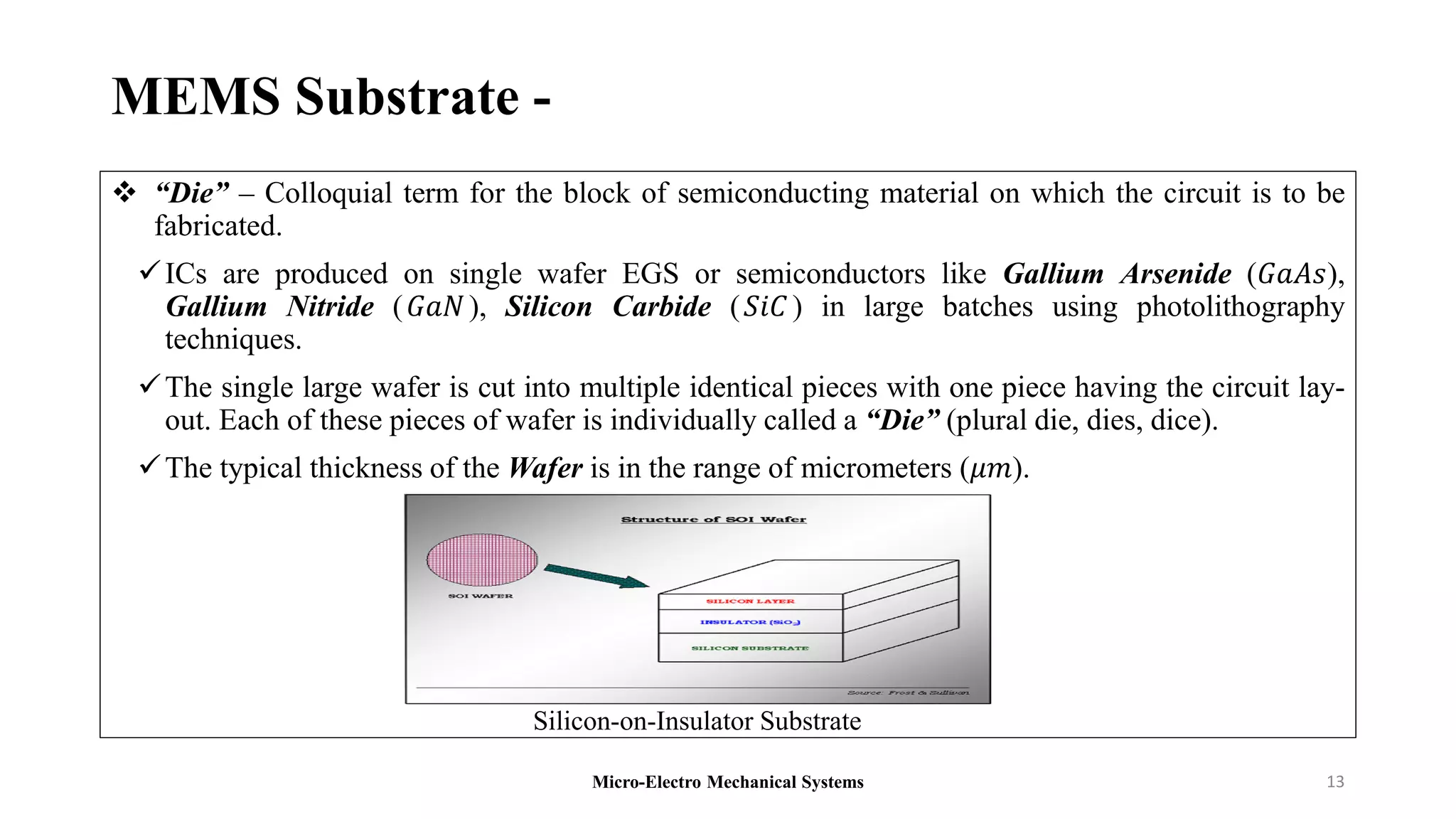
 “Die” – Colloquial term for the block of semiconducting material on which the circuit is to be
fabricated.
ICs are produced on single wafer EGS or semiconductors like Gallium Arsenide (𝐺𝑎𝐴𝑠),
Gallium Nitride (𝐺𝑎𝑁), Silicon Carbide (𝑆𝑖𝐶 ) in large batches using photolithography
techniques.
The single large wafer is cut into multiple identical pieces with one piece having the circuit lay-
out. Each of these pieces of wafer is individually called a “Die” (plural die, dies, dice).
The typical thickness of the Wafer is in the range of micrometers (𝜇𝑚).
Micro-Electro Mechanical Systems 13
Silicon-on-Insulator Substrate
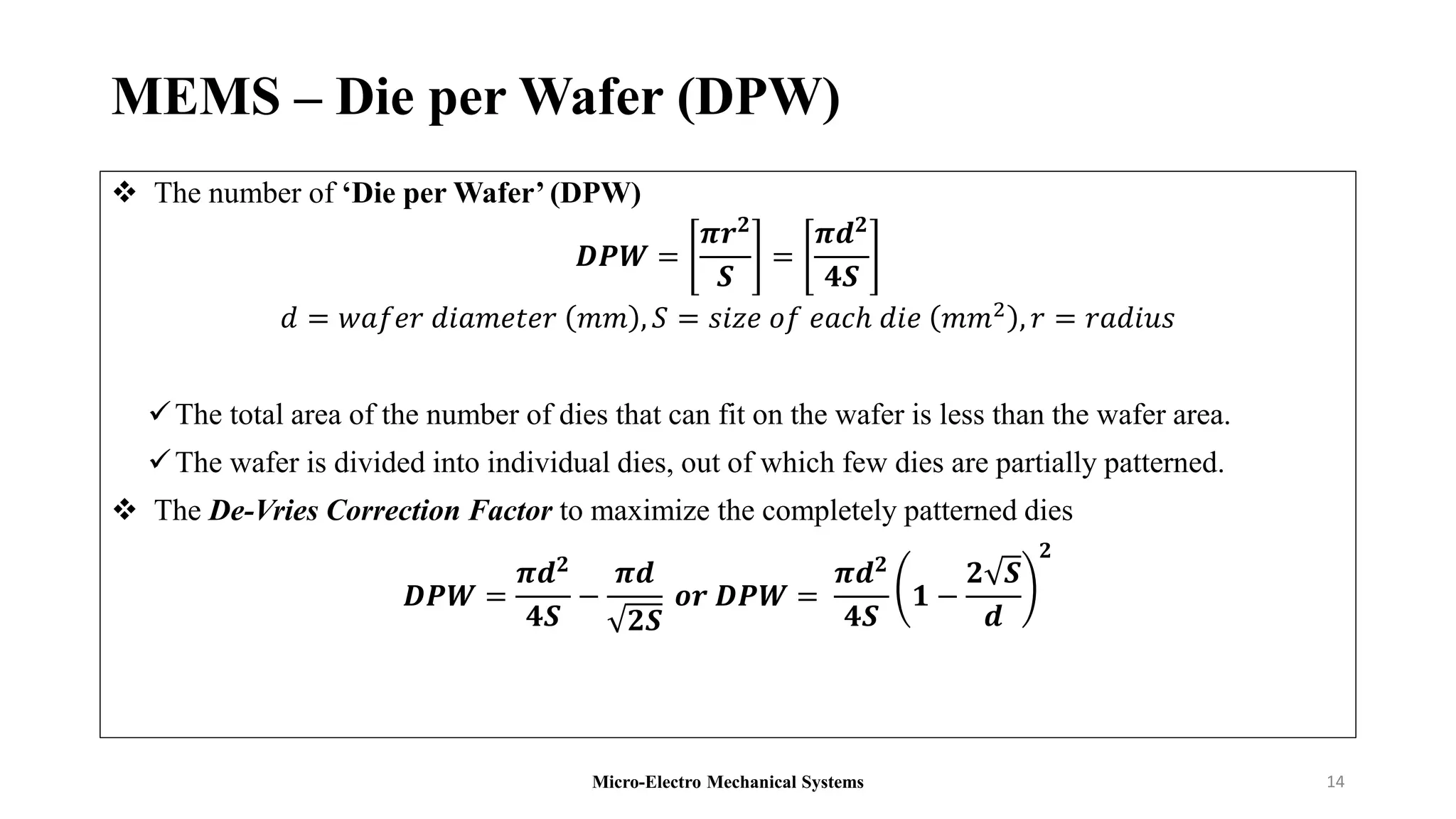
MEMS – Die per Wafer (DPW)
 The number of ‘Die per Wafer’ (DPW)
𝑫𝑷𝑾 =
𝝅𝒓𝟐
𝑺
=
𝝅𝒅𝟐
𝟒𝑺
𝑑 = 𝑤𝑎𝑓𝑒𝑟 𝑑𝑖𝑎𝑚𝑒𝑡𝑒𝑟 𝑚𝑚 , 𝑆 = 𝑠𝑖𝑧𝑒 𝑜𝑓 𝑒𝑎𝑐ℎ 𝑑𝑖𝑒 𝑚𝑚2 , 𝑟 = 𝑟𝑎𝑑𝑖𝑢𝑠
The total area of the number of dies that can fit on the wafer is less than the wafer area.
The wafer is divided into individual dies, out of which few dies are partially patterned.
 The De-Vries Correction Factor to maximize the completely patterned dies
𝑫𝑷𝑾 =
𝝅𝒅𝟐
𝟒𝑺
−
𝝅𝒅
𝟐𝑺
𝒐𝒓 𝑫𝑷𝑾 =
𝝅𝒅𝟐
𝟒𝑺
𝟏 −
𝟐 𝑺
𝒅
𝟐
Micro-Electro Mechanical Systems 14
MEMS – Die per Wafer (DPW):
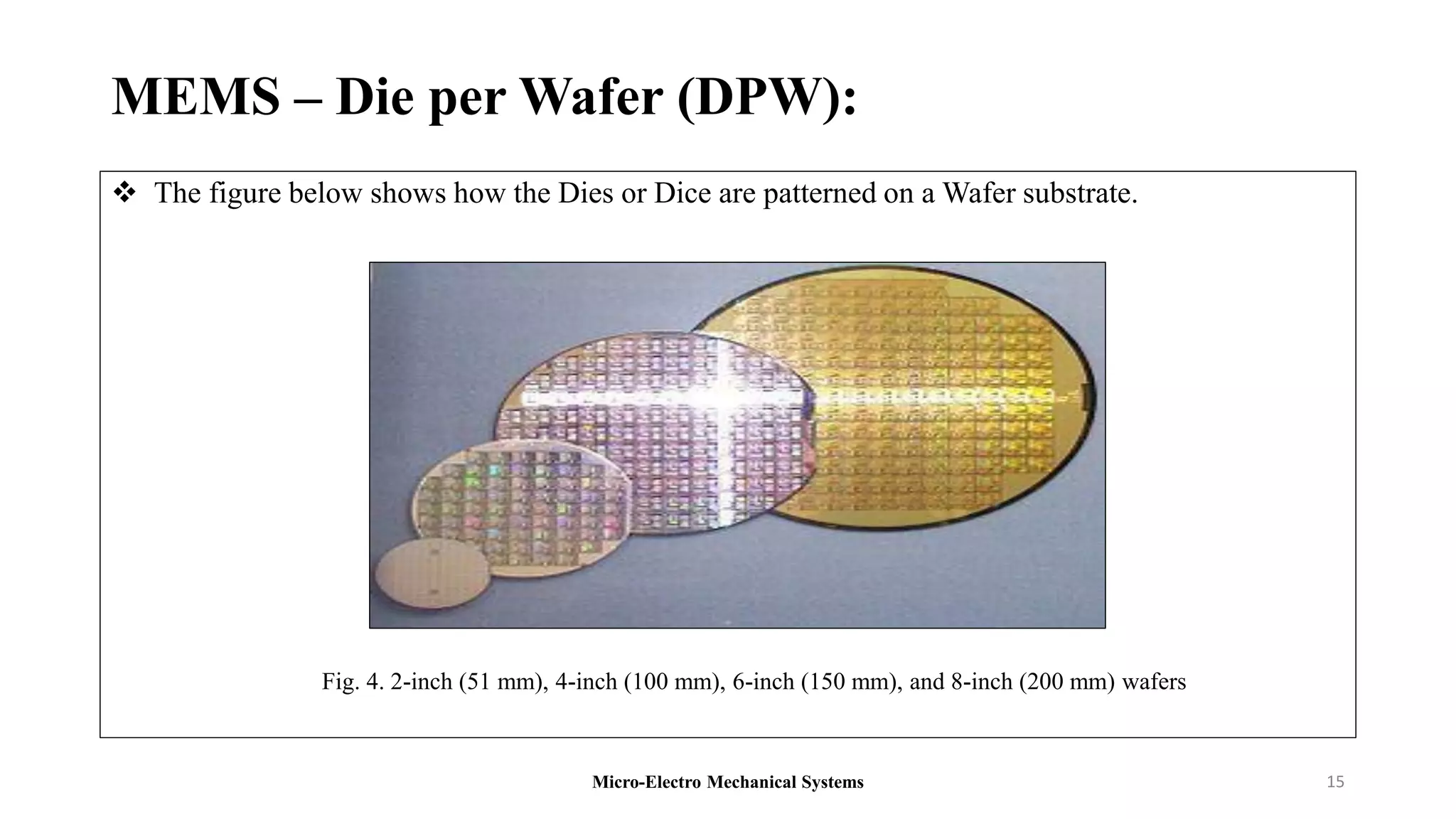
 The figure below shows how the Dies or Dice are patterned on a Wafer substrate.
Micro-Electro Mechanical Systems 15
Fig. 4. 2-inch (51 mm), 4-inch (100 mm), 6-inch (150 mm), and 8-inch (200 mm) wafers
References:
1. P.C https://www.mems-exchange.org/MEMS/what-is.html
2. P.C https://www.bosch-sensortec.com/about-us/our-company/mems-expertise/
3. P.C https://wpo-altertechnology.com/mems-packaging/
4. Gabriel K, Jarvis J, Trimmer W (1988). Small Machines, Large Opportunities: A Report on the Emerging
Field of Microdynamics: Report of the Workshop on Microelectromechanical Systems Research. National
Science Foundation (sponsor). AT&T Bell Laboratories.
5. Waldner JB (2008). Nanocomputers and Swarm Intelligence. London: ISTE John Wiley & Sons.
p. 205. ISBN 9781848210097.
6. Angell JB, Terry SC, Barth PW (1983). "Silicon Micromechanical Devices".
7. Sci. Am. 248 (4): 44–55
8. Bibcode:1983SciAm.248d..44A. doi:10.1038/scientificamerican0483-44.
9. Dirk K. de Vries (2005). "Investigation of gross die per wafer formulas". IEEE Transactions on
Semiconductor Manufacturing. 18 (February 2005): 136–139.
10. https://en.wikipedia.org/wiki/Flexural_strength
Micro-Electro Mechanical Systems 16

2_MEMS - Sensors, Transducers & Actuators.pdf

  • 1.
  • 2.
    Contents 1. MEMS SensorsDomains 2. MEMS Transducers 3. MEMS Actuators 4. MEMS Fabrication Materials 5. MEMS Fabrication Material Properties 6. MEMS Substrate 7. Die Per Wafer (DPW) Micro-Electro Mechanical Systems 2
  • 3.
    MEMS – SensorDomains:  Sensor – Senses one form of energy.  The MEMS technology ventures in the following domains by using different sensors, 1. Physical/ Mechanical Sensors deal with – Force, Pressure, Velocity, Acceleration, Position. 2. Chemical Sensors deal with – Concentration, Material composition, Reaction Rate. 3. Electrical Sensors deal with – Voltage, Current, Charge, Phase, Resistance, Capacitance, Inductance. 4. Thermal Sensors deal with – Temperature, Entropy, Heat, Heat Flow. 5. Magnetic Sensors deal with – Magnetic Field Intensity, Flux Density, Magnetization. 6. Radio Frequency Sensors deal with – EM Wave Intensity, Wavelength, Polarization. 7. Optical Sensors deal with – Reflectance, Refractive Index, Transmittance, Dispersion. Micro-Electro Mechanical Systems 3
  • 4.
    MEMS Transducers - Core of the MEMS device 1. Micro-sensing, 2. Micro-transduction, 3. Micro-actuation.  A transducer is a device that converts one form of energy into another form of energy.  An actuator is a part of or a machine that is responsible to control the output using movable parts by some control mechanism, and therefore it is generally referred to as “Mover”, e.g., Valve. Micro-Electro Mechanical Systems 4
  • 5.
    MEMS Transducers - The current MEMS-based technology is operational with the following transduction. 1. Tribo-electric – Glass (𝑆𝑖𝑂4), Silk, Hard rubber ( 𝐶5𝐻8 𝑛), fur. 2. Electrostatic – Amber Rod (𝐶10𝐻16𝑂). 3. Piezoelectric – Quartz (𝑆𝑖𝑂2), Lead Zirconate Titanate (𝑃𝑍𝑇), Polyvinylidene Fluoride (𝑃𝑉𝐷𝐹), Zinc Oxide (𝑍𝑛𝑂), Bone, DNA. 4. Ferroelectric – Barium Titanate (𝐵𝑎𝑇𝑖𝑂3), Lead Titanate (𝑃𝑏𝑇𝑖𝑂3) Lead Zirconate Titanate (PZT) and Rochelle salt (i.e. Potassium Sodium Tartrate Tetra-hydrate (𝐾𝑁𝑎𝐶4𝐻4𝑂6. 4𝐻2𝑂)) 5. Magnetostrictive – Cobalt Ferrite ( C𝑜𝐹𝑒2𝑂4 𝐶𝑜𝑂. 𝐹𝑒2𝑂3 ), Alloys like Terfenol-D [Terbium-Iron-Dysprosium (𝑇𝑏𝑥𝐷𝑦1−𝑥𝐹𝑒2 )], Galfenol (Gallium-Iron), Metglas 2605SC [Metallic Glass] 6. Magnetic – Iron, Steel, Nickel, Cobalt. Micro-Electro Mechanical Systems 5
  • 6.
    MEMS Transducers - 7.Electromagnetic Acoustic Transducer (EMAT) – Magnet, and Electric Coil. 8. Radio-frequency – Short range device frequency 315 MHz to 868 MHz. 9. Thermal – Metallic Oxides, Semiconductors, Platinum. 10. Optical – Smart polymers, metal, metal oxide and semiconductor materials LED, Light Modulators. 11. Chemical (micro-fluidics) – Calorimetric transducers, Chemi-capacitors, Chemi-resistors, Chemo-mechanical sensors. 12. Biological and biomedical – Bio-receptors viz. Enzymes, Ligands, Nucleic Acids, DNA. Micro-Electro Mechanical Systems 6
  • 7.
    MEMS Actuators - Major MEMS Actuation Techniques: Micro-Electro Mechanical Systems 7 Fig. 3. MEMS based actuations
  • 8.
    MEMS Actuators - Widely used MEMS actuators: 1. Electrostatic Actuator – Parallel-plate actuator, Comb-drive actuator (inter-digitated finger structure). 2. Piezoelectric Actuator – Stack Actuators (multiple-layered piezo element) and Stripe Actuators (bi-laminar flexing element). 3. Electro-Magnetic Actuator – Solenoid actuator (electromagnetic), Moving-coil actuator. 4. Electro-Thermal Actuator – V-type, hot arm/U-type, and bimorph (double-layered cantilever). 5. Optical Actuator – Charge-coupled Devices (CCD) (integrated circuit linked capacitors). 6. Physical Actuators - Shape Memory Alloy (SMA) Actuator (elastically deformable). 7. Chemical Actuator – Microelectrodes (bio-compatible). Micro-Electro Mechanical Systems 8
  • 9.
    MEMS – FabricationMaterials:  The materials that are widely used in MEMS device manufacturing are, 1. Non-metals/Metalloid – Silicon, Germanium, Gallium Arsenide (𝐺𝑎𝐴𝑠). 2. Polymer (long, repeating chains of molecules) – SU8 (Bisphenol A Novolac 8-epoxy), Polyamide (𝑛 − (𝐶𝑂 − 𝑁𝐻))) 3. Ceramic – Diamond, Silicon Carbide (𝑆𝑖𝐶), Silicon Dioxide (𝑆𝑖𝑂2), Silicon Nitride (𝑆𝑖3𝑁4). 4. Metal – Nickel, Aluminium, Copper, Titanium, Tungsten. Micro-Electro Mechanical Systems 9
  • 10.
    MEMS Fabrication Materials–  The Polymer materials used in MEMS fabrication process are 1. SU-8, epoxy based negative photoresist, 2. Polyimide (imide group (= 𝑁𝐻)) which are high performance plastics, 3. Parylene (𝑃𝑎𝑟𝑎 − 𝑥𝑦𝑙𝑒𝑛𝑒 𝐶8𝐻10 , 𝑝𝑎𝑟𝑎 − 𝑏𝑒𝑛𝑧𝑒𝑛𝑒𝑑𝑖𝑦𝑙 𝑟𝑖𝑛𝑔𝑠 (𝐶6𝐻4)), 4. Poly-dimethyl-siloxane (𝑃𝐷𝑀𝑆) (polymeric organosilicon (𝐶 − 𝑆𝑖) compounds), 5. Liquid Crystal Polymers (𝐿𝐶𝑃𝑠), 6. Cyclic Olefin Polymers (𝐶𝑂𝑃𝑠), 7. Poly-methyl Methacrylate (𝑃𝑀𝑀𝐴 𝑜𝑟 𝑝𝑙𝑒𝑥𝑖 − 𝑔𝑙𝑎𝑠𝑠), 8. Polycarbonate (𝑃𝐶) (𝑂𝐶 𝑂𝐶 2 𝑐𝑜𝑟𝑒), 9. Polystyrene (𝑃𝑆) (𝑝𝑜𝑙𝑦 − 𝐶6𝐻5𝐶𝐻 = 𝐶𝐻2) 10. Poly-Vinylidene Fluoride (𝑃𝑉𝐷𝐹) (𝑝𝑜𝑙𝑦 − 𝐶2𝐻2𝐹2). Micro-Electro Mechanical Systems 10
  • 11.
    MEMS – FabricationMaterials Properties:  The properties which are looked up carefully before choosing the material for fabrication are, 1. Elastic Properties – Young’s Modulus (elasticity) and Poisson’s Ratio (deformation). 2. Inelastic Properties – Plastic deformation, Fatigue (break-point stress). 3. Strength Properties – Tensile Strength (breaking resistance), Fracture Strength, Flexural Strength (rupture modulus) and Yield Strength (elastic-behavior limit). Micro-Electro Mechanical Systems 11
  • 12.
    MEMS Substrate - Substrate (wafer or slice) - Base upon which a design and processing is carried out.  It is a thin semiconductor slice.  It produces new films, or material layers like deposited coatings.  Commonly used substrate materials - Crystalline Silicon (𝑐 − 𝑆𝑖), Electronic-grade Silicon (𝐸𝐺𝑆).  EGS is exceptionally pure polycrystalline Silicon (impurity in few ppb).  The (𝑐 − 𝑆𝑖) can be polycrystalline Silicon (𝑝𝑜𝑙𝑦 − 𝑆𝑖 𝑜𝑓 𝑠𝑚𝑎𝑙𝑙 𝑐𝑟𝑦𝑠𝑡𝑎𝑙), or mono-crystalline Silicon (𝑚𝑜𝑛𝑜 − 𝑆𝑖 𝑜𝑓 𝑐𝑜𝑛𝑡𝑖𝑛𝑢𝑜𝑢𝑠 𝑐𝑟𝑦𝑠𝑡𝑎𝑙). Micro-Electro Mechanical Systems 12
  • 13.
    MEMS Substrate - “Die” – Colloquial term for the block of semiconducting material on which the circuit is to be fabricated. ICs are produced on single wafer EGS or semiconductors like Gallium Arsenide (𝐺𝑎𝐴𝑠), Gallium Nitride (𝐺𝑎𝑁), Silicon Carbide (𝑆𝑖𝐶 ) in large batches using photolithography techniques. The single large wafer is cut into multiple identical pieces with one piece having the circuit lay- out. Each of these pieces of wafer is individually called a “Die” (plural die, dies, dice). The typical thickness of the Wafer is in the range of micrometers (𝜇𝑚). Micro-Electro Mechanical Systems 13 Silicon-on-Insulator Substrate
  • 14.
    MEMS – Dieper Wafer (DPW)  The number of ‘Die per Wafer’ (DPW) 𝑫𝑷𝑾 = 𝝅𝒓𝟐 𝑺 = 𝝅𝒅𝟐 𝟒𝑺 𝑑 = 𝑤𝑎𝑓𝑒𝑟 𝑑𝑖𝑎𝑚𝑒𝑡𝑒𝑟 𝑚𝑚 , 𝑆 = 𝑠𝑖𝑧𝑒 𝑜𝑓 𝑒𝑎𝑐ℎ 𝑑𝑖𝑒 𝑚𝑚2 , 𝑟 = 𝑟𝑎𝑑𝑖𝑢𝑠 The total area of the number of dies that can fit on the wafer is less than the wafer area. The wafer is divided into individual dies, out of which few dies are partially patterned.  The De-Vries Correction Factor to maximize the completely patterned dies 𝑫𝑷𝑾 = 𝝅𝒅𝟐 𝟒𝑺 − 𝝅𝒅 𝟐𝑺 𝒐𝒓 𝑫𝑷𝑾 = 𝝅𝒅𝟐 𝟒𝑺 𝟏 − 𝟐 𝑺 𝒅 𝟐 Micro-Electro Mechanical Systems 14
  • 15.
    MEMS – Dieper Wafer (DPW):  The figure below shows how the Dies or Dice are patterned on a Wafer substrate. Micro-Electro Mechanical Systems 15 Fig. 4. 2-inch (51 mm), 4-inch (100 mm), 6-inch (150 mm), and 8-inch (200 mm) wafers
  • 16.
    References: 1. P.C https://www.mems-exchange.org/MEMS/what-is.html 2.P.C https://www.bosch-sensortec.com/about-us/our-company/mems-expertise/ 3. P.C https://wpo-altertechnology.com/mems-packaging/ 4. Gabriel K, Jarvis J, Trimmer W (1988). Small Machines, Large Opportunities: A Report on the Emerging Field of Microdynamics: Report of the Workshop on Microelectromechanical Systems Research. National Science Foundation (sponsor). AT&T Bell Laboratories. 5. Waldner JB (2008). Nanocomputers and Swarm Intelligence. London: ISTE John Wiley & Sons. p. 205. ISBN 9781848210097. 6. Angell JB, Terry SC, Barth PW (1983). "Silicon Micromechanical Devices". 7. Sci. Am. 248 (4): 44–55 8. Bibcode:1983SciAm.248d..44A. doi:10.1038/scientificamerican0483-44. 9. Dirk K. de Vries (2005). "Investigation of gross die per wafer formulas". IEEE Transactions on Semiconductor Manufacturing. 18 (February 2005): 136–139. 10. https://en.wikipedia.org/wiki/Flexural_strength Micro-Electro Mechanical Systems 16