Electrical & Electronic Measurement
Part – XI
Power Factor Meter
ER. FARUK BIN POYEN
faruk.poyen@gmail.com
AEIE, UIT, BU
Contents:
 Power Factor
 Power Factor Meter
2
Power Factor:
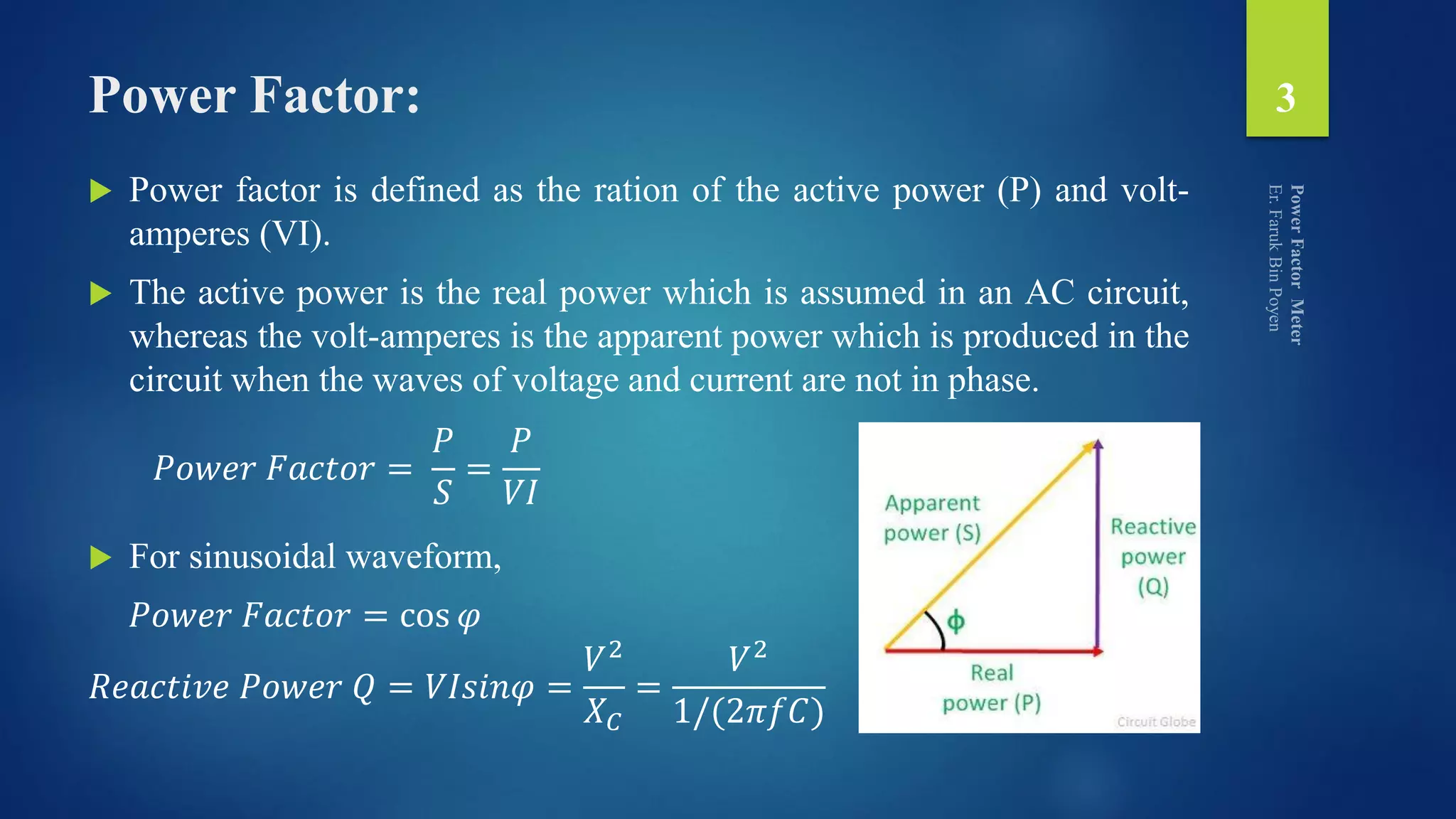
 Power factor is defined as the ration of the active power (P) and volt-
amperes (VI).
 The active power is the real power which is assumed in an AC circuit,
whereas the volt-amperes is the apparent power which is produced in the
circuit when the waves of voltage and current are not in phase.
 For sinusoidal waveform,
𝑃𝑜𝑤𝑒𝑟 𝐹𝑎𝑐𝑡𝑜𝑟 = cos 𝜑
𝑅𝑒𝑎𝑐𝑡𝑖𝑣𝑒 𝑃𝑜𝑤𝑒𝑟 𝑄 = 𝑉𝐼𝑠𝑖𝑛𝜑 =
𝑉2
𝑋 𝐶
=
𝑉2
1/(2𝜋𝑓𝐶)
3
𝑃𝑜𝑤𝑒𝑟 𝐹𝑎𝑐𝑡𝑜𝑟 =
𝑃
𝑆
=
𝑃
𝑉𝐼
Low Power Factor Causes:
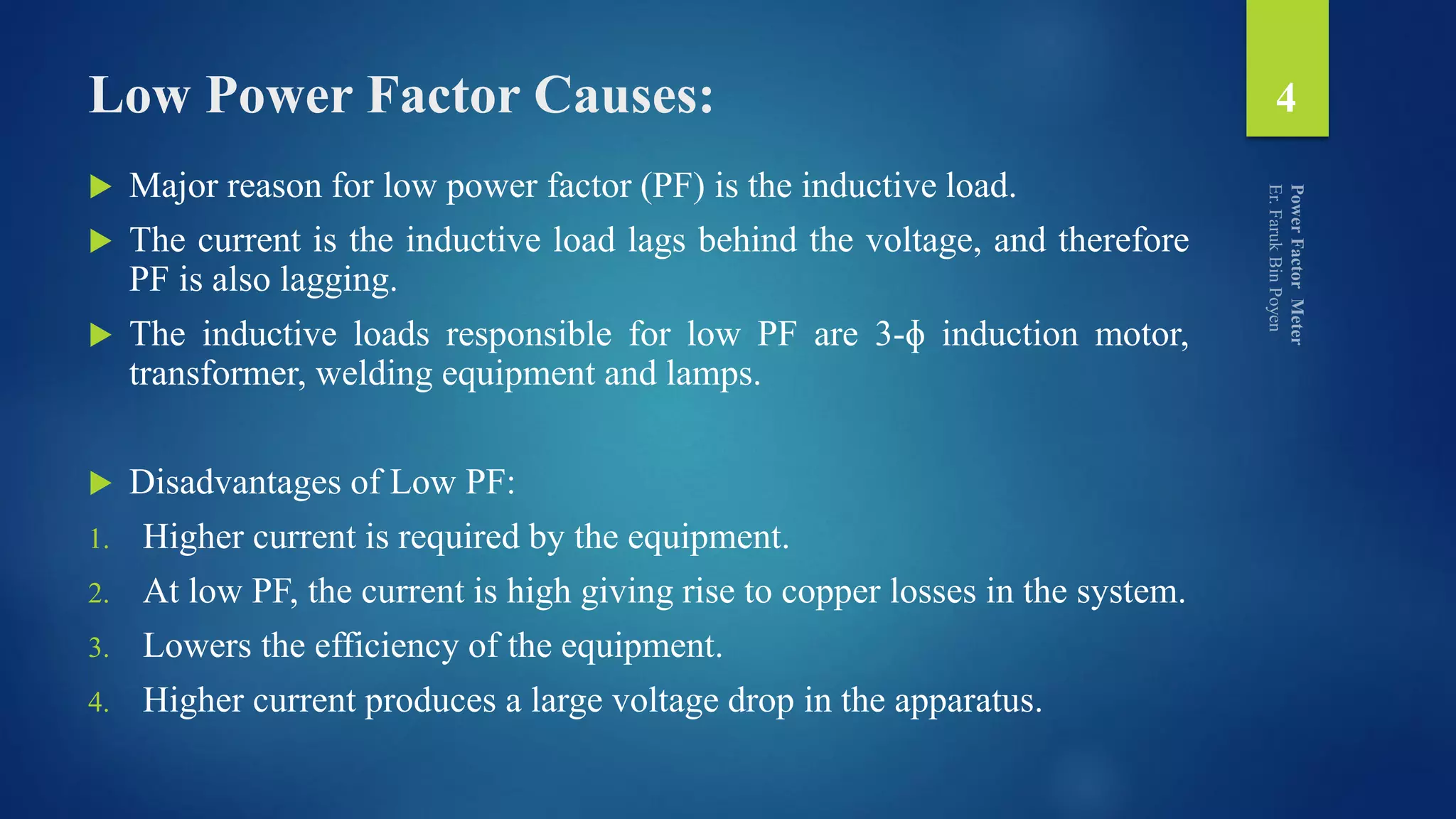
 Major reason for low power factor (PF) is the inductive load.
 The current is the inductive load lags behind the voltage, and therefore
PF is also lagging.
 The inductive loads responsible for low PF are 3-ɸ induction motor,
transformer, welding equipment and lamps.
 Disadvantages of Low PF:
1. Higher current is required by the equipment.
2. At low PF, the current is high giving rise to copper losses in the system.
3. Lowers the efficiency of the equipment.
4. Higher current produces a large voltage drop in the apparatus.
4
Power Factor Improvement:
 There are three main ways of improving PF
1. Capacitor Banks
2. Synchronous Condensers
3. Phase Advancers
5
Power Factor Improvement: Capacitor Bank
 By reducing the phase difference between voltage and current, PF can
be improved.
 Since the majority of the load is inductive, this requires some amount of
reactive power for functioning.
 Capacitor bank installed in parallel to the load provides this reactive
power.
 It acts as a source of local reactive power, and thus less reactive power
flows through the line.
 Capacitor banks reduce the phase difference between the voltage and the
current.
6
Power Factor Improvement: Synchronous Condenser:
 Synchronous condensers are 3 phase synchronous motor with no load
attached to its shaft.
 The synchronous motor has the characteristics of operating under any
power factor leading, lagging or unity depending upon the excitation.
 For inductive loads, a synchronous condenser is connected towards the
load side and is overexcited.
 Synchronous condensers make it behave like a capacitor.
 It draws the lagging current from the supply or supplies the reactive
power.
7
Power Factor Improvement: Phase Advancers
 This is an AC exciter mainly used to improve the PF of an induction
motor.
 They are mounted on the shaft of the motor and are connected to the
rotor circuit of the motor.
 It improves the power factor by providing the exciting ampere turns to
produce the required flux at the given slip frequency.
 Further, if ampere-turns increase, it can be made to operate at leading
power factor.
8
Power Factor Meter:
 The power factor meter measures the power factor of a transmission
system.
 The power factor is the cosine of the angle between the voltage and
current.
 The power factor meter determines the types of load using on the line,
and it also calculates the losses occur on it.
 The power factor of the transmission line is measured by dividing the
product of voltage and current with the power. And the value of voltage
current and power is easily determined by the voltmeter, ammeter and
wattmeter respectively.
 This method gives high accuracy, but it takes time.
9
Power Factor Meter:
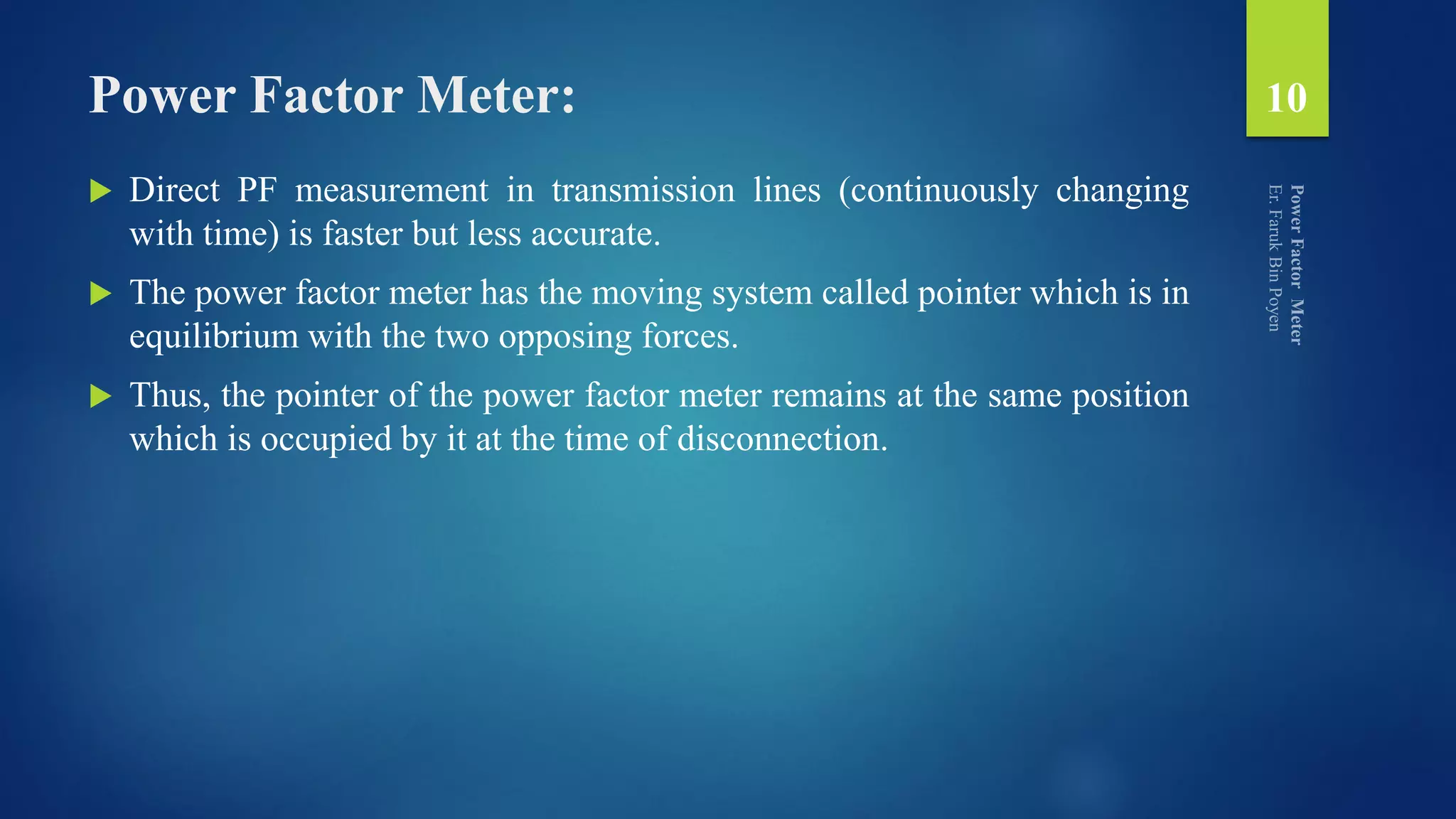
 Direct PF measurement in transmission lines (continuously changing
with time) is faster but less accurate.
 The power factor meter has the moving system called pointer which is in
equilibrium with the two opposing forces.
 Thus, the pointer of the power factor meter remains at the same position
which is occupied by it at the time of disconnection.
10
Power Factor Meter: Construction
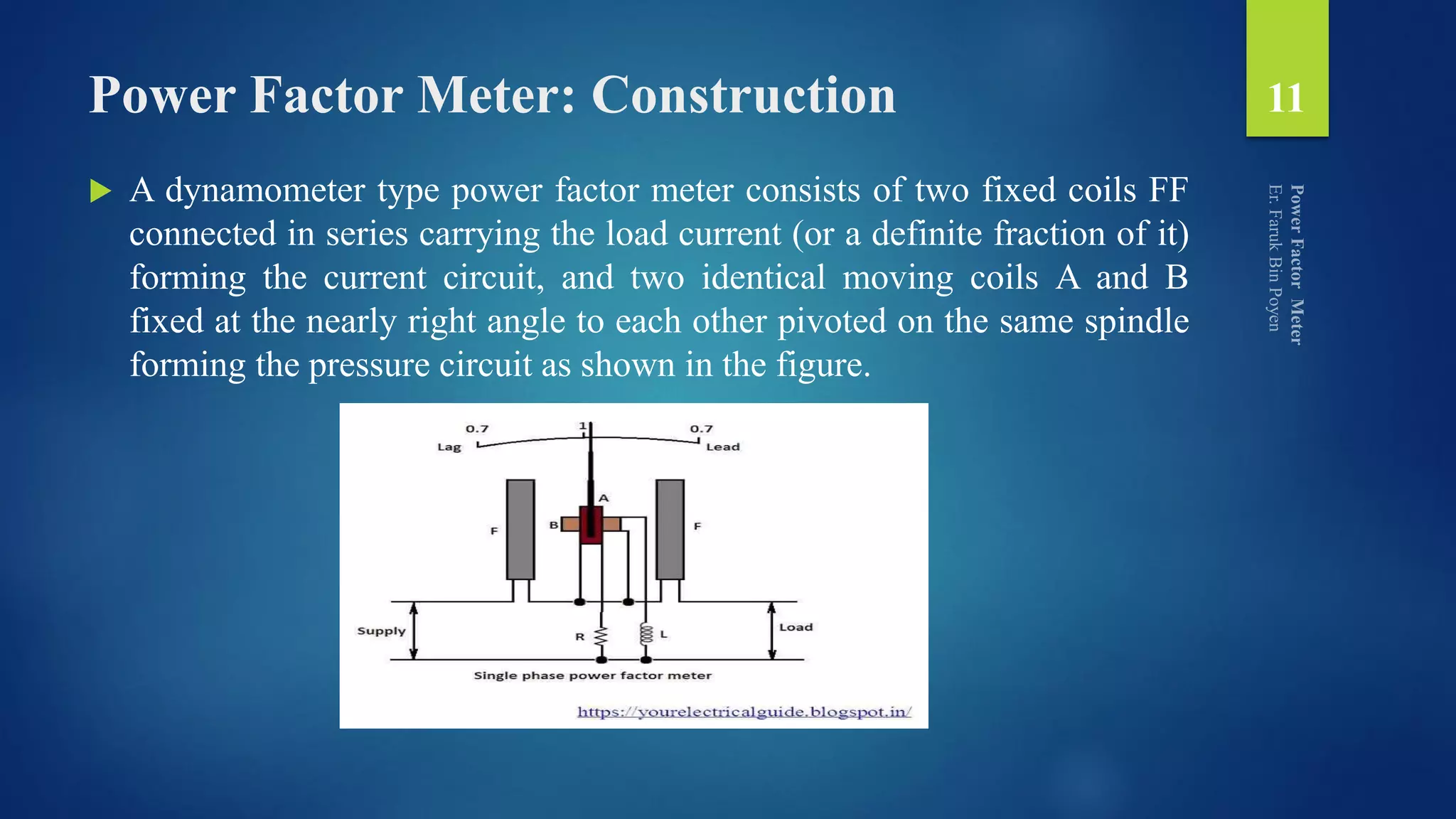
 A dynamometer type power factor meter consists of two fixed coils FF
connected in series carrying the load current (or a definite fraction of it)
forming the current circuit, and two identical moving coils A and B
fixed at the nearly right angle to each other pivoted on the same spindle
forming the pressure circuit as shown in the figure.
11
Power Factor Meter: Construction
 The current coils FF are wound with thick wire whereas pressure coils A
and B are wound with fine wire.
 The pressure coils fixed on the same spindle, to which a pointer is
attached, constitutes the moving system.
 The pressure coil A is connected across the supply through a non-
inductive resistant and pressure coil B is connected across the supply
through highly inductive choke coil of inductance L.
 The value of resistance R and inductance L are so chosen that for the
main supply frequency, the current in the two pressure coils A and B is
the same.
12
Power Factor Meter: Construction
 Thus the fields produced by the two coils are of the same strength. The
field produced by the coil B lags behind the field produced by the coil A
slightly less than 90° because of resistance of the coil.
 Accordingly while fixing the coil B the plane of this coil is displaced
from the plane of the coil A by the electrical angle which is slightly less
than 90°.
 However while discussing the action (working) of the instrument it will
be assumed that the phase difference between the two currents flowing
through the coils A and B is 90° and same is the angle between the
planes of the coils.
13
Power Factor Meter: Working Principle
 The basic working principle of PF meter is similar to that of
dynamometer type wattmeter i.e. when the field produced by moving
system tries to come in line with the field produced by the fixed coil,
deflecting torque is exerted on the moving system which deflects the
pointer attached to it (the moving system).
 PF meter is an indicating instrument and no controlling torque is
provided in this instrument. The currents are being led into the moving
coils A and B by fine ligaments which exert no control.
14
Power Factor Meter: Working Principle
 When the instrument is connected to the load circuit, current flows
through the fixed coils FF and Moving coils A and B, flux is set by the
fixed coils and moving coils.
15
Power Factor Meter: Output Conditions
 By the alignment of two fields, torque is developed i.e. the resultant
field produced by the moving coils tries to come in line with the field
produced by the fixed coils and torque is developed till both of them
come in line with each other. There are three extreme conditions in
which this instrument is connected in the circuit.
1. When power factor of the circuit is unity:
2. When power factor of the circuit is zero lagging:
3. When power factor of the circuit is zero leading:
16
Power Factor Meter: Condition 1
 When power factor of the circuit is unity: In this case, current is in
phase with circuit voltage. The current flowing through potential coil A
is in phase with the voltage which is also in phase with the current
flowing through current coil FF.
 At the same time, the current flowing through potential coil B lags
behind voltage as well as the current flowing through current coil FF by
90°. Thus pressure coil A will experience a turning moment so its plane
will come in position a parallel to the plane of the current coil FF.
 The torque acting on the pressure coil B is zero. Thus, the pointer
indicates unity power factor on the scale.
17
Power Factor Meter: Condition 2
 When power factor of the circuit is zero lagging: In this case, current
lags behind the circuit voltage by 90°. Therefore, the current flowing
through pressure coil B will be in phase with the current in current coils
FF, both being lagging behind the circuit voltage by 90°.
 The current flowing through pressure coil A will lead the current in
current coil FF by 90°. Thus a turning moment acts on the pressure coil
B and brings its plane parallel to the plane of current coil FF and pointer
indicates zero power factor lagging.
18
Power Factor Meter: Condition 3
 When power factor of the circuit is zero leading: In this case current
leads the circuit voltage by 90o. Therefore, the current flowing through
pressure coil A lags the current in current coil FF by 90° and the current
flowing through pressure coil B lags the current in current coil FF by
180°.
 Thus field produced by the moving system is just reversed to that in the
case (2). Thus an opposite turning moment acts on the pressure coil B
and brings its plane parallel to the plane of current coil FF and pointer
indicates zero power factor leading.
19
Power Factor Meter: Types
 The power factor meter is of two types. They are
1. Electrodynamometer
a) Single Phase Electrodynamometer
b) Three Phases Electrodynamometer
2. Moving Iron Type Meter
a) Rotating Iron Magnetic Field
b) Number of Alternating Field
20
References:
 https://circuitglobe.com/power-factor-meter.html
 https://www.electrical4u.com/power-factor-meters-electrodynamometer-
type-power-factor-meter/
 https://www.yourelectricalguide.com/2017/01/power-factor-meter.html
21

Electronic Measurement - Power Factor Meter

  • 1.
    Electrical & ElectronicMeasurement Part – XI Power Factor Meter ER. FARUK BIN POYEN faruk.poyen@gmail.com AEIE, UIT, BU
  • 2.
    Contents:  Power Factor Power Factor Meter 2
  • 3.
    Power Factor:  Powerfactor is defined as the ration of the active power (P) and volt- amperes (VI).  The active power is the real power which is assumed in an AC circuit, whereas the volt-amperes is the apparent power which is produced in the circuit when the waves of voltage and current are not in phase.  For sinusoidal waveform, 𝑃𝑜𝑤𝑒𝑟 𝐹𝑎𝑐𝑡𝑜𝑟 = cos 𝜑 𝑅𝑒𝑎𝑐𝑡𝑖𝑣𝑒 𝑃𝑜𝑤𝑒𝑟 𝑄 = 𝑉𝐼𝑠𝑖𝑛𝜑 = 𝑉2 𝑋 𝐶 = 𝑉2 1/(2𝜋𝑓𝐶) 3 𝑃𝑜𝑤𝑒𝑟 𝐹𝑎𝑐𝑡𝑜𝑟 = 𝑃 𝑆 = 𝑃 𝑉𝐼
  • 4.
    Low Power FactorCauses:  Major reason for low power factor (PF) is the inductive load.  The current is the inductive load lags behind the voltage, and therefore PF is also lagging.  The inductive loads responsible for low PF are 3-ɸ induction motor, transformer, welding equipment and lamps.  Disadvantages of Low PF: 1. Higher current is required by the equipment. 2. At low PF, the current is high giving rise to copper losses in the system. 3. Lowers the efficiency of the equipment. 4. Higher current produces a large voltage drop in the apparatus. 4
  • 5.
    Power Factor Improvement: There are three main ways of improving PF 1. Capacitor Banks 2. Synchronous Condensers 3. Phase Advancers 5
  • 6.
    Power Factor Improvement:Capacitor Bank  By reducing the phase difference between voltage and current, PF can be improved.  Since the majority of the load is inductive, this requires some amount of reactive power for functioning.  Capacitor bank installed in parallel to the load provides this reactive power.  It acts as a source of local reactive power, and thus less reactive power flows through the line.  Capacitor banks reduce the phase difference between the voltage and the current. 6
  • 7.
    Power Factor Improvement:Synchronous Condenser:  Synchronous condensers are 3 phase synchronous motor with no load attached to its shaft.  The synchronous motor has the characteristics of operating under any power factor leading, lagging or unity depending upon the excitation.  For inductive loads, a synchronous condenser is connected towards the load side and is overexcited.  Synchronous condensers make it behave like a capacitor.  It draws the lagging current from the supply or supplies the reactive power. 7
  • 8.
    Power Factor Improvement:Phase Advancers  This is an AC exciter mainly used to improve the PF of an induction motor.  They are mounted on the shaft of the motor and are connected to the rotor circuit of the motor.  It improves the power factor by providing the exciting ampere turns to produce the required flux at the given slip frequency.  Further, if ampere-turns increase, it can be made to operate at leading power factor. 8
  • 9.
    Power Factor Meter: The power factor meter measures the power factor of a transmission system.  The power factor is the cosine of the angle between the voltage and current.  The power factor meter determines the types of load using on the line, and it also calculates the losses occur on it.  The power factor of the transmission line is measured by dividing the product of voltage and current with the power. And the value of voltage current and power is easily determined by the voltmeter, ammeter and wattmeter respectively.  This method gives high accuracy, but it takes time. 9
  • 10.
    Power Factor Meter: Direct PF measurement in transmission lines (continuously changing with time) is faster but less accurate.  The power factor meter has the moving system called pointer which is in equilibrium with the two opposing forces.  Thus, the pointer of the power factor meter remains at the same position which is occupied by it at the time of disconnection. 10
  • 11.
    Power Factor Meter:Construction  A dynamometer type power factor meter consists of two fixed coils FF connected in series carrying the load current (or a definite fraction of it) forming the current circuit, and two identical moving coils A and B fixed at the nearly right angle to each other pivoted on the same spindle forming the pressure circuit as shown in the figure. 11
  • 12.
    Power Factor Meter:Construction  The current coils FF are wound with thick wire whereas pressure coils A and B are wound with fine wire.  The pressure coils fixed on the same spindle, to which a pointer is attached, constitutes the moving system.  The pressure coil A is connected across the supply through a non- inductive resistant and pressure coil B is connected across the supply through highly inductive choke coil of inductance L.  The value of resistance R and inductance L are so chosen that for the main supply frequency, the current in the two pressure coils A and B is the same. 12
  • 13.
    Power Factor Meter:Construction  Thus the fields produced by the two coils are of the same strength. The field produced by the coil B lags behind the field produced by the coil A slightly less than 90° because of resistance of the coil.  Accordingly while fixing the coil B the plane of this coil is displaced from the plane of the coil A by the electrical angle which is slightly less than 90°.  However while discussing the action (working) of the instrument it will be assumed that the phase difference between the two currents flowing through the coils A and B is 90° and same is the angle between the planes of the coils. 13
  • 14.
    Power Factor Meter:Working Principle  The basic working principle of PF meter is similar to that of dynamometer type wattmeter i.e. when the field produced by moving system tries to come in line with the field produced by the fixed coil, deflecting torque is exerted on the moving system which deflects the pointer attached to it (the moving system).  PF meter is an indicating instrument and no controlling torque is provided in this instrument. The currents are being led into the moving coils A and B by fine ligaments which exert no control. 14
  • 15.
    Power Factor Meter:Working Principle  When the instrument is connected to the load circuit, current flows through the fixed coils FF and Moving coils A and B, flux is set by the fixed coils and moving coils. 15
  • 16.
    Power Factor Meter:Output Conditions  By the alignment of two fields, torque is developed i.e. the resultant field produced by the moving coils tries to come in line with the field produced by the fixed coils and torque is developed till both of them come in line with each other. There are three extreme conditions in which this instrument is connected in the circuit. 1. When power factor of the circuit is unity: 2. When power factor of the circuit is zero lagging: 3. When power factor of the circuit is zero leading: 16
  • 17.
    Power Factor Meter:Condition 1  When power factor of the circuit is unity: In this case, current is in phase with circuit voltage. The current flowing through potential coil A is in phase with the voltage which is also in phase with the current flowing through current coil FF.  At the same time, the current flowing through potential coil B lags behind voltage as well as the current flowing through current coil FF by 90°. Thus pressure coil A will experience a turning moment so its plane will come in position a parallel to the plane of the current coil FF.  The torque acting on the pressure coil B is zero. Thus, the pointer indicates unity power factor on the scale. 17
  • 18.
    Power Factor Meter:Condition 2  When power factor of the circuit is zero lagging: In this case, current lags behind the circuit voltage by 90°. Therefore, the current flowing through pressure coil B will be in phase with the current in current coils FF, both being lagging behind the circuit voltage by 90°.  The current flowing through pressure coil A will lead the current in current coil FF by 90°. Thus a turning moment acts on the pressure coil B and brings its plane parallel to the plane of current coil FF and pointer indicates zero power factor lagging. 18
  • 19.
    Power Factor Meter:Condition 3  When power factor of the circuit is zero leading: In this case current leads the circuit voltage by 90o. Therefore, the current flowing through pressure coil A lags the current in current coil FF by 90° and the current flowing through pressure coil B lags the current in current coil FF by 180°.  Thus field produced by the moving system is just reversed to that in the case (2). Thus an opposite turning moment acts on the pressure coil B and brings its plane parallel to the plane of current coil FF and pointer indicates zero power factor leading. 19
  • 20.
    Power Factor Meter:Types  The power factor meter is of two types. They are 1. Electrodynamometer a) Single Phase Electrodynamometer b) Three Phases Electrodynamometer 2. Moving Iron Type Meter a) Rotating Iron Magnetic Field b) Number of Alternating Field 20
  • 21.