Electrical & Electronic Measurement
Part – V
Commonly Used Transducers
ER. FARUK BIN POYEN
faruk.poyen@gmail.com
AEIE, UIT, BU
Contents:
 Material Transduction Properties
 Transducer Types
 Active Transducers
 Strain Gauge
 Potentiometer
 LVDT
 Load Cell
2
Material Transduction Properties:
1. Electrostrictive (Ferroelectric)
2. Piezoelectric (Ferroeletric)
3. Piezoresistive
4. Shape Memory Effect (Ferroelastic)
5. Magnetostriction (Ferromagnetic)
6. Magnetostriction Ferromagnetic Shape Memory Alloys (FSMA)
7. Magnetocaloric
8. Thermoelectric
9. Magnetoresistance
10. Pyroelectric
3
Material Transduction Properties:
1. Electrostrictive (Ferroelectric): Electrostriction is a property of all electrical non-
conductors, or dielectrics, that causes them to change their shape under the
application of an electric field.
2. Piezoelectric (Ferroelectric): Piezoelectric Effect is the ability of certain materials to
generate an electric charge in response to applied mechanical stress. It works the other
way as well i.e. on application of electric charge, material deformation takes place.
3. Piezoresistive Effect: The piezoresistive effect is marked by changes in resistance of
materials as the result of pressure applied on the structure.
4. Shape Memory Effect (Ferroelastic): It is a phenomenon, in which a material recovers
to its original size and shape when heated above a certain characteristic
transformation temperature.
4
Material Transduction Properties:
5. Magnetostriction (Ferromagnetic): Magnetostriction is a property of ferromagnetic
materials which causes them to expand or contract in response to a magnetic field.
This effect allows magnetostrictive materials to convert electromagnetic energy into
mechanical energy.
6. Magnetostriction Ferromagnetic Shape Memory Alloys (FSMA): Magnetic shape
memory alloys (MSMAs), also called ferromagnetic shape memory alloys (FSMA),
are particular shape memory alloys which produce forces and deformations in
response to a magnetic field. The thermal shape memory effect has been obtained in
these materials, too.
7. Magnetocaloric Effect: It (MCE) is a heating or cooling (rise or drop in temperature)
of a magnetic material when the applied magnetic field changes.
5
Material Transduction Properties:
8. Thermoelectric Effect: It is the direct conversion of temperature differences to electric
voltage and vice versa via a thermocouple. A thermoelectric device creates voltage
when there is a different temperature on each side. Conversely, when a voltage is
applied to it, heat is transferred from one side to the other, creating a temperature
difference.
9. Magnetoresistance: It is the tendency of a material (preferably ferromagnetic) to
change the value of its electrical resistance in an externally-applied magnetic field.
10. Pyroelectric Effect: It is the direct conversion of temperature differences to electric
voltage and vice versa via a thermocouple. A thermoelectric device creates voltage
when there is a different temperature on each side.
6
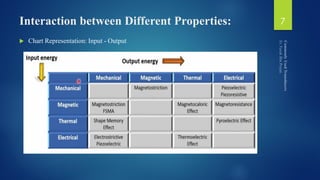
Interaction between Different Properties:
 Chart Representation: Input - Output
7
Transducer Types – Quantity Measured:
 Types of Transducer based on Quantity to be Measured
1. Temperature transducers (e.g. a thermocouple)
2. Pressure transducers (e.g. a diaphragm)
3. Displacement transducers (e.g. LVDT)
4. Oscillator transducer
5. Flow transducers
6. Inductive Transducer
8
Transducer Types – Operational Principle:
 Types of Transducer based on the Principle of Operation
1. Photovoltaic (e.g. a solar cell)
2. Piezoelectric transducer
3. Chemical
4. Mutual induction
5. Electromagnetic
6. Hall effect
7. Photoconductors
9
Transducer Types – Active & Passive:
 Types of Active Transducers
1. Magnetic Induction Type
2. Piezoelectric Type
3. Photovoltaic Type
4. Thermoelectric Type
 Types of Passive Transducers
1. Resistive Type
2. Inductive type
3. Capacitive Type
10
Transducer - Magnetic Induction Type:
 When an electrical conductor moves in a magnetic field, it changes the magnetic flux
through the conductor. This produces a voltage, which is proportional to the rate of
change of flux.
𝐼𝑛𝑑𝑢𝑐𝑒𝑑 𝐸𝑀𝐹 𝑒 = −𝐵 ∗ 𝑙 ∗ 𝑉
 Applications Magnetic Induction Type Transducers
1. Electromagnetic flow meter
2. Heart sound Microphones
3. Indicating instruments
4. Pen motor in biomedical recorders
11
Transducer – Piezoelectric Type:
 When compression or tension is applied to the crystal, charge separation occurs in the
crystals. This produces electrical voltage resulting in Piezoelectric Effect.
 Piezoelectric transducers convert displacement or pressure into an electrical value.
 Barium Titanium, Rochelle salt, Lithium Niobate are few piezoelectric transducer
materials.
 Applications of Piezoelectric Transducers
1. Piezoelectric Transducer acts as a pulse sensor to measure the pulse rate of a
human.
12
Transducer – Photovoltaic Type:
 When light or any other radiation of wavelength falls on the metal or semiconductor
surface, it ejects electrons. This is the Photoelectric Effect.
 Photoemissive, Photoconductive and photovoltaic are the types of Photoelectric
Transducers.
 Among these, Photovoltaic is an active transducer which generates an electrical
voltage in proportion to the radiation incident on it.
 Applications of Photovoltaic Transducers
1. In Photoelectric Plethysmography silicon photovoltaic cells acts as pulse sensor.
2. To measure sodium and potassium ion concentration in a sample using light
absorption techniques.
13
Transducer – Thermoelectric Type:
 These transducers work based on the Seebeck Effect.
 Seebeck effect states that, when two junctions of the thermocouple are at two different
temperatures, it generates a potential voltage.
 The generated voltage is proportional to the difference in temperature between two
junctions of the thermocouple.
 Applications of Thermoelectric Transducers
1. To measure physiological temperature in remote sensing circuits and biotelemetry
circuits.
2. In the doctor’s cold box to store plasma, antibiotics, etc.
14
Strain Gauge:
 Strain Gauge is a device that operates on this principle of elongation and contraction.
 A strain gauge is a resistor used to measure strain on an object.
 Strain Gauge’s conductors are very thin (1/1000 inch in diameter) for round wires.
 It can be thin strips of metallic film deposited on non-conducting substrate ‘carrier’.
 Bonded strain gauges are glued to a larger structure under stress.
 Un-mounted gauge wire stretched between two mechanical points under tension is also
possible.
 Strain gauge converts force, pressure, tension, weight etc. into a change in electrical
resistance.
 Stress (cause) is the object’s internal resisting force.
 Strain (effect) is the displacement or deformation that occurs.
15
Strain Gauge Property:
 If a strip of conductive metal is stretched, it will become skinnier and longer, both
changes resulting in an increase of electrical resistance end-to-end. Conversely, if a
strip of conductive metal is placed under compressive force (without buckling), it will
broaden and shorten.
 If these stresses are kept within the elastic limit of the metal strip (avoiding permanent
deform), the strip can be used as a measuring element for physical force, the amount of
applied force inferred from measuring its resistance.
16
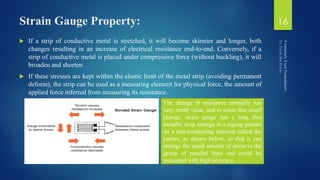
The change in resistance normally has
very small value, and to sense that small
change, strain gauge has a long thin
metallic strip arrange in a zigzag pattern
on a non-conducting material called the
carrier, as shown below, so that it can
enlarge the small amount of stress in the
group of parallel lines and could be
measured with high accuracy.
Strain Gauge – Bridge Balance:
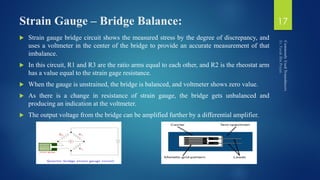
 Strain gauge bridge circuit shows the measured stress by the degree of discrepancy, and
uses a voltmeter in the center of the bridge to provide an accurate measurement of that
imbalance.
 In this circuit, R1 and R3 are the ratio arms equal to each other, and R2 is the rheostat arm
has a value equal to the strain gage resistance.
 When the gauge is unstrained, the bridge is balanced, and voltmeter shows zero value.
 As there is a change in resistance of strain gauge, the bridge gets unbalanced and
producing an indication at the voltmeter.
 The output voltage from the bridge can be amplified further by a differential amplifier.
17
Strain Gauge - Principle:
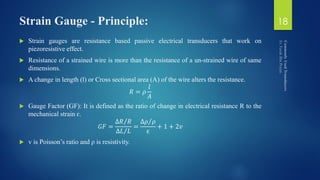
 Strain gauges are resistance based passive electrical transducers that work on
piezoresistive effect.
 Resistance of a strained wire is more than the resistance of a un-strained wire of same
dimensions.
 A change in length (l) or Cross sectional area (A) of the wire alters the resistance.
𝑅 = 𝜌
𝑙
𝐴
 Gauge Factor (GF): It is defined as the ratio of change in electrical resistance R to the
mechanical strain ɛ.
𝐺𝐹 =
∆𝑅 𝑅
∆𝐿 𝐿
=
∆𝜌 𝜌
ɛ
+ 1 + 2𝑣
 v is Poisson’s ratio and ρ is resistivity.
18
Strain Gauge Temperature Error Recompense
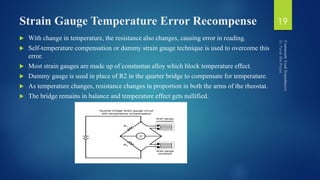
 With change in temperature, the resistance also changes, causing error in reading.
 Self-temperature compensation or dummy strain gauge technique is used to overcome this
error.
 Most strain gauges are made up of constantan alloy which block temperature effect.
 Dummy gauge is used in place of R2 in the quarter bridge to compensate for temperature.
 As temperature changes, resistance changes in proportion in both the arms of the rheostat.
 The bridge remains in balance and temperature effect gets nullified.
19
Strain Gauge Configurations:
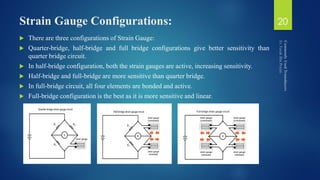
 There are three configurations of Strain Gauge:
 Quarter-bridge, half-bridge and full bridge configurations give better sensitivity than
quarter bridge circuit.
 In half-bridge configuration, both the strain gauges are active, increasing sensitivity.
 Half-bridge and full-bridge are more sensitive than quarter bridge.
 In full-bridge circuit, all four elements are bonded and active.
 Full-bridge configuration is the best as it is more sensitive and linear.
20
Strain Gauge Types:
 Unbonded Metal
 Bonded Metal Wire
 Bonded Metal Foil
 Thin Film
 Semiconductor
 Rosette
21
Strain Gauge - Unbonded:
 The wire is not completely bonded with the carrier. It consists of a fixed body and a
movable part.
 Metal wires connect these two parts and the movable part is in contact with the specimen.
 Application of unbounded metal strain gauge:
1. Used in applications where there is a need for removable gauges.
2. Force, Pressure and Acceleration are some quantities measured.
 Advantage: High Accuracy; Disadvantage: More space consuming.
22
Strain Gauge – Bonded:
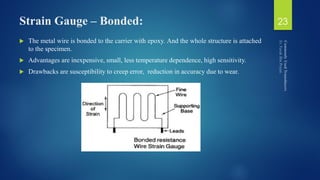
 The metal wire is bonded to the carrier with epoxy. And the whole structure is attached
to the specimen.
 Advantages are inexpensive, small, less temperature dependence, high sensitivity.
 Drawbacks are susceptibility to creep error, reduction in accuracy due to wear.
23
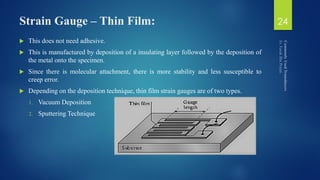
Strain Gauge – Thin Film:
 This does not need adhesive.
 This is manufactured by deposition of a insulating layer followed by the deposition of
the metal onto the specimen.
 Since there is molecular attachment, there is more stability and less susceptible to
creep error.
 Depending on the deposition technique, thin film strain gauges are of two types.
1. Vacuum Deposition
2. Sputtering Technique
24
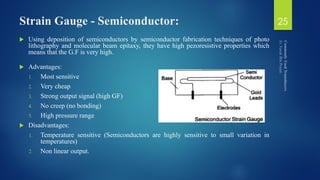
Strain Gauge - Semiconductor:
 Using deposition of semiconductors by semiconductor fabrication techniques of photo
lithography and molecular beam epitaxy, they have high pezoresistive properties which
means that the G.F is very high.
 Advantages:
1. Most sensitive
2. Very cheap
3. Strong output signal (high GF)
4. No creep (no bonding)
5. High pressure range
 Disadvantages:
1. Temperature sensitive (Semiconductors are highly sensitive to small variation in
temperatures)
2. Non linear output.
25
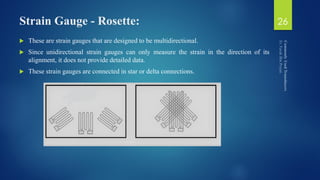
Strain Gauge - Rosette:
 These are strain gauges that are designed to be multidirectional.
 Since unidirectional strain gauges can only measure the strain in the direction of its
alignment, it does not provide detailed data.
 These strain gauges are connected in star or delta connections.
26
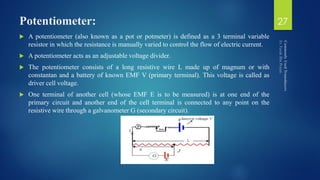
Potentiometer:
 A potentiometer (also known as a pot or potmeter) is defined as a 3 terminal variable
resistor in which the resistance is manually varied to control the flow of electric current.
 A potentiometer acts as an adjustable voltage divider.
 The potentiometer consists of a long resistive wire L made up of magnum or with
constantan and a battery of known EMF V (primary terminal). This voltage is called as
driver cell voltage.
 One terminal of another cell (whose EMF E is to be measured) is at one end of the
primary circuit and another end of the cell terminal is connected to any point on the
resistive wire through a galvanometer G (secondary circuit).
27
Potentiometer - Principle:
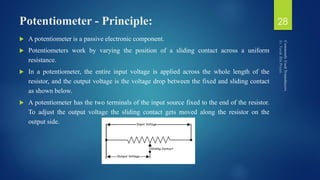
 A potentiometer is a passive electronic component.
 Potentiometers work by varying the position of a sliding contact across a uniform
resistance.
 In a potentiometer, the entire input voltage is applied across the whole length of the
resistor, and the output voltage is the voltage drop between the fixed and sliding contact
as shown below.
 A potentiometer has the two terminals of the input source fixed to the end of the resistor.
To adjust the output voltage the sliding contact gets moved along the resistor on the
output side.
28
Potentiometer Types:
 There are two main types of potentiometers:
1. Rotary potentiometer
2. Linear potentiometer
 Although the basic constructional features of these potentiometers vary, the working
principle of both of these types of potentiometers is the same.
29
Potentiometer - Rotary:
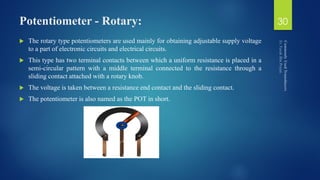
 The rotary type potentiometers are used mainly for obtaining adjustable supply voltage
to a part of electronic circuits and electrical circuits.
 This type has two terminal contacts between which a uniform resistance is placed in a
semi-circular pattern with a middle terminal connected to the resistance through a
sliding contact attached with a rotary knob.
 The voltage is taken between a resistance end contact and the sliding contact.
 The potentiometer is also named as the POT in short.
30
Potentiometer - Linear:
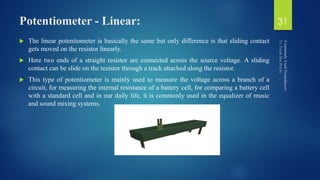
 The linear potentiometer is basically the same but only difference is that sliding contact
gets moved on the resistor linearly.
 Here two ends of a straight resistor are connected across the source voltage. A sliding
contact can be slide on the resistor through a track attached along the resistor.
 This type of potentiometer is mainly used to measure the voltage across a branch of a
circuit, for measuring the internal resistance of a battery cell, for comparing a battery cell
with a standard cell and in our daily life, it is commonly used in the equalizer of music
and sound mixing systems.
31
Potentiometer as Transducer:
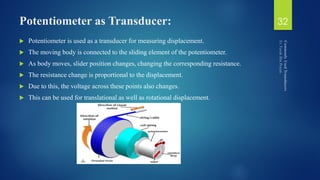
 Potentiometer is used as a transducer for measuring displacement.
 The moving body is connected to the sliding element of the potentiometer.
 As body moves, slider position changes, changing the corresponding resistance.
 The resistance change is proportional to the displacement.
 Due to this, the voltage across these points also changes.
 This can be used for translational as well as rotational displacement.
32
LVDT:
 The term LVDT or Linear Variable Differential Transformer is a robust, complete linear
arrangement transducer and naturally frictionless.
 They have an endless life cycle when it is used properly.
 As AC controlled LVDT does not include any kind of electronics, they intended to work
at very low temperatures otherwise up to 650 °C (1200 °F) in insensitive environments.
 The applications of LVDTs mainly include automation, power turbines, aircraft,
hydraulics, nuclear reactors, satellites, and many more. These types of transducers contain
low physical phenomena and outstanding repetition.
 The LVDT alters a linear dislocation from a mechanical position into a relative electrical
signal including phase and amplitude of the information of direction and distance.
 The operation of LVDT does not need an electrical bond between the touching parts and
coil, but as an alternative depends on the electromagnetic coupling.
33
LVDT:
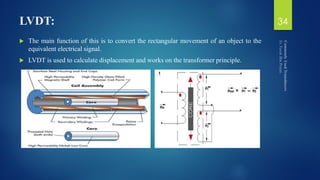
 The main function of this is to convert the rectangular movement of an object to the
equivalent electrical signal.
 LVDT is used to calculate displacement and works on the transformer principle.
34
LVDT:
 LVDT comprises a core as well as a coil assembly.
 The core is protected by the thing whose location is being calculated, while the coil
assembly is increased to a stationary structure.
 The coil assembly includes three wire wound coils on the hollow shape. The inside coil is
the major, which is energized by an AC source. The magnetic flux generated by the main
is attached to the two minor coils, making an AC voltage in every coil.
 There is no material contact across the sensing component.
 As the machine depends on the combination of magnetic flux, this transducer can have an
unlimited resolution.
35
LVDT Construction:
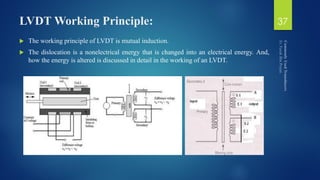
 LVDT comprises of a cylindrical former, which is bounded by one main winding in the
hub of the former and the two minor LVDT windings are wound on the surfaces.
 The amount of twists in both the minor windings is equivalent, but they are reverse to
each other like clockwise direction and anti-clockwise direction.
 For this reason, the output voltages will be the variation in voltages among the two
minor coils. These two coils are denoted with S1 & S2.
 Esteem iron core is located in the middle of the cylindrical former.
 The excitation voltage of AC is 5-12V and the operating frequency is given by 50 to
400 HZ.
 The lower end of both secondary coils S1 and S2 are joined together to get a
differential output.
36
LVDT Working Principle:
 The working principle of LVDT is mutual induction.
 The dislocation is a nonelectrical energy that is changed into an electrical energy. And,
how the energy is altered is discussed in detail in the working of an LVDT.
37
LVDT – Conditions in Operation:
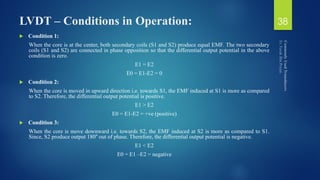
 Condition 1:
When the core is at the center, both secondary coils (S1 and S2) produce equal EMF. The two secondary
coils (S1 and S2) are connected in phase opposition so that the differential output potential in the above
condition is zero.
E1 = E2
E0 = E1-E2 = 0
 Condition 2:
When the core is moved in upward direction i.e. towards S1, the EMF induced at S1 is more as compared
to S2. Therefore, the differential output potential is positive.
E1 > E2
E0 = E1-E2 = +ve (positive)
 Condition 3:
When the core is move downward i.e. towards S2, the EMF induced at S2 is more as compared to S1.
Since, S2 produce output 180° out of phase. Therefore, the differential output potential is negative.
E1 < E2
E0 = E1 –E2 = negative
38
LVDT Types:
 Captive Armature LVDT: These types of LVDTs are superior for lengthy working
series. This LVDTs help to prevent incorrect arrangement because they are directed
and controlled by low resistance assemblies.
 Unguided Armature: These LVDTs have unlimited resolution behavior. The LVDT is
connected to the sample, fitting limply in the cylinder, involving linear transducer’s
body to be held independently.
 Force Extended Armature: Internal spring mechanism is utilized making the electric
motor to move forward the armature constantly. No connection is required between the
armature and the specimen and is used of sluggish moving applications.
39
Pros and Cons of LVDT:
 Pros:
1. High range (1.25 mm – 250 mm).
2. High compassion (40 V/mm).
3. Low power consumption (about 1 W).
4. Linear dislocation into an electrical voltage.
5. It has higher sensitive and precision as the core travels within a hollow former.
6. It has ruggedness.
7. It has low hysteresis and high repeatability.
 Cons:
1. It has large primary voltage produce distortion in output.
2. Temperature and vibration affect the performance.
3. Sensitive to stray magnetic field.
40
Applications of LVDT:
 Applications:
1. It act as a secondary transducer.
2. It is used to measure force, weight, load and pressure.
3. The LVDT can be used for displacement measurement ranging from fraction of mm to
few cm.
4. The LVDT sensor works as the main transducer, and that changes dislocation to
electrical signal straight.
5. LVDT’s are mostly used in industries as well as servomechanisms.
6. Other applications like power turbines, hydraulics, automation, aircraft, and satellites.
41
Pressure Measurement by LVDT:
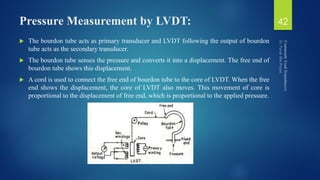
 The bourdon tube acts as primary transducer and LVDT following the output of bourdon
tube acts as the secondary transducer.
 The bourdon tube senses the pressure and converts it into a displacement. The free end of
bourdon tube shows this displacement.
 A cord is used to connect the free end of bourdon tube to the core of LVDT. When the free
end shows the displacement, the core of LVDT also moves. This movement of core is
proportional to the displacement of free end, which is proportional to the applied pressure.
42
Load Cell:
 A load cell is a type of transducer, specifically a force transducer converting a force such
as tension, compression, pressure, or torque into a proportional electrical signal that can
be measured and standardized.
 The figure shows the construction of the tensile compressive cell which is a cylinder. This
arrangement uses four strain gauges, each mounted at 90° to each other.
 On applying load, due to tension, two of the strain gauges experience elongation or tensile
stress while the other two are subjected to compression.
43
Load Cell:
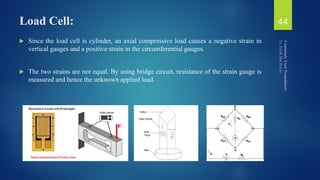
 Since the load cell is cylinder, an axial compressive load causes a negative strain in
vertical gauges and a positive strain in the circumferential gauges.
 The two strains are not equal. By using bridge circuit, resistance of the strain gauge is
measured and hence the unknown applied load.
44
Load Cell - Classification:
 The Load Cell Types are classified based on three criteria. They are
1. Working principle of a load cell
2. Electrical Properties of the load cell
3. Construction of Load Cell
45
Load Cell - Classification:
 Based on the Working Principle of the Load Cell
1. Compression Principle
2. Tensile based Working
3. Universal
4. Hollow
5. Shear Based
 Based on the Electrical Properties of the Load cell
1. Analog and Digital property based load cell
2. Resistance and Capacitance Based
3. Piezoelectric and Wireless Based Load cell
46
Load Cell - Classification:
 Based on the Construction of the Load Cell
1. S type Construction load cell
2. Load Button types
3. Single ended shear beam
4. Double ended shear beam Load cell
5. Single column and Multi Column load cell
6. Pancake Load cell
7. Diaphragm/membrane
8. Torsion Ring Load cell
47
Load Cell Types:
 Load cell designs can be distinguished according to the type of output signal generated
(pneumatic, hydraulic, electric) or according to the way they detect weight (bending,
shear, compression, tension, etc.)
1. Hydraulic load cells are force -balance devices, measuring weight as a change in
pressure of the internal filling fluid confined within an elastomeric diaphragm chamber.
As force increases, the pressure of the hydraulic fluid rises.
2. Pneumatic load cells also operate on the force-balance principle. These devices use
multiple dampener chambers to provide higher accuracy than can a hydraulic device and
also contain no fluids. These are explosion proof and insensitive to temperature but slow
in response.
3. Strain-gage load cells convert the load acting on them into electrical signals. When
weight is applied, the strain changes the electrical resistance of the gauges in proportion
to the load. These offer lower cost and increased accuracy.
48
References:
 https://www.electrical4u.com/transducer-types-of-transducer/
 https://www.electrical4u.com/biomedical-transducers-types-of-biomedical-transducers/
 https://www.allaboutcircuits.com/textbook/direct-current/chpt-9/strain-gauges/
 https://www.electrical4u.com/strain-gauge/
 https://automationforum.in/t/strain-gauge-principle-types-advantages-applications/4949
 http://www.gvpcew.ac.in/unit%202.pdf
 https://en.wikipedia.org/wiki/Potentiometer_(measuring_instrument)
 https://www.elprocus.com/potentiometer-construction-working-and-applications/
 https://www.electrical4u.com/potentiometer/
49
References:
 https://www.elprocus.com/lvdt-working-principle-construction-types-applications-
advantages-and-disadvantages/
 https://www.polytechnichub.com/pressure-measured-using-lvdt/
 https://instrumentationtools.com/load-cell-working-principle/
 https://in.omega.com/prodinfo/loadcells.html
 https://en.wikipedia.org/wiki/Load_cell
50

5 Commonly Used Transducers

  • 1.
    Electrical & ElectronicMeasurement Part – V Commonly Used Transducers ER. FARUK BIN POYEN faruk.poyen@gmail.com AEIE, UIT, BU
  • 2.
    Contents:  Material TransductionProperties  Transducer Types  Active Transducers  Strain Gauge  Potentiometer  LVDT  Load Cell 2
  • 3.
    Material Transduction Properties: 1.Electrostrictive (Ferroelectric) 2. Piezoelectric (Ferroeletric) 3. Piezoresistive 4. Shape Memory Effect (Ferroelastic) 5. Magnetostriction (Ferromagnetic) 6. Magnetostriction Ferromagnetic Shape Memory Alloys (FSMA) 7. Magnetocaloric 8. Thermoelectric 9. Magnetoresistance 10. Pyroelectric 3
  • 4.
    Material Transduction Properties: 1.Electrostrictive (Ferroelectric): Electrostriction is a property of all electrical non- conductors, or dielectrics, that causes them to change their shape under the application of an electric field. 2. Piezoelectric (Ferroelectric): Piezoelectric Effect is the ability of certain materials to generate an electric charge in response to applied mechanical stress. It works the other way as well i.e. on application of electric charge, material deformation takes place. 3. Piezoresistive Effect: The piezoresistive effect is marked by changes in resistance of materials as the result of pressure applied on the structure. 4. Shape Memory Effect (Ferroelastic): It is a phenomenon, in which a material recovers to its original size and shape when heated above a certain characteristic transformation temperature. 4
  • 5.
    Material Transduction Properties: 5.Magnetostriction (Ferromagnetic): Magnetostriction is a property of ferromagnetic materials which causes them to expand or contract in response to a magnetic field. This effect allows magnetostrictive materials to convert electromagnetic energy into mechanical energy. 6. Magnetostriction Ferromagnetic Shape Memory Alloys (FSMA): Magnetic shape memory alloys (MSMAs), also called ferromagnetic shape memory alloys (FSMA), are particular shape memory alloys which produce forces and deformations in response to a magnetic field. The thermal shape memory effect has been obtained in these materials, too. 7. Magnetocaloric Effect: It (MCE) is a heating or cooling (rise or drop in temperature) of a magnetic material when the applied magnetic field changes. 5
  • 6.
    Material Transduction Properties: 8.Thermoelectric Effect: It is the direct conversion of temperature differences to electric voltage and vice versa via a thermocouple. A thermoelectric device creates voltage when there is a different temperature on each side. Conversely, when a voltage is applied to it, heat is transferred from one side to the other, creating a temperature difference. 9. Magnetoresistance: It is the tendency of a material (preferably ferromagnetic) to change the value of its electrical resistance in an externally-applied magnetic field. 10. Pyroelectric Effect: It is the direct conversion of temperature differences to electric voltage and vice versa via a thermocouple. A thermoelectric device creates voltage when there is a different temperature on each side. 6
  • 7.
    Interaction between DifferentProperties:  Chart Representation: Input - Output 7
  • 8.
    Transducer Types –Quantity Measured:  Types of Transducer based on Quantity to be Measured 1. Temperature transducers (e.g. a thermocouple) 2. Pressure transducers (e.g. a diaphragm) 3. Displacement transducers (e.g. LVDT) 4. Oscillator transducer 5. Flow transducers 6. Inductive Transducer 8
  • 9.
    Transducer Types –Operational Principle:  Types of Transducer based on the Principle of Operation 1. Photovoltaic (e.g. a solar cell) 2. Piezoelectric transducer 3. Chemical 4. Mutual induction 5. Electromagnetic 6. Hall effect 7. Photoconductors 9
  • 10.
    Transducer Types –Active & Passive:  Types of Active Transducers 1. Magnetic Induction Type 2. Piezoelectric Type 3. Photovoltaic Type 4. Thermoelectric Type  Types of Passive Transducers 1. Resistive Type 2. Inductive type 3. Capacitive Type 10
  • 11.
    Transducer - MagneticInduction Type:  When an electrical conductor moves in a magnetic field, it changes the magnetic flux through the conductor. This produces a voltage, which is proportional to the rate of change of flux. 𝐼𝑛𝑑𝑢𝑐𝑒𝑑 𝐸𝑀𝐹 𝑒 = −𝐵 ∗ 𝑙 ∗ 𝑉  Applications Magnetic Induction Type Transducers 1. Electromagnetic flow meter 2. Heart sound Microphones 3. Indicating instruments 4. Pen motor in biomedical recorders 11
  • 12.
    Transducer – PiezoelectricType:  When compression or tension is applied to the crystal, charge separation occurs in the crystals. This produces electrical voltage resulting in Piezoelectric Effect.  Piezoelectric transducers convert displacement or pressure into an electrical value.  Barium Titanium, Rochelle salt, Lithium Niobate are few piezoelectric transducer materials.  Applications of Piezoelectric Transducers 1. Piezoelectric Transducer acts as a pulse sensor to measure the pulse rate of a human. 12
  • 13.
    Transducer – PhotovoltaicType:  When light or any other radiation of wavelength falls on the metal or semiconductor surface, it ejects electrons. This is the Photoelectric Effect.  Photoemissive, Photoconductive and photovoltaic are the types of Photoelectric Transducers.  Among these, Photovoltaic is an active transducer which generates an electrical voltage in proportion to the radiation incident on it.  Applications of Photovoltaic Transducers 1. In Photoelectric Plethysmography silicon photovoltaic cells acts as pulse sensor. 2. To measure sodium and potassium ion concentration in a sample using light absorption techniques. 13
  • 14.
    Transducer – ThermoelectricType:  These transducers work based on the Seebeck Effect.  Seebeck effect states that, when two junctions of the thermocouple are at two different temperatures, it generates a potential voltage.  The generated voltage is proportional to the difference in temperature between two junctions of the thermocouple.  Applications of Thermoelectric Transducers 1. To measure physiological temperature in remote sensing circuits and biotelemetry circuits. 2. In the doctor’s cold box to store plasma, antibiotics, etc. 14
  • 15.
    Strain Gauge:  StrainGauge is a device that operates on this principle of elongation and contraction.  A strain gauge is a resistor used to measure strain on an object.  Strain Gauge’s conductors are very thin (1/1000 inch in diameter) for round wires.  It can be thin strips of metallic film deposited on non-conducting substrate ‘carrier’.  Bonded strain gauges are glued to a larger structure under stress.  Un-mounted gauge wire stretched between two mechanical points under tension is also possible.  Strain gauge converts force, pressure, tension, weight etc. into a change in electrical resistance.  Stress (cause) is the object’s internal resisting force.  Strain (effect) is the displacement or deformation that occurs. 15
  • 16.
    Strain Gauge Property: If a strip of conductive metal is stretched, it will become skinnier and longer, both changes resulting in an increase of electrical resistance end-to-end. Conversely, if a strip of conductive metal is placed under compressive force (without buckling), it will broaden and shorten.  If these stresses are kept within the elastic limit of the metal strip (avoiding permanent deform), the strip can be used as a measuring element for physical force, the amount of applied force inferred from measuring its resistance. 16 The change in resistance normally has very small value, and to sense that small change, strain gauge has a long thin metallic strip arrange in a zigzag pattern on a non-conducting material called the carrier, as shown below, so that it can enlarge the small amount of stress in the group of parallel lines and could be measured with high accuracy.
  • 17.
    Strain Gauge –Bridge Balance:  Strain gauge bridge circuit shows the measured stress by the degree of discrepancy, and uses a voltmeter in the center of the bridge to provide an accurate measurement of that imbalance.  In this circuit, R1 and R3 are the ratio arms equal to each other, and R2 is the rheostat arm has a value equal to the strain gage resistance.  When the gauge is unstrained, the bridge is balanced, and voltmeter shows zero value.  As there is a change in resistance of strain gauge, the bridge gets unbalanced and producing an indication at the voltmeter.  The output voltage from the bridge can be amplified further by a differential amplifier. 17
  • 18.
    Strain Gauge -Principle:  Strain gauges are resistance based passive electrical transducers that work on piezoresistive effect.  Resistance of a strained wire is more than the resistance of a un-strained wire of same dimensions.  A change in length (l) or Cross sectional area (A) of the wire alters the resistance. 𝑅 = 𝜌 𝑙 𝐴  Gauge Factor (GF): It is defined as the ratio of change in electrical resistance R to the mechanical strain ɛ. 𝐺𝐹 = ∆𝑅 𝑅 ∆𝐿 𝐿 = ∆𝜌 𝜌 ɛ + 1 + 2𝑣  v is Poisson’s ratio and ρ is resistivity. 18
  • 19.
    Strain Gauge TemperatureError Recompense  With change in temperature, the resistance also changes, causing error in reading.  Self-temperature compensation or dummy strain gauge technique is used to overcome this error.  Most strain gauges are made up of constantan alloy which block temperature effect.  Dummy gauge is used in place of R2 in the quarter bridge to compensate for temperature.  As temperature changes, resistance changes in proportion in both the arms of the rheostat.  The bridge remains in balance and temperature effect gets nullified. 19
  • 20.
    Strain Gauge Configurations: There are three configurations of Strain Gauge:  Quarter-bridge, half-bridge and full bridge configurations give better sensitivity than quarter bridge circuit.  In half-bridge configuration, both the strain gauges are active, increasing sensitivity.  Half-bridge and full-bridge are more sensitive than quarter bridge.  In full-bridge circuit, all four elements are bonded and active.  Full-bridge configuration is the best as it is more sensitive and linear. 20
  • 21.
    Strain Gauge Types: Unbonded Metal  Bonded Metal Wire  Bonded Metal Foil  Thin Film  Semiconductor  Rosette 21
  • 22.
    Strain Gauge -Unbonded:  The wire is not completely bonded with the carrier. It consists of a fixed body and a movable part.  Metal wires connect these two parts and the movable part is in contact with the specimen.  Application of unbounded metal strain gauge: 1. Used in applications where there is a need for removable gauges. 2. Force, Pressure and Acceleration are some quantities measured.  Advantage: High Accuracy; Disadvantage: More space consuming. 22
  • 23.
    Strain Gauge –Bonded:  The metal wire is bonded to the carrier with epoxy. And the whole structure is attached to the specimen.  Advantages are inexpensive, small, less temperature dependence, high sensitivity.  Drawbacks are susceptibility to creep error, reduction in accuracy due to wear. 23
  • 24.
    Strain Gauge –Thin Film:  This does not need adhesive.  This is manufactured by deposition of a insulating layer followed by the deposition of the metal onto the specimen.  Since there is molecular attachment, there is more stability and less susceptible to creep error.  Depending on the deposition technique, thin film strain gauges are of two types. 1. Vacuum Deposition 2. Sputtering Technique 24
  • 25.
    Strain Gauge -Semiconductor:  Using deposition of semiconductors by semiconductor fabrication techniques of photo lithography and molecular beam epitaxy, they have high pezoresistive properties which means that the G.F is very high.  Advantages: 1. Most sensitive 2. Very cheap 3. Strong output signal (high GF) 4. No creep (no bonding) 5. High pressure range  Disadvantages: 1. Temperature sensitive (Semiconductors are highly sensitive to small variation in temperatures) 2. Non linear output. 25
  • 26.
    Strain Gauge -Rosette:  These are strain gauges that are designed to be multidirectional.  Since unidirectional strain gauges can only measure the strain in the direction of its alignment, it does not provide detailed data.  These strain gauges are connected in star or delta connections. 26
  • 27.
    Potentiometer:  A potentiometer(also known as a pot or potmeter) is defined as a 3 terminal variable resistor in which the resistance is manually varied to control the flow of electric current.  A potentiometer acts as an adjustable voltage divider.  The potentiometer consists of a long resistive wire L made up of magnum or with constantan and a battery of known EMF V (primary terminal). This voltage is called as driver cell voltage.  One terminal of another cell (whose EMF E is to be measured) is at one end of the primary circuit and another end of the cell terminal is connected to any point on the resistive wire through a galvanometer G (secondary circuit). 27
  • 28.
    Potentiometer - Principle: A potentiometer is a passive electronic component.  Potentiometers work by varying the position of a sliding contact across a uniform resistance.  In a potentiometer, the entire input voltage is applied across the whole length of the resistor, and the output voltage is the voltage drop between the fixed and sliding contact as shown below.  A potentiometer has the two terminals of the input source fixed to the end of the resistor. To adjust the output voltage the sliding contact gets moved along the resistor on the output side. 28
  • 29.
    Potentiometer Types:  Thereare two main types of potentiometers: 1. Rotary potentiometer 2. Linear potentiometer  Although the basic constructional features of these potentiometers vary, the working principle of both of these types of potentiometers is the same. 29
  • 30.
    Potentiometer - Rotary: The rotary type potentiometers are used mainly for obtaining adjustable supply voltage to a part of electronic circuits and electrical circuits.  This type has two terminal contacts between which a uniform resistance is placed in a semi-circular pattern with a middle terminal connected to the resistance through a sliding contact attached with a rotary knob.  The voltage is taken between a resistance end contact and the sliding contact.  The potentiometer is also named as the POT in short. 30
  • 31.
    Potentiometer - Linear: The linear potentiometer is basically the same but only difference is that sliding contact gets moved on the resistor linearly.  Here two ends of a straight resistor are connected across the source voltage. A sliding contact can be slide on the resistor through a track attached along the resistor.  This type of potentiometer is mainly used to measure the voltage across a branch of a circuit, for measuring the internal resistance of a battery cell, for comparing a battery cell with a standard cell and in our daily life, it is commonly used in the equalizer of music and sound mixing systems. 31
  • 32.
    Potentiometer as Transducer: Potentiometer is used as a transducer for measuring displacement.  The moving body is connected to the sliding element of the potentiometer.  As body moves, slider position changes, changing the corresponding resistance.  The resistance change is proportional to the displacement.  Due to this, the voltage across these points also changes.  This can be used for translational as well as rotational displacement. 32
  • 33.
    LVDT:  The termLVDT or Linear Variable Differential Transformer is a robust, complete linear arrangement transducer and naturally frictionless.  They have an endless life cycle when it is used properly.  As AC controlled LVDT does not include any kind of electronics, they intended to work at very low temperatures otherwise up to 650 °C (1200 °F) in insensitive environments.  The applications of LVDTs mainly include automation, power turbines, aircraft, hydraulics, nuclear reactors, satellites, and many more. These types of transducers contain low physical phenomena and outstanding repetition.  The LVDT alters a linear dislocation from a mechanical position into a relative electrical signal including phase and amplitude of the information of direction and distance.  The operation of LVDT does not need an electrical bond between the touching parts and coil, but as an alternative depends on the electromagnetic coupling. 33
  • 34.
    LVDT:  The mainfunction of this is to convert the rectangular movement of an object to the equivalent electrical signal.  LVDT is used to calculate displacement and works on the transformer principle. 34
  • 35.
    LVDT:  LVDT comprisesa core as well as a coil assembly.  The core is protected by the thing whose location is being calculated, while the coil assembly is increased to a stationary structure.  The coil assembly includes three wire wound coils on the hollow shape. The inside coil is the major, which is energized by an AC source. The magnetic flux generated by the main is attached to the two minor coils, making an AC voltage in every coil.  There is no material contact across the sensing component.  As the machine depends on the combination of magnetic flux, this transducer can have an unlimited resolution. 35
  • 36.
    LVDT Construction:  LVDTcomprises of a cylindrical former, which is bounded by one main winding in the hub of the former and the two minor LVDT windings are wound on the surfaces.  The amount of twists in both the minor windings is equivalent, but they are reverse to each other like clockwise direction and anti-clockwise direction.  For this reason, the output voltages will be the variation in voltages among the two minor coils. These two coils are denoted with S1 & S2.  Esteem iron core is located in the middle of the cylindrical former.  The excitation voltage of AC is 5-12V and the operating frequency is given by 50 to 400 HZ.  The lower end of both secondary coils S1 and S2 are joined together to get a differential output. 36
  • 37.
    LVDT Working Principle: The working principle of LVDT is mutual induction.  The dislocation is a nonelectrical energy that is changed into an electrical energy. And, how the energy is altered is discussed in detail in the working of an LVDT. 37
  • 38.
    LVDT – Conditionsin Operation:  Condition 1: When the core is at the center, both secondary coils (S1 and S2) produce equal EMF. The two secondary coils (S1 and S2) are connected in phase opposition so that the differential output potential in the above condition is zero. E1 = E2 E0 = E1-E2 = 0  Condition 2: When the core is moved in upward direction i.e. towards S1, the EMF induced at S1 is more as compared to S2. Therefore, the differential output potential is positive. E1 > E2 E0 = E1-E2 = +ve (positive)  Condition 3: When the core is move downward i.e. towards S2, the EMF induced at S2 is more as compared to S1. Since, S2 produce output 180° out of phase. Therefore, the differential output potential is negative. E1 < E2 E0 = E1 –E2 = negative 38
  • 39.
    LVDT Types:  CaptiveArmature LVDT: These types of LVDTs are superior for lengthy working series. This LVDTs help to prevent incorrect arrangement because they are directed and controlled by low resistance assemblies.  Unguided Armature: These LVDTs have unlimited resolution behavior. The LVDT is connected to the sample, fitting limply in the cylinder, involving linear transducer’s body to be held independently.  Force Extended Armature: Internal spring mechanism is utilized making the electric motor to move forward the armature constantly. No connection is required between the armature and the specimen and is used of sluggish moving applications. 39
  • 40.
    Pros and Consof LVDT:  Pros: 1. High range (1.25 mm – 250 mm). 2. High compassion (40 V/mm). 3. Low power consumption (about 1 W). 4. Linear dislocation into an electrical voltage. 5. It has higher sensitive and precision as the core travels within a hollow former. 6. It has ruggedness. 7. It has low hysteresis and high repeatability.  Cons: 1. It has large primary voltage produce distortion in output. 2. Temperature and vibration affect the performance. 3. Sensitive to stray magnetic field. 40
  • 41.
    Applications of LVDT: Applications: 1. It act as a secondary transducer. 2. It is used to measure force, weight, load and pressure. 3. The LVDT can be used for displacement measurement ranging from fraction of mm to few cm. 4. The LVDT sensor works as the main transducer, and that changes dislocation to electrical signal straight. 5. LVDT’s are mostly used in industries as well as servomechanisms. 6. Other applications like power turbines, hydraulics, automation, aircraft, and satellites. 41
  • 42.
    Pressure Measurement byLVDT:  The bourdon tube acts as primary transducer and LVDT following the output of bourdon tube acts as the secondary transducer.  The bourdon tube senses the pressure and converts it into a displacement. The free end of bourdon tube shows this displacement.  A cord is used to connect the free end of bourdon tube to the core of LVDT. When the free end shows the displacement, the core of LVDT also moves. This movement of core is proportional to the displacement of free end, which is proportional to the applied pressure. 42
  • 43.
    Load Cell:  Aload cell is a type of transducer, specifically a force transducer converting a force such as tension, compression, pressure, or torque into a proportional electrical signal that can be measured and standardized.  The figure shows the construction of the tensile compressive cell which is a cylinder. This arrangement uses four strain gauges, each mounted at 90° to each other.  On applying load, due to tension, two of the strain gauges experience elongation or tensile stress while the other two are subjected to compression. 43
  • 44.
    Load Cell:  Sincethe load cell is cylinder, an axial compressive load causes a negative strain in vertical gauges and a positive strain in the circumferential gauges.  The two strains are not equal. By using bridge circuit, resistance of the strain gauge is measured and hence the unknown applied load. 44
  • 45.
    Load Cell -Classification:  The Load Cell Types are classified based on three criteria. They are 1. Working principle of a load cell 2. Electrical Properties of the load cell 3. Construction of Load Cell 45
  • 46.
    Load Cell -Classification:  Based on the Working Principle of the Load Cell 1. Compression Principle 2. Tensile based Working 3. Universal 4. Hollow 5. Shear Based  Based on the Electrical Properties of the Load cell 1. Analog and Digital property based load cell 2. Resistance and Capacitance Based 3. Piezoelectric and Wireless Based Load cell 46
  • 47.
    Load Cell -Classification:  Based on the Construction of the Load Cell 1. S type Construction load cell 2. Load Button types 3. Single ended shear beam 4. Double ended shear beam Load cell 5. Single column and Multi Column load cell 6. Pancake Load cell 7. Diaphragm/membrane 8. Torsion Ring Load cell 47
  • 48.
    Load Cell Types: Load cell designs can be distinguished according to the type of output signal generated (pneumatic, hydraulic, electric) or according to the way they detect weight (bending, shear, compression, tension, etc.) 1. Hydraulic load cells are force -balance devices, measuring weight as a change in pressure of the internal filling fluid confined within an elastomeric diaphragm chamber. As force increases, the pressure of the hydraulic fluid rises. 2. Pneumatic load cells also operate on the force-balance principle. These devices use multiple dampener chambers to provide higher accuracy than can a hydraulic device and also contain no fluids. These are explosion proof and insensitive to temperature but slow in response. 3. Strain-gage load cells convert the load acting on them into electrical signals. When weight is applied, the strain changes the electrical resistance of the gauges in proportion to the load. These offer lower cost and increased accuracy. 48
  • 49.
    References:  https://www.electrical4u.com/transducer-types-of-transducer/  https://www.electrical4u.com/biomedical-transducers-types-of-biomedical-transducers/ https://www.allaboutcircuits.com/textbook/direct-current/chpt-9/strain-gauges/  https://www.electrical4u.com/strain-gauge/  https://automationforum.in/t/strain-gauge-principle-types-advantages-applications/4949  http://www.gvpcew.ac.in/unit%202.pdf  https://en.wikipedia.org/wiki/Potentiometer_(measuring_instrument)  https://www.elprocus.com/potentiometer-construction-working-and-applications/  https://www.electrical4u.com/potentiometer/ 49
  • 50.
    References:  https://www.elprocus.com/lvdt-working-principle-construction-types-applications- advantages-and-disadvantages/  https://www.polytechnichub.com/pressure-measured-using-lvdt/ https://instrumentationtools.com/load-cell-working-principle/  https://in.omega.com/prodinfo/loadcells.html  https://en.wikipedia.org/wiki/Load_cell 50