The document discusses pH and how it is measured using a pH electrode. It defines pH as the negative logarithm of hydrogen ion concentration on a scale of 0-14. It then explains that a pH electrode consists of a sensing glass bulb electrode and a reference electrode connected by an internal electrolyte solution. The sensing electrode develops a potential based on the hydrogen ion activity of the sample solution. The reference electrode provides a stable reference potential for comparison. The document outlines factors that can affect pH measurement accuracy such as temperature, ion interference, and conductivity. It also discusses electrode calibration using buffer solutions of known pH values.
www.hannainst.in
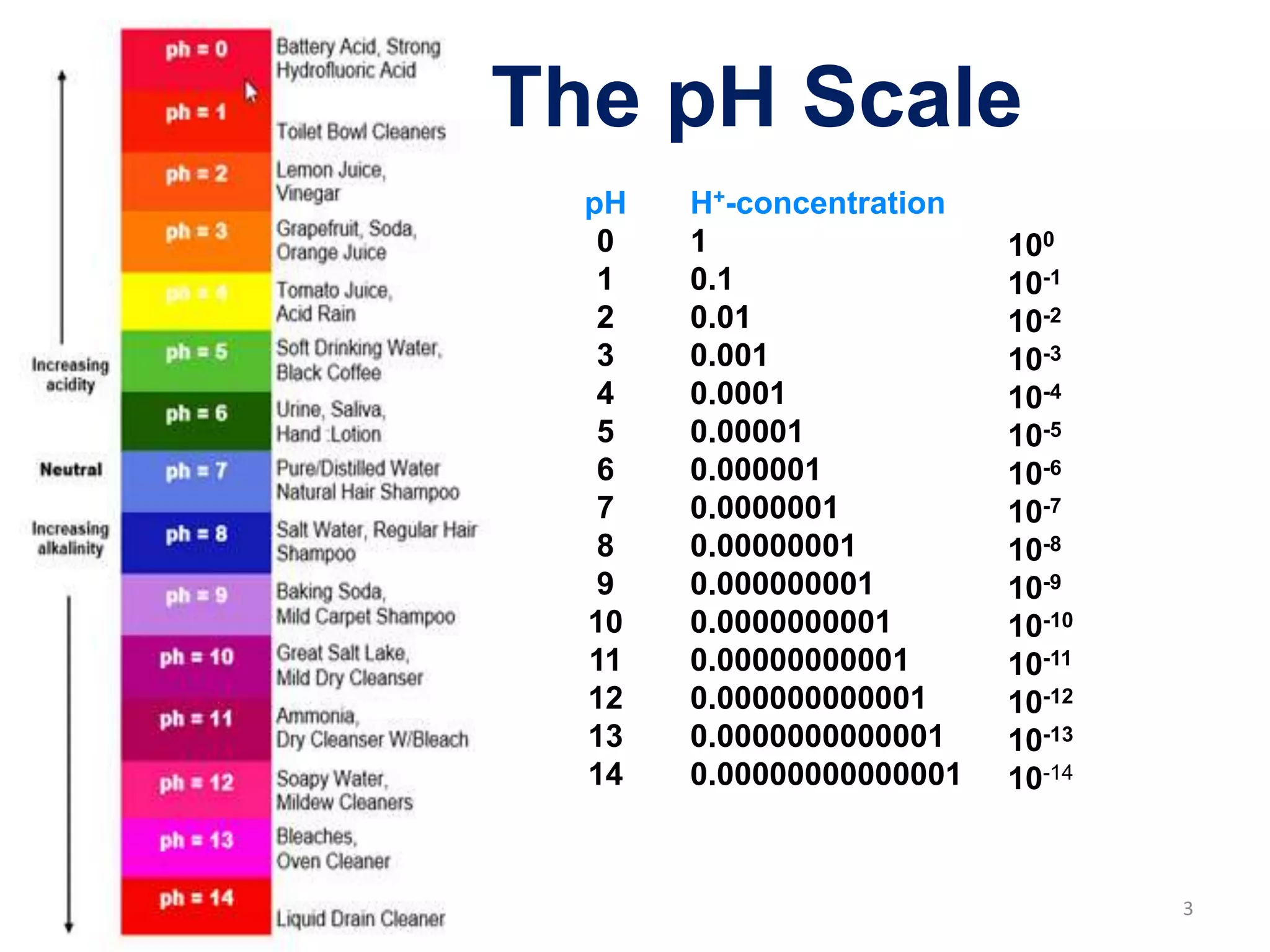
What is pH?
pHis defined as the negative logarithm of the Hydrogen ion
concentration. It is the measure of Acidity and Alkalinity,
measured commonly from 0 to 14.
2
Number of Hydrogen ions (H+) present determine if a solution is Acidic or Alkaline
Logarithm of H+ Concentration in pH14
• Log(0.00000000000001) = Log(10-14 ) = -14
Logarithm of H+ Concentration in pH 7
• Log(0.0000001) = Log(10-7 ) = -7
Logarithm of H+ Concentration in pH1
• Log(0.1) = Log(10-1 ) = -1
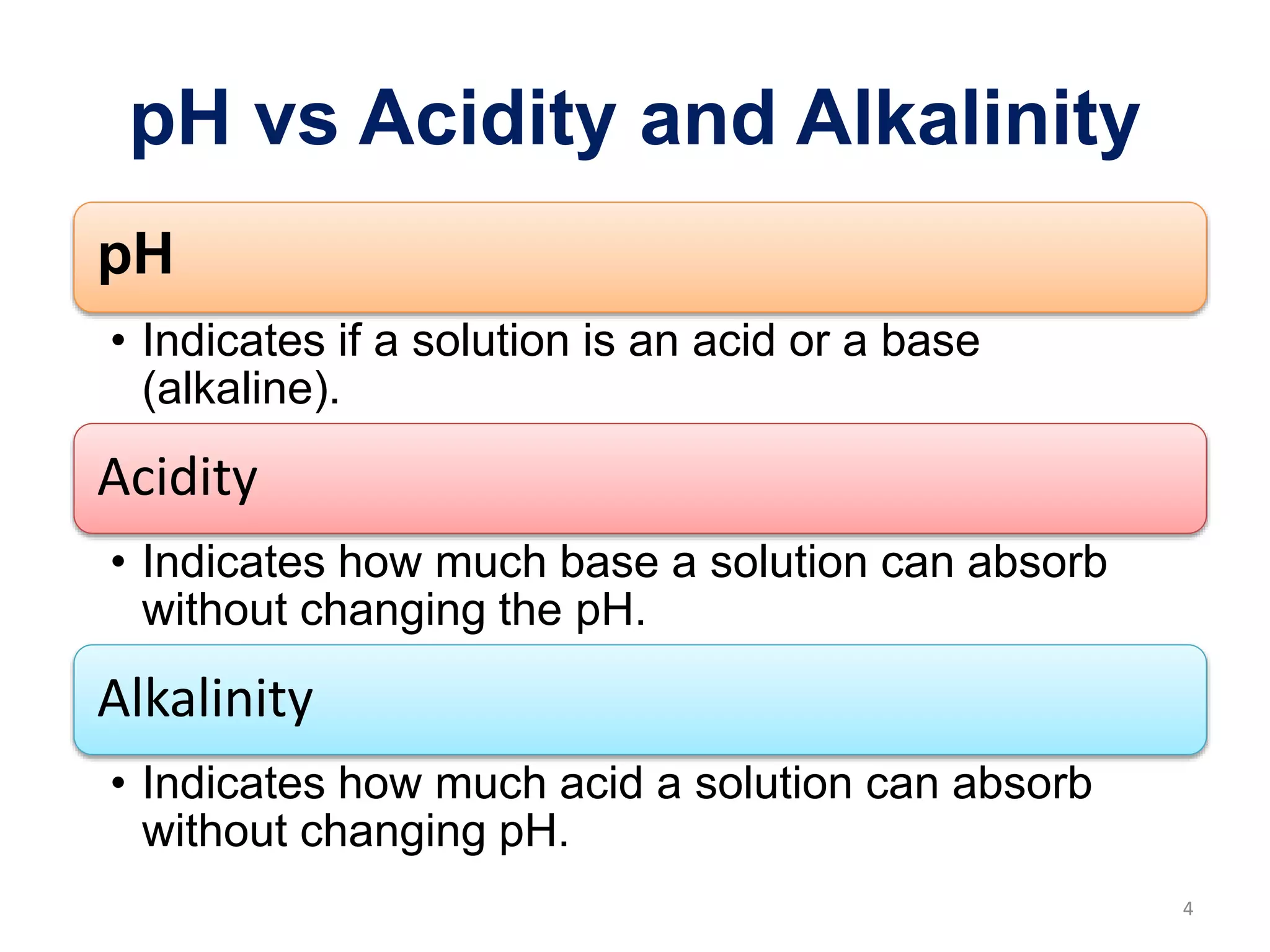
pH vs Acidityand Alkalinity
4
pH
• Indicates if a solution is an acid or a base
(alkaline).
Acidity
• Indicates how much base a solution can absorb
without changing the pH.
Alkalinity
• Indicates how much acid a solution can absorb
without changing pH.
Elements of aPotentiometric cell?
6
pH Indicator electrode
• To sense Hydrogen Ion activity
Reference electrode
• To provide stable reference voltage
Sample Solution
• Sample of which pH is to measured
Volta meter
• To measure generated voltage
7.
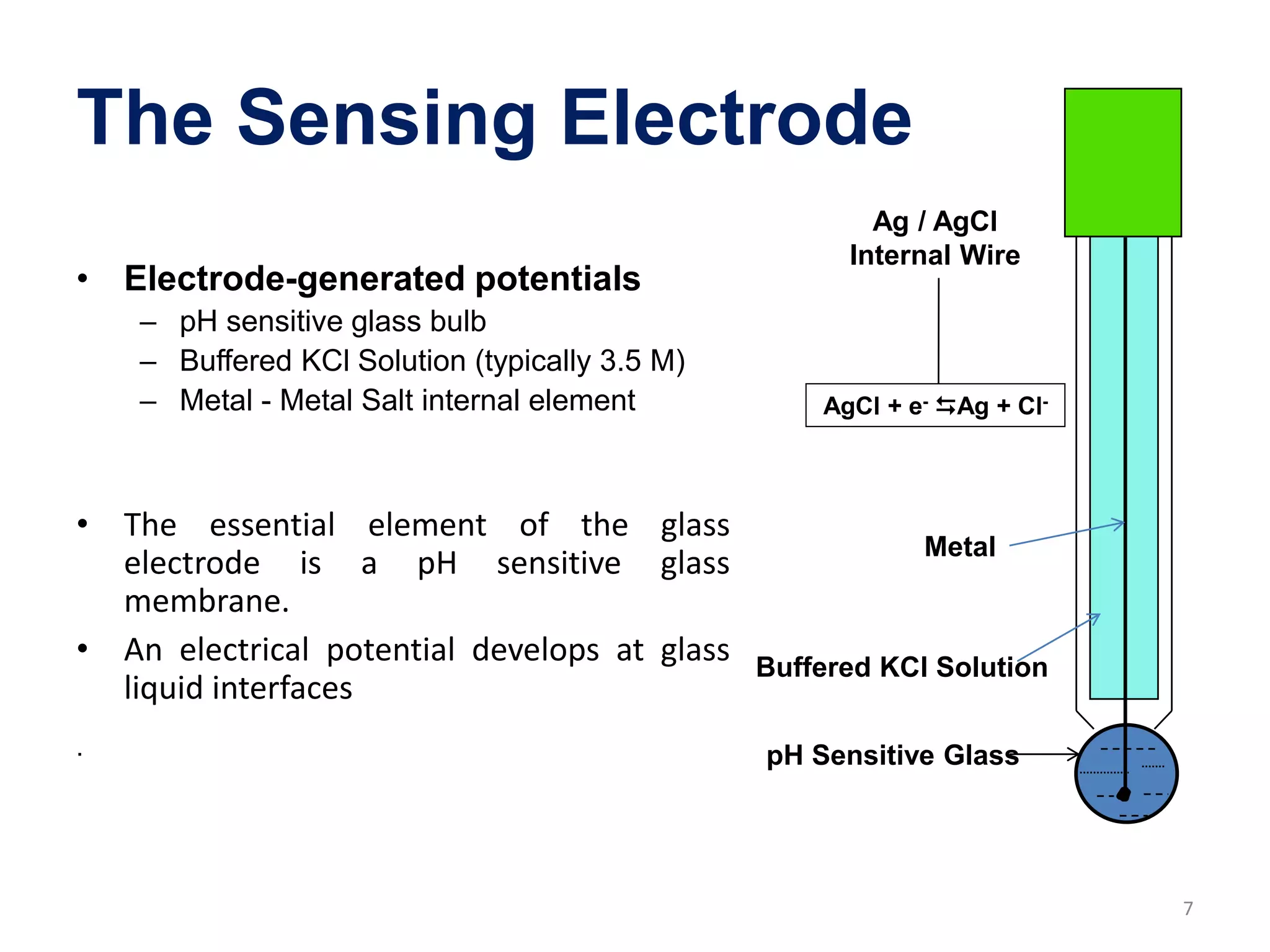
The Sensing Electrode
•Electrode-generated potentials
– pH sensitive glass bulb
– Buffered KCl Solution (typically 3.5 M)
– Metal - Metal Salt internal element
• The essential element of the glass
electrode is a pH sensitive glass
membrane.
• An electrical potential develops at glass
liquid interfaces
.
Ag / AgCl
Internal Wire
AgCl + e- Ag + Cl-
Metal
Buffered KCl Solution
pH Sensitive Glass
7
8.
Reference Electrode
Two functions:
1.Supply a stable reference potential against which
any change in the indicator electrode is
measured.
2. Provide electrical continuity with the solution
being analyzed.
The primary requirement of a reference electrode is...
STABILITY!
8
9.
Types of pHelectrode
• Depending on the constructing criteria pH
electrodes are:
• Single (half cell)
• Combined
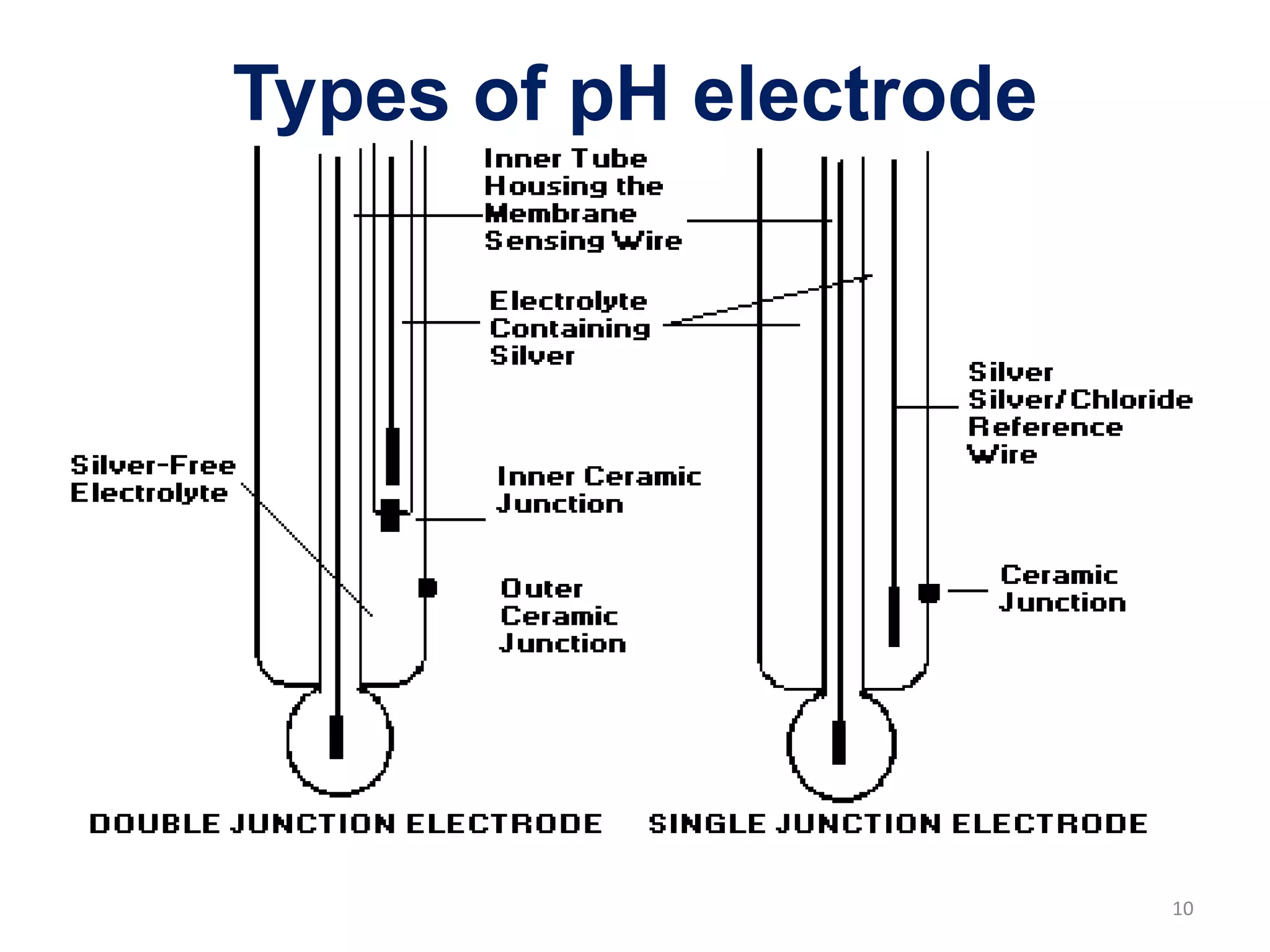
• Single junction electrodes
• Double junction electrodes
9
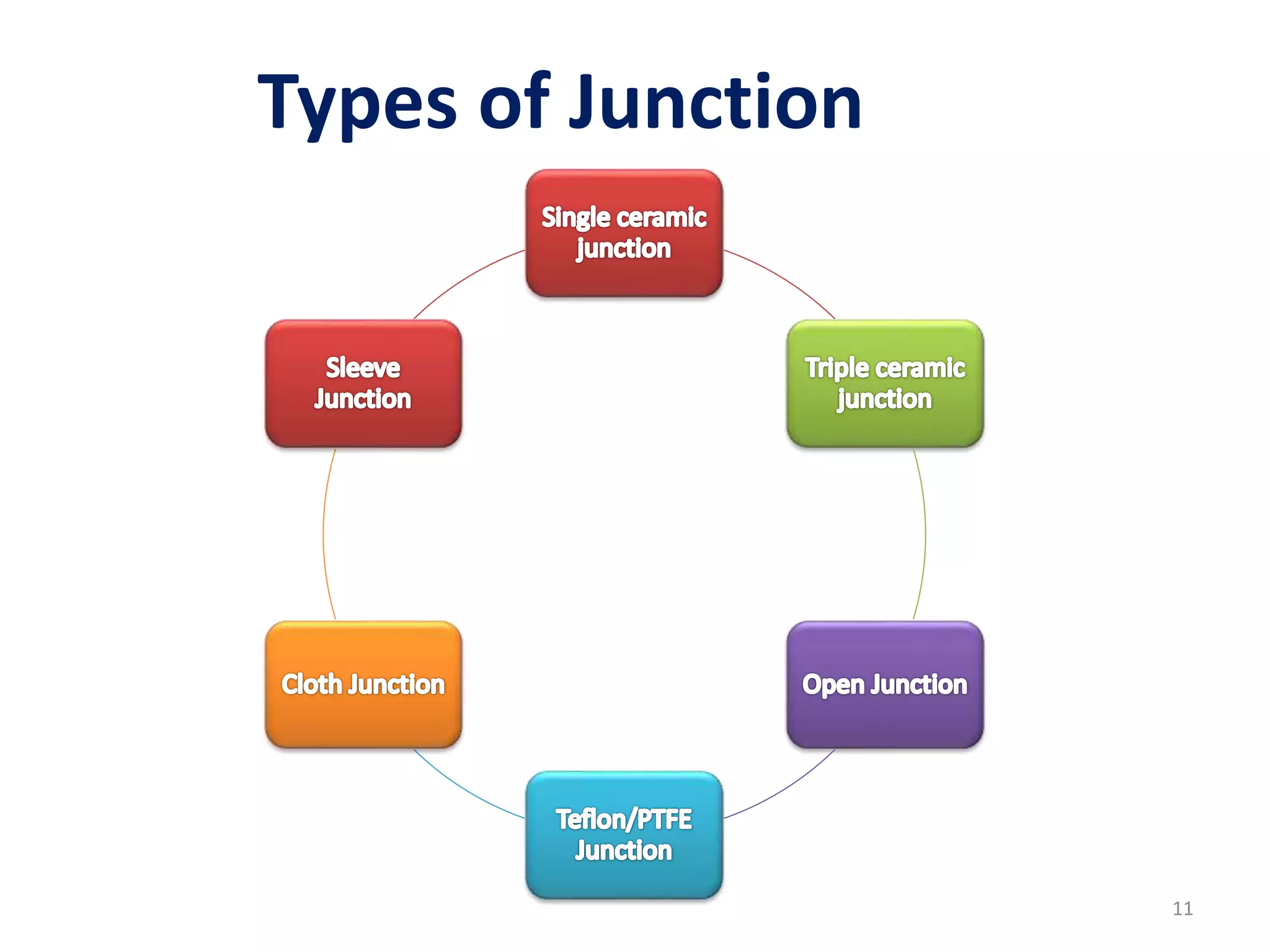
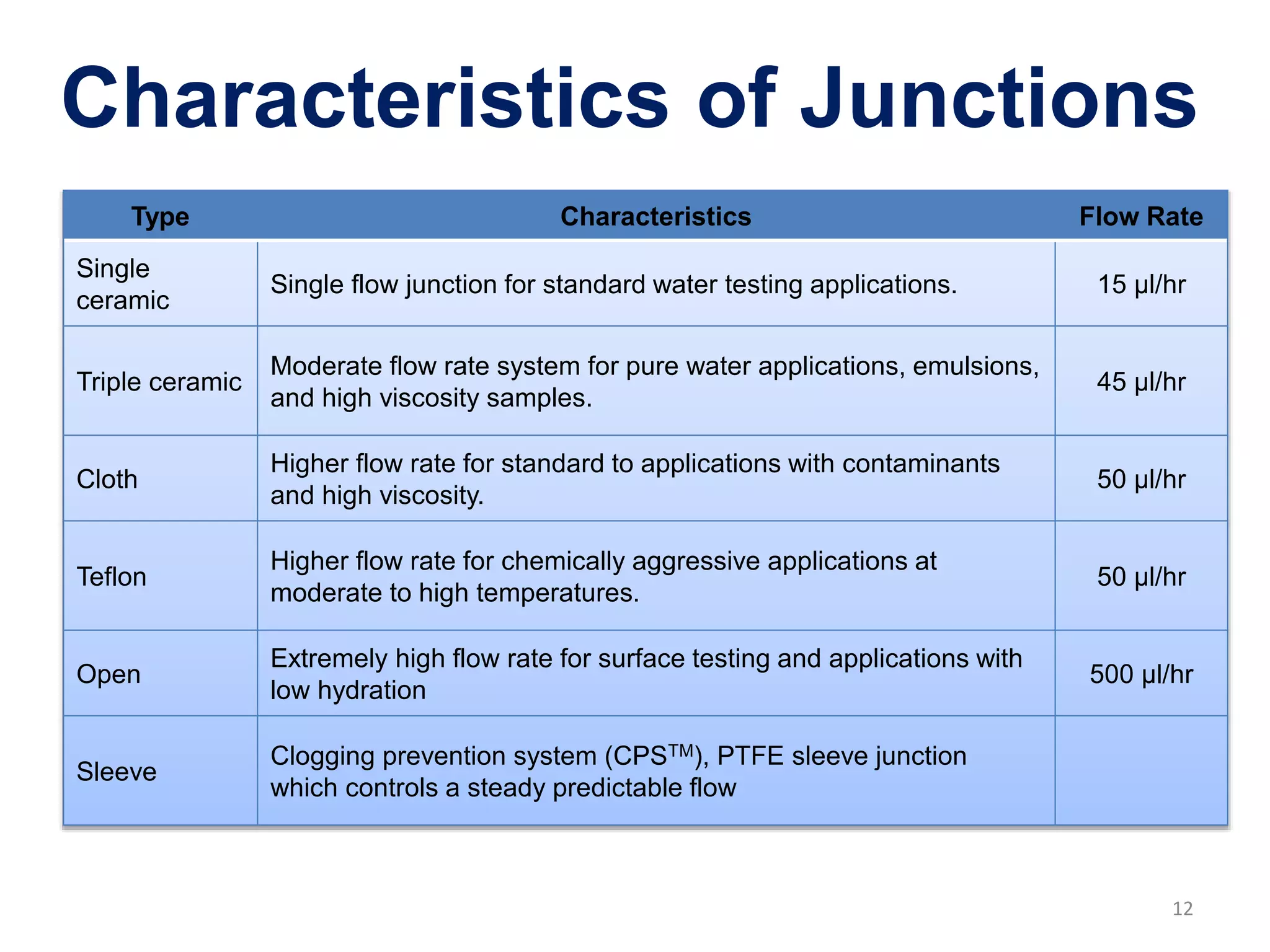
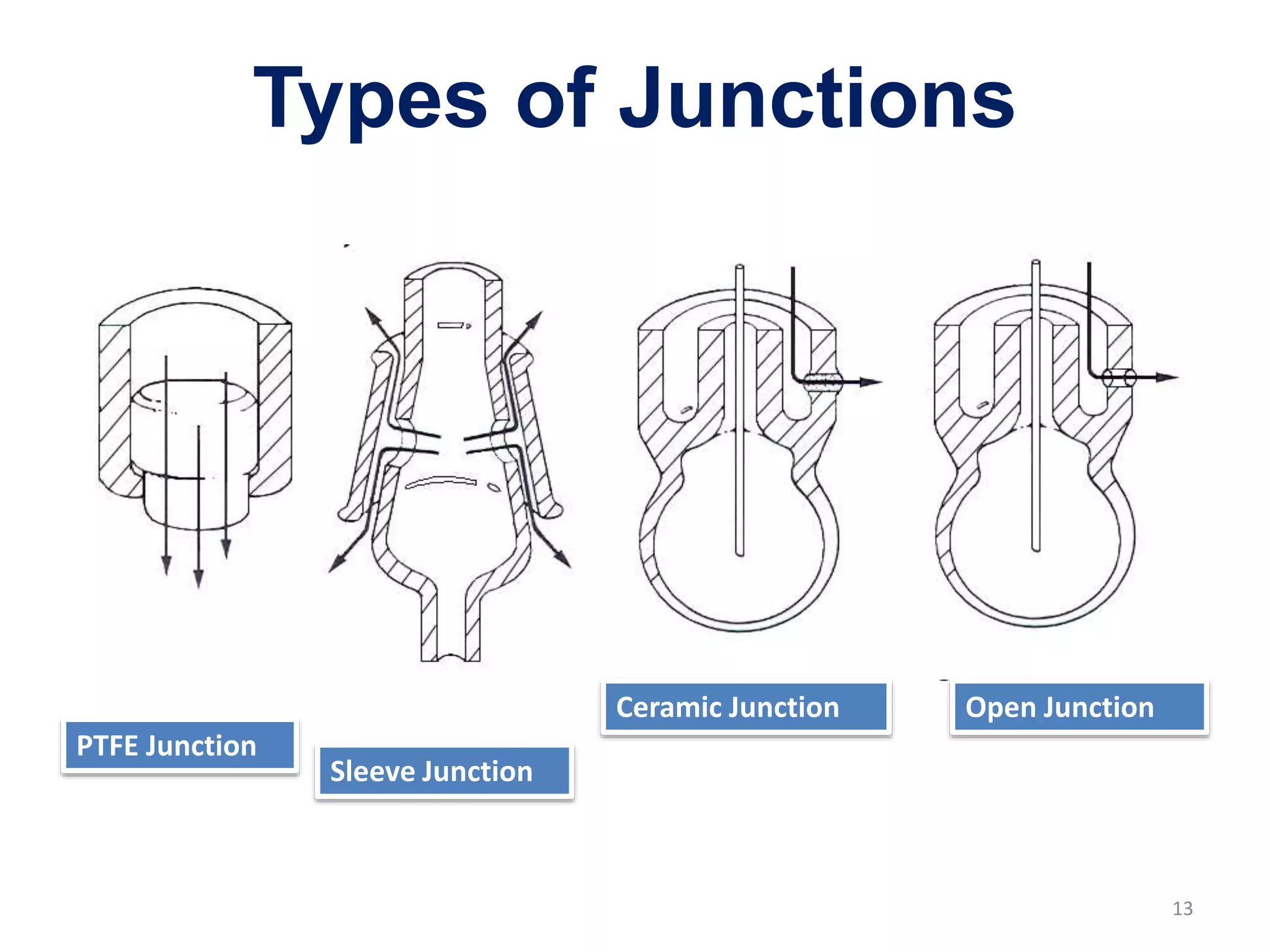
Characteristics of Junctions
TypeCharacteristics Flow Rate
Single
ceramic
Single flow junction for standard water testing applications. 15 μl/hr
Triple ceramic
Moderate flow rate system for pure water applications, emulsions,
and high viscosity samples.
45 μl/hr
Cloth
Higher flow rate for standard to applications with contaminants
and high viscosity.
50 μl/hr
Teflon
Higher flow rate for chemically aggressive applications at
moderate to high temperatures.
50 μl/hr
Open
Extremely high flow rate for surface testing and applications with
low hydration
500 μl/hr
Sleeve
Clogging prevention system (CPSTM), PTFE sleeve junction
which controls a steady predictable flow
12
15
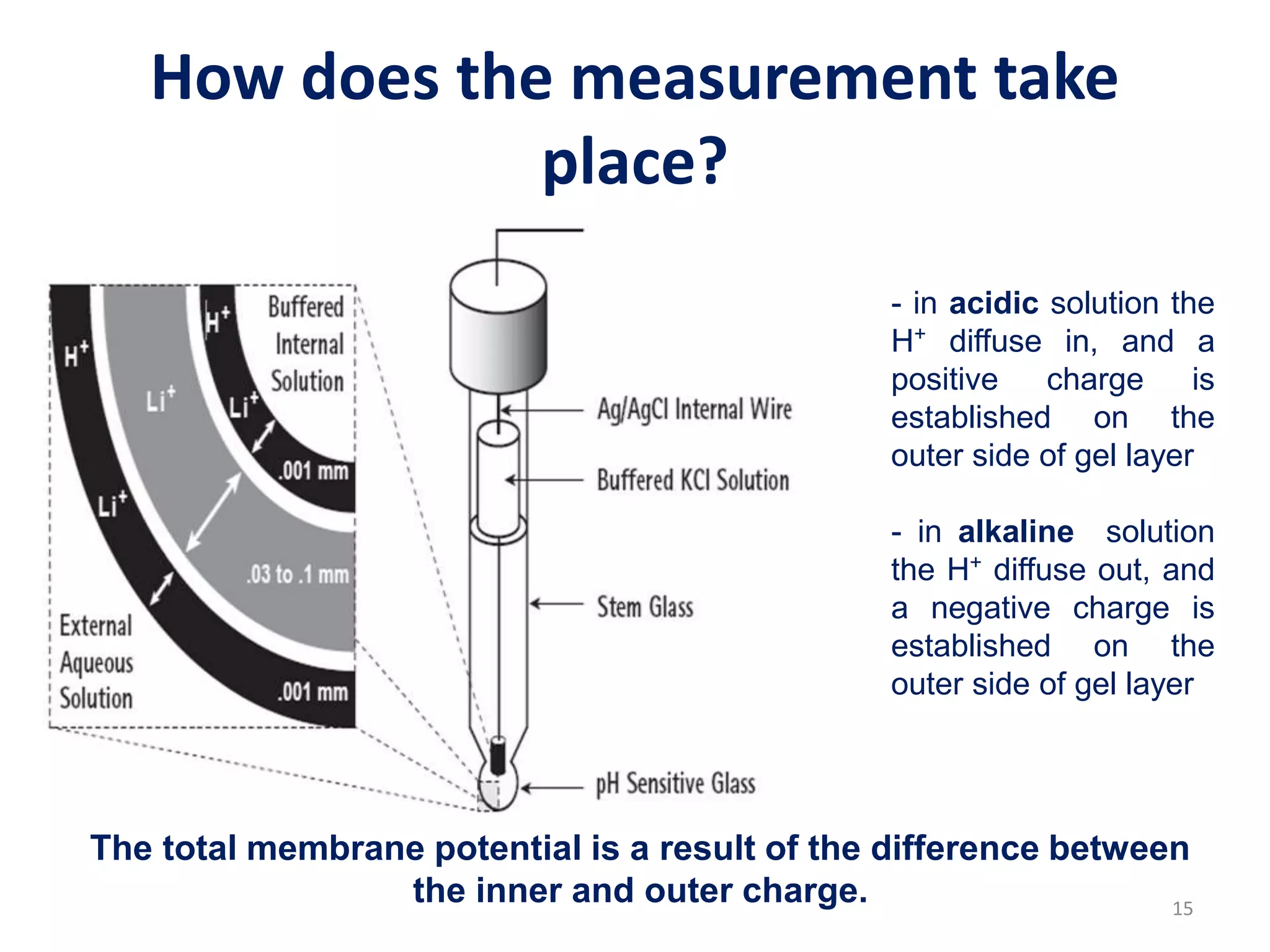
How does themeasurement take
place?
- in acidic solution the
H+
diffuse in, and a
positive charge is
established on the
outer side of gel layer
- in alkaline solution
the H+
diffuse out, and
a negative charge is
established on the
outer side of gel layer
The total membrane potential is a result of the difference between
the inner and outer charge.
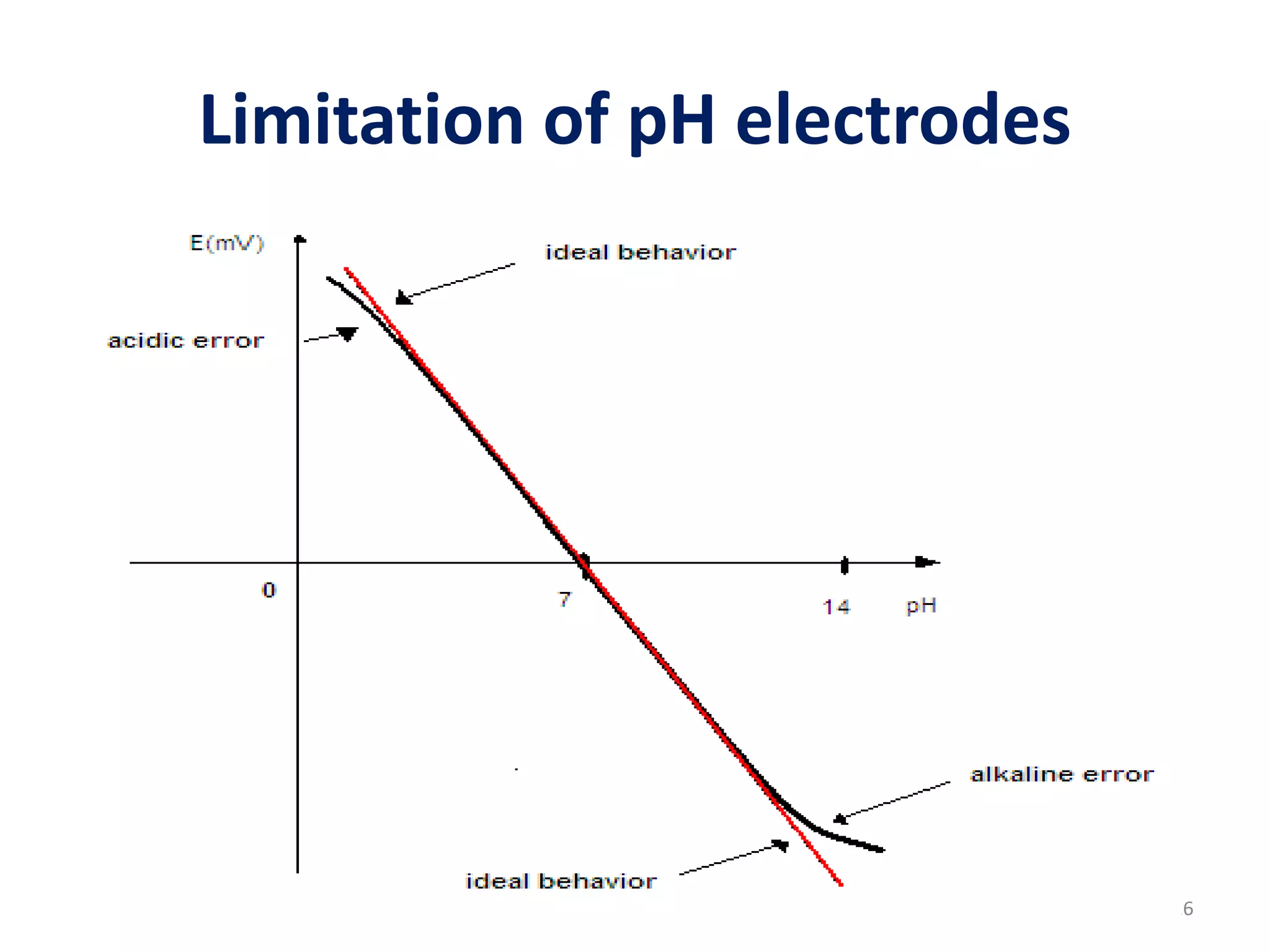
Acid Error andAlkali Error
• Gel layer absorbs acid
molecules
– Increases the layer’s
H+ ion activity
because it has
become dehydrated.
– Creates a higher
(more basic) reading
than the actual value.
– Decreased efficiency.
• Only noticeable at very
low pH values
• H+ ions in the gel layer are
partially or completely
replaced by alkali Ions,
particularly sodium ions.
• Low H+ ion activity of the
gel layer results in lower
(more acidic) pH than
actual values.
17
18.
18
Elements that competein pH
measurement
Temperature effect
• pH value changes with temperature
• The slope of the electrode changes with the
temperature
• High temperature shortens the life span of
the electrode
Interference Effect
• Interference due to Sodium Ions
Conductivity Effect
• Low conductivity effect stability.
Bulb Shapes
20
Spherical tip
•is recommended for general use in aqueous or
liquid solutions and provides a wide area of contact
with the solution
Conical tip
• is recommended for semi-solid products like
emulsions, cheese, meat and food, in general.
Flat tip
• is recommended for direct surface measurement on
skin, leather paper, etc…
21.
The Nernst Equation
•Electrode cell potentials and hydrogen ion activity are
related by the Nernst Equation, which states:
𝑬 𝒐𝒃𝒔 = 𝑬 𝒄 + ln(𝟏𝟎)(𝑹𝑻 / 𝒏𝑭) log(𝒂𝑯
+
)
– Eobs = Observed potential (sum of reference and liquid junction potentials)
– Ec = Reference potential including other stable and fixed potentials
– R = Gas Constant (8.31432J / KMol)
– T = Temperature in Kelvin (C° + 273.15)
– n = Valency of the ion measured (1)
– F =Faraday’s constant (9.64845 x 10⁴)
– aH+= The Hydrogen ion activity
21
22.
Slope and Offset
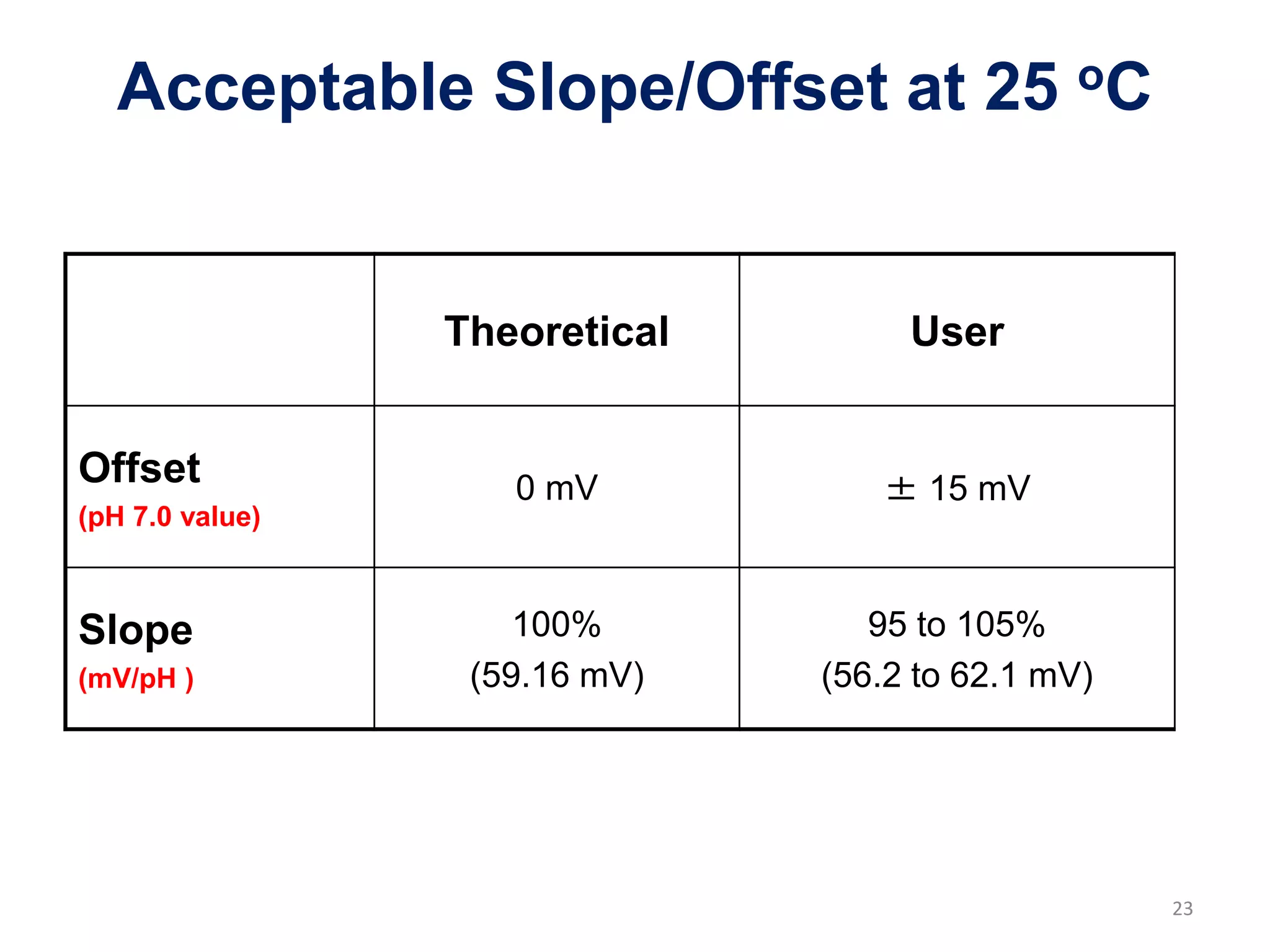
•Offset is the mV generated at pH 7
• Theoretically offset should be 0 mV
• Slope is the change in mV potential
per pH unit
• Theoretical slope is + 59.16 mV
(@25 oC)
• Relative to pH 7.0
– Acids will generate an
increasingly positive voltage.
– Bases will generate an
increasingly negative voltage.
Slope
-450
-350
-250
-150
-50
50
150
250
350
450
0 2 4 6 8 10 12 14
mV
pH
22
𝑺𝒍𝒐𝒑𝒆% =
𝒅𝒊𝒇𝒇𝒆𝒓𝒆𝒏𝒄𝒆 𝒃𝒆𝒕𝒘𝒆𝒆𝒏 𝒎𝑽 𝒈𝒆𝒏𝒆𝒓𝒂𝒕𝒆𝒅 𝒂𝒕 𝒕𝒘𝒐 𝒑𝒐𝒊𝒏𝒕𝒔
𝒅𝒊𝒇𝒇𝒆𝒓𝒆𝒏𝒄𝒆 𝒃𝒆𝒕𝒘𝒆𝒆𝒏 𝒑𝑯 𝒖𝒏𝒊𝒕𝒔 ∗ 𝟓𝟗. 𝟏𝟔
× 𝟏𝟎𝟎
23.
Acceptable Slope/Offset at25 oC
Theoretical User
Offset
(pH 7.0 value)
0 mV ± 15 mV
Slope
(mV/pH )
100%
(59.16 mV)
95 to 105%
(56.2 to 62.1 mV)
23
24.
24
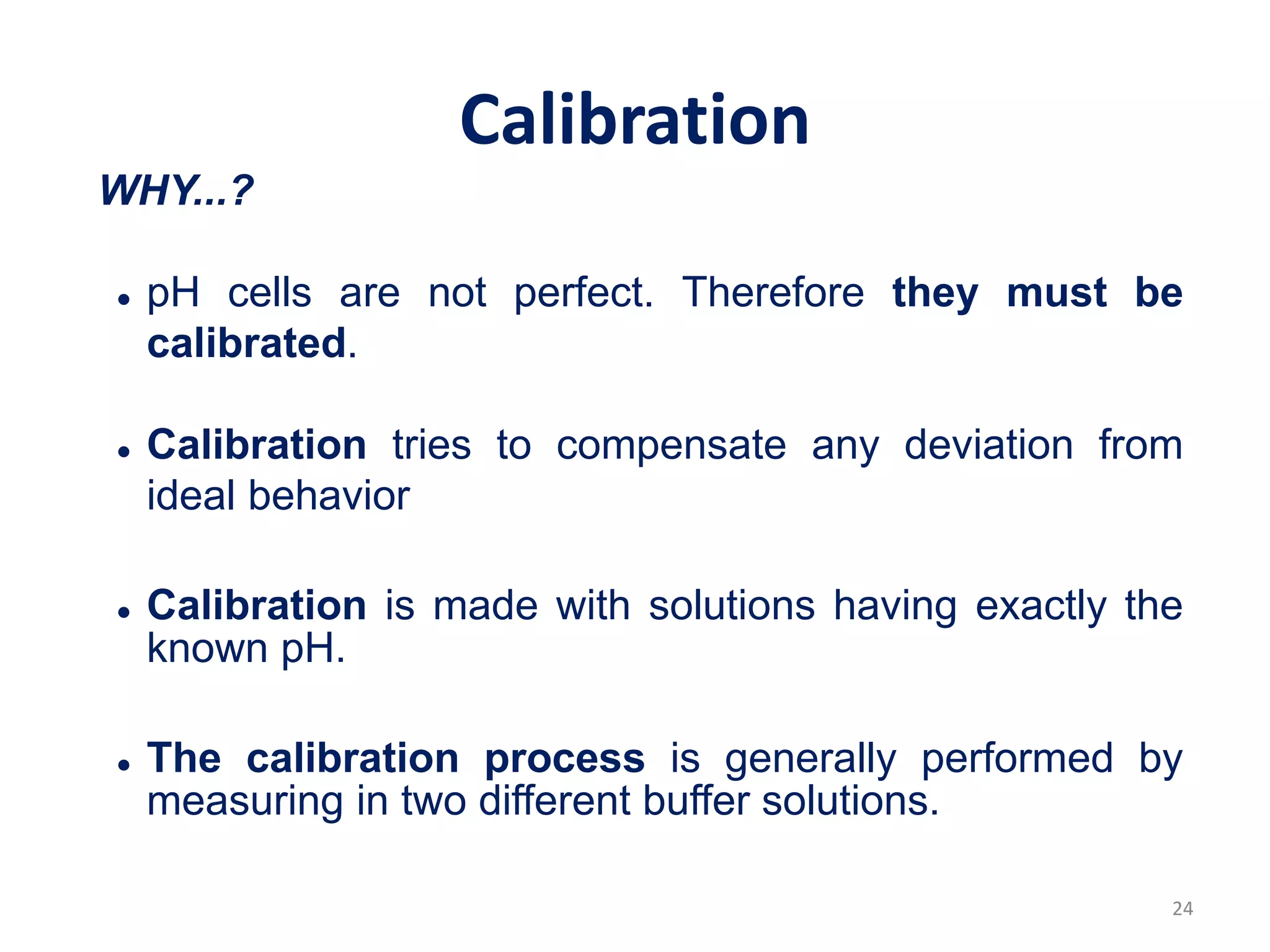
Calibration
WHY...?
pH cellsare not perfect. Therefore they must be
calibrated.
Calibration tries to compensate any deviation from
ideal behavior
Calibration is made with solutions having exactly the
known pH.
The calibration process is generally performed by
measuring in two different buffer solutions.
25.
25
Steps for theCalibration Process
Rinsing solutions
1
2
3 4
5
6
Measuring solutions
26.
Electrode Behavior
• pHelectrodes differ from ideal behavior due to:
– Electrode condition and cleaning
– Electrode aging
– Manufacturing process
• Calibration tries to compensate for all the above
effects without knowing which effect is causing the
deviation from ideal behavior.
26
27.
27
Possible errors duringpH
measurement
Offset Error
Error in mV of slope points
Use of contaminated buffers
Clogged junction.
Calibrating dirty electrode
Storing pH electrode dry or in DI water
Wiping the sensing glass of pH electrode
Calibrating/ measuring with closed filling cap
Low electrolyte fill level
Use application specificelectrode
• Make sure that you use electrode that is
suitable to your application
• Flowrate of electrolyte is enough to get fast
and stable readings
• Junction and membrane suits the sample and
is in contact with sample simultaneously.
29