ASSESSMENT OF WATER QUALITY PARAMETERS ON MANIMUTHAR DAM, RIVER AND CANAL
A MINI-PROJECT REPORT
Submitted to the
MANONMANIAM SUNDARANAR UNIVERSITY
Submitted By
K. AJAY KALLAPIRAN
INTEGRATED ENVIRONMENTAL SCIENCES
(Reg No. 361139)
Under the Guidance of
Dr. G. ANNADURAI
Professor and Head
MANONMANIAM SUNDARANAR UNIVERSITY
SRI PARAMAKALYANI CENTRE OF EXCELLENCE IN
ENVIRONMENTAL SCIENCES,
ALWARKURICHI-627412, TAMILNADU.
MAY 2019
CONTENT
I. INTRODUCTION
II. THE IMPORTANCE OF WATER
III. MANIMUTHAR DAM
IV. EXPERIMENTAL
V. CONCLUSION
VI.BIBLIOGRAPHY
▪ Water quality testing is an important part of environmental monitoring.
When water quality is poor, it affects not only aquatic life but the
surrounding ecosystem as well.
▪ Also, humans can know about the permissible limit and about some details of
water and he could be aware of taking the water which is beyond its
permissible limit.
▪ Every water which is to be purified was initially tested in an industry or
company.
▪ Hence, we should consume the water which was standardized by BIS,
USEPA, ISI, ICMR, and CPCB.
INTRODUCTION
THE IMPORTANCE OF WATER
▪ It is a basic resource.
▪ All plants and animals must have water to survive.
▪ If there was no water there would be no life on earth basic resource.
▪ Water is involved in every bodily function from digestion and circulation.
▪ It regulates the activities of fluids, tissues, cells, lymph, blood and glandular secretions.
MANIMUTHAR DAM
▪ It is the biggest reservoir of the Tirunelveli district.
▪ This dam was built in 1958 near Singampatti by our Tamil Nadu Chief Minister Kamaraj
and K T Kosalram MP to prevent mixing of rainwater with the Bay of Bengal during the
rainy season.
▪ The dam is 5,511 million cubic feet.
▪ The total length of the dam is 3 km It irrigated around 65,000 acres of areas.
Fig. Manimuthar Dam
Collection of water sample from Manimuthar river
EXPERIMENTAL
PHYSICAL PARAMETERS OF THE WATER
APPEARANCE
▪ This parameter was done by visual method based on the type of
water sample.
▪ If the water sample is collected from the sewage, it will bear dark
grey in color.
▪ It is due to the presence of bacteria present in the water sample.
Some of the water sample will be pure and white, as it was collected
from dams or river.
Manimuthar Dam Manimuthar CanalManimuthar River
APPEARANCE
Clear Clear Clear
pH
▪ Hydrogen ion activity.
▪ pH is the intensity of the acidic or basic character
▪ The pH scale is a series of numbers which measure acidity or
alkalinity.
▪ These numbers are shown from 0 to 14 and each number
represents a definite degree of acidity or alkalinity.
▪ pH (p=power; H=hydrogen ion concentration) value is negative
logarithm of hydrogen ion concentration [= -log H+ ].
Fig. pH meter
Manimuthar Dam Manimuthar CanalManimuthar River
pH
9.38 7.32 6.53
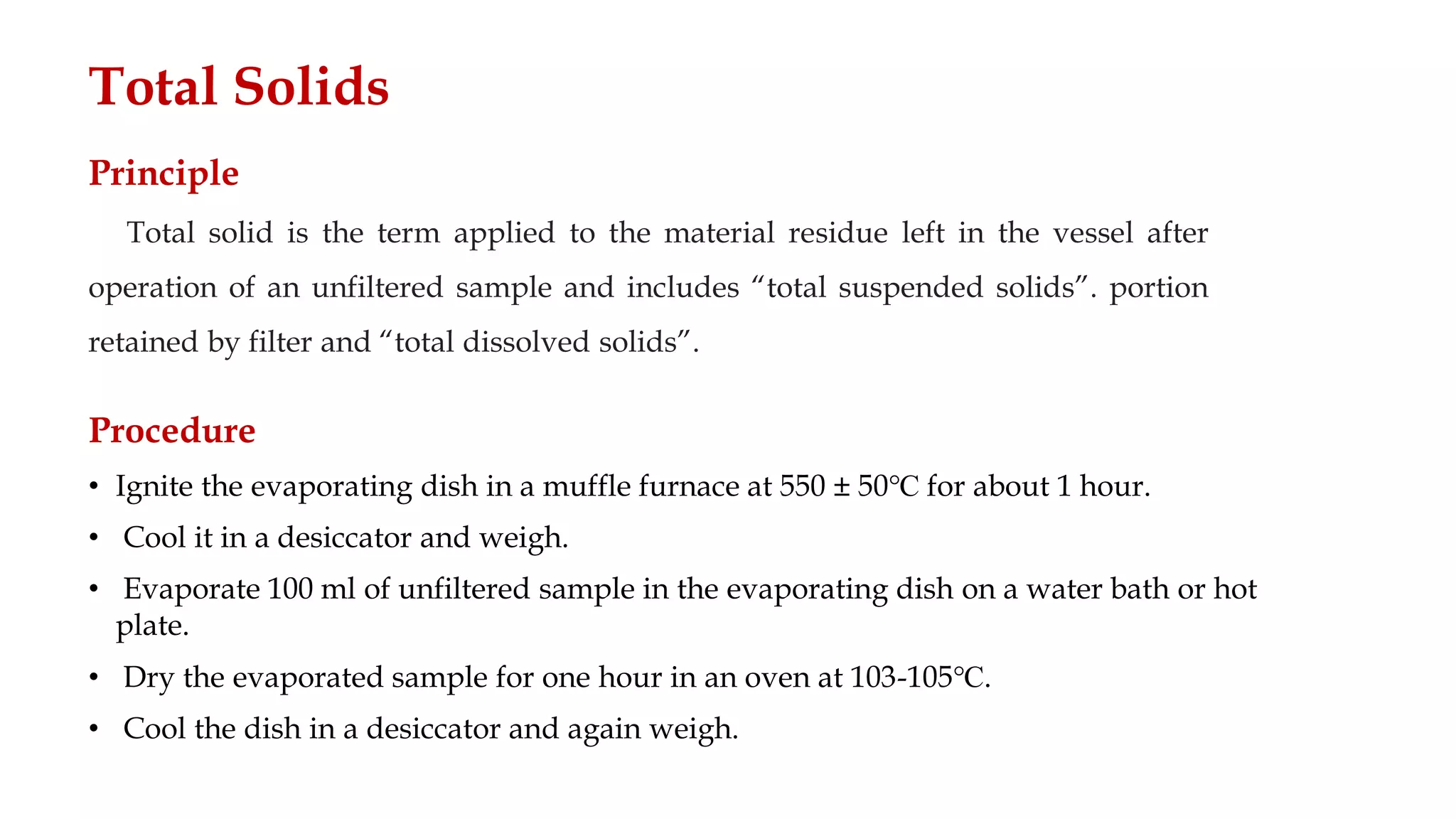
Total Solids
Principle
Total solid is the term applied to the material residue left in the vessel after
operation of an unfiltered sample and includes “total suspended solids”. portion
retained by filter and “total dissolved solids”.
Procedure
• Ignite the evaporating dish in a muffle furnace at 550 ± 50℃ for about 1 hour.
• Cool it in a desiccator and weigh.
• Evaporate 100 ml of unfiltered sample in the evaporating dish on a water bath or hot
plate.
• Dry the evaporated sample for one hour in an oven at 103-105℃.
• Cool the dish in a desiccator and again weigh.
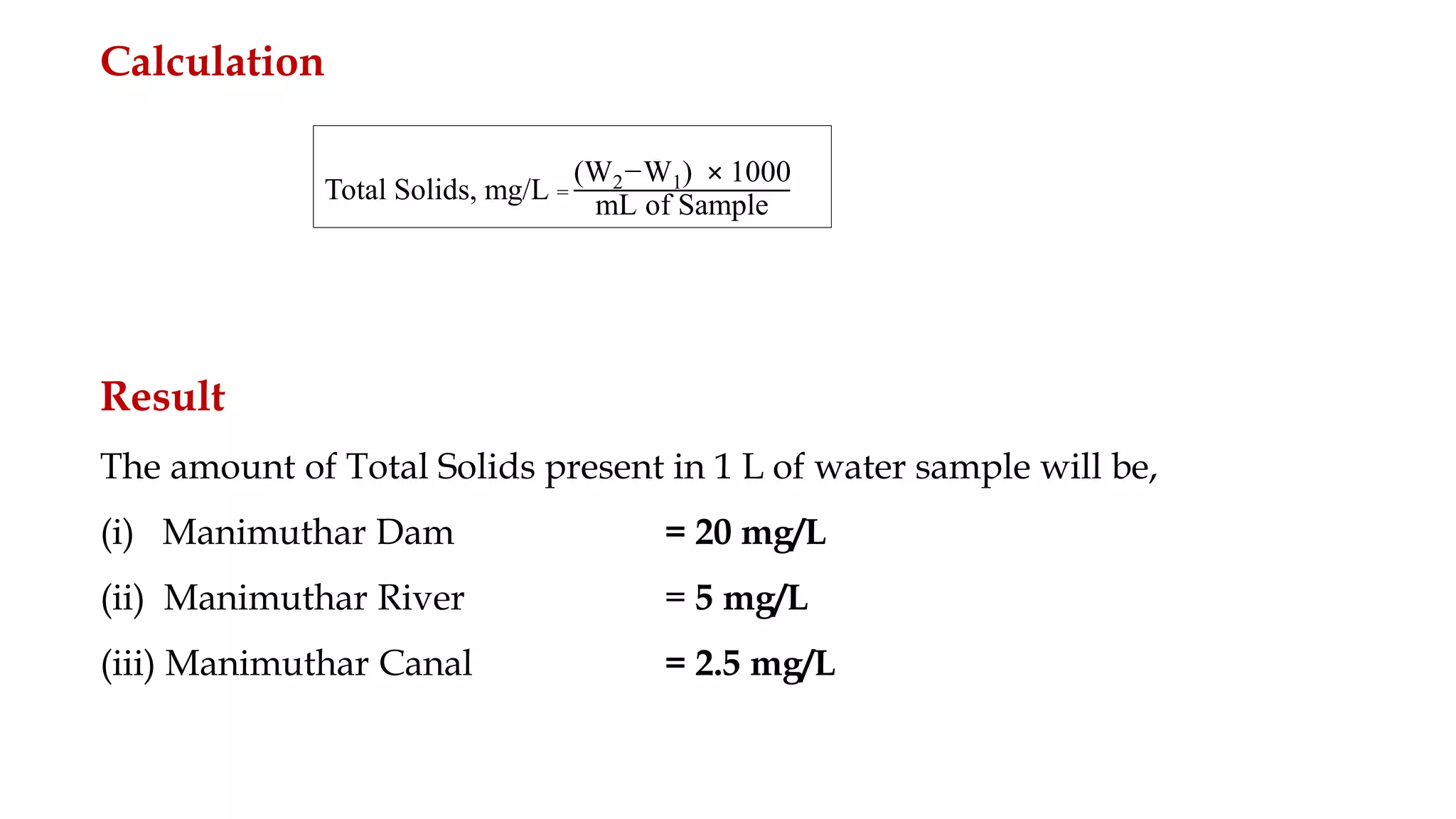
Calculation
Total Solids, mg/L =
(W2−W1) × 1000
mL of Sample
Result
The amount of Total Solids present in 1 L of water sample will be,
(i) Manimuthar Dam = 20 mg/L
(ii) Manimuthar River = 5 mg/L
(iii) Manimuthar Canal = 2.5 mg/L
Manimuthar Dam Manimuthar CanalManimuthar River
Total solids
0.4 mg 0.1 mg 0.05 mg
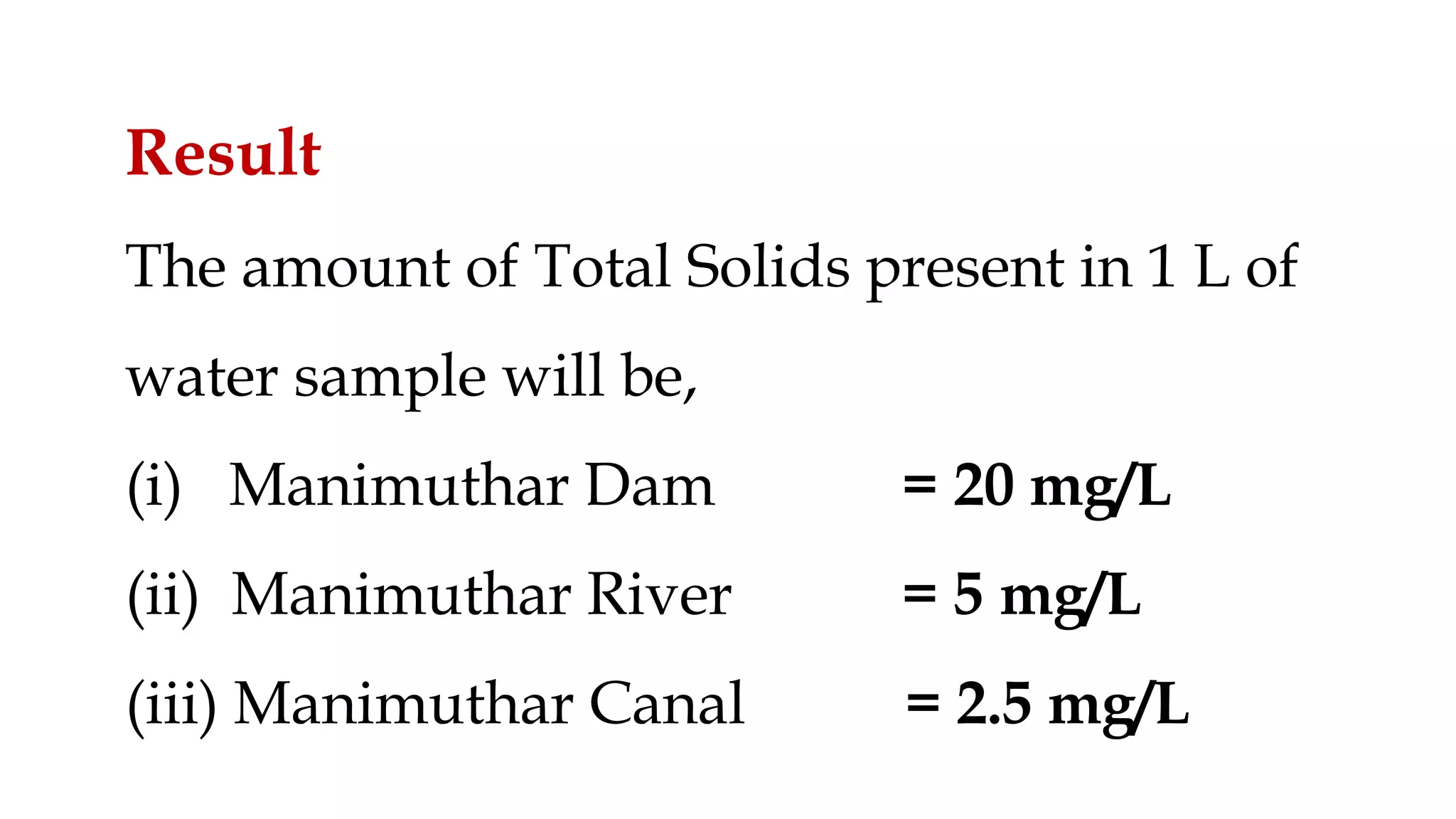
Result
The amount of Total Solids present in 1 L of
water sample will be,
(i) Manimuthar Dam = 20 mg/L
(ii) Manimuthar River = 5 mg/L
(iii) Manimuthar Canal = 2.5 mg/L
CHEMICAL PARAMETERS OF THE WATER
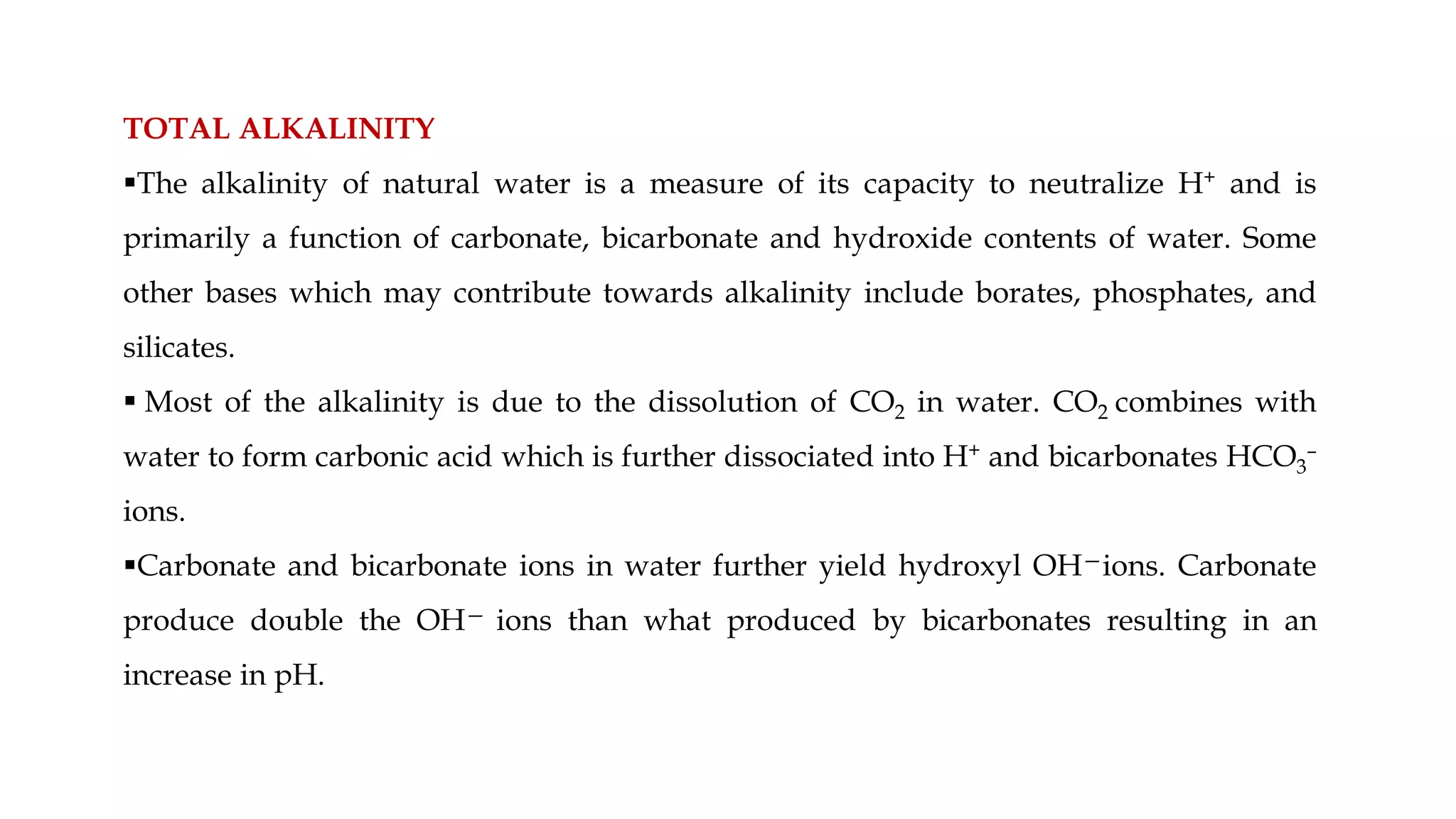
TOTAL ALKALINITY
▪The alkalinity of natural water is a measure of its capacity to neutralize H+ and is
primarily a function of carbonate, bicarbonate and hydroxide contents of water. Some
other bases which may contribute towards alkalinity include borates, phosphates, and
silicates.
▪ Most of the alkalinity is due to the dissolution of CO2 in water. CO2 combines with
water to form carbonic acid which is further dissociated into H+ and bicarbonates HCO3
–
ions.
▪Carbonate and bicarbonate ions in water further yield hydroxyl OH—ions. Carbonate
produce double the OH— ions than what produced by bicarbonates resulting in an
increase in pH.
▪ Take 20 mL of the sample in a conical flask and add 2-3 drops of
phenolphthalein indicator solution. If the solution remains
colorless, PA=0. If a slight pink color appears, phenolphthalein
alkalinity (due to hydroxide or carbonate) is present.
▪ Titrate the solution against sulfuric acid until the color disappears.
Note the reading. This is phenolphthalein alkalinity (PA).
▪ Then for testing the Methyl Orange alkalinity, add 3-4 drops of
Methyl Orange indicator. The orange-red or yellow color is
developed. If the solution remains colorless, MA=0.
Procedure
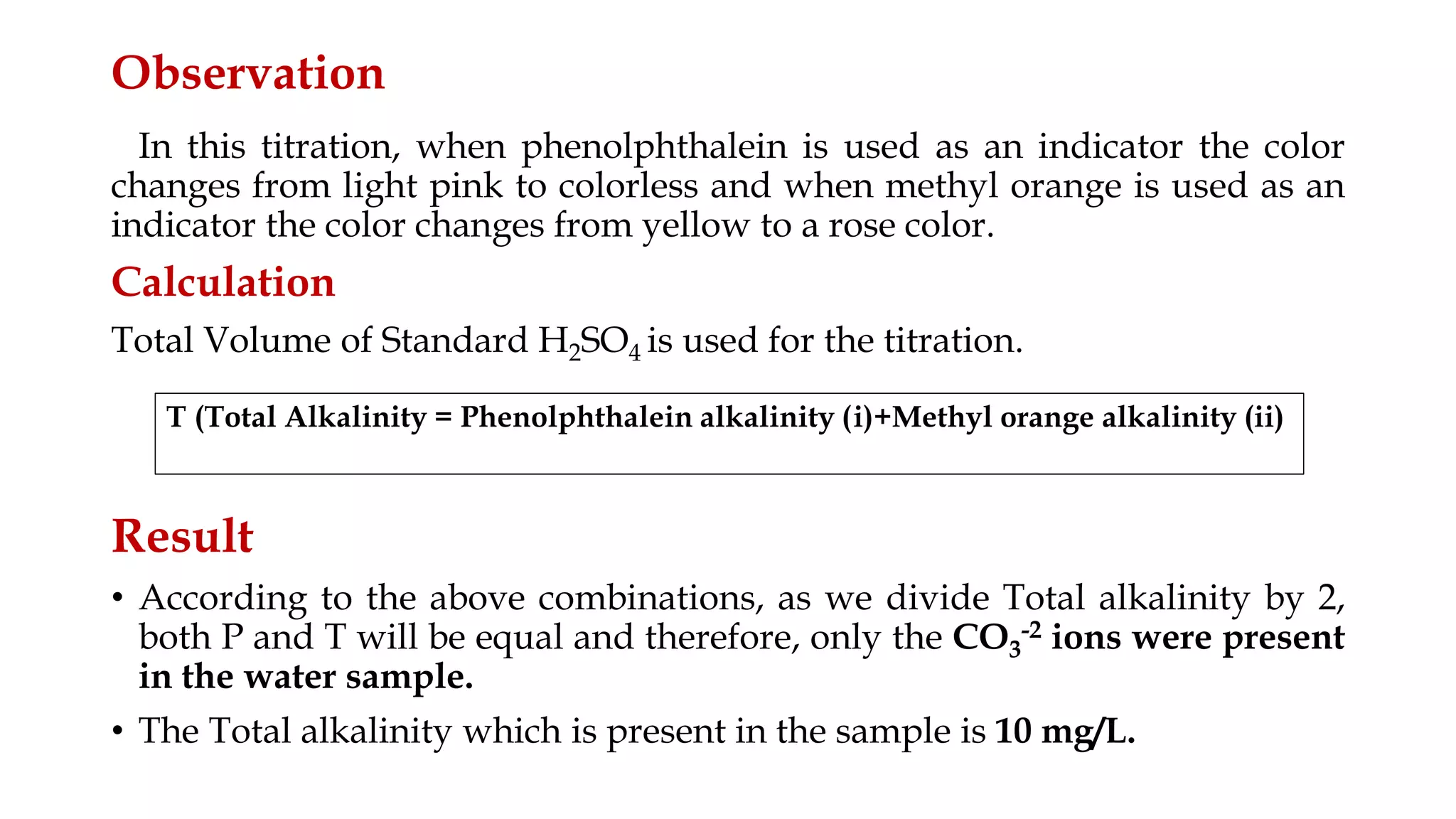
In this titration, when phenolphthalein is used as an indicator the color
changes from light pink to colorless and when methyl orange is used as an
indicator the color changes from yellow to a rose color.
Calculation
Total Volume of Standard H2SO4 is used for the titration.
Result
• According to the above combinations, as we divide Total alkalinity by 2,
both P and T will be equal and therefore, only the CO3
-2 ions were present
in the water sample.
• The Total alkalinity which is present in the sample is 10 mg/L.
Observation
T (Total Alkalinity = Phenolphthalein alkalinity (i)+Methyl orange alkalinity (ii)
Fig. Concept of Methyl Orange in Alkalinity
Fig. Concept of Phenolphthalein in Alkalinity
TOTAL ACIDITY
Principle
▪ Hydrogen ions of the water sample present as a result of
dissociation of hydrolysis of solutes, react with a strong base
such as NaOH.
▪ If the sample has strong mineral acids and their salts, it is
titrated first to pH 3.7, using methyl orange as an indicator.
▪ This is called methyl orange acidity.
▪ If the sample is titrated directly to pH 8.3 using
phenolphthalein, the endpoint denotes total acidity.
Procedure
• Take 20 ml of a colorless sample of water in a conical flask
• Add 3-4 drops of methyl orange indicator.
• If the solution turns yellow, methyl orange acidity is absent.
• If the solution turns pink, titrate it against NaOH till yellow color appears.
• Now add a few drops of phenolphthalein indicator solution to the same solution
and if it turns colorless, it is known as Phenolphthalein acidity (PA).
• Then titrate further with NaOH until the solution turns pink to get Endpoint.
Fig. Concept of Methyl Orange in Acidity
Fig. Concept of Phenolphthalein in Acidity
Fig. Showing that the Methyl Orange acidity is absent
Fig. Showing that the Methyl Orange acidity is present
Calculation
Mineral Acidity (mg/L) =
mL of NaOH used with Methyl Orange × 1000
Volume of sample (mL)
Total Acidity=
mL of NaOH used with Phenolphthalein × 1000
Volume of sample (mL)
Result
(i) Mineral acidity present in the Manimuthar Dam = 5 mg/L
(ii)Mineral acidity present in the Manimuthar River = 5 mg/L
(iii) Mineral acidity present in the Manimuthar Canal = 5 mg/L
(iv) Total acidity present in the Manimuthar Dam = 5 mg/L
(v)Total acidity present in the Manimuthar River = 5 mg/L
(vi)Total acidity present in the Manimuthar Canal = 5 mg/L
HARDNESS
▪ Total hardness may be defined as the sum of the calcium and magnesium
concentrations, both expressed as calcium carbonate in milligrams per liter.
▪ The amount of hardness equivalent to the total alkalinity is called “carbonate
hardness”. The amount of hardness in excess of total alkalinity is called
“non-carbonate hardness”.
▪ In common usage, water is classified as soft, if it contains less than 75 ppm of
hardness as calcium carbonate.
Procedure
▪ Take 20 mL of the sample in a conical flask.
▪ Add 1 mL of the Ammonia buffer solution.
▪ Add 2 drops of the Eriochrome Black-T indicator solution.
▪ Titrate the contents with EDTA with continuous stirring.
▪ The last few drops may be added at 3-5 seconds interval. At the
end point color changes from wine red to blue.
Observation
In this titration, the color changes from wine red to blue sharply at
the end-point.
Fig. Hardness is present in the Water sample
Comparison of hardness value with WHO
(World Health Organization)
Degree of Hardness Hardness mg/L
CaCO3
Soft <50
Moderately Hard 50-150
Hard 150-300
Very Hard >300
Result
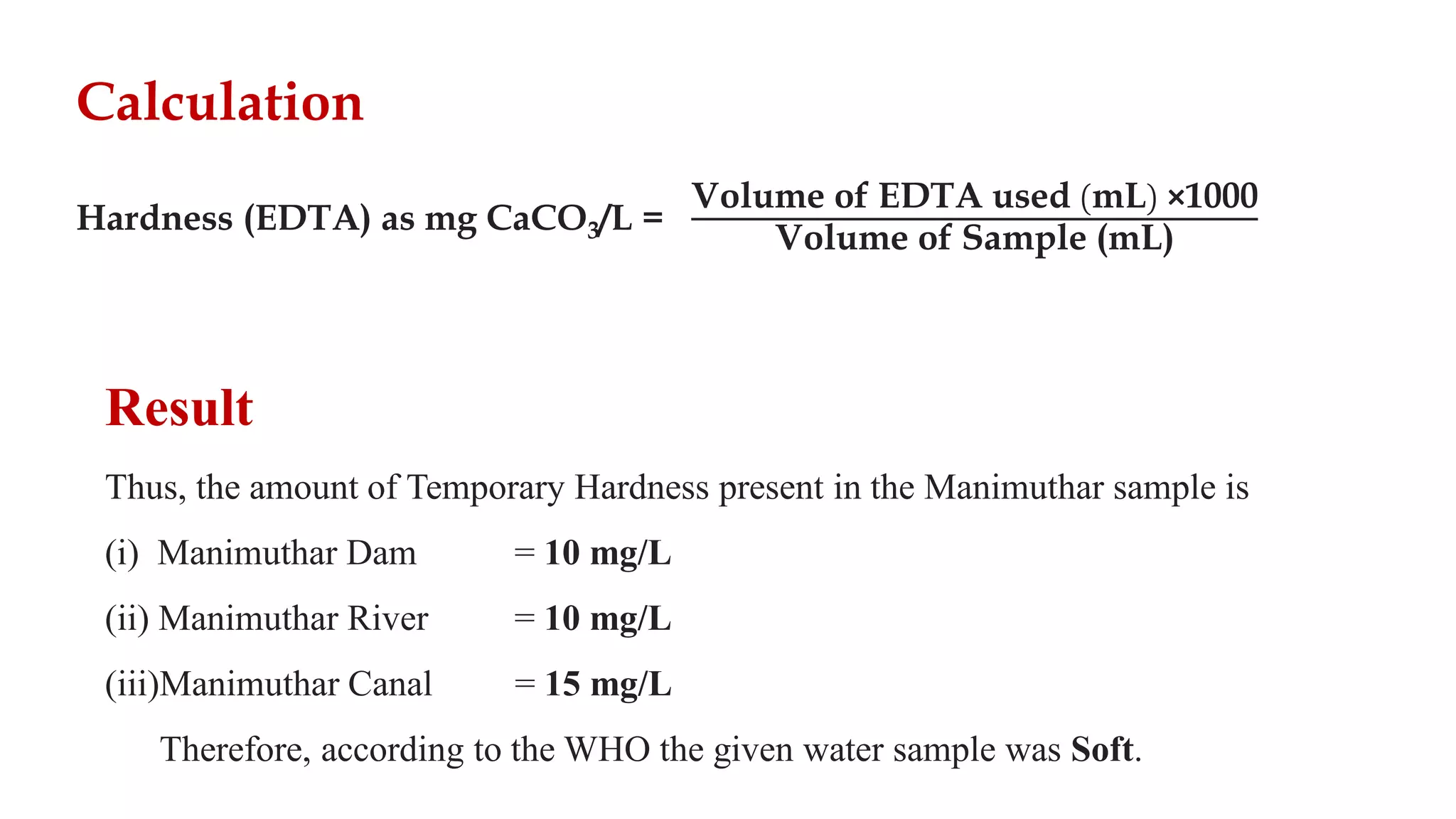
Thus, the amount of Temporary Hardness present in the Manimuthar sample is
(i) Manimuthar Dam = 10 mg/L
(ii) Manimuthar River = 10 mg/L
(iii)Manimuthar Canal = 15 mg/L
Therefore, according to the WHO the given water sample was Soft.
Calculation
Hardness (EDTA) as mg CaCO3/L =
Volume of EDTA used mL ×1000
Volume of Sample (mL)
CHLORIDE
▪ Most of the chloride in the soil are soluble in water.
▪ In natural fresh waters, high concentration of chloride is regarded as an indicator of
pollution which is due to organic wastes of animal origin.
▪ Industrial effluents may be able to increase the chloride contents in natural waters.
▪ The chloride concentration above 250 ppm makes the water salty in taste.
▪ Silver nitrate reacts with the chloride to form a very slightly soluble white
precipitate of AgCl.
▪ At the end point, when all the chlorides get precipitated, free silver ions react with
chromate to form silver chromate of brownish silver hydroxide color.
Procedure
• Take 20 mL of sample in a conical flask and add 2 mL of K2CrO4
solution.
• Titrate the contents against 0.0153 N AgNO3 until a persistent
greenish yellow color appears.
Fig. Presence of the Chloride in the Water sample
Result
Thus, the amount of Chloride present in the Manimuthar sample is
(i) Manimuthar Dam = 22 mg/L
(ii) Manimuthar River = 16 mg/L
(iii)Manimuthar Canal =14 mg/L
Calculation
Chloride (mg/L) =
Volume of AgNO3×Normality of AgNO3×1000×35.5
Sample amount (mL)
BIOLOGICAL PARAMETERS OF THE WATER
DISSOLVED OXYGEN TEST
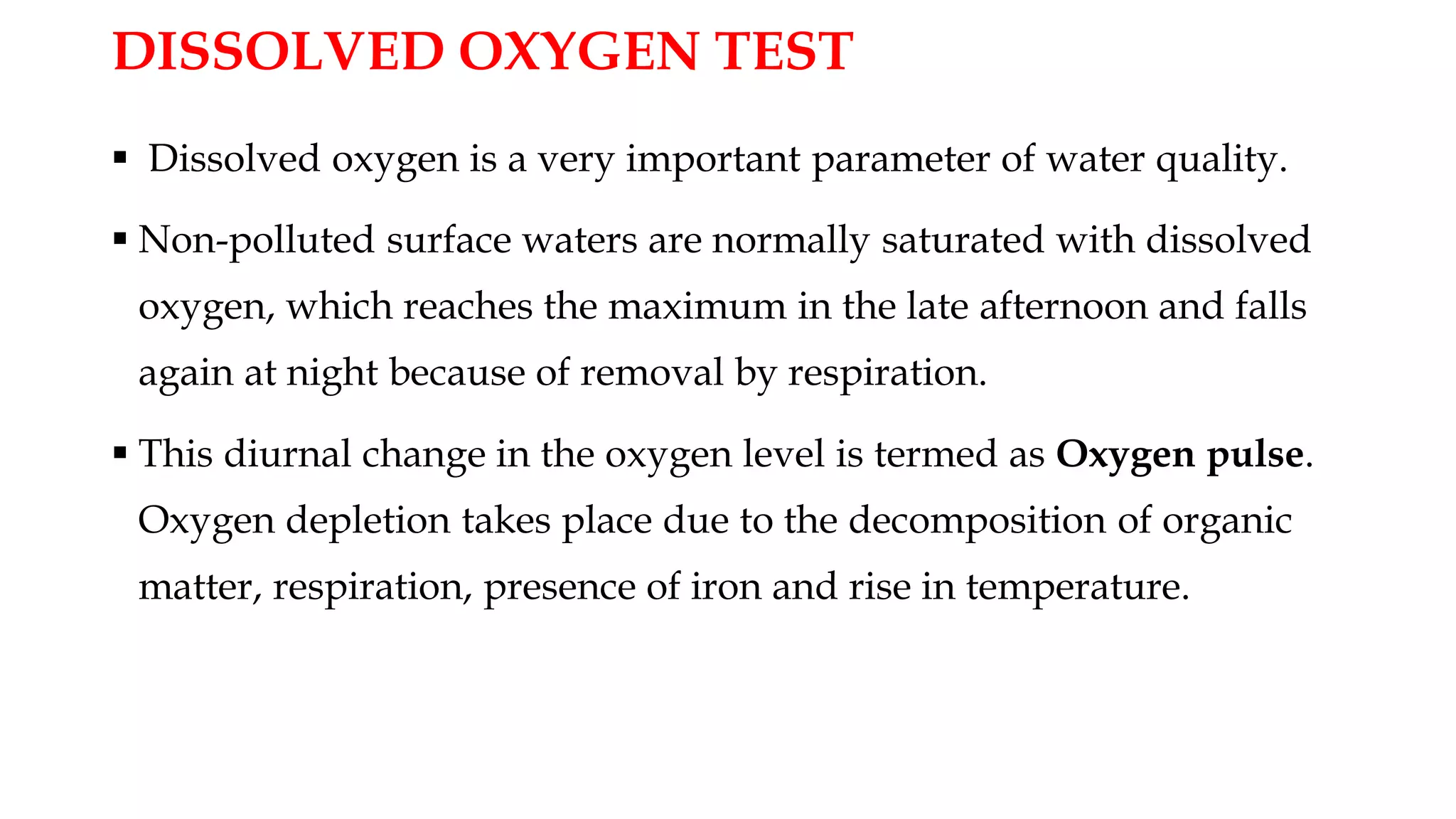
▪ Dissolved oxygen is a very important parameter of water quality.
▪ Non-polluted surface waters are normally saturated with dissolved
oxygen, which reaches the maximum in the late afternoon and falls
again at night because of removal by respiration.
▪ This diurnal change in the oxygen level is termed as Oxygen pulse.
Oxygen depletion takes place due to the decomposition of organic
matter, respiration, presence of iron and rise in temperature.
Procedure
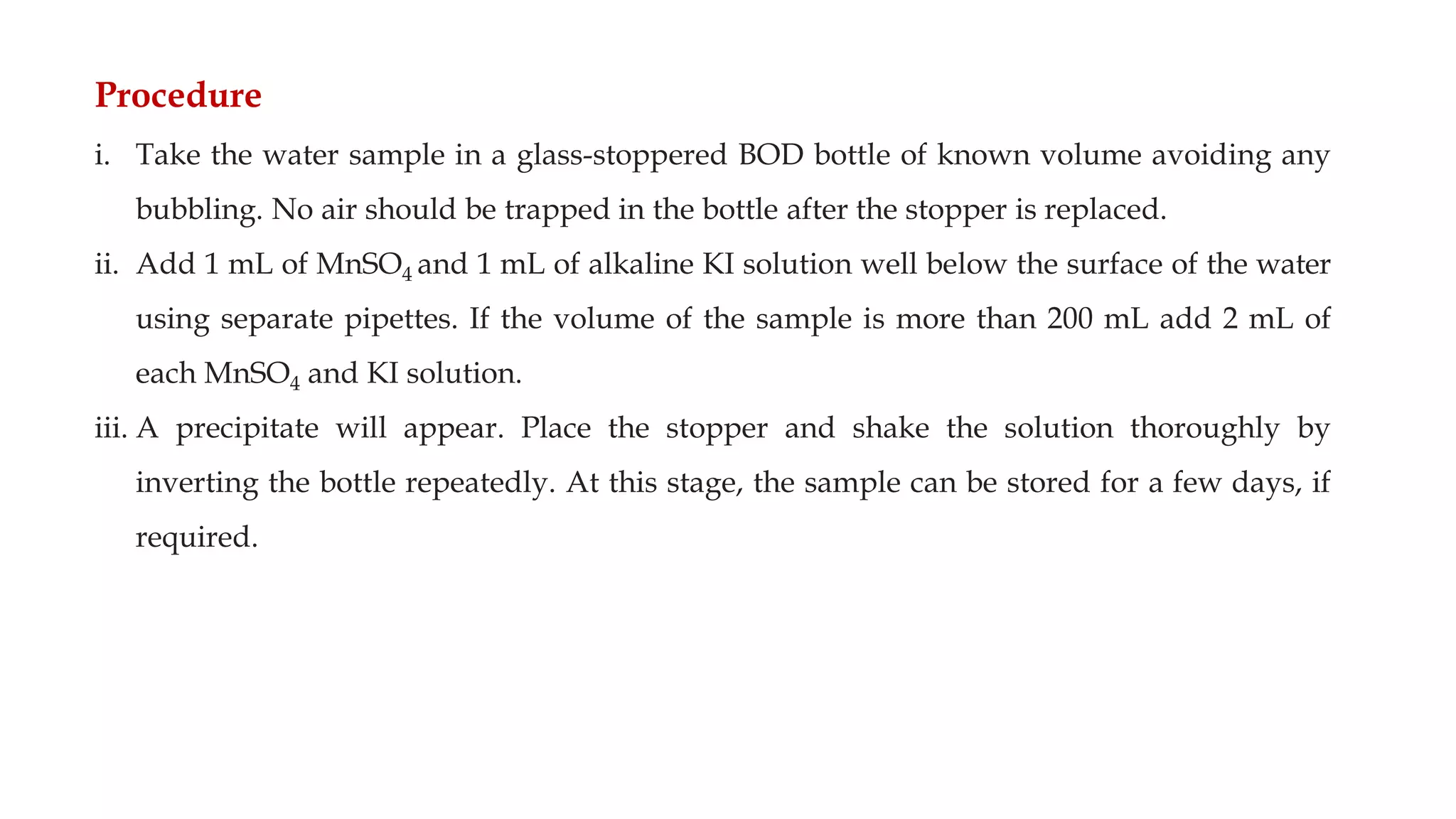
(i) Take the water sample in a glass-stoppered BOD bottle of known volume avoiding any
bubbling. No air should be trapped in the bottle after the stopper is replaced.
(ii) Add 1 mL of MnSO4 and 1 mL of alkaline KI solution well below the surface of the water
using separate pipettes. If the volume of the sample is more than 200 mL add 2 mL of each
MnSO4 and KI solution.
(iii) A precipitate will appear. Place the stopper and shake the solution thoroughly by inverting
the bottle repeatedly. At this stage, the sample can be stored for a few days, if required.
(iv) Add 1-2 mL of concentrated Sulfuric acid to dissolve the precipitate.
(v) Transfer gently (avoiding bubbling) the whole content or a known part of it in a conical flask.
(vi) Add a few drops of starch indicator and titrate against sodium thiosulphate solution within
one hour of the dissolution of the precipitate.
(vii) Note the endpoint when the initial dark blue color disappears completely.
Fig. Dissolved oxygen test by Winkler’s method
Calculation
If the whole content is used for titration,
DO(mg/L) =
Where V1 = Volume of titrant (Sodium thiosulphate);
V2 = Volume of sampling bottle;
V3 = Volume of MnSO4 and KI solutions added;
V4 = Volume of the part of the contents titrated;
N = Normality of sodium thiosulphate (0.025).
Result
Thus, the amount of DO present in the Manimuthar sample is
(i) Manimuthar Dam = 30 mg/L
(ii) Manimuthar River = 16 mg/L
(iii) Manimuthar Canal = 2 mg/L
DETERMINATION OF BIOCHEMICAL OXYGEN DEMAND
▪ It is the amount of oxygen required by microorganisms in aerobic degradation
▪ Biodegradable organic matter serves as a food for bacteria and energy
▪ It gives us an idea about the extent of organic pollution in water.
▪ More the oxidizable organic matter present in water, more the amount of oxygen required to
degrade it biologically, hence more the BOD.
▪ BOD mainly depends upon the pH, presence of toxins, reduced organic matter and different types
of microorganisms.
▪ The complete degradation of the organic matter may require as long as 20 to 30 days.
▪ Simple organic compounds are oxidized in 5 days.
Procedure
i. Take the water sample in a glass-stoppered BOD bottle of known volume avoiding any
bubbling. No air should be trapped in the bottle after the stopper is replaced.
ii. Add 1 mL of MnSO4 and 1 mL of alkaline KI solution well below the surface of the water
using separate pipettes. If the volume of the sample is more than 200 mL add 2 mL of
each MnSO4 and KI solution.
iii. A precipitate will appear. Place the stopper and shake the solution thoroughly by
inverting the bottle repeatedly. At this stage, the sample can be stored for a few days, if
required.
iv. Add 1-2 mL of concentrated Sulphuric acid to dissolve the precipitate.
v. Transfer gently (avoiding bubbling) the whole content or a known part of
it in a conical flask.
vi. Add a few drops of starch indicator and titrate against sodium
thiosulphate solution within one hour of the dissolution of the precipitate.
vii. Note the end point when the initial dark blue color disappears
completely.
Fig. Determination of BOD
Calculation
If the whole content is used for titration,
BOD (mg/L) = Initial DO − Final DO
Volume of the Sample
Where V1 = Volume of titrant (Sodium thiosulphate);
V2 = Volume of sampling bottle;
V3 = Volume of MnSO4 and KI solutions added;
V4 = Volume of the part of the contents titrated;
N = Normality of sodium thiosulphate (0.025).
Result
(i) Manimuthar Dam = 0.5 mg/L
(ii) Manimuthar river = 15 mg/L
(iii) Manimuthar Canal =1.5 mg/L
CHEMICAL OXYGEN DEMAND
COD is a measure of measuring pollution strength of domestic and industrial effluents. It is
the measure of oxygen required in oxidizing the organic compounds present in water by means
of chemical reactions involving strong oxidizing agents, such as potassium dichromate and
potassium permanganate.
As almost all organic compounds can be oxidized by strong oxidizing agents in acidic
medium, COD values are greater than BOD values. COD is too large, if great amount of
biologically resistant organic matter, such as lignin is present. COD determination is
advantageous for waters having unfavorable conditions for the growth of microorganisms.
In such waters, BOD determination cannot be made accurately. Moreover, another advantage
of COD in comparison to BOD is short time required for valuation.
Procedure
(i) Dissolve 0.4 g of Potassium dichromate and 3.3 g of Mercuric sulfate in 17 mL of
conc. H2SO4.
(ii) Dissolve 1 g of Silver sulfate in 100 mL of water.
(iii) Dissolve 3.92 g of Ferrous Ammonium Sulphate in 100 mL of water and 2 mL of
H2SO4.
(iv) Take 5 mL of sample and 7 mL of oxidizing solution.
(v)Take a pinch amount of Silver sulfate and add 2-4 drops of Ferroin indicator. It
becomes red in color.
(vi) Titrate with the Ammonium ferrous sulfate, then the green color will be developed.
Calculation
COD as mg O2/L =
(B − A) × N × 1000 × 8
Volume of Sample (mL)
Where A =Volume of FAS used for sample (mL)
B =Volume of FAS used for blank (mL)
N =Normality of FAS
Result
Thus, the amount of COD present in the Manimuthar sample is
(i) Manimuthar Dam = 80 mg/L
(ii) Manimuthar River = 160 mg/L
(iii) Manimuthar Canal = 144 mg/L
CONCLUSION
▪ Water quality monitoring is of vital imperativeness as it gives particular data about
the nature of water.
▪ In the present study, we have analyzed the basic parameters of the Manimuthar
Dam, River and Canal.
▪ By knowing the status of the water samples we can reduce the pollutions and toxic
chemicals and salts.
▪ Every laboratory in the industry come forth to find out their water quality by
conducting a series of test. In the Milk industry, they are conducting the Lactometer
test. In Tirupur industry, they are assessing the TDS with the help of the instrument.
The basic parameter can also save the aquatic organisms.
BIBLIOGRAPHY
[1] Pinto F, Thais F, Sawdust Derivative for Environmental Application (2016); “Functionalization
and Removal of textile dye from aqueous solution”, An Acad Bras Cienc; Vol.88, Issue 3, pp:1211-
1220.
[2] A. B. Akolkar et al (2014-15) “Report on Assessment of Pollution from Textile Dyeing Units in
Tirupur, Tamil Nadu and Measures taken to Achieve Zero Liquid Discharge”, Central Pollution
Control Board Zonal Office (South), Bengaluru.
[3] Sunantha G and Vasudevan N, “Assessment of Bacterial indicators and Physico-Chemical
parameters in Tirupur, Erode and Chennai, Tamil Nadu (India)”.
DOI: http://dx.doi.org/doi:10.1016/j.enmm.2016.10.005. Manuscript accepted for publication.
[4] Geetha. An et al. (2008) “Assessment of Underground Water Contamination and Effect of Textile
Effluents on Noyyal River Basin In and Around Tirupur Town, Tamilnadu” Vol. 5, Issue 4, pp:696-
705.
[5] Abhijit M. (2017) “Textbook on Basics of Environmental Science”. DOI: 10.1007/978-81-322-
2707-6.
[6] Raja Guru P and Subbram V (2000), “Ground Water Quality in Tirupur” Environmental
Awareness on Quality Management of Irrigation Water, Edited by and Krishnaraj, Department
of Environmental Sciences, Bharathiyar University, Coimbatore.
[7] Tushar K Sen, et al. (2014) “Review on Dye Removal from Its Aqueous Solution into
Alternative Cost Effective and Non-Conventional Adsorbents”. Chem Proc Engg pp:1-11
[8] Rahmanian N Analysis of Physiochemical Parameters to Evaluate the Drinking Water
Quality in the State of Perak, Malaysia. Vol No.2015; DOIManuscript accepted for publication.
[9] Kramer, Donald L. (1987) “Dissolved oxygen and fish behavior”, Environmental Biology of
Fishes. DOI: 10.1007/BF00002597, ISSN: 03781909.
[10] Logesh. S et al (2011) Environmental issues and its impacts associated with the
textile processing units in Tirupur, 2nd International Conference on Environmental Science
and Development, IPCBEE.
ANY QUERY?
WATER QUALITY PARAMETERS

WATER QUALITY PARAMETERS

  • 1.
    ASSESSMENT OF WATERQUALITY PARAMETERS ON MANIMUTHAR DAM, RIVER AND CANAL A MINI-PROJECT REPORT Submitted to the MANONMANIAM SUNDARANAR UNIVERSITY Submitted By K. AJAY KALLAPIRAN INTEGRATED ENVIRONMENTAL SCIENCES (Reg No. 361139) Under the Guidance of Dr. G. ANNADURAI Professor and Head MANONMANIAM SUNDARANAR UNIVERSITY SRI PARAMAKALYANI CENTRE OF EXCELLENCE IN ENVIRONMENTAL SCIENCES, ALWARKURICHI-627412, TAMILNADU. MAY 2019
  • 2.
    CONTENT I. INTRODUCTION II. THEIMPORTANCE OF WATER III. MANIMUTHAR DAM IV. EXPERIMENTAL V. CONCLUSION VI.BIBLIOGRAPHY
  • 3.
    ▪ Water qualitytesting is an important part of environmental monitoring. When water quality is poor, it affects not only aquatic life but the surrounding ecosystem as well. ▪ Also, humans can know about the permissible limit and about some details of water and he could be aware of taking the water which is beyond its permissible limit. ▪ Every water which is to be purified was initially tested in an industry or company. ▪ Hence, we should consume the water which was standardized by BIS, USEPA, ISI, ICMR, and CPCB. INTRODUCTION
  • 4.
    THE IMPORTANCE OFWATER ▪ It is a basic resource. ▪ All plants and animals must have water to survive. ▪ If there was no water there would be no life on earth basic resource. ▪ Water is involved in every bodily function from digestion and circulation. ▪ It regulates the activities of fluids, tissues, cells, lymph, blood and glandular secretions.
  • 5.
    MANIMUTHAR DAM ▪ Itis the biggest reservoir of the Tirunelveli district. ▪ This dam was built in 1958 near Singampatti by our Tamil Nadu Chief Minister Kamaraj and K T Kosalram MP to prevent mixing of rainwater with the Bay of Bengal during the rainy season. ▪ The dam is 5,511 million cubic feet. ▪ The total length of the dam is 3 km It irrigated around 65,000 acres of areas.
  • 6.
  • 7.
    Collection of watersample from Manimuthar river
  • 8.
  • 9.
  • 10.
    APPEARANCE ▪ This parameterwas done by visual method based on the type of water sample. ▪ If the water sample is collected from the sewage, it will bear dark grey in color. ▪ It is due to the presence of bacteria present in the water sample. Some of the water sample will be pure and white, as it was collected from dams or river.
  • 11.
    Manimuthar Dam ManimutharCanalManimuthar River APPEARANCE Clear Clear Clear
  • 12.
    pH ▪ Hydrogen ionactivity. ▪ pH is the intensity of the acidic or basic character ▪ The pH scale is a series of numbers which measure acidity or alkalinity. ▪ These numbers are shown from 0 to 14 and each number represents a definite degree of acidity or alkalinity. ▪ pH (p=power; H=hydrogen ion concentration) value is negative logarithm of hydrogen ion concentration [= -log H+ ]. Fig. pH meter
  • 13.
    Manimuthar Dam ManimutharCanalManimuthar River pH 9.38 7.32 6.53
  • 14.
    Total Solids Principle Total solidis the term applied to the material residue left in the vessel after operation of an unfiltered sample and includes “total suspended solids”. portion retained by filter and “total dissolved solids”. Procedure • Ignite the evaporating dish in a muffle furnace at 550 ± 50℃ for about 1 hour. • Cool it in a desiccator and weigh. • Evaporate 100 ml of unfiltered sample in the evaporating dish on a water bath or hot plate. • Dry the evaporated sample for one hour in an oven at 103-105℃. • Cool the dish in a desiccator and again weigh.
  • 15.
    Calculation Total Solids, mg/L= (W2−W1) × 1000 mL of Sample Result The amount of Total Solids present in 1 L of water sample will be, (i) Manimuthar Dam = 20 mg/L (ii) Manimuthar River = 5 mg/L (iii) Manimuthar Canal = 2.5 mg/L
  • 16.
    Manimuthar Dam ManimutharCanalManimuthar River Total solids 0.4 mg 0.1 mg 0.05 mg
  • 17.
    Result The amount ofTotal Solids present in 1 L of water sample will be, (i) Manimuthar Dam = 20 mg/L (ii) Manimuthar River = 5 mg/L (iii) Manimuthar Canal = 2.5 mg/L
  • 18.
  • 19.
    TOTAL ALKALINITY ▪The alkalinityof natural water is a measure of its capacity to neutralize H+ and is primarily a function of carbonate, bicarbonate and hydroxide contents of water. Some other bases which may contribute towards alkalinity include borates, phosphates, and silicates. ▪ Most of the alkalinity is due to the dissolution of CO2 in water. CO2 combines with water to form carbonic acid which is further dissociated into H+ and bicarbonates HCO3 – ions. ▪Carbonate and bicarbonate ions in water further yield hydroxyl OH—ions. Carbonate produce double the OH— ions than what produced by bicarbonates resulting in an increase in pH.
  • 20.
    ▪ Take 20mL of the sample in a conical flask and add 2-3 drops of phenolphthalein indicator solution. If the solution remains colorless, PA=0. If a slight pink color appears, phenolphthalein alkalinity (due to hydroxide or carbonate) is present. ▪ Titrate the solution against sulfuric acid until the color disappears. Note the reading. This is phenolphthalein alkalinity (PA). ▪ Then for testing the Methyl Orange alkalinity, add 3-4 drops of Methyl Orange indicator. The orange-red or yellow color is developed. If the solution remains colorless, MA=0. Procedure
  • 21.
    In this titration,when phenolphthalein is used as an indicator the color changes from light pink to colorless and when methyl orange is used as an indicator the color changes from yellow to a rose color. Calculation Total Volume of Standard H2SO4 is used for the titration. Result • According to the above combinations, as we divide Total alkalinity by 2, both P and T will be equal and therefore, only the CO3 -2 ions were present in the water sample. • The Total alkalinity which is present in the sample is 10 mg/L. Observation T (Total Alkalinity = Phenolphthalein alkalinity (i)+Methyl orange alkalinity (ii)
  • 22.
    Fig. Concept ofMethyl Orange in Alkalinity
  • 23.
    Fig. Concept ofPhenolphthalein in Alkalinity
  • 24.
    TOTAL ACIDITY Principle ▪ Hydrogenions of the water sample present as a result of dissociation of hydrolysis of solutes, react with a strong base such as NaOH. ▪ If the sample has strong mineral acids and their salts, it is titrated first to pH 3.7, using methyl orange as an indicator. ▪ This is called methyl orange acidity. ▪ If the sample is titrated directly to pH 8.3 using phenolphthalein, the endpoint denotes total acidity.
  • 25.
    Procedure • Take 20ml of a colorless sample of water in a conical flask • Add 3-4 drops of methyl orange indicator. • If the solution turns yellow, methyl orange acidity is absent. • If the solution turns pink, titrate it against NaOH till yellow color appears. • Now add a few drops of phenolphthalein indicator solution to the same solution and if it turns colorless, it is known as Phenolphthalein acidity (PA). • Then titrate further with NaOH until the solution turns pink to get Endpoint.
  • 26.
    Fig. Concept ofMethyl Orange in Acidity
  • 27.
    Fig. Concept ofPhenolphthalein in Acidity
  • 28.
    Fig. Showing thatthe Methyl Orange acidity is absent
  • 29.
    Fig. Showing thatthe Methyl Orange acidity is present
  • 30.
    Calculation Mineral Acidity (mg/L)= mL of NaOH used with Methyl Orange × 1000 Volume of sample (mL) Total Acidity= mL of NaOH used with Phenolphthalein × 1000 Volume of sample (mL)
  • 31.
    Result (i) Mineral aciditypresent in the Manimuthar Dam = 5 mg/L (ii)Mineral acidity present in the Manimuthar River = 5 mg/L (iii) Mineral acidity present in the Manimuthar Canal = 5 mg/L (iv) Total acidity present in the Manimuthar Dam = 5 mg/L (v)Total acidity present in the Manimuthar River = 5 mg/L (vi)Total acidity present in the Manimuthar Canal = 5 mg/L
  • 32.
    HARDNESS ▪ Total hardnessmay be defined as the sum of the calcium and magnesium concentrations, both expressed as calcium carbonate in milligrams per liter. ▪ The amount of hardness equivalent to the total alkalinity is called “carbonate hardness”. The amount of hardness in excess of total alkalinity is called “non-carbonate hardness”. ▪ In common usage, water is classified as soft, if it contains less than 75 ppm of hardness as calcium carbonate.
  • 33.
    Procedure ▪ Take 20mL of the sample in a conical flask. ▪ Add 1 mL of the Ammonia buffer solution. ▪ Add 2 drops of the Eriochrome Black-T indicator solution. ▪ Titrate the contents with EDTA with continuous stirring. ▪ The last few drops may be added at 3-5 seconds interval. At the end point color changes from wine red to blue. Observation In this titration, the color changes from wine red to blue sharply at the end-point.
  • 34.
    Fig. Hardness ispresent in the Water sample
  • 35.
    Comparison of hardnessvalue with WHO (World Health Organization) Degree of Hardness Hardness mg/L CaCO3 Soft <50 Moderately Hard 50-150 Hard 150-300 Very Hard >300
  • 36.
    Result Thus, the amountof Temporary Hardness present in the Manimuthar sample is (i) Manimuthar Dam = 10 mg/L (ii) Manimuthar River = 10 mg/L (iii)Manimuthar Canal = 15 mg/L Therefore, according to the WHO the given water sample was Soft. Calculation Hardness (EDTA) as mg CaCO3/L = Volume of EDTA used mL ×1000 Volume of Sample (mL)
  • 37.
    CHLORIDE ▪ Most ofthe chloride in the soil are soluble in water. ▪ In natural fresh waters, high concentration of chloride is regarded as an indicator of pollution which is due to organic wastes of animal origin. ▪ Industrial effluents may be able to increase the chloride contents in natural waters. ▪ The chloride concentration above 250 ppm makes the water salty in taste. ▪ Silver nitrate reacts with the chloride to form a very slightly soluble white precipitate of AgCl. ▪ At the end point, when all the chlorides get precipitated, free silver ions react with chromate to form silver chromate of brownish silver hydroxide color.
  • 38.
    Procedure • Take 20mL of sample in a conical flask and add 2 mL of K2CrO4 solution. • Titrate the contents against 0.0153 N AgNO3 until a persistent greenish yellow color appears.
  • 39.
    Fig. Presence ofthe Chloride in the Water sample
  • 40.
    Result Thus, the amountof Chloride present in the Manimuthar sample is (i) Manimuthar Dam = 22 mg/L (ii) Manimuthar River = 16 mg/L (iii)Manimuthar Canal =14 mg/L Calculation Chloride (mg/L) = Volume of AgNO3×Normality of AgNO3×1000×35.5 Sample amount (mL)
  • 41.
  • 42.
    DISSOLVED OXYGEN TEST ▪Dissolved oxygen is a very important parameter of water quality. ▪ Non-polluted surface waters are normally saturated with dissolved oxygen, which reaches the maximum in the late afternoon and falls again at night because of removal by respiration. ▪ This diurnal change in the oxygen level is termed as Oxygen pulse. Oxygen depletion takes place due to the decomposition of organic matter, respiration, presence of iron and rise in temperature.
  • 43.
    Procedure (i) Take thewater sample in a glass-stoppered BOD bottle of known volume avoiding any bubbling. No air should be trapped in the bottle after the stopper is replaced. (ii) Add 1 mL of MnSO4 and 1 mL of alkaline KI solution well below the surface of the water using separate pipettes. If the volume of the sample is more than 200 mL add 2 mL of each MnSO4 and KI solution. (iii) A precipitate will appear. Place the stopper and shake the solution thoroughly by inverting the bottle repeatedly. At this stage, the sample can be stored for a few days, if required. (iv) Add 1-2 mL of concentrated Sulfuric acid to dissolve the precipitate. (v) Transfer gently (avoiding bubbling) the whole content or a known part of it in a conical flask. (vi) Add a few drops of starch indicator and titrate against sodium thiosulphate solution within one hour of the dissolution of the precipitate. (vii) Note the endpoint when the initial dark blue color disappears completely.
  • 44.
    Fig. Dissolved oxygentest by Winkler’s method
  • 45.
    Calculation If the wholecontent is used for titration, DO(mg/L) = Where V1 = Volume of titrant (Sodium thiosulphate); V2 = Volume of sampling bottle; V3 = Volume of MnSO4 and KI solutions added; V4 = Volume of the part of the contents titrated; N = Normality of sodium thiosulphate (0.025).
  • 46.
    Result Thus, the amountof DO present in the Manimuthar sample is (i) Manimuthar Dam = 30 mg/L (ii) Manimuthar River = 16 mg/L (iii) Manimuthar Canal = 2 mg/L
  • 47.
    DETERMINATION OF BIOCHEMICALOXYGEN DEMAND ▪ It is the amount of oxygen required by microorganisms in aerobic degradation ▪ Biodegradable organic matter serves as a food for bacteria and energy ▪ It gives us an idea about the extent of organic pollution in water. ▪ More the oxidizable organic matter present in water, more the amount of oxygen required to degrade it biologically, hence more the BOD. ▪ BOD mainly depends upon the pH, presence of toxins, reduced organic matter and different types of microorganisms. ▪ The complete degradation of the organic matter may require as long as 20 to 30 days. ▪ Simple organic compounds are oxidized in 5 days.
  • 48.
    Procedure i. Take thewater sample in a glass-stoppered BOD bottle of known volume avoiding any bubbling. No air should be trapped in the bottle after the stopper is replaced. ii. Add 1 mL of MnSO4 and 1 mL of alkaline KI solution well below the surface of the water using separate pipettes. If the volume of the sample is more than 200 mL add 2 mL of each MnSO4 and KI solution. iii. A precipitate will appear. Place the stopper and shake the solution thoroughly by inverting the bottle repeatedly. At this stage, the sample can be stored for a few days, if required.
  • 49.
    iv. Add 1-2mL of concentrated Sulphuric acid to dissolve the precipitate. v. Transfer gently (avoiding bubbling) the whole content or a known part of it in a conical flask. vi. Add a few drops of starch indicator and titrate against sodium thiosulphate solution within one hour of the dissolution of the precipitate. vii. Note the end point when the initial dark blue color disappears completely.
  • 50.
  • 51.
    Calculation If the wholecontent is used for titration, BOD (mg/L) = Initial DO − Final DO Volume of the Sample Where V1 = Volume of titrant (Sodium thiosulphate); V2 = Volume of sampling bottle; V3 = Volume of MnSO4 and KI solutions added; V4 = Volume of the part of the contents titrated; N = Normality of sodium thiosulphate (0.025).
  • 52.
    Result (i) Manimuthar Dam= 0.5 mg/L (ii) Manimuthar river = 15 mg/L (iii) Manimuthar Canal =1.5 mg/L
  • 53.
    CHEMICAL OXYGEN DEMAND CODis a measure of measuring pollution strength of domestic and industrial effluents. It is the measure of oxygen required in oxidizing the organic compounds present in water by means of chemical reactions involving strong oxidizing agents, such as potassium dichromate and potassium permanganate. As almost all organic compounds can be oxidized by strong oxidizing agents in acidic medium, COD values are greater than BOD values. COD is too large, if great amount of biologically resistant organic matter, such as lignin is present. COD determination is advantageous for waters having unfavorable conditions for the growth of microorganisms. In such waters, BOD determination cannot be made accurately. Moreover, another advantage of COD in comparison to BOD is short time required for valuation.
  • 54.
    Procedure (i) Dissolve 0.4g of Potassium dichromate and 3.3 g of Mercuric sulfate in 17 mL of conc. H2SO4. (ii) Dissolve 1 g of Silver sulfate in 100 mL of water. (iii) Dissolve 3.92 g of Ferrous Ammonium Sulphate in 100 mL of water and 2 mL of H2SO4. (iv) Take 5 mL of sample and 7 mL of oxidizing solution. (v)Take a pinch amount of Silver sulfate and add 2-4 drops of Ferroin indicator. It becomes red in color. (vi) Titrate with the Ammonium ferrous sulfate, then the green color will be developed.
  • 55.
    Calculation COD as mgO2/L = (B − A) × N × 1000 × 8 Volume of Sample (mL) Where A =Volume of FAS used for sample (mL) B =Volume of FAS used for blank (mL) N =Normality of FAS
  • 56.
    Result Thus, the amountof COD present in the Manimuthar sample is (i) Manimuthar Dam = 80 mg/L (ii) Manimuthar River = 160 mg/L (iii) Manimuthar Canal = 144 mg/L
  • 57.
  • 58.
    ▪ Water qualitymonitoring is of vital imperativeness as it gives particular data about the nature of water. ▪ In the present study, we have analyzed the basic parameters of the Manimuthar Dam, River and Canal. ▪ By knowing the status of the water samples we can reduce the pollutions and toxic chemicals and salts. ▪ Every laboratory in the industry come forth to find out their water quality by conducting a series of test. In the Milk industry, they are conducting the Lactometer test. In Tirupur industry, they are assessing the TDS with the help of the instrument. The basic parameter can also save the aquatic organisms.
  • 59.
  • 60.
    [1] Pinto F,Thais F, Sawdust Derivative for Environmental Application (2016); “Functionalization and Removal of textile dye from aqueous solution”, An Acad Bras Cienc; Vol.88, Issue 3, pp:1211- 1220. [2] A. B. Akolkar et al (2014-15) “Report on Assessment of Pollution from Textile Dyeing Units in Tirupur, Tamil Nadu and Measures taken to Achieve Zero Liquid Discharge”, Central Pollution Control Board Zonal Office (South), Bengaluru. [3] Sunantha G and Vasudevan N, “Assessment of Bacterial indicators and Physico-Chemical parameters in Tirupur, Erode and Chennai, Tamil Nadu (India)”. DOI: http://dx.doi.org/doi:10.1016/j.enmm.2016.10.005. Manuscript accepted for publication. [4] Geetha. An et al. (2008) “Assessment of Underground Water Contamination and Effect of Textile Effluents on Noyyal River Basin In and Around Tirupur Town, Tamilnadu” Vol. 5, Issue 4, pp:696- 705. [5] Abhijit M. (2017) “Textbook on Basics of Environmental Science”. DOI: 10.1007/978-81-322- 2707-6.
  • 61.
    [6] Raja GuruP and Subbram V (2000), “Ground Water Quality in Tirupur” Environmental Awareness on Quality Management of Irrigation Water, Edited by and Krishnaraj, Department of Environmental Sciences, Bharathiyar University, Coimbatore. [7] Tushar K Sen, et al. (2014) “Review on Dye Removal from Its Aqueous Solution into Alternative Cost Effective and Non-Conventional Adsorbents”. Chem Proc Engg pp:1-11 [8] Rahmanian N Analysis of Physiochemical Parameters to Evaluate the Drinking Water Quality in the State of Perak, Malaysia. Vol No.2015; DOIManuscript accepted for publication. [9] Kramer, Donald L. (1987) “Dissolved oxygen and fish behavior”, Environmental Biology of Fishes. DOI: 10.1007/BF00002597, ISSN: 03781909. [10] Logesh. S et al (2011) Environmental issues and its impacts associated with the textile processing units in Tirupur, 2nd International Conference on Environmental Science and Development, IPCBEE.
  • 62.