NETWORK SECURITY
Jupriyadi, S.Kom. M.T.
jupriyadi@teknokrat.ac.id
Bandarlampung, Maret 2020
https://spada.teknokrat.ac.id
Chapter 4
• To be understand the basic concepts of cryptography
• The student will be able hide the message using cryptography
techniques
Cryptography is the study of secure communications
techniques that allow only the sender and intended recipient of
a message to view its contents. The term is derived from the
Greek word kryptos, which means hidden. It is closely
associated to encryption, which is the act of scrambling
ordinary text into what's known as ciphertext and then back
again upon arrival
Cryptography is the science of using mathematics to encrypt
and decrypt data (Phil Zimmermann)
Cryptography is the art and science of keeping messages
secure (Bruce Schneier)
Cryptography
Symmetric
Key
Cryptography
Symmetric
Key
Cryptography
Hash
Function
Basic Terminologies
A message is plaintext (sometimes called cleartext). The process of
disguising a message in such a way as to hide its substance is encryption.
An encrypted message is ciphertext. The process of turning ciphertext
back into plaintext is decryption.
A cipher (or cypher) is an algorithm for performing encryption or
decryption
Basic Terminologies (Cont’d)
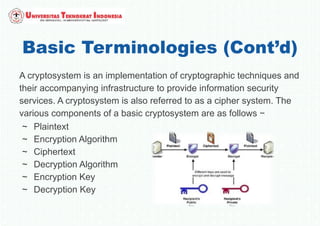
A cryptosystem is an implementation of cryptographic techniques and
their accompanying infrastructure to provide information security
services. A cryptosystem is also referred to as a cipher system. The
various components of a basic cryptosystem are as follows −
 Plaintext
 Encryption Algorithm
 Ciphertext
 Decryption Algorithm
 Encryption Key
 Decryption Key
Basic Terminologies (Cont’d)
While cryptography is the science of securing data, cryptanalysis
is the science of analyzing and breaking secure communication.
Classical cryptanalysis involves an interesting combination of
analytical reasoning, application of mathematical tools, pattern
finding, patience, determination, and luck. Cryptanalysts are also
called attackers.
Cryptology embraces both cryptography and cryptanalysis.
Classical Cryptography
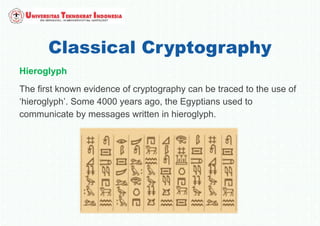
Hieroglyph
The first known evidence of cryptography can be traced to the use of
‘hieroglyph’. Some 4000 years ago, the Egyptians used to
communicate by messages written in hieroglyph.
Classical Cryptography (Cont’d)
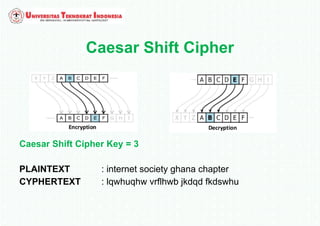
Caesar Shift Cipher
Caesar Shift Cipher, relies on shifting the letters of a message by
an agreed number (three was a common choice), the recipient of
this message would then shift the letters back by the same
number and obtain the original message.
The Caesar cipher is named after Julius Caesar ,
who used it with a shift of three to protect
messages of military significance.
Caesar Shift Cipher
Caesar Shift Cipher Key = 3
PLAINTEXT : internet society ghana chapter
CYPHERTEXT : lqwhuqhw vrflhwb jkdqd fkdswhu
Goal and Service Cryptography
Goal: The primary goal of cryptography is to secure important data
on the hard disk or as it passes through a medium that may not be
secure itself. Usually, that medium is a computer network.
Services: Cryptography can provide the following services:
 Confidentiality (secrecy)
 Integrity (anti-tampering)
 Authentication
 Non-repudiation.
Service Cryptography
Confidentiality (secrecy)
 Ensuring that no one can read the message except the intended
receiver
 Data is kept secret from those without the proper credentials, even
if that data travels through an insecure medium
Integrity (anti-tampering)
 Assuring the receiver that the received message has not
been altered in any way from the original.
Service Cryptography
Authentication
 Cryptography can help establish identity for authentication
purposes. The process of proving one's identity. (The primary
forms of host-to-host authentication on the Internet today are
name-based or address-based, both of which are notoriously
weak.)
Non-repudiation
 A mechanism to prove that the sender
really sent this message
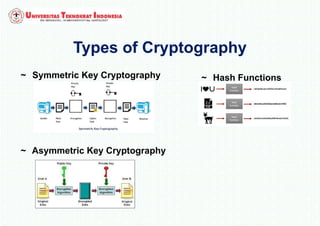
Types of Cryptography
 Symmetric Key Cryptography
 Asymmetric Key Cryptography
 Hash Functions
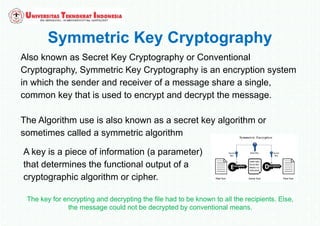
Symmetric Key Cryptography
Also known as Secret Key Cryptography or Conventional
Cryptography, Symmetric Key Cryptography is an encryption system
in which the sender and receiver of a message share a single,
common key that is used to encrypt and decrypt the message.
The Algorithm use is also known as a secret key algorithm or
sometimes called a symmetric algorithm
A key is a piece of information (a parameter)
that determines the functional output of a
cryptographic algorithm or cipher.
The key for encrypting and decrypting the file had to be known to all the recipients. Else,
the message could not be decrypted by conventional means.
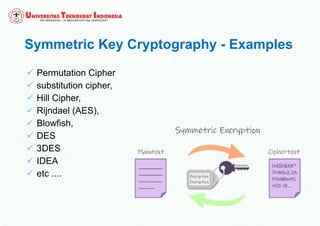
Symmetric Key Cryptography - Examples
 Permutation Cipher
 substitution cipher,
 Hill Cipher,
 Rijndael (AES),
 Blowfish,
 DES
 3DES
 IDEA
 etc ....
Problem Symmetric Key Cryptography
Key Management
Symmetric-key systems are simpler and faster; their main drawback
is that the two parties must somehow exchange the key in a secure
way and keep it secure after that.
Key Management caused nightmare for the parties using the
symmetric key cryptography. They were worried about how to get the
keys safely and securely across to all users so that the decryption of
the message would be possible. This gave the chance for third
parties to intercept the keys in transit to decode the top-secret
messages. Thus, if the key was compromised, the entire coding
system was compromised and a “Secret” would no longer remain a
“Secret”.
This is why the “Public Key Cryptography” came into existence.
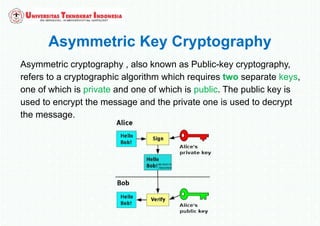
Asymmetric Key Cryptography
Asymmetric cryptography , also known as Public-key cryptography,
refers to a cryptographic algorithm which requires two separate keys,
one of which is private and one of which is public. The public key is
used to encrypt the message and the private one is used to decrypt
the message.
Asymmetric Key Cryptography (cont’d)
Asymmetric Key Cryptography - Examples
 Digital Signature Standard (DSS)
 Rivest, Shamir and Adleman (RSA)
 ElGamal
 Elliptic Curve cryptography
 etc ...
HASH Function
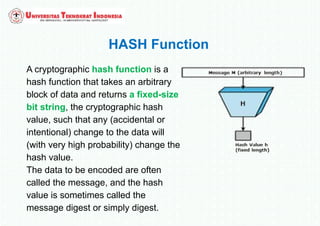
A cryptographic hash function is a
hash function that takes an arbitrary
block of data and returns a fixed-size
bit string, the cryptographic hash
value, such that any (accidental or
intentional) change to the data will
(with very high probability) change the
hash value.
The data to be encoded are often
called the message, and the hash
value is sometimes called the
message digest or simply digest.
What is a HASH Function
The ideal cryptographic hash function has four main properties:
 it is easy to compute the hash value for any given message
 it is infeasible to generate a message that has a given hash
 it is infeasible to modify a message without changing the hash
 it is infeasible to find two different messages with the same hash.
HASH Function Algorithm - Examples
 Message Digest (MD)
 MD2, MD4, MD5, MD6
 Secure Hash Function (SHA)
 SHA-0, SHA-1, SHA-2, and SHA-3
 RACE Integrity Primitives Evaluation Message Digest (RIPEMD)
 RIPEMD-128, and RIPEMD-160. There also exist 256, and 320-bit versions
of this algorithm.
HASH Function Algorithm - Examples
 Message Digest (MD)
 MD2, MD4, MD5, MD6
 Secure Hash Function (SHA)
 SHA-0, SHA-1, SHA-2, and SHA-3
 RACE Integrity Primitives Evaluation
Message Digest (RIPEMD)
 RIPEMD-128, and RIPEMD-160. There
also exist 256, and 320-bit versions of
this algorithm.
Applications of Hash Functions
 Password Storage
 Hash functions provide protection to password storage.
 Instead of storing password in clear, mostly all logon
processes store the hash values of passwords in the file.
 The Password file consists of a table of pairs which are in the
form (user id, h(P))
 Data Integrity Check
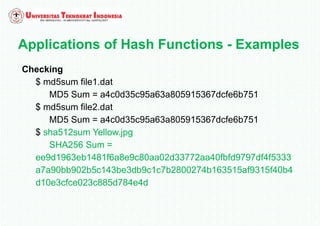
 Data integrity check is a most common application of the
hash functions. It is used to generate the checksums on data
files. This application provides assurance to the user about
correctness of the data.
Applications of Hash Functions - Examples
Checking
$ md5sum file1.dat
MD5 Sum = a4c0d35c95a63a805915367dcfe6b751
$ md5sum file2.dat
MD5 Sum = a4c0d35c95a63a805915367dcfe6b751
$ sha512sum Yellow.jpg
SHA256 Sum =
ee9d1963eb1481f6a8e9c80aa02d33772aa40fbfd9797df4f5333
a7a90bb902b5c143be3db9c1c7b2800274b163515af9315f40b4
d10e3cfce023c885d784e4d
What's Next ?
29

Pertemuan 4 information hiding (cryptography)

  • 1.
    NETWORK SECURITY Jupriyadi, S.Kom.M.T. jupriyadi@teknokrat.ac.id Bandarlampung, Maret 2020 https://spada.teknokrat.ac.id Chapter 4
  • 2.
    • To beunderstand the basic concepts of cryptography • The student will be able hide the message using cryptography techniques
  • 3.
    Cryptography is thestudy of secure communications techniques that allow only the sender and intended recipient of a message to view its contents. The term is derived from the Greek word kryptos, which means hidden. It is closely associated to encryption, which is the act of scrambling ordinary text into what's known as ciphertext and then back again upon arrival
  • 4.
    Cryptography is thescience of using mathematics to encrypt and decrypt data (Phil Zimmermann) Cryptography is the art and science of keeping messages secure (Bruce Schneier)
  • 5.
  • 6.
    Basic Terminologies A messageis plaintext (sometimes called cleartext). The process of disguising a message in such a way as to hide its substance is encryption. An encrypted message is ciphertext. The process of turning ciphertext back into plaintext is decryption. A cipher (or cypher) is an algorithm for performing encryption or decryption
  • 7.
    Basic Terminologies (Cont’d) Acryptosystem is an implementation of cryptographic techniques and their accompanying infrastructure to provide information security services. A cryptosystem is also referred to as a cipher system. The various components of a basic cryptosystem are as follows −  Plaintext  Encryption Algorithm  Ciphertext  Decryption Algorithm  Encryption Key  Decryption Key
  • 8.
    Basic Terminologies (Cont’d) Whilecryptography is the science of securing data, cryptanalysis is the science of analyzing and breaking secure communication. Classical cryptanalysis involves an interesting combination of analytical reasoning, application of mathematical tools, pattern finding, patience, determination, and luck. Cryptanalysts are also called attackers. Cryptology embraces both cryptography and cryptanalysis.
  • 9.
    Classical Cryptography Hieroglyph The firstknown evidence of cryptography can be traced to the use of ‘hieroglyph’. Some 4000 years ago, the Egyptians used to communicate by messages written in hieroglyph.
  • 10.
    Classical Cryptography (Cont’d) CaesarShift Cipher Caesar Shift Cipher, relies on shifting the letters of a message by an agreed number (three was a common choice), the recipient of this message would then shift the letters back by the same number and obtain the original message. The Caesar cipher is named after Julius Caesar , who used it with a shift of three to protect messages of military significance.
  • 11.
    Caesar Shift Cipher CaesarShift Cipher Key = 3 PLAINTEXT : internet society ghana chapter CYPHERTEXT : lqwhuqhw vrflhwb jkdqd fkdswhu
  • 12.
    Goal and ServiceCryptography Goal: The primary goal of cryptography is to secure important data on the hard disk or as it passes through a medium that may not be secure itself. Usually, that medium is a computer network. Services: Cryptography can provide the following services:  Confidentiality (secrecy)  Integrity (anti-tampering)  Authentication  Non-repudiation.
  • 13.
    Service Cryptography Confidentiality (secrecy) Ensuring that no one can read the message except the intended receiver  Data is kept secret from those without the proper credentials, even if that data travels through an insecure medium Integrity (anti-tampering)  Assuring the receiver that the received message has not been altered in any way from the original.
  • 14.
    Service Cryptography Authentication  Cryptographycan help establish identity for authentication purposes. The process of proving one's identity. (The primary forms of host-to-host authentication on the Internet today are name-based or address-based, both of which are notoriously weak.) Non-repudiation  A mechanism to prove that the sender really sent this message
  • 15.
    Types of Cryptography Symmetric Key Cryptography  Asymmetric Key Cryptography  Hash Functions
  • 16.
    Symmetric Key Cryptography Alsoknown as Secret Key Cryptography or Conventional Cryptography, Symmetric Key Cryptography is an encryption system in which the sender and receiver of a message share a single, common key that is used to encrypt and decrypt the message. The Algorithm use is also known as a secret key algorithm or sometimes called a symmetric algorithm A key is a piece of information (a parameter) that determines the functional output of a cryptographic algorithm or cipher. The key for encrypting and decrypting the file had to be known to all the recipients. Else, the message could not be decrypted by conventional means.
  • 17.
    Symmetric Key Cryptography- Examples  Permutation Cipher  substitution cipher,  Hill Cipher,  Rijndael (AES),  Blowfish,  DES  3DES  IDEA  etc ....
  • 18.
    Problem Symmetric KeyCryptography Key Management Symmetric-key systems are simpler and faster; their main drawback is that the two parties must somehow exchange the key in a secure way and keep it secure after that. Key Management caused nightmare for the parties using the symmetric key cryptography. They were worried about how to get the keys safely and securely across to all users so that the decryption of the message would be possible. This gave the chance for third parties to intercept the keys in transit to decode the top-secret messages. Thus, if the key was compromised, the entire coding system was compromised and a “Secret” would no longer remain a “Secret”. This is why the “Public Key Cryptography” came into existence.
  • 19.
    Asymmetric Key Cryptography Asymmetriccryptography , also known as Public-key cryptography, refers to a cryptographic algorithm which requires two separate keys, one of which is private and one of which is public. The public key is used to encrypt the message and the private one is used to decrypt the message.
  • 20.
  • 21.
    Asymmetric Key Cryptography- Examples  Digital Signature Standard (DSS)  Rivest, Shamir and Adleman (RSA)  ElGamal  Elliptic Curve cryptography  etc ...
  • 22.
    HASH Function A cryptographichash function is a hash function that takes an arbitrary block of data and returns a fixed-size bit string, the cryptographic hash value, such that any (accidental or intentional) change to the data will (with very high probability) change the hash value. The data to be encoded are often called the message, and the hash value is sometimes called the message digest or simply digest.
  • 23.
    What is aHASH Function The ideal cryptographic hash function has four main properties:  it is easy to compute the hash value for any given message  it is infeasible to generate a message that has a given hash  it is infeasible to modify a message without changing the hash  it is infeasible to find two different messages with the same hash.
  • 24.
    HASH Function Algorithm- Examples  Message Digest (MD)  MD2, MD4, MD5, MD6  Secure Hash Function (SHA)  SHA-0, SHA-1, SHA-2, and SHA-3  RACE Integrity Primitives Evaluation Message Digest (RIPEMD)  RIPEMD-128, and RIPEMD-160. There also exist 256, and 320-bit versions of this algorithm.
  • 25.
    HASH Function Algorithm- Examples  Message Digest (MD)  MD2, MD4, MD5, MD6  Secure Hash Function (SHA)  SHA-0, SHA-1, SHA-2, and SHA-3  RACE Integrity Primitives Evaluation Message Digest (RIPEMD)  RIPEMD-128, and RIPEMD-160. There also exist 256, and 320-bit versions of this algorithm.
  • 26.
    Applications of HashFunctions  Password Storage  Hash functions provide protection to password storage.  Instead of storing password in clear, mostly all logon processes store the hash values of passwords in the file.  The Password file consists of a table of pairs which are in the form (user id, h(P))  Data Integrity Check  Data integrity check is a most common application of the hash functions. It is used to generate the checksums on data files. This application provides assurance to the user about correctness of the data.
  • 27.
    Applications of HashFunctions - Examples Checking $ md5sum file1.dat MD5 Sum = a4c0d35c95a63a805915367dcfe6b751 $ md5sum file2.dat MD5 Sum = a4c0d35c95a63a805915367dcfe6b751 $ sha512sum Yellow.jpg SHA256 Sum = ee9d1963eb1481f6a8e9c80aa02d33772aa40fbfd9797df4f5333 a7a90bb902b5c143be3db9c1c7b2800274b163515af9315f40b4 d10e3cfce023c885d784e4d
  • 28.
  • 29.