CRYPTOGRAPHY:
Securing the Digital World
Course: BTech, 3rd Semester
Presented by: MAHESH GURJAR
Introduction to Cryptography
Definition:
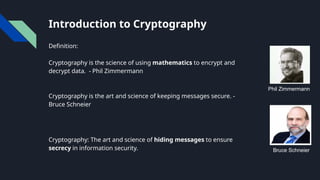
Cryptography is the science of using mathematics to encrypt and
decrypt data. - Phil Zimmermann
Cryptography is the art and science of keeping messages secure. -
Bruce Schneier
Cryptography: The art and science of hiding messages to ensure
secrecy in information security. Bruce Schneier
Phil Zimmermann
Terminologies
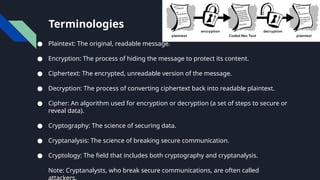
● Plaintext: The original, readable message.
● Encryption: The process of hiding the message to protect its content.
● Ciphertext: The encrypted, unreadable version of the message.
● Decryption: The process of converting ciphertext back into readable plaintext.
● Cipher: An algorithm used for encryption or decryption (a set of steps to secure or
reveal data).
● Cryptography: The science of securing data.
● Cryptanalysis: The science of breaking secure communication.
● Cryptology: The field that includes both cryptography and cryptanalysis.
Note: Cryptanalysts, who break secure communications, are often called
attackers.
History of Cryptography
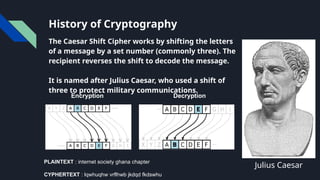
The Caesar Shift Cipher works by shifting the letters
of a message by a set number (commonly three). The
recipient reverses the shift to decode the message.
It is named after Julius Caesar, who used a shift of
three to protect military communications.
Julius Caesar
Encryption Decryption
PLAINTEXT : internet society ghana chapter
CYPHERTEXT : lqwhuqhw vrflhwb jkdqd fkdswhu
Goal and Services
Goal: The primary goal of cryptography is to secure
important data on the hard disk or as it passes through
a medium that may not be secure itself. Usually, that
medium is a computer network.
Services: Cryptography can provide the following
services:
1. Confidentiality (secrecy)
2. Integrity (anti-tampering)
3. Authentication
4. Non-repudiation.
Goal and Services
1. Confidentiality (secrecy) :
Ensuring that no one can read the message except the intended
receiver Data is kept secret from those without the proper credentials,
even if that data travels through an insecure medium
2. Integrity (anti-tampering):
Assuring the receiver that the received message has not been altered
in any way from the original.
Goal and Services
3. Authentication:
Cryptography can help establish identity for authentication purposes
The process of proving one's identity. (The primary forms of host-to-
host
authentication on the Internet today are name-based or address-based,
both of which are notoriously weak.)
4. Non-repudiation:
A mechanism to prove that the sender really sent this message
Types of Cryptography
1. Symmetric Cryptography (Secret Key).
2. Asymmetric Cryptography (Public/Private Key).
3. Hash Functions (One-way encryption for integrity).
Symmetric Key Cryptography
Also known as Secret Key Cryptography or Conventional
Cryptography, Symmetric Key Cryptography is an encryption system
in which the sender and receiver of a message share a single,
common key that is used to encrypt and decrypt the message.
The Algorithm use is also known as a secret key algorithm or
sometimes called a symmetric algorithm
A key is a piece of information (a parameter) that determines the
functional output of a cryptographic algorithm or cipher.
Symmetric Key Cryptography
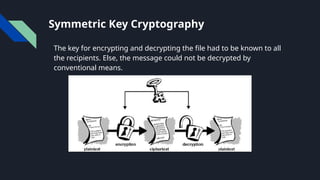
The key for encrypting and decrypting the file had to be known to all
the recipients. Else, the message could not be decrypted by
conventional means.
Symmetric Key Cryptography
Examples :
Data Encryption Standard (DES):
● Developed in 1977 by the US National Bureau of Standards.
● Uses a 56-bit key to map 64-bit plaintext to 64-bit ciphertext.
● Considered insecure today due to small key size.
Triple DES:
● An improvement on DES, using three rounds of DES encryption.
● Longer key length provides better security, making it harder to break than DES.
● Based on the same algorithm, making it easy to upgrade from DES.
Advanced Encryption Standard (AES):
● Adopted by the U.S. government.
● Offers three variants: AES-128, AES-192, and AES-256, based on key sizes.
● 128-bit block size with key sizes of 128, 192, and 256 bits.
● AES is highly secure and widely used globally.
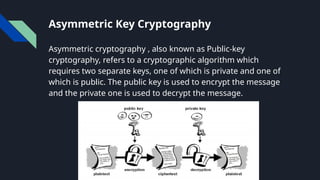
Asymmetric Key Cryptography
Asymmetric cryptography , also known as Public-key
cryptography, refers to a cryptographic algorithm which
requires two separate keys, one of which is private and one of
which is public. The public key is used to encrypt the message
and the private one is used to decrypt the message.
Asymmetric Key Cryptography
Examples:
Digital Signature Standard (DSS):
● Developed by the NSA for creating digital signatures.
● Used to authenticate electronic documents.
● Established by NIST in 1994 and became a U.S. government standard for
electronic document authentication.
● Specified in FIPS 186.
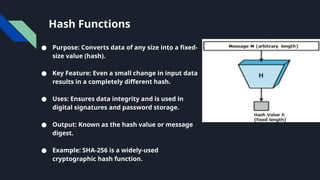
Hash Functions
● Purpose: Converts data of any size into a fixed-
size value (hash).
● Key Feature: Even a small change in input data
results in a completely different hash.
● Uses: Ensures data integrity and is used in
digital signatures and password storage.
● Output: Known as the hash value or message
digest.
● Example: SHA-256 is a widely-used
cryptographic hash function.
Applications of Cryptography
1. Secure Communication: SSL/TLS used in HTTPS for securing internet
traffic.
2. Email Encryption: PGP (Pretty Good Privacy) and S/MIME.
3. Blockchain: Uses cryptography for transaction verification.
4. Banking & E-commerce: Secure online transactions (3D Secure, digital
wallets).
Quantum Cryptography
Definition: Uses quantum mechanics principles to create unbreakable
encryption.
Key Feature: Quantum Key Distribution (QKD) offers a way to secure
communication by detecting eavesdropping.
Future Impact: May replace current encryption methods vulnerable to
quantum computing.
Quantum Internet Prototypte
by me.
Challenges in Cryptography
Key Management: Securely generating, storing, and exchanging keys.
Algorithm Vulnerabilities: Certain algorithms (like DES, MD5) have been
broken.
Quantum Computing: A future threat that can crack today's encryption
algorithms.
Backdoors: Government and organization attempts to weaken
encryption for access.
Conclusion
Summary: Cryptography plays a crucial role in protecting data
in the digital age, ensuring secure communication, maintaining
data integrity, and safeguarding privacy.
Final Thought: As emerging technologies like quantum
computing pose new threats, cryptography will need to adapt
and evolve to address future security challenges.
Q&A
Open the floor for any questions or discussions.

Introduction to Cryptography for btech cse

  • 1.
    CRYPTOGRAPHY: Securing the DigitalWorld Course: BTech, 3rd Semester Presented by: MAHESH GURJAR
  • 2.
    Introduction to Cryptography Definition: Cryptographyis the science of using mathematics to encrypt and decrypt data. - Phil Zimmermann Cryptography is the art and science of keeping messages secure. - Bruce Schneier Cryptography: The art and science of hiding messages to ensure secrecy in information security. Bruce Schneier Phil Zimmermann
  • 3.
    Terminologies ● Plaintext: Theoriginal, readable message. ● Encryption: The process of hiding the message to protect its content. ● Ciphertext: The encrypted, unreadable version of the message. ● Decryption: The process of converting ciphertext back into readable plaintext. ● Cipher: An algorithm used for encryption or decryption (a set of steps to secure or reveal data). ● Cryptography: The science of securing data. ● Cryptanalysis: The science of breaking secure communication. ● Cryptology: The field that includes both cryptography and cryptanalysis. Note: Cryptanalysts, who break secure communications, are often called attackers.
  • 4.
    History of Cryptography TheCaesar Shift Cipher works by shifting the letters of a message by a set number (commonly three). The recipient reverses the shift to decode the message. It is named after Julius Caesar, who used a shift of three to protect military communications. Julius Caesar Encryption Decryption PLAINTEXT : internet society ghana chapter CYPHERTEXT : lqwhuqhw vrflhwb jkdqd fkdswhu
  • 5.
    Goal and Services Goal:The primary goal of cryptography is to secure important data on the hard disk or as it passes through a medium that may not be secure itself. Usually, that medium is a computer network. Services: Cryptography can provide the following services: 1. Confidentiality (secrecy) 2. Integrity (anti-tampering) 3. Authentication 4. Non-repudiation.
  • 6.
    Goal and Services 1.Confidentiality (secrecy) : Ensuring that no one can read the message except the intended receiver Data is kept secret from those without the proper credentials, even if that data travels through an insecure medium 2. Integrity (anti-tampering): Assuring the receiver that the received message has not been altered in any way from the original.
  • 7.
    Goal and Services 3.Authentication: Cryptography can help establish identity for authentication purposes The process of proving one's identity. (The primary forms of host-to- host authentication on the Internet today are name-based or address-based, both of which are notoriously weak.) 4. Non-repudiation: A mechanism to prove that the sender really sent this message
  • 8.
    Types of Cryptography 1.Symmetric Cryptography (Secret Key). 2. Asymmetric Cryptography (Public/Private Key). 3. Hash Functions (One-way encryption for integrity).
  • 9.
    Symmetric Key Cryptography Alsoknown as Secret Key Cryptography or Conventional Cryptography, Symmetric Key Cryptography is an encryption system in which the sender and receiver of a message share a single, common key that is used to encrypt and decrypt the message. The Algorithm use is also known as a secret key algorithm or sometimes called a symmetric algorithm A key is a piece of information (a parameter) that determines the functional output of a cryptographic algorithm or cipher.
  • 10.
    Symmetric Key Cryptography Thekey for encrypting and decrypting the file had to be known to all the recipients. Else, the message could not be decrypted by conventional means.
  • 11.
    Symmetric Key Cryptography Examples: Data Encryption Standard (DES): ● Developed in 1977 by the US National Bureau of Standards. ● Uses a 56-bit key to map 64-bit plaintext to 64-bit ciphertext. ● Considered insecure today due to small key size. Triple DES: ● An improvement on DES, using three rounds of DES encryption. ● Longer key length provides better security, making it harder to break than DES. ● Based on the same algorithm, making it easy to upgrade from DES. Advanced Encryption Standard (AES): ● Adopted by the U.S. government. ● Offers three variants: AES-128, AES-192, and AES-256, based on key sizes. ● 128-bit block size with key sizes of 128, 192, and 256 bits. ● AES is highly secure and widely used globally.
  • 12.
    Asymmetric Key Cryptography Asymmetriccryptography , also known as Public-key cryptography, refers to a cryptographic algorithm which requires two separate keys, one of which is private and one of which is public. The public key is used to encrypt the message and the private one is used to decrypt the message.
  • 14.
    Asymmetric Key Cryptography Examples: DigitalSignature Standard (DSS): ● Developed by the NSA for creating digital signatures. ● Used to authenticate electronic documents. ● Established by NIST in 1994 and became a U.S. government standard for electronic document authentication. ● Specified in FIPS 186.
  • 15.
    Hash Functions ● Purpose:Converts data of any size into a fixed- size value (hash). ● Key Feature: Even a small change in input data results in a completely different hash. ● Uses: Ensures data integrity and is used in digital signatures and password storage. ● Output: Known as the hash value or message digest. ● Example: SHA-256 is a widely-used cryptographic hash function.
  • 17.
    Applications of Cryptography 1.Secure Communication: SSL/TLS used in HTTPS for securing internet traffic. 2. Email Encryption: PGP (Pretty Good Privacy) and S/MIME. 3. Blockchain: Uses cryptography for transaction verification. 4. Banking & E-commerce: Secure online transactions (3D Secure, digital wallets).
  • 18.
    Quantum Cryptography Definition: Usesquantum mechanics principles to create unbreakable encryption. Key Feature: Quantum Key Distribution (QKD) offers a way to secure communication by detecting eavesdropping. Future Impact: May replace current encryption methods vulnerable to quantum computing. Quantum Internet Prototypte by me.
  • 19.
    Challenges in Cryptography KeyManagement: Securely generating, storing, and exchanging keys. Algorithm Vulnerabilities: Certain algorithms (like DES, MD5) have been broken. Quantum Computing: A future threat that can crack today's encryption algorithms. Backdoors: Government and organization attempts to weaken encryption for access.
  • 20.
    Conclusion Summary: Cryptography playsa crucial role in protecting data in the digital age, ensuring secure communication, maintaining data integrity, and safeguarding privacy. Final Thought: As emerging technologies like quantum computing pose new threats, cryptography will need to adapt and evolve to address future security challenges.
  • 22.
    Q&A Open the floorfor any questions or discussions.