INFORMATION SYSTEM
SECURITY
Jupriyadi, S.Kom. M.T.
jupriyadi@teknokrat.ac.id
Bandarlampung, Juli 2021
Chapter 4
Threat, Vulnerability,
and Attack
Threat
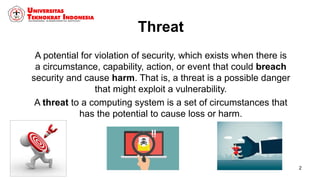
A potential for violation of security, which exists when there is
a circumstance, capability, action, or event that could breach
security and cause harm. That is, a threat is a possible danger
that might exploit a vulnerability.
A threat to a computing system is a set of circumstances that
has the potential to cause loss or harm.
2
Threat
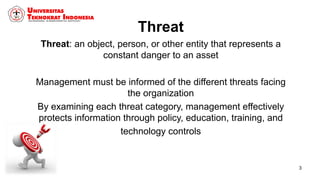
Threat: an object, person, or other entity that represents a
constant danger to an asset
Management must be informed of the different threats facing
the organization
By examining each threat category, management effectively
protects information through policy, education, training, and
technology controls
3
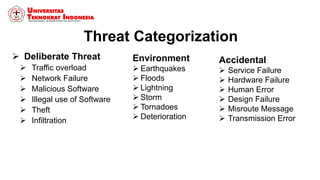
Threat Categorization
 Deliberate Threat
 Traffic overload
 Network Failure
 Malicious Software
 Illegal use of Software
 Theft
 Infiltration
Environment
 Earthquakes
 Floods
 Lightning
 Storm
 Tornadoes
 Deterioration
Accidental
 Service Failure
 Hardware Failure
 Human Error
 Design Failure
 Misroute Message
 Transmission Error
5
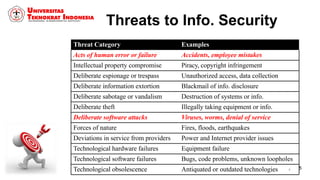
Threats to Info. Security
Threat Category Examples
Acts of human error or failure Accidents, employee mistakes
Intellectual property compromise Piracy, copyright infringement
Deliberate espionage or trespass Unauthorized access, data collection
Deliberate information extortion Blackmail of info. disclosure
Deliberate sabotage or vandalism Destruction of systems or info.
Deliberate theft Illegally taking equipment or info.
Deliberate software attacks Viruses, worms, denial of service
Forces of nature Fires, floods, earthquakes
Deviations in service from providers Power and Internet provider issues
Technological hardware failures Equipment failure
Technological software failures Bugs, code problems, unknown loopholes
Technological obsolescence Antiquated or outdated technologies 6
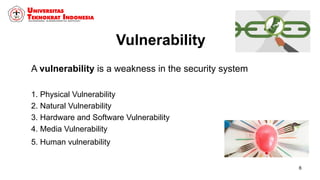
Vulnerability
A vulnerability is a weakness in the security system
1. Physical Vulnerability
2. Natural Vulnerability
3. Hardware and Software Vulnerability
4. Media Vulnerability
5. Human vulnerability
6
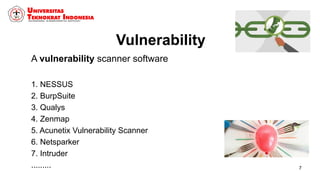
Vulnerability
A vulnerability scanner software
1. NESSUS
2. BurpSuite
3. Qualys
4. Zenmap
5. Acunetix Vulnerability Scanner
6. Netsparker
7. Intruder
......... 7
Attacks
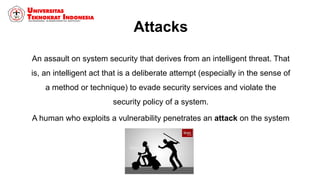
An assault on system security that derives from an intelligent threat. That
is, an intelligent act that is a deliberate attempt (especially in the sense of
a method or technique) to evade security services and violate the
security policy of a system.
A human who exploits a vulnerability penetrates an attack on the system
Attacks (1)
• Act or action that exploits vulnerability (i.e., an
identified weakness) in controlled system
• Accomplished by threat agent which damages or
steals organization’s information
Attacks (2)
• Malicious code: launching viruses, worms, Trojan horses, and active
Web scripts aiming to steal or destroy info.
• Backdoor: accessing system or network using known or
previously unknown mechanism
• Password crack: attempting to reverse calculate a password
• Brute force: trying every possible combination of options of a
password
• Dictionary: selects specific accounts to attack and uses commonly
used passwords (i.e., the dictionary) to guide guesses
Security Attacks Categories
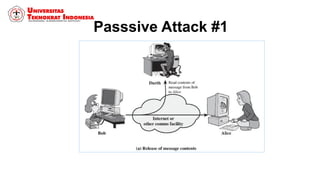
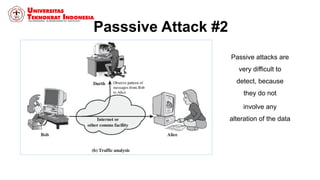
1. Passive Attacks
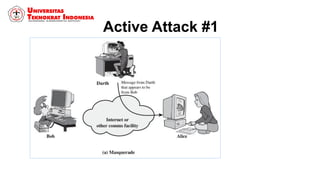
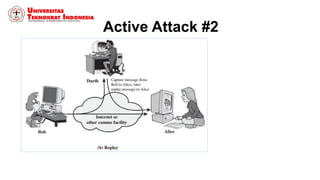
2. Active Attacks
A passive attack attempts to learn or make use of information
from the system but does not affect system resources.
An active attack attempts to alter system resources or affect
their operation.
11
Passsive Attack #1
Passsive Attack #2
Passive attacks are
very difficult to
detect, because
they do not
involve any
alteration of the data
Active Attack #1
Active Attack #2
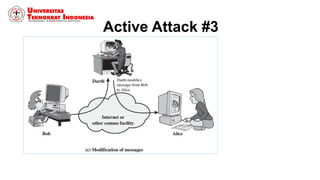
Active Attack #3
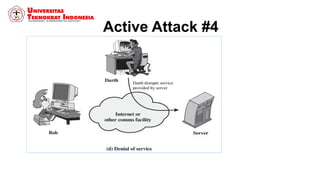
Active Attack #4
Attack Categories
 Interruption
 Interception
 Modification
 Fabrication
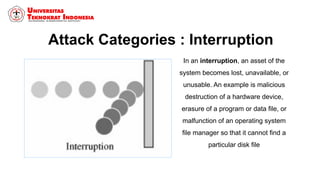
Attack Categories : Interruption
In an interruption, an asset of the
system becomes lost, unavailable, or
unusable. An example is malicious
destruction of a hardware device,
erasure of a program or data file, or
malfunction of an operating system
file manager so that it cannot find a
particular disk file
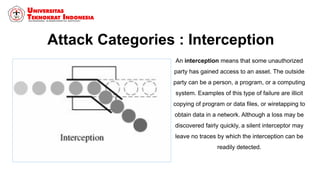
Attack Categories : Interception
An interception means that some unauthorized
party has gained access to an asset. The outside
party can be a person, a program, or a computing
system. Examples of this type of failure are illicit
copying of program or data files, or wiretapping to
obtain data in a network. Although a loss may be
discovered fairly quickly, a silent interceptor may
leave no traces by which the interception can be
readily detected.
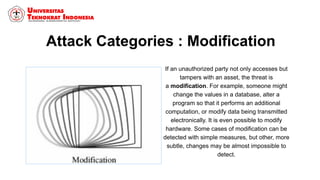
Attack Categories : Modification
If an unauthorized party not only accesses but
tampers with an asset, the threat is
a modification. For example, someone might
change the values in a database, alter a
program so that it performs an additional
computation, or modify data being transmitted
electronically. It is even possible to modify
hardware. Some cases of modification can be
detected with simple measures, but other, more
subtle, changes may be almost impossible to
detect.
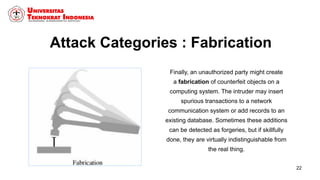
Attack Categories : Fabrication
Finally, an unauthorized party might create
a fabrication of counterfeit objects on a
computing system. The intruder may insert
spurious transactions to a network
communication system or add records to an
existing database. Sometimes these additions
can be detected as forgeries, but if skillfully
done, they are virtually indistinguishable from
the real thing.
22
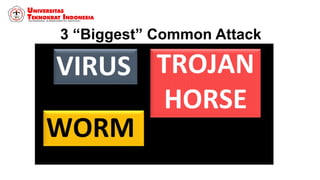
3 “Biggest” Common Attack
 The primary vulnerabilities for end-user computers are virus, worm, and Trojan
Horse attacks:
 A virus is malicious software which attaches to another program to execute a
specific unwanted function on a computer.
 A worm executes arbitrary code and installs copies of itself in the memory of the
infected computer, which then infects other hosts.
 A Trojan Horse is an application written to look like something else. When a Trojan
Horse is downloaded and opened, it attacks the end-user computer from within.
Question or Comments…….
Whats Next .. ??
25

Chapter 4 vulnerability threat and attack

  • 1.
    INFORMATION SYSTEM SECURITY Jupriyadi, S.Kom.M.T. jupriyadi@teknokrat.ac.id Bandarlampung, Juli 2021 Chapter 4 Threat, Vulnerability, and Attack
  • 2.
    Threat A potential forviolation of security, which exists when there is a circumstance, capability, action, or event that could breach security and cause harm. That is, a threat is a possible danger that might exploit a vulnerability. A threat to a computing system is a set of circumstances that has the potential to cause loss or harm. 2
  • 3.
    Threat Threat: an object,person, or other entity that represents a constant danger to an asset Management must be informed of the different threats facing the organization By examining each threat category, management effectively protects information through policy, education, training, and technology controls 3
  • 4.
    Threat Categorization  DeliberateThreat  Traffic overload  Network Failure  Malicious Software  Illegal use of Software  Theft  Infiltration Environment  Earthquakes  Floods  Lightning  Storm  Tornadoes  Deterioration Accidental  Service Failure  Hardware Failure  Human Error  Design Failure  Misroute Message  Transmission Error
  • 5.
    5 Threats to Info.Security Threat Category Examples Acts of human error or failure Accidents, employee mistakes Intellectual property compromise Piracy, copyright infringement Deliberate espionage or trespass Unauthorized access, data collection Deliberate information extortion Blackmail of info. disclosure Deliberate sabotage or vandalism Destruction of systems or info. Deliberate theft Illegally taking equipment or info. Deliberate software attacks Viruses, worms, denial of service Forces of nature Fires, floods, earthquakes Deviations in service from providers Power and Internet provider issues Technological hardware failures Equipment failure Technological software failures Bugs, code problems, unknown loopholes Technological obsolescence Antiquated or outdated technologies 6
  • 6.
    Vulnerability A vulnerability isa weakness in the security system 1. Physical Vulnerability 2. Natural Vulnerability 3. Hardware and Software Vulnerability 4. Media Vulnerability 5. Human vulnerability 6
  • 7.
    Vulnerability A vulnerability scannersoftware 1. NESSUS 2. BurpSuite 3. Qualys 4. Zenmap 5. Acunetix Vulnerability Scanner 6. Netsparker 7. Intruder ......... 7
  • 8.
    Attacks An assault onsystem security that derives from an intelligent threat. That is, an intelligent act that is a deliberate attempt (especially in the sense of a method or technique) to evade security services and violate the security policy of a system. A human who exploits a vulnerability penetrates an attack on the system
  • 9.
    Attacks (1) • Actor action that exploits vulnerability (i.e., an identified weakness) in controlled system • Accomplished by threat agent which damages or steals organization’s information
  • 10.
    Attacks (2) • Maliciouscode: launching viruses, worms, Trojan horses, and active Web scripts aiming to steal or destroy info. • Backdoor: accessing system or network using known or previously unknown mechanism • Password crack: attempting to reverse calculate a password • Brute force: trying every possible combination of options of a password • Dictionary: selects specific accounts to attack and uses commonly used passwords (i.e., the dictionary) to guide guesses
  • 11.
    Security Attacks Categories 1.Passive Attacks 2. Active Attacks A passive attack attempts to learn or make use of information from the system but does not affect system resources. An active attack attempts to alter system resources or affect their operation. 11
  • 12.
  • 13.
    Passsive Attack #2 Passiveattacks are very difficult to detect, because they do not involve any alteration of the data
  • 14.
  • 15.
  • 16.
  • 17.
  • 18.
    Attack Categories  Interruption Interception  Modification  Fabrication
  • 19.
    Attack Categories :Interruption In an interruption, an asset of the system becomes lost, unavailable, or unusable. An example is malicious destruction of a hardware device, erasure of a program or data file, or malfunction of an operating system file manager so that it cannot find a particular disk file
  • 20.
    Attack Categories :Interception An interception means that some unauthorized party has gained access to an asset. The outside party can be a person, a program, or a computing system. Examples of this type of failure are illicit copying of program or data files, or wiretapping to obtain data in a network. Although a loss may be discovered fairly quickly, a silent interceptor may leave no traces by which the interception can be readily detected.
  • 21.
    Attack Categories :Modification If an unauthorized party not only accesses but tampers with an asset, the threat is a modification. For example, someone might change the values in a database, alter a program so that it performs an additional computation, or modify data being transmitted electronically. It is even possible to modify hardware. Some cases of modification can be detected with simple measures, but other, more subtle, changes may be almost impossible to detect.
  • 22.
    Attack Categories :Fabrication Finally, an unauthorized party might create a fabrication of counterfeit objects on a computing system. The intruder may insert spurious transactions to a network communication system or add records to an existing database. Sometimes these additions can be detected as forgeries, but if skillfully done, they are virtually indistinguishable from the real thing. 22
  • 23.
  • 24.
    3 “Biggest” CommonAttack  The primary vulnerabilities for end-user computers are virus, worm, and Trojan Horse attacks:  A virus is malicious software which attaches to another program to execute a specific unwanted function on a computer.  A worm executes arbitrary code and installs copies of itself in the memory of the infected computer, which then infects other hosts.  A Trojan Horse is an application written to look like something else. When a Trojan Horse is downloaded and opened, it attacks the end-user computer from within.
  • 25.