PERT & CPM
SUBMITTED BY:-
SHASHANK KAPOOR
MECHANICAL , 154169
What isthe PERT&CPM?
It is nothing but the technique used in Network analysis
of project management, such as planning ,
management and control of project.
So, what is project ??
“A project is a series of activities directed
to accomplishment of a desired objective.”
Plan your work first…..then work your plan
Project Evaluation & Review
Techniques
(PERT)
In PERT is basicallyamethod to analyze the tasks involved in
completing agiven project,especially the time neededto completeeachtask,
and to identify the minimum time neededto complete the total project.
– Multiple time estimates
– Probabilistic activity times
USED IN : Project management - for non-repetitive jobs
(research and development work), where the time and cost
estimates tend to be quite uncertain. This technique uses
probabilistic time estimates.
Critical Path Method
(CPM)
In CPM activities are shown as a network of
precedence relationships using activity-on-node network
construction.
– Single estimate of activity time
– Deterministic activity times
USED IN : Production management - for the jobs of
repetitive in nature where the activity time
estimates can be predicted with considerable
certainty due to the existence of past experience.
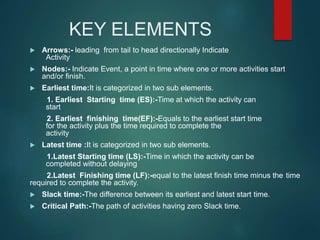
KEY ELEMENTS
 Arrows:- leading from tail to head directionally Indicate
Activity
 Nodes:- Indicate Event, a point in time where one or more activities start
and/or finish.
 Earliest time:It is categorized in two sub elements.
1. Earliest Starting time (ES):-Time at which the activity can
start
2. Earliest finishing time(EF):-Equals to the earliest start time
for the activity plus the time required to complete the
activity
 Latest time :It is categorized in two sub elements.
1.Latest Starting time (LS):-Time in which the activity can be
completed without delaying
2.Latest Finishing time (LF):-equal to the latest finish time minus the time
required to complete the activity.
 Slack time:-The difference between its earliest and latest start time.
 Critical Path:-The path of activities having zero Slack time.
KEY ELEMENTS
 Optimistic time (a): – It is the shortest time in which the activity
can be completed.
 Most likely time (m) – It is the probable time required to perform
the activity.
 Pessimistic time (b)– It is the longest estimated time required to
perform an activity .
 Expected time (Te) – approximation time taken to complete an
activity.
Te=
𝒂+𝟒𝒎+𝒃
𝟔
 Standard deviation ( ) – Higher the SD is the greater amount of
uncertainty exists
 Variance (𝝈 𝟐
) − Large variance indicates great uncertainty, a small
variance indicates a more accurate estimate
=
𝑏−𝑎
6
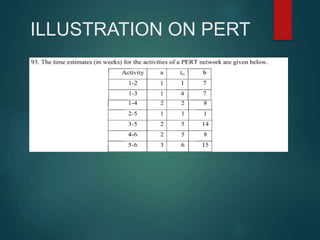
ILLUSTRATION ON PERT
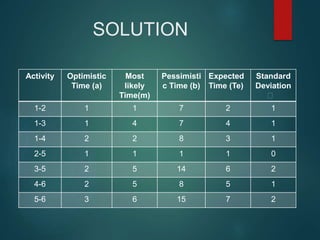
SOLUTION
Activity Optimistic
Time (a)
Most
likely
Time(m)
Pessimisti
c Time (b)
Expected
Time (Te)
Standard
Deviation
1-2 1 1 7 2 1
1-3 1 4 7 4 1
1-4 2 2 8 3 1
2-5 1 1 1 1 0
3-5 2 5 14 6 2
4-6 2 5 8 5 1
5-6 3 6 15 7 2
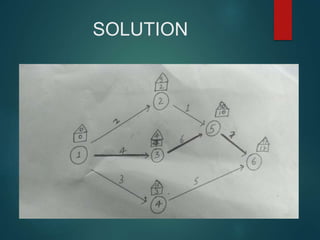
SOLUTION
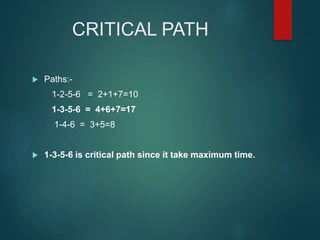
CRITICAL PATH
 Paths:-
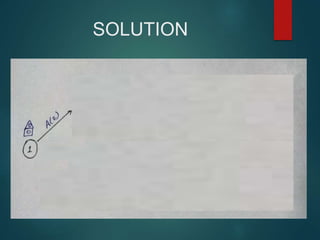
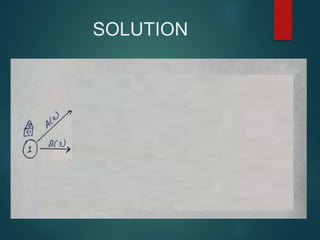
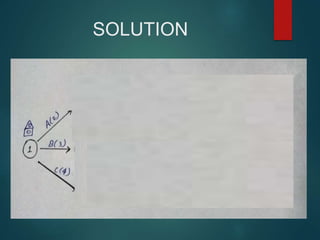
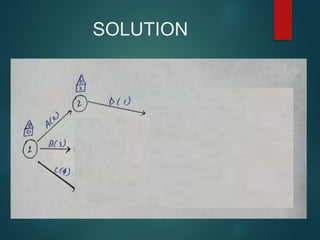
1-2-5-6 = 2+1+7=10
1-3-5-6 = 4+6+7=17
1-4-6 = 3+5=8
 1-3-5-6 is critical path since it take maximum time.
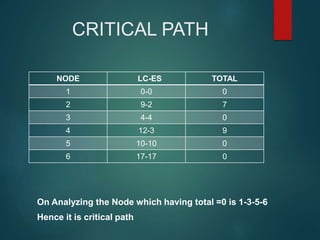
CRITICAL PATH
NODE LC-ES TOTAL
1 0-0 0
2 9-2 7
3 4-4 0
4 12-3 9
5 10-10 0
6 17-17 0
On Analyzing the Node which having total =0 is 1-3-5-6
Hence it is critical path
PROBABILISTIC
DETERMINATION
 What isthe Probability of it taking20 weeks?
CriticalPath=1-3-5-6=17weeks
T =20 weeks C=17 weeks
𝑧 = 𝑇−𝐶
𝜎2
(Variance) 𝜎2 = 1 + 4 + 4 = 9
𝑧 = 20−17
9
= 1
Lookup Zvalue in normal distribution table
Pz=0.8413 or 84.13%
Goingover 20 weeks would be 100 – 84.13 = 15.87%
(Probability of ittaking 20 weeks)
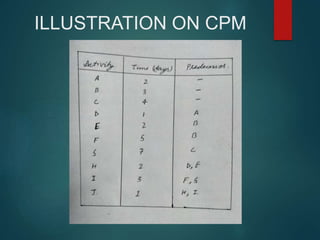
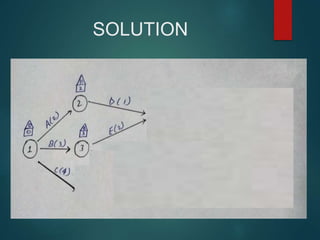
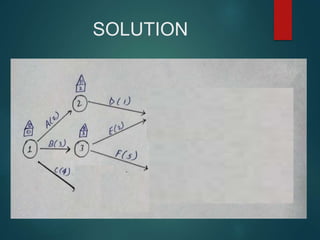
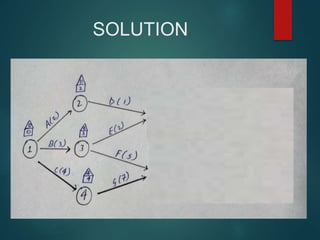
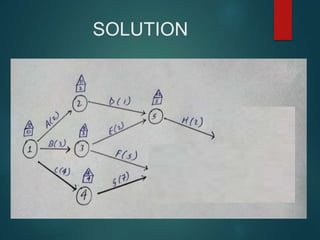
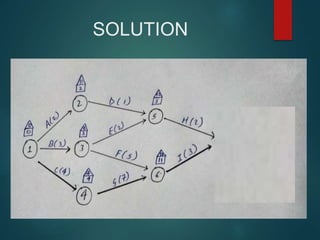
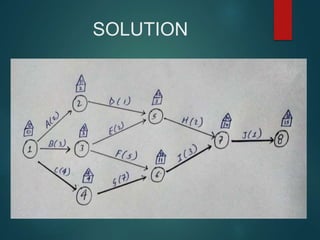
ILLUSTRATION ON CPM
SOLUTION
SOLUTION
SOLUTION
SOLUTION
SOLUTION
SOLUTION
SOLUTION
SOLUTION
SOLUTION
SOLUTION
SOLUTION
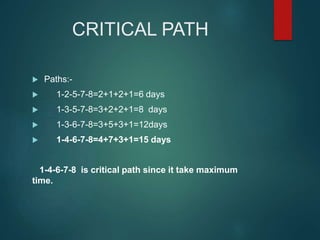
CRITICAL PATH
 Paths:-
 1-2-5-7-8=2+1+2+1=6 days
 1-3-5-7-8=3+2+2+1=8 days
 1-3-6-7-8=3+5+3+1=12days
 1-4-6-7-8=4+7+3+1=15 days
1-4-6-7-8 is critical path since it take maximum
time.
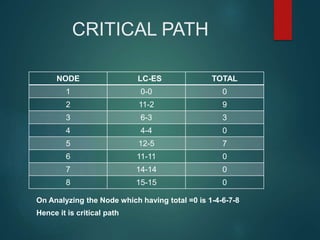
CRITICAL PATH
NODE LC-ES TOTAL
1 0-0 0
2 11-2 9
3 6-3 3
4 4-4 0
5 12-5 7
6 11-11 0
7 14-14 0
8 15-15 0
On Analyzing the Node which having total =0 is 1-4-6-7-8
Hence it is critical path
What happen if we have large
number of Network problem??
Conclusion
 For large number of network problem Ford
Fulkerson Max Flow Algorithm is the point
that can give us the optimal critical path
since it is use for finding the maximum flow
in a flow network for single source and single
sink.
THANK YOU

Pert and cpm

  • 1.
    PERT & CPM SUBMITTEDBY:- SHASHANK KAPOOR MECHANICAL , 154169
  • 2.
    What isthe PERT&CPM? Itis nothing but the technique used in Network analysis of project management, such as planning , management and control of project. So, what is project ?? “A project is a series of activities directed to accomplishment of a desired objective.” Plan your work first…..then work your plan
  • 3.
    Project Evaluation &Review Techniques (PERT) In PERT is basicallyamethod to analyze the tasks involved in completing agiven project,especially the time neededto completeeachtask, and to identify the minimum time neededto complete the total project. – Multiple time estimates – Probabilistic activity times USED IN : Project management - for non-repetitive jobs (research and development work), where the time and cost estimates tend to be quite uncertain. This technique uses probabilistic time estimates.
  • 4.
    Critical Path Method (CPM) InCPM activities are shown as a network of precedence relationships using activity-on-node network construction. – Single estimate of activity time – Deterministic activity times USED IN : Production management - for the jobs of repetitive in nature where the activity time estimates can be predicted with considerable certainty due to the existence of past experience.
  • 5.
    KEY ELEMENTS  Arrows:-leading from tail to head directionally Indicate Activity  Nodes:- Indicate Event, a point in time where one or more activities start and/or finish.  Earliest time:It is categorized in two sub elements. 1. Earliest Starting time (ES):-Time at which the activity can start 2. Earliest finishing time(EF):-Equals to the earliest start time for the activity plus the time required to complete the activity  Latest time :It is categorized in two sub elements. 1.Latest Starting time (LS):-Time in which the activity can be completed without delaying 2.Latest Finishing time (LF):-equal to the latest finish time minus the time required to complete the activity.  Slack time:-The difference between its earliest and latest start time.  Critical Path:-The path of activities having zero Slack time.
  • 6.
    KEY ELEMENTS  Optimistictime (a): – It is the shortest time in which the activity can be completed.  Most likely time (m) – It is the probable time required to perform the activity.  Pessimistic time (b)– It is the longest estimated time required to perform an activity .  Expected time (Te) – approximation time taken to complete an activity. Te= 𝒂+𝟒𝒎+𝒃 𝟔  Standard deviation ( ) – Higher the SD is the greater amount of uncertainty exists  Variance (𝝈 𝟐 ) − Large variance indicates great uncertainty, a small variance indicates a more accurate estimate = 𝑏−𝑎 6
  • 7.
  • 8.
    SOLUTION Activity Optimistic Time (a) Most likely Time(m) Pessimisti cTime (b) Expected Time (Te) Standard Deviation 1-2 1 1 7 2 1 1-3 1 4 7 4 1 1-4 2 2 8 3 1 2-5 1 1 1 1 0 3-5 2 5 14 6 2 4-6 2 5 8 5 1 5-6 3 6 15 7 2
  • 9.
  • 10.
    CRITICAL PATH  Paths:- 1-2-5-6= 2+1+7=10 1-3-5-6 = 4+6+7=17 1-4-6 = 3+5=8  1-3-5-6 is critical path since it take maximum time.
  • 11.
    CRITICAL PATH NODE LC-ESTOTAL 1 0-0 0 2 9-2 7 3 4-4 0 4 12-3 9 5 10-10 0 6 17-17 0 On Analyzing the Node which having total =0 is 1-3-5-6 Hence it is critical path
  • 12.
    PROBABILISTIC DETERMINATION  What istheProbability of it taking20 weeks? CriticalPath=1-3-5-6=17weeks T =20 weeks C=17 weeks 𝑧 = 𝑇−𝐶 𝜎2 (Variance) 𝜎2 = 1 + 4 + 4 = 9 𝑧 = 20−17 9 = 1 Lookup Zvalue in normal distribution table Pz=0.8413 or 84.13% Goingover 20 weeks would be 100 – 84.13 = 15.87% (Probability of ittaking 20 weeks)
  • 13.
  • 14.
  • 15.
  • 16.
  • 17.
  • 18.
  • 19.
  • 20.
  • 21.
  • 22.
  • 23.
  • 24.
  • 25.
    CRITICAL PATH  Paths:- 1-2-5-7-8=2+1+2+1=6 days  1-3-5-7-8=3+2+2+1=8 days  1-3-6-7-8=3+5+3+1=12days  1-4-6-7-8=4+7+3+1=15 days 1-4-6-7-8 is critical path since it take maximum time.
  • 26.
    CRITICAL PATH NODE LC-ESTOTAL 1 0-0 0 2 11-2 9 3 6-3 3 4 4-4 0 5 12-5 7 6 11-11 0 7 14-14 0 8 15-15 0 On Analyzing the Node which having total =0 is 1-4-6-7-8 Hence it is critical path
  • 27.
    What happen ifwe have large number of Network problem??
  • 28.
    Conclusion  For largenumber of network problem Ford Fulkerson Max Flow Algorithm is the point that can give us the optimal critical path since it is use for finding the maximum flow in a flow network for single source and single sink.
  • 29.