Nano 3D Printing:
Two photon
lithography
SHASHANK KAPOOR
154169
Introduction
 Additive manufacturing is a way of making 3-D objects by building
up material, layer upon layer, with the guidance of a digital design.
The processes are engineered to use material more efficiently, give
designs more flexibility and produce objects more precisely.
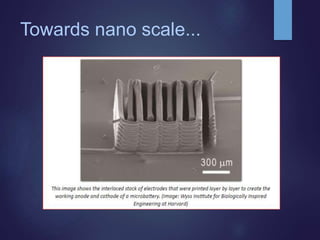
 Already, 3D printing can now be used to print lithium-ion
microbatteries the size of a grain of sand. To make the
microbatteries, a team based at Harvard University and the
University of Illinois at Urbana-Champaign printed precisely
interlaced stacks of tiny battery electrodes, each less than the width
of a human hair.
Towards nano scale...
What is nano 3D printing ?
 Applying 3D printing concepts to nanotechnology could bring
similar advantages to nanofabrication – speed, less waste,
economic viability – than it is expected to bring to manufacturing
technologies.
 Printing three dimensional objects with incredibly fine details is
now possible using "two-photon lithography". With this
technology, tiny structures on a nanometer scale can be fabricated.
 Researchers at the Vienna University of Technology (TU Vienna)
have now made a major breakthrough in speeding up this printing
technique. The high-precision-3D-printer at TU Vienna is orders of
magnitude faster than similar devices. This opens up completely
new areas of application, such as in medicine, Biological Scaffold,
Compact bio-sensor design.
How it looks?
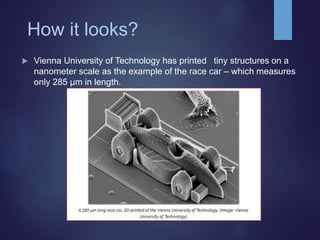
 Vienna University of Technology has printed tiny structures on a
nanometer scale as the example of the race car – which measures
only 285 µm in length.
Nano 3d printing in action
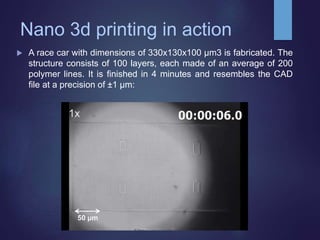
 A race car with dimensions of 330x130x100 µm3 is fabricated. The
structure consists of 100 layers, each made of an average of 200
polymer lines. It is finished in 4 minutes and resembles the CAD
file at a precision of ±1 µm:
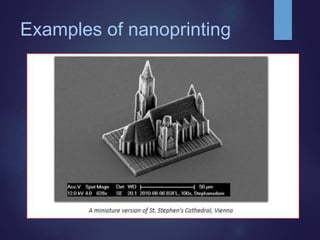
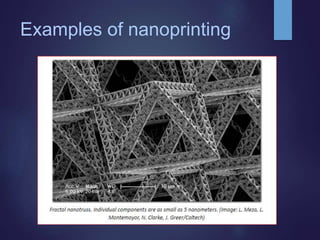
Examples of nanoprinting
Two Photon Lithography
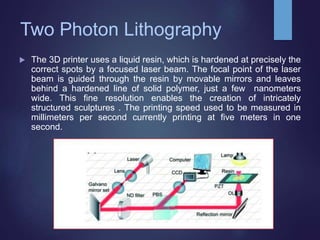
 The 3D printer uses a liquid resin, which is hardened at precisely the
correct spots by a focused laser beam. The focal point of the laser
beam is guided through the resin by movable mirrors and leaves
behind a hardened line of solid polymer, just a few nanometers
wide. This fine resolution enables the creation of intricately
structured sculptures . The printing speed used to be measured in
millimeters per second currently printing at five meters in one
second.
Two Photon Lithography
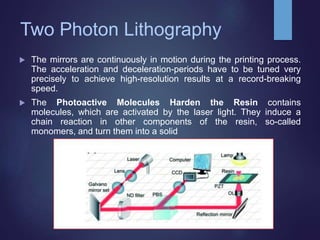
 The mirrors are continuously in motion during the printing process.
The acceleration and deceleration-periods have to be tuned very
precisely to achieve high-resolution results at a record-breaking
speed.
 The Photoactive Molecules Harden the Resin contains
molecules, which are activated by the laser light. They induce a
chain reaction in other components of the resin, so-called
monomers, and turn them into a solid
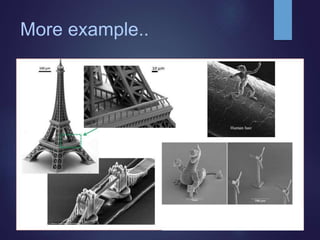
More example..
Thank you

Nano 3d printing : Two Photon lithography

  • 1.
    Nano 3D Printing: Twophoton lithography SHASHANK KAPOOR 154169
  • 2.
    Introduction  Additive manufacturingis a way of making 3-D objects by building up material, layer upon layer, with the guidance of a digital design. The processes are engineered to use material more efficiently, give designs more flexibility and produce objects more precisely.  Already, 3D printing can now be used to print lithium-ion microbatteries the size of a grain of sand. To make the microbatteries, a team based at Harvard University and the University of Illinois at Urbana-Champaign printed precisely interlaced stacks of tiny battery electrodes, each less than the width of a human hair.
  • 3.
  • 4.
    What is nano3D printing ?  Applying 3D printing concepts to nanotechnology could bring similar advantages to nanofabrication – speed, less waste, economic viability – than it is expected to bring to manufacturing technologies.  Printing three dimensional objects with incredibly fine details is now possible using "two-photon lithography". With this technology, tiny structures on a nanometer scale can be fabricated.  Researchers at the Vienna University of Technology (TU Vienna) have now made a major breakthrough in speeding up this printing technique. The high-precision-3D-printer at TU Vienna is orders of magnitude faster than similar devices. This opens up completely new areas of application, such as in medicine, Biological Scaffold, Compact bio-sensor design.
  • 5.
    How it looks? Vienna University of Technology has printed tiny structures on a nanometer scale as the example of the race car – which measures only 285 µm in length.
  • 6.
    Nano 3d printingin action  A race car with dimensions of 330x130x100 µm3 is fabricated. The structure consists of 100 layers, each made of an average of 200 polymer lines. It is finished in 4 minutes and resembles the CAD file at a precision of ±1 µm:
  • 7.
  • 8.
  • 9.
    Two Photon Lithography The 3D printer uses a liquid resin, which is hardened at precisely the correct spots by a focused laser beam. The focal point of the laser beam is guided through the resin by movable mirrors and leaves behind a hardened line of solid polymer, just a few nanometers wide. This fine resolution enables the creation of intricately structured sculptures . The printing speed used to be measured in millimeters per second currently printing at five meters in one second.
  • 10.
    Two Photon Lithography The mirrors are continuously in motion during the printing process. The acceleration and deceleration-periods have to be tuned very precisely to achieve high-resolution results at a record-breaking speed.  The Photoactive Molecules Harden the Resin contains molecules, which are activated by the laser light. They induce a chain reaction in other components of the resin, so-called monomers, and turn them into a solid
  • 11.
  • 12.