Personal Selling
Presented By:
Jatin Vaid
Consumer buying process
Problem / Need recognition
Information search / collection
Evaluation of alternatives
Purchase decision
Post-purchase behaviour
Jatin Vaid 2
Stages of consumer buying process
1. Problem recognition
 Internal stimuli (hunger, prestige)
 External stimuli
2. Information search
 Low involvement V/S High involvement category
 Visiting stores, asking friends, talking to sales
personnel, Internet
Jatin Vaid 3
Stages of consumer buying process
3. Evaluation of alternatives
 Evaluation of product features
 Brand beliefs: Price, quality, safety and life
 Positive & negative emotional beliefs
4. Purchase decision
 Most preferred brand
 Attitude of others: Friends, published reviews
 Situational factors
 Brand; timing; quantity; payment method
Jatin Vaid 4
Stages of consumer buying process
5. Post-purchase behavior
 Meeting customer expectations
 Satisfied: Repurchase, brand ambassadors
 Dissatisfied: Return product, stop buying,
negative word of mouth, complain, legal
recourse
Jatin Vaid 5
Personal Selling
According to AMA, “Personal Selling is an oral
presentation in a conversation with one or more
prospective purchaser for the purpose of
making sales”
Jatin Vaid 6
Nature of Personal Selling
 Face to face contact
 Two – way communication
 Helps build long term customer relations
 Highly effective method of promotion
 Flexible
 Expensive
 Limited reach
Jatin Vaid 7
Objectives of Personal Selling
Product Awareness
Creates interest
Provides information
Causes demand
Reinforcing brand
Increase sales volume
Jatin Vaid 8
Personal Selling Process
Steps:
1. Prospecting & Qualifying
2. Pre-approach
3. Approach
4. Presentation & Demonstration
5. Overcoming objections
6. Closing the sale
7. Follow-up & Service
Jatin Vaid 9
1. Prospecting & Qualifying
Prospect or a potential customer is
someone who needs a product and
has an ability to buy
 Search for new markets /
customers
 Methods:
i. Referrals from existing
customers
ii. Internal company sources
iii. Sales people networking
iv. Cold canvassing
v. Standard Databases
Qualifying means the prospect is
qualified to meet necessary
standards and receive further
attention
 Have the need for the product
 Can afford the product
• Category:
i. Hot – Good requirement &
financially sound
ii. Warm – Medium requirement
& financially sound
iii. Cool – Low requirements & low
affordability
Jatin Vaid 10
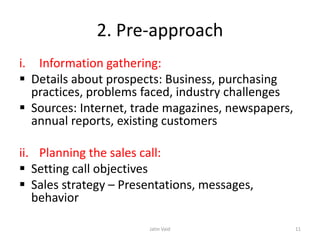
2. Pre-approach
i. Information gathering:
 Details about prospects: Business, purchasing
practices, problems faced, industry challenges
 Sources: Internet, trade magazines, newspapers,
annual reports, existing customers
ii. Planning the sales call:
 Setting call objectives
 Sales strategy – Presentations, messages,
behavior
Jatin Vaid 11
3. Approach
 Make an appointment to meet the prospect
 Favourable first impression
 Appearance, dressing sense, attitude, opening
lines, greetings
 Get the attention of prospects
 Arouse interest
Jatin Vaid 12
4. Presentation & Demonstration
Presentation:
i. Understanding buyer’s needs
 Relevant questions – situation/problem/impact/solution
ii. Sales presentation methods
 Attention, Interest, Desire, Action (AIDA)
 Features, Advantages, Benefits, Value (FABV)
 Problem – solution
 Team Selling
iii. Effective presentation
 Tailored to the situation
 Persuasive & Convincing
 Use of technology
 Easily understood
Jatin Vaid 13
Presentation & Demonstration (Cont.)
Demonstration
 Important selling tool
 Prove benefits
 Reduce risk of wrong buying
 Potential to clear buyer’s doubt
 Potential to suit specific customer needs
Jatin Vaid 14
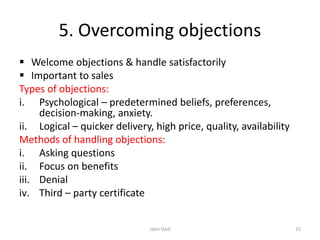
5. Overcoming objections
 Welcome objections & handle satisfactorily
 Important to sales
Types of objections:
i. Psychological – predetermined beliefs, preferences,
decision-making, anxiety.
ii. Logical – quicker delivery, high price, quality, availability
Methods of handling objections:
i. Asking questions
ii. Focus on benefits
iii. Denial
iv. Third – party certificate
Jatin Vaid 15
6. Closing the sale
 Closing means asking customer for order
 It helps buyer make a decision
 Trial close: Technique to check customer’s attitude /
opinion before closing
 Favourable response to trial close: Ask for order
 Negative response to trial close: Go back to presentation
 Readiness to buy signals:
 Examines the product
 Ask a friend’s opinion
 Asks questions
 Becomes friendly
Jatin Vaid 16
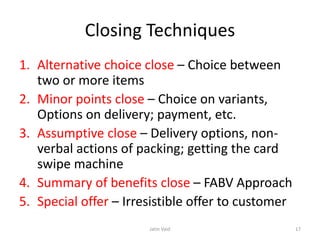
Closing Techniques
1. Alternative choice close – Choice between
two or more items
2. Minor points close – Choice on variants,
Options on delivery; payment, etc.
3. Assumptive close – Delivery options, non-
verbal actions of packing; getting the card
swipe machine
4. Summary of benefits close – FABV Approach
5. Special offer – Irresistible offer to customer
Jatin Vaid 17
7. Follow-up & Service
Sales personnel’s job is not over after closing the
sale. Customer service is crucial to maintain
long-term relations
 Check customer order
 Plan follow-up visit at delivery
 Account penetration
 Relationship marketing (CRM)
 Cross-selling & Up-selling
Jatin Vaid 18
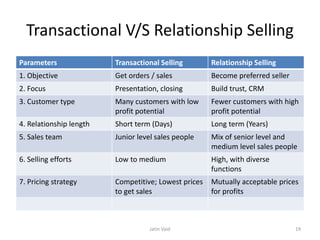
Transactional V/S Relationship Selling
Parameters Transactional Selling Relationship Selling
1. Objective Get orders / sales Become preferred seller
2. Focus Presentation, closing Build trust, CRM
3. Customer type Many customers with low
profit potential
Fewer customers with high
profit potential
4. Relationship length Short term (Days) Long term (Years)
5. Sales team Junior level sales people Mix of senior level and
medium level sales people
6. Selling efforts Low to medium High, with diverse
functions
7. Pricing strategy Competitive; Lowest prices
to get sales
Mutually acceptable prices
for profits
Jatin Vaid 19
Thank You!
jatinvaid@gmail.com
Jatin Vaid 20

Personal selling process & Consumer Behaviour

  • 1.
  • 2.
    Consumer buying process Problem/ Need recognition Information search / collection Evaluation of alternatives Purchase decision Post-purchase behaviour Jatin Vaid 2
  • 3.
    Stages of consumerbuying process 1. Problem recognition  Internal stimuli (hunger, prestige)  External stimuli 2. Information search  Low involvement V/S High involvement category  Visiting stores, asking friends, talking to sales personnel, Internet Jatin Vaid 3
  • 4.
    Stages of consumerbuying process 3. Evaluation of alternatives  Evaluation of product features  Brand beliefs: Price, quality, safety and life  Positive & negative emotional beliefs 4. Purchase decision  Most preferred brand  Attitude of others: Friends, published reviews  Situational factors  Brand; timing; quantity; payment method Jatin Vaid 4
  • 5.
    Stages of consumerbuying process 5. Post-purchase behavior  Meeting customer expectations  Satisfied: Repurchase, brand ambassadors  Dissatisfied: Return product, stop buying, negative word of mouth, complain, legal recourse Jatin Vaid 5
  • 6.
    Personal Selling According toAMA, “Personal Selling is an oral presentation in a conversation with one or more prospective purchaser for the purpose of making sales” Jatin Vaid 6
  • 7.
    Nature of PersonalSelling  Face to face contact  Two – way communication  Helps build long term customer relations  Highly effective method of promotion  Flexible  Expensive  Limited reach Jatin Vaid 7
  • 8.
    Objectives of PersonalSelling Product Awareness Creates interest Provides information Causes demand Reinforcing brand Increase sales volume Jatin Vaid 8
  • 9.
    Personal Selling Process Steps: 1.Prospecting & Qualifying 2. Pre-approach 3. Approach 4. Presentation & Demonstration 5. Overcoming objections 6. Closing the sale 7. Follow-up & Service Jatin Vaid 9
  • 10.
    1. Prospecting &Qualifying Prospect or a potential customer is someone who needs a product and has an ability to buy  Search for new markets / customers  Methods: i. Referrals from existing customers ii. Internal company sources iii. Sales people networking iv. Cold canvassing v. Standard Databases Qualifying means the prospect is qualified to meet necessary standards and receive further attention  Have the need for the product  Can afford the product • Category: i. Hot – Good requirement & financially sound ii. Warm – Medium requirement & financially sound iii. Cool – Low requirements & low affordability Jatin Vaid 10
  • 11.
    2. Pre-approach i. Informationgathering:  Details about prospects: Business, purchasing practices, problems faced, industry challenges  Sources: Internet, trade magazines, newspapers, annual reports, existing customers ii. Planning the sales call:  Setting call objectives  Sales strategy – Presentations, messages, behavior Jatin Vaid 11
  • 12.
    3. Approach  Makean appointment to meet the prospect  Favourable first impression  Appearance, dressing sense, attitude, opening lines, greetings  Get the attention of prospects  Arouse interest Jatin Vaid 12
  • 13.
    4. Presentation &Demonstration Presentation: i. Understanding buyer’s needs  Relevant questions – situation/problem/impact/solution ii. Sales presentation methods  Attention, Interest, Desire, Action (AIDA)  Features, Advantages, Benefits, Value (FABV)  Problem – solution  Team Selling iii. Effective presentation  Tailored to the situation  Persuasive & Convincing  Use of technology  Easily understood Jatin Vaid 13
  • 14.
    Presentation & Demonstration(Cont.) Demonstration  Important selling tool  Prove benefits  Reduce risk of wrong buying  Potential to clear buyer’s doubt  Potential to suit specific customer needs Jatin Vaid 14
  • 15.
    5. Overcoming objections Welcome objections & handle satisfactorily  Important to sales Types of objections: i. Psychological – predetermined beliefs, preferences, decision-making, anxiety. ii. Logical – quicker delivery, high price, quality, availability Methods of handling objections: i. Asking questions ii. Focus on benefits iii. Denial iv. Third – party certificate Jatin Vaid 15
  • 16.
    6. Closing thesale  Closing means asking customer for order  It helps buyer make a decision  Trial close: Technique to check customer’s attitude / opinion before closing  Favourable response to trial close: Ask for order  Negative response to trial close: Go back to presentation  Readiness to buy signals:  Examines the product  Ask a friend’s opinion  Asks questions  Becomes friendly Jatin Vaid 16
  • 17.
    Closing Techniques 1. Alternativechoice close – Choice between two or more items 2. Minor points close – Choice on variants, Options on delivery; payment, etc. 3. Assumptive close – Delivery options, non- verbal actions of packing; getting the card swipe machine 4. Summary of benefits close – FABV Approach 5. Special offer – Irresistible offer to customer Jatin Vaid 17
  • 18.
    7. Follow-up &Service Sales personnel’s job is not over after closing the sale. Customer service is crucial to maintain long-term relations  Check customer order  Plan follow-up visit at delivery  Account penetration  Relationship marketing (CRM)  Cross-selling & Up-selling Jatin Vaid 18
  • 19.
    Transactional V/S RelationshipSelling Parameters Transactional Selling Relationship Selling 1. Objective Get orders / sales Become preferred seller 2. Focus Presentation, closing Build trust, CRM 3. Customer type Many customers with low profit potential Fewer customers with high profit potential 4. Relationship length Short term (Days) Long term (Years) 5. Sales team Junior level sales people Mix of senior level and medium level sales people 6. Selling efforts Low to medium High, with diverse functions 7. Pricing strategy Competitive; Lowest prices to get sales Mutually acceptable prices for profits Jatin Vaid 19
  • 20.