
PRODUCT –
Building Customer Value

Presented By:
Jatin Vaid
What is a Product?
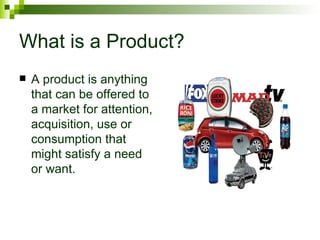
   A product is anything
    that can be offered to
    a market for attention,
    acquisition, use or
    consumption that
    might satisfy a need
    or want.
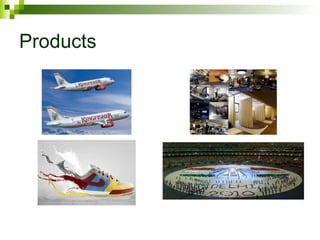
Products
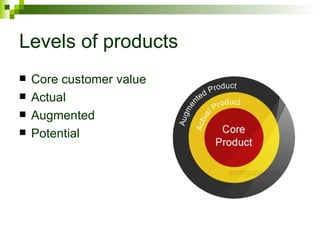
Levels of products
   Core customer value
   Actual
   Augmented
   Potential
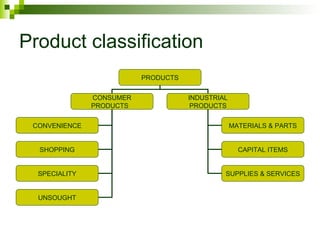
Product classification
                          PRODUCTS


               CONSUMER              INDUSTRIAL
               PRODUCTS               PRODUCTS


 CONVENIENCE                                      MATERIALS & PARTS


  SHOPPING                                          CAPITAL ITEMS


  SPECIALITY                                  SUPPLIES & SERVICES


  UNSOUGHT
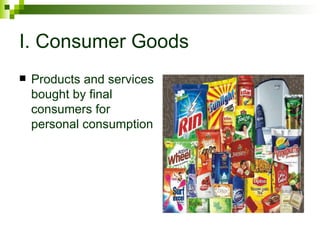
I. Consumer Goods
   Products and services
    bought by final
    consumers for
    personal consumption
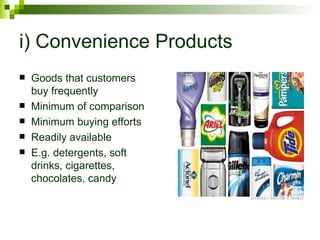
i) Convenience Products
   Goods that customers
    buy frequently
   Minimum of comparison
   Minimum buying efforts
   Readily available
   E.g. detergents, soft
    drinks, cigarettes,
    chocolates, candy
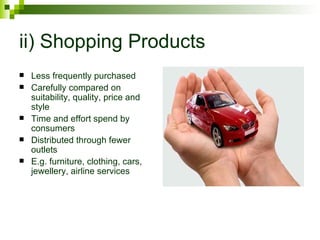
ii) Shopping Products
   Less frequently purchased
   Carefully compared on
    suitability, quality, price and
    style
   Time and effort spend by
    consumers
   Distributed through fewer
    outlets
   E.g. furniture, clothing, cars,
    jewellery, airline services
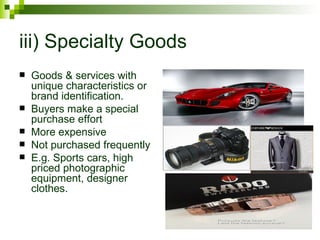
iii) Specialty Goods
   Goods & services with
    unique characteristics or
    brand identification.
   Buyers make a special
    purchase effort
   More expensive
   Not purchased frequently
   E.g. Sports cars, high
    priced photographic
    equipment, designer
    clothes.
iv) Unsought Products
   Products that the
    consumer either doesn’t
    knows about or doesn’t
    normally think of buying
   Require lot of advertising,
    and personal selling
   E.g. Life insurance,
    funeral services,
    donations for charity,
    blood donations
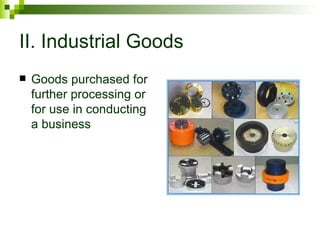
II. Industrial Goods
   Goods purchased for
    further processing or
    for use in conducting
    a business
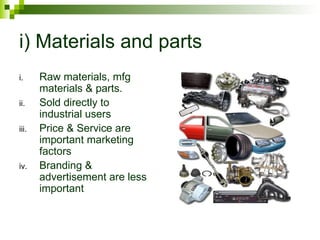
i) Materials and parts
i.     Raw materials, mfg
       materials & parts.
ii.    Sold directly to
       industrial users
iii.   Price & Service are
       important marketing
       factors
iv.    Branding &
       advertisement are less
       important
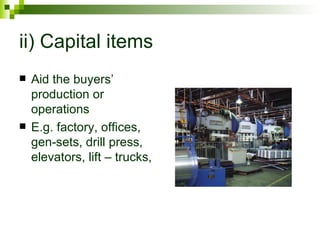
ii) Capital items
   Aid the buyers’
    production or
    operations
   E.g. factory, offices,
    gen-sets, drill press,
    elevators, lift – trucks,
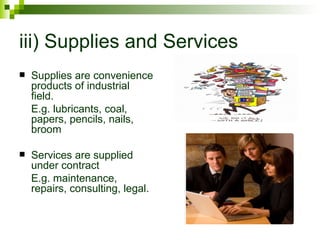
iii) Supplies and Services
   Supplies are convenience
    products of industrial
    field.
    E.g. lubricants, coal,
    papers, pencils, nails,
    broom

   Services are supplied
    under contract
    E.g. maintenance,
    repairs, consulting, legal.
Product Decisions
     Marketers make product decisions at
     three levels:
2.   Individual product decisions
3.   Product line decisions
4.   Product Mix decisions
1. Individual Product Decisions
   Product attributes : The characteristics of a product that
    bear on its ability to satisfy stated or implied customer needs.
   Quality
   Features
   Style & Design
   Branding: A name, term, sign symbol, design or a combination
    of these that identifies the product or service of one seller or group
    of sellers and differentiate them from those of competitors.
   Packaging: The activities of designing and producing the
    container or wrapper for a product.
   Labeling: Labels are simple tags attached to products. The
    identify the brand, origin, contents and use instructions.
2. Product Line Decisions
    A product line is a group of products that are
    closely related because they function in a
    similar manner, are sold to the same customer
    groups, are marketed through similar outlets,
    or fall within given price range.
   Product Line Length: No. of items in a
    product line.
3. Product Mix Decisions
     Product Mix is set of all product lines and items
     that a particular seller offers for sale.
2)   Product Mix Width: No. of different product lines, a Co.
     carries.
3)   Product mix Length: Total No. of items the Co. carries
     within its product lines
4)   Product Mix Depth: No. of versions offered of each
     product in the line.
5)   Product Mix Consistency: How closely related are
     various product lines are in end use.`
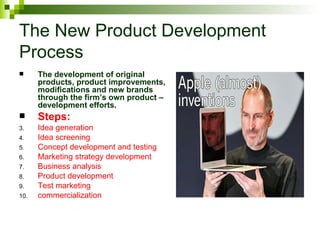
The New Product Development
Process
     The development of original
      products, product improvements,
      modifications and new brands
      through the firm’s own product –
      development efforts.
     Steps:
3.    Idea generation
4.    Idea screening
5.    Concept development and testing
6.    Marketing strategy development
7.    Business analysis
8.    Product development
9.    Test marketing
10.   commercialization
Steps of New Product Development Process

   Idea generation: The systematic search for new product ideas. Internal
    sources (brainstorming) External sources ( distributors, suppliers)
   Idea Screening: Screening new ideas to spot good ones and drop poor
    ones. Review Committee (“real, win, worth it”)
   Concept development: An attractive idea developed in to a product
    concept, stated in consumer terms.
   Marketing strategy development: Designing an initial marketing
    strategy for a new product. Target market, market share, planned price,
    distribution, budget, sales, profit goals.
   Business analysis: A review of sales, costs and profits according to Co
    objectives.
   Product development: Developing the product concept into a physical
    product.
   Test marketing: Products are tested in realistic market settings.
   Commercialization: introducing a new product into the market.
Product life cycle
   The course that a product’s sale and profits
    take over its lifetime.
   Products have limited life
   Product sales pass through distinct stages
   Profits rise and fall at different stages
   Organizations require to pursue different
    strategies
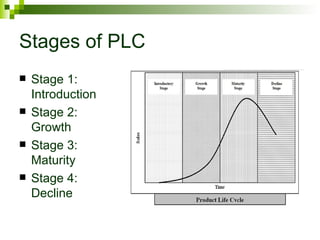
Stages of PLC
   Stage 1:
    Introduction
   Stage 2:
    Growth
   Stage 3:
    Maturity
   Stage 4:
    Decline
1. Introduction Stage
 A period of slow sales growth as product
  is introduced in the market.
 Profits are non – existent because of
  heavy expenses
 Highest ratio of promotion expenses to
  sales.
2. Growth Stage
   A period of rapid market acceptance and
    substantial profit improvement
3. Maturity Stages
 A slowdown in sales as product has
  achieved acceptance by most potential
  buyers.
 Profits stabilize or decline because of
  increased competition
4. Decline Stage
   Sales show a downward drift and profits
    erode.
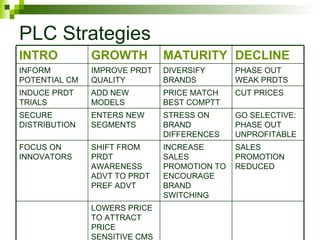
PLC Strategies
INTRO          GROWTH          MATURITY DECLINE
INFORM         IMPROVE PRDT    DIVERSIFY      PHASE OUT
POTENTIAL CM   QUALITY         BRANDS         WEAK PRDTS
INDUCE PRDT    ADD NEW         PRICE MATCH    CUT PRICES
TRIALS         MODELS          BEST COMPTT
SECURE         ENTERS NEW      STRESS ON      GO SELECTIVE:
DISTRIBUTION   SEGMENTS        BRAND          PHASE OUT
                               DIFFERENCES    UNPROFITABLE
FOCUS ON       SHIFT FROM      INCREASE       SALES
INNOVATORS     PRDT            SALES          PROMOTION
               AWARENESS       PROMOTION TO   REDUCED
               ADVT TO PRDT    ENCOURAGE
               PREF ADVT       BRAND
                               SWITCHING
               LOWERS PRICE
               TO ATTRACT
               PRICE
               SENSITIVE CMS

Product1 –

  • 1.
    PRODUCT – Building CustomerValue Presented By: Jatin Vaid
  • 2.
    What is aProduct?  A product is anything that can be offered to a market for attention, acquisition, use or consumption that might satisfy a need or want.
  • 3.
  • 4.
    Levels of products  Core customer value  Actual  Augmented  Potential
  • 5.
    Product classification PRODUCTS CONSUMER INDUSTRIAL PRODUCTS PRODUCTS CONVENIENCE MATERIALS & PARTS SHOPPING CAPITAL ITEMS SPECIALITY SUPPLIES & SERVICES UNSOUGHT
  • 6.
    I. Consumer Goods  Products and services bought by final consumers for personal consumption
  • 7.
    i) Convenience Products  Goods that customers buy frequently  Minimum of comparison  Minimum buying efforts  Readily available  E.g. detergents, soft drinks, cigarettes, chocolates, candy
  • 8.
    ii) Shopping Products  Less frequently purchased  Carefully compared on suitability, quality, price and style  Time and effort spend by consumers  Distributed through fewer outlets  E.g. furniture, clothing, cars, jewellery, airline services
  • 9.
    iii) Specialty Goods  Goods & services with unique characteristics or brand identification.  Buyers make a special purchase effort  More expensive  Not purchased frequently  E.g. Sports cars, high priced photographic equipment, designer clothes.
  • 10.
    iv) Unsought Products  Products that the consumer either doesn’t knows about or doesn’t normally think of buying  Require lot of advertising, and personal selling  E.g. Life insurance, funeral services, donations for charity, blood donations
  • 11.
    II. Industrial Goods  Goods purchased for further processing or for use in conducting a business
  • 12.
    i) Materials andparts i. Raw materials, mfg materials & parts. ii. Sold directly to industrial users iii. Price & Service are important marketing factors iv. Branding & advertisement are less important
  • 13.
    ii) Capital items  Aid the buyers’ production or operations  E.g. factory, offices, gen-sets, drill press, elevators, lift – trucks,
  • 14.
    iii) Supplies andServices  Supplies are convenience products of industrial field. E.g. lubricants, coal, papers, pencils, nails, broom  Services are supplied under contract E.g. maintenance, repairs, consulting, legal.
  • 15.
    Product Decisions Marketers make product decisions at three levels: 2. Individual product decisions 3. Product line decisions 4. Product Mix decisions
  • 16.
    1. Individual ProductDecisions  Product attributes : The characteristics of a product that bear on its ability to satisfy stated or implied customer needs.  Quality  Features  Style & Design  Branding: A name, term, sign symbol, design or a combination of these that identifies the product or service of one seller or group of sellers and differentiate them from those of competitors.  Packaging: The activities of designing and producing the container or wrapper for a product.  Labeling: Labels are simple tags attached to products. The identify the brand, origin, contents and use instructions.
  • 17.
    2. Product LineDecisions A product line is a group of products that are closely related because they function in a similar manner, are sold to the same customer groups, are marketed through similar outlets, or fall within given price range.  Product Line Length: No. of items in a product line.
  • 18.
    3. Product MixDecisions Product Mix is set of all product lines and items that a particular seller offers for sale. 2) Product Mix Width: No. of different product lines, a Co. carries. 3) Product mix Length: Total No. of items the Co. carries within its product lines 4) Product Mix Depth: No. of versions offered of each product in the line. 5) Product Mix Consistency: How closely related are various product lines are in end use.`
  • 19.
    The New ProductDevelopment Process  The development of original products, product improvements, modifications and new brands through the firm’s own product – development efforts.  Steps: 3. Idea generation 4. Idea screening 5. Concept development and testing 6. Marketing strategy development 7. Business analysis 8. Product development 9. Test marketing 10. commercialization
  • 20.
    Steps of NewProduct Development Process  Idea generation: The systematic search for new product ideas. Internal sources (brainstorming) External sources ( distributors, suppliers)  Idea Screening: Screening new ideas to spot good ones and drop poor ones. Review Committee (“real, win, worth it”)  Concept development: An attractive idea developed in to a product concept, stated in consumer terms.  Marketing strategy development: Designing an initial marketing strategy for a new product. Target market, market share, planned price, distribution, budget, sales, profit goals.  Business analysis: A review of sales, costs and profits according to Co objectives.  Product development: Developing the product concept into a physical product.  Test marketing: Products are tested in realistic market settings.  Commercialization: introducing a new product into the market.
  • 21.
    Product life cycle  The course that a product’s sale and profits take over its lifetime.  Products have limited life  Product sales pass through distinct stages  Profits rise and fall at different stages  Organizations require to pursue different strategies
  • 22.
    Stages of PLC  Stage 1: Introduction  Stage 2: Growth  Stage 3: Maturity  Stage 4: Decline
  • 23.
    1. Introduction Stage A period of slow sales growth as product is introduced in the market.  Profits are non – existent because of heavy expenses  Highest ratio of promotion expenses to sales.
  • 24.
    2. Growth Stage  A period of rapid market acceptance and substantial profit improvement
  • 25.
    3. Maturity Stages A slowdown in sales as product has achieved acceptance by most potential buyers.  Profits stabilize or decline because of increased competition
  • 26.
    4. Decline Stage  Sales show a downward drift and profits erode.
  • 27.
    PLC Strategies INTRO GROWTH MATURITY DECLINE INFORM IMPROVE PRDT DIVERSIFY PHASE OUT POTENTIAL CM QUALITY BRANDS WEAK PRDTS INDUCE PRDT ADD NEW PRICE MATCH CUT PRICES TRIALS MODELS BEST COMPTT SECURE ENTERS NEW STRESS ON GO SELECTIVE: DISTRIBUTION SEGMENTS BRAND PHASE OUT DIFFERENCES UNPROFITABLE FOCUS ON SHIFT FROM INCREASE SALES INNOVATORS PRDT SALES PROMOTION AWARENESS PROMOTION TO REDUCED ADVT TO PRDT ENCOURAGE PREF ADVT BRAND SWITCHING LOWERS PRICE TO ATTRACT PRICE SENSITIVE CMS