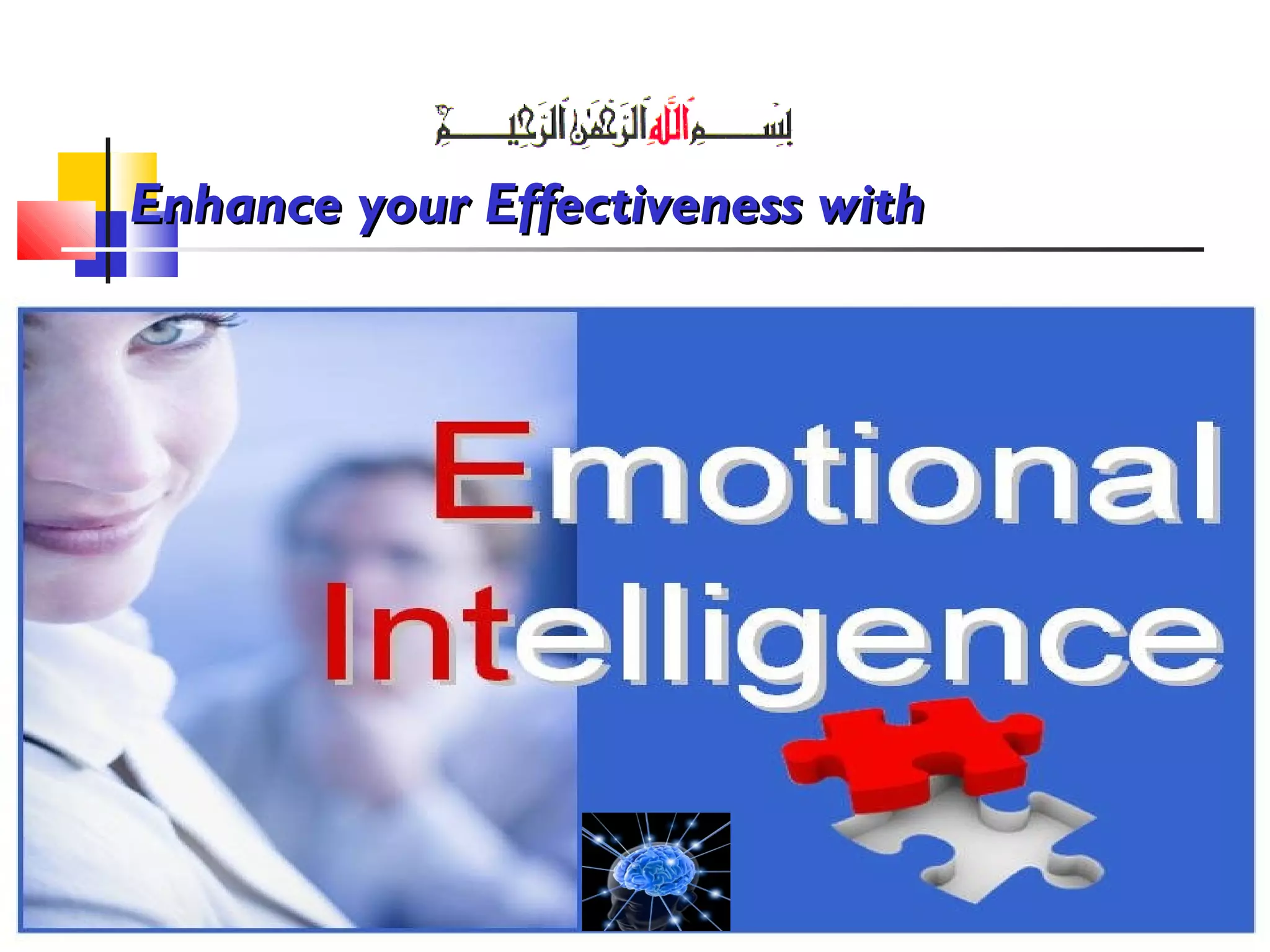

Enhance your Effectiveness withEnhance your Effectiveness with
Power of ParadigmPower of Paradigm
We see the world, not as it is, but as we are – or as weWe see the world, not as it is, but as we are – or as we
are conditioned to see it !are conditioned to see it !
All personal break through begin with a change inAll personal break through begin with a change in
paradigms.paradigms.
2
HabitsHabits
An Idea / A Thought / Aik Khayal turns into an ACTIONAn Idea / A Thought / Aik Khayal turns into an ACTION
• Our repeated actions become HABITOur repeated actions become HABIT
• Our habits define our CHARACTEROur habits define our CHARACTER
• Our character takes us to our DESTINYOur character takes us to our DESTINY
Kinds of Intelligence:Kinds of Intelligence:
• Intellectual IntelligenceIntellectual Intelligence
• Emotional IntelligenceEmotional Intelligence
3
Emotional intelligenceEmotional intelligence
Emotional intelligence (EI) is the ability, capacity, skill; or, in the case of theEmotional intelligence (EI) is the ability, capacity, skill; or, in the case of the
trait EI model, a self-perceived ability to identify, assess, and control thetrait EI model, a self-perceived ability to identify, assess, and control the
emotions of oneself, of others, and of groups.emotions of oneself, of others, and of groups.
Emotional intelligence is the ability to understand one’s emotional makeEmotional intelligence is the ability to understand one’s emotional make
emotional make-up and the emotional make up of others and to useemotional make-up and the emotional make up of others and to use
insight from this knowledge to Effectively manage and regulate one owninsight from this knowledge to Effectively manage and regulate one own
emotions to make good decisions and to act effectively.emotions to make good decisions and to act effectively.
““It is with the heart that one sees rightly; what is essential is invisible to theIt is with the heart that one sees rightly; what is essential is invisible to the
eye.”eye.”
……Antoine Saint-Exupery…Antoine Saint-Exupery… 4
““Achieving one’s goals through the ability to manageAchieving one’s goals through the ability to manage
one’s own feelings and emotions being sensitive to andone’s own feelings and emotions being sensitive to and
able to influence other key people being able to balanceable to influence other key people being able to balance
one’s motives and drives with conscientious and ethicalone’s motives and drives with conscientious and ethical
behavior.”behavior.”
Dulewicz & HiggsDulewicz & Higgs
5
Emotional intelligenceEmotional intelligence
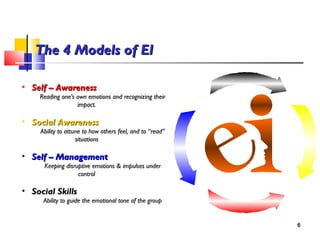
The 4 Models of EIThe 4 Models of EI
6
• Self – AwarenessSelf – Awareness
Reading one’s own emotions and recognizing theirReading one’s own emotions and recognizing their
impact.impact.
• Social AwarenessSocial Awareness
Ability to attune to how others feel, and to “read”Ability to attune to how others feel, and to “read”
situationssituations
• Self – ManagementSelf – Management
Keeping disruptive emotions & impulses underKeeping disruptive emotions & impulses under
controlcontrol
• Social SkillsSocial Skills
Ability to guide the emotional tone of the groupAbility to guide the emotional tone of the group
Self – AwarenessSelf – Awareness
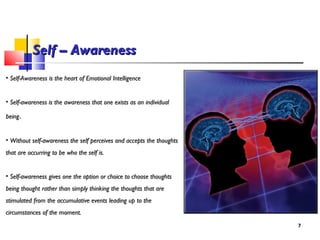
• Self-Awareness is the heart of Emotional IntelligenceSelf-Awareness is the heart of Emotional Intelligence
• Self-awareness is the awareness that one exists as an individualSelf-awareness is the awareness that one exists as an individual
beingbeing.
• Without self-awareness the self perceives and accepts the thoughtsWithout self-awareness the self perceives and accepts the thoughts
that are occurring to be who the self is.that are occurring to be who the self is.
• Self-awareness gives one the option or choice to choose thoughtsSelf-awareness gives one the option or choice to choose thoughts
being thought rather than simply thinking the thoughts that arebeing thought rather than simply thinking the thoughts that are
stimulated from the accumulative events leading up to thestimulated from the accumulative events leading up to the
circumstances of the moment.circumstances of the moment.
77
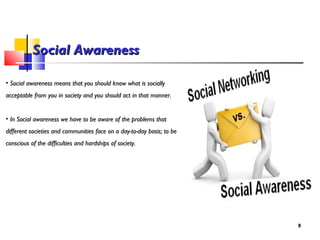
• Social awareness means that you should know what is sociallySocial awareness means that you should know what is socially
acceptable from you in society and you should act in that manner.acceptable from you in society and you should act in that manner.
• In Social awareness we have to be aware of the problems thatIn Social awareness we have to be aware of the problems that
different societies and communities face on a day-to-day basis; to bedifferent societies and communities face on a day-to-day basis; to be
conscious of the difficulties and hardships of society.conscious of the difficulties and hardships of society.
88
Social AwarenessSocial Awareness
Self – ManagementSelf – Management
• To develop a strategy to overcome a social problem, it is useful toTo develop a strategy to overcome a social problem, it is useful to
have a clear analysis of the present situation and a picture ofhave a clear analysis of the present situation and a picture of
alternative social arrangements which do not give rise to the problem.alternative social arrangements which do not give rise to the problem.
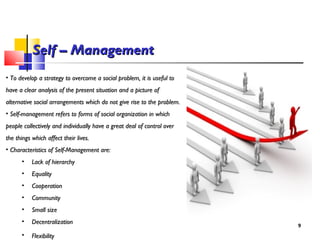
• Self-management refers to forms of social organization in whichSelf-management refers to forms of social organization in which
people collectively and individually have a great deal of control overpeople collectively and individually have a great deal of control over
the things which affect their lives.the things which affect their lives.
• Characteristics of Self-Management are:Characteristics of Self-Management are:
• Lack of hierarchyLack of hierarchy
• EqualityEquality
• CooperationCooperation
• CommunityCommunity
• Small sizeSmall size
• DecentralizationDecentralization
• FlexibilityFlexibility
99
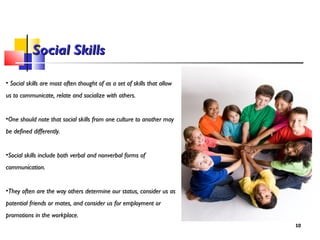
• Social skills are most often thought of as a set of skills that allowSocial skills are most often thought of as a set of skills that allow
us to communicate, relate and socialize with others.us to communicate, relate and socialize with others.
•One should note that social skills from one culture to another mayOne should note that social skills from one culture to another may
be defined differently.be defined differently.
•Social skills include both verbal and nonverbal forms ofSocial skills include both verbal and nonverbal forms of
communication.communication.
•They often are the way others determine our status, consider us asThey often are the way others determine our status, consider us as
potential friends or mates, and consider us for employment orpotential friends or mates, and consider us for employment or
promotions in the workplace.promotions in the workplace.
1010
Social SkillsSocial Skills
When Smart is Dumb:When Smart is Dumb:
• Many high IQ scoring students have failed in their practical livesMany high IQ scoring students have failed in their practical lives
while many average people have got phenomenon successes.while many average people have got phenomenon successes.
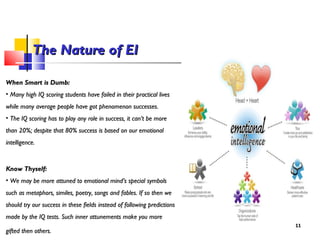
• The IQ scoring has to play any role in success, it can’t be moreThe IQ scoring has to play any role in success, it can’t be more
than 20%; despite that 80% success is based on our emotionalthan 20%; despite that 80% success is based on our emotional
intelligence.intelligence.
Know Thyself:Know Thyself:
• We may be more attuned to emotional mind’s special symbolsWe may be more attuned to emotional mind’s special symbols
such as metaphors, similes, poetry, songs and fables. If so then wesuch as metaphors, similes, poetry, songs and fables. If so then we
should try our success in these fields instead of following predictionsshould try our success in these fields instead of following predictions
made by the IQ tests. Such inner attunements make you moremade by the IQ tests. Such inner attunements make you more
gifted then others.gifted then others.
1111
The Nature of EIThe Nature of EI
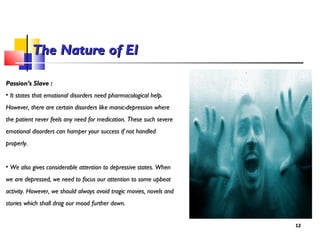
Passion’s Slave :Passion’s Slave :
• It states that emotional disorders need pharmacological help.It states that emotional disorders need pharmacological help.
However, there are certain disorders like manic-depression whereHowever, there are certain disorders like manic-depression where
the patient never feels any need for medication. These such severethe patient never feels any need for medication. These such severe
emotional disorders can hamper your success if not handledemotional disorders can hamper your success if not handled
properly.properly.
• We also gives considerable attention to depressive states. WhenWe also gives considerable attention to depressive states. When
we are depressed, we need to focus our attention to some upbeatwe are depressed, we need to focus our attention to some upbeat
activity. However, we should always avoid tragic movies, novels andactivity. However, we should always avoid tragic movies, novels and
stories which shall drag our mood further down.stories which shall drag our mood further down.
1212
The Nature of EIThe Nature of EI
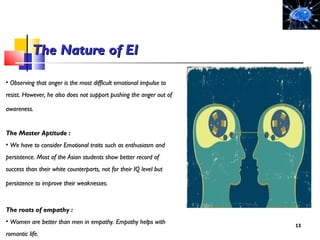
• Observing that anger is the most difficult emotional impulse toObserving that anger is the most difficult emotional impulse to
resist. However, he also does not support pushing the anger out ofresist. However, he also does not support pushing the anger out of
awareness.awareness.
The Master Aptitude :The Master Aptitude :
• We have to consider Emotional traits such as enthusiasm andWe have to consider Emotional traits such as enthusiasm and
persistence. Most of the Asian students show better record ofpersistence. Most of the Asian students show better record of
success than their white counterparts, not for their IQ level butsuccess than their white counterparts, not for their IQ level but
persistence to improve their weaknesses.persistence to improve their weaknesses.
The roots of empathy :The roots of empathy :
• Women are better than men in empathy. Empathy helps withWomen are better than men in empathy. Empathy helps with
romantic life.romantic life.
1313
The Nature of EIThe Nature of EI
Intimate Enemies :Intimate Enemies :
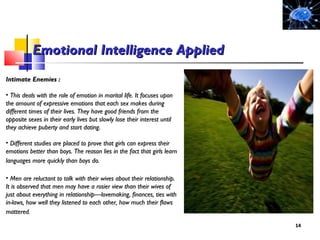
• This deals with the role of emotion in marital life. It focuses uponThis deals with the role of emotion in marital life. It focuses upon
the amount of expressive emotions that each sex makes duringthe amount of expressive emotions that each sex makes during
different times of their lives. They have good friends from thedifferent times of their lives. They have good friends from the
opposite sexes in their early lives but slowly lose their interest untilopposite sexes in their early lives but slowly lose their interest until
they achieve puberty and start dating.they achieve puberty and start dating.
• Different studies are placed to prove that girls can express theirDifferent studies are placed to prove that girls can express their
emotions better than boys. The reason lies in the fact that girls learnemotions better than boys. The reason lies in the fact that girls learn
languages more quickly than boys do.languages more quickly than boys do.
• Men are reluctant to talk with their wives about their relationship.Men are reluctant to talk with their wives about their relationship.
It is observed that men may have a rosier view than their wives ofIt is observed that men may have a rosier view than their wives of
just about everything in relationship—lovemaking, finances, ties withjust about everything in relationship—lovemaking, finances, ties with
in-laws, how well they listened to each other, how much their flawsin-laws, how well they listened to each other, how much their flaws
mattered.mattered.
1414
Emotional Intelligence AppliedEmotional Intelligence Applied
• ““Mirroring” which is used often on marital therapy. It is repetitionMirroring” which is used often on marital therapy. It is repetition
of the same sentences in the same tone by the opposite sex. But thisof the same sentences in the same tone by the opposite sex. But this
technique may be dangerous. When your partner is covertly-hostiletechnique may be dangerous. When your partner is covertly-hostile
he or she may find a fault in your fair comments.he or she may find a fault in your fair comments.
Managing with Heart :Managing with Heart :
• The ultimate study proved that the those peoples who are good inThe ultimate study proved that the those peoples who are good in
emotional intelligence were the people who used to get their workemotional intelligence were the people who used to get their work
finished on time. Interestingly, it is one of the main characteristics offinished on time. Interestingly, it is one of the main characteristics of
the successful people.the successful people.
• Peoples who are average or the below average scorers in thePeoples who are average or the below average scorers in the
emotional intelligence people were those who start many tasks at aemotional intelligence people were those who start many tasks at a
time and leave most of them unfinished. It is one of the reasonstime and leave most of them unfinished. It is one of the reasons
behind most of the unsuccessful people.behind most of the unsuccessful people.
1515
Emotional Intelligence AppliedEmotional Intelligence Applied
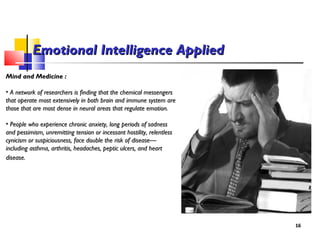
Mind and Medicine :Mind and Medicine :
• A network of researchers is finding that the chemical messengersA network of researchers is finding that the chemical messengers
that operate most extensively in both brain and immune system arethat operate most extensively in both brain and immune system are
those that are most dense in neural areas that regulate emotion.those that are most dense in neural areas that regulate emotion.
• People who experience chronic anxiety, long periods of sadnessPeople who experience chronic anxiety, long periods of sadness
and pessimism, unremitting tension or incessant hostility, relentlessand pessimism, unremitting tension or incessant hostility, relentless
cynicism or suspiciousness, face double the risk of disease—cynicism or suspiciousness, face double the risk of disease—
including asthma, arthritis, headaches, peptic ulcers, and heartincluding asthma, arthritis, headaches, peptic ulcers, and heart
disease.disease.
1616
Emotional Intelligence AppliedEmotional Intelligence Applied
1717
Windows of OpportunityWindows of Opportunity
The Family Crucible :The Family Crucible :
• Children who are often subject of beating by their parents reactChildren who are often subject of beating by their parents react
with the same way in distress. They loose empathy if they have towith the same way in distress. They loose empathy if they have to
face such situations frequently.face such situations frequently.
Trauma and Emotional Relearning :Trauma and Emotional Relearning :
• When we face trauma we may end in biological problems. But theWhen we face trauma we may end in biological problems. But the
problem becomes severe when we put in an uncontrollable stressproblem becomes severe when we put in an uncontrollable stress.
1818
Windows of OpportunityWindows of Opportunity
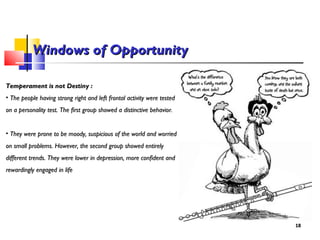
Temperament is not Destiny :Temperament is not Destiny :
• The people having strong right and left frontal activity were testedThe people having strong right and left frontal activity were tested
on a personality test. The first group showed a distinctive behavior.on a personality test. The first group showed a distinctive behavior.
• They were prone to be moody, suspicious of the world and worriedThey were prone to be moody, suspicious of the world and worried
on small problems. However, the second group showed entirelyon small problems. However, the second group showed entirely
different trends. They were lower in depression, more confident anddifferent trends. They were lower in depression, more confident and
rewardingly engaged in liferewardingly engaged in life
1919
Emotional LiteracyEmotional Literacy
The Cost of Emotional LiteracyThe Cost of Emotional Literacy ::
• Some people are unable to differentiate between being scared andSome people are unable to differentiate between being scared and
angry. They feel more hunger in depressing situations and eat moreangry. They feel more hunger in depressing situations and eat more
to gain weight. The people with few friends or with extremeto gain weight. The people with few friends or with extreme
tendencies for loneliness are at great risk of medical diseases andtendencies for loneliness are at great risk of medical diseases and
early death.early death.
Schooling the Emotions :Schooling the Emotions :
• We have to train peoples with training programs to educate ourWe have to train peoples with training programs to educate our
“Self Science". We also have to start Emotional coaching such as“Self Science". We also have to start Emotional coaching such as
“Resolving Conflict Creatively Program” in which Peoples are“Resolving Conflict Creatively Program” in which Peoples are
encouraged to “be assertive” and articulate their feelings inencouraged to “be assertive” and articulate their feelings in
situations involving conflict with others.situations involving conflict with others.
Questions & AnswersQuestions & Answers
2020
2121

Understanding Emotional Intelligence

  • 1.
    Enhance your EffectivenesswithEnhance your Effectiveness with
  • 2.
    Power of ParadigmPowerof Paradigm We see the world, not as it is, but as we are – or as weWe see the world, not as it is, but as we are – or as we are conditioned to see it !are conditioned to see it ! All personal break through begin with a change inAll personal break through begin with a change in paradigms.paradigms. 2
  • 3.
    HabitsHabits An Idea /A Thought / Aik Khayal turns into an ACTIONAn Idea / A Thought / Aik Khayal turns into an ACTION • Our repeated actions become HABITOur repeated actions become HABIT • Our habits define our CHARACTEROur habits define our CHARACTER • Our character takes us to our DESTINYOur character takes us to our DESTINY Kinds of Intelligence:Kinds of Intelligence: • Intellectual IntelligenceIntellectual Intelligence • Emotional IntelligenceEmotional Intelligence 3
  • 4.
    Emotional intelligenceEmotional intelligence Emotionalintelligence (EI) is the ability, capacity, skill; or, in the case of theEmotional intelligence (EI) is the ability, capacity, skill; or, in the case of the trait EI model, a self-perceived ability to identify, assess, and control thetrait EI model, a self-perceived ability to identify, assess, and control the emotions of oneself, of others, and of groups.emotions of oneself, of others, and of groups. Emotional intelligence is the ability to understand one’s emotional makeEmotional intelligence is the ability to understand one’s emotional make emotional make-up and the emotional make up of others and to useemotional make-up and the emotional make up of others and to use insight from this knowledge to Effectively manage and regulate one owninsight from this knowledge to Effectively manage and regulate one own emotions to make good decisions and to act effectively.emotions to make good decisions and to act effectively. ““It is with the heart that one sees rightly; what is essential is invisible to theIt is with the heart that one sees rightly; what is essential is invisible to the eye.”eye.” ……Antoine Saint-Exupery…Antoine Saint-Exupery… 4
  • 5.
    ““Achieving one’s goalsthrough the ability to manageAchieving one’s goals through the ability to manage one’s own feelings and emotions being sensitive to andone’s own feelings and emotions being sensitive to and able to influence other key people being able to balanceable to influence other key people being able to balance one’s motives and drives with conscientious and ethicalone’s motives and drives with conscientious and ethical behavior.”behavior.” Dulewicz & HiggsDulewicz & Higgs 5 Emotional intelligenceEmotional intelligence
  • 6.
    The 4 Modelsof EIThe 4 Models of EI 6 • Self – AwarenessSelf – Awareness Reading one’s own emotions and recognizing theirReading one’s own emotions and recognizing their impact.impact. • Social AwarenessSocial Awareness Ability to attune to how others feel, and to “read”Ability to attune to how others feel, and to “read” situationssituations • Self – ManagementSelf – Management Keeping disruptive emotions & impulses underKeeping disruptive emotions & impulses under controlcontrol • Social SkillsSocial Skills Ability to guide the emotional tone of the groupAbility to guide the emotional tone of the group
  • 7.
    Self – AwarenessSelf– Awareness • Self-Awareness is the heart of Emotional IntelligenceSelf-Awareness is the heart of Emotional Intelligence • Self-awareness is the awareness that one exists as an individualSelf-awareness is the awareness that one exists as an individual beingbeing. • Without self-awareness the self perceives and accepts the thoughtsWithout self-awareness the self perceives and accepts the thoughts that are occurring to be who the self is.that are occurring to be who the self is. • Self-awareness gives one the option or choice to choose thoughtsSelf-awareness gives one the option or choice to choose thoughts being thought rather than simply thinking the thoughts that arebeing thought rather than simply thinking the thoughts that are stimulated from the accumulative events leading up to thestimulated from the accumulative events leading up to the circumstances of the moment.circumstances of the moment. 77
  • 8.
    • Social awarenessmeans that you should know what is sociallySocial awareness means that you should know what is socially acceptable from you in society and you should act in that manner.acceptable from you in society and you should act in that manner. • In Social awareness we have to be aware of the problems thatIn Social awareness we have to be aware of the problems that different societies and communities face on a day-to-day basis; to bedifferent societies and communities face on a day-to-day basis; to be conscious of the difficulties and hardships of society.conscious of the difficulties and hardships of society. 88 Social AwarenessSocial Awareness
  • 9.
    Self – ManagementSelf– Management • To develop a strategy to overcome a social problem, it is useful toTo develop a strategy to overcome a social problem, it is useful to have a clear analysis of the present situation and a picture ofhave a clear analysis of the present situation and a picture of alternative social arrangements which do not give rise to the problem.alternative social arrangements which do not give rise to the problem. • Self-management refers to forms of social organization in whichSelf-management refers to forms of social organization in which people collectively and individually have a great deal of control overpeople collectively and individually have a great deal of control over the things which affect their lives.the things which affect their lives. • Characteristics of Self-Management are:Characteristics of Self-Management are: • Lack of hierarchyLack of hierarchy • EqualityEquality • CooperationCooperation • CommunityCommunity • Small sizeSmall size • DecentralizationDecentralization • FlexibilityFlexibility 99
  • 10.
    • Social skillsare most often thought of as a set of skills that allowSocial skills are most often thought of as a set of skills that allow us to communicate, relate and socialize with others.us to communicate, relate and socialize with others. •One should note that social skills from one culture to another mayOne should note that social skills from one culture to another may be defined differently.be defined differently. •Social skills include both verbal and nonverbal forms ofSocial skills include both verbal and nonverbal forms of communication.communication. •They often are the way others determine our status, consider us asThey often are the way others determine our status, consider us as potential friends or mates, and consider us for employment orpotential friends or mates, and consider us for employment or promotions in the workplace.promotions in the workplace. 1010 Social SkillsSocial Skills
  • 11.
    When Smart isDumb:When Smart is Dumb: • Many high IQ scoring students have failed in their practical livesMany high IQ scoring students have failed in their practical lives while many average people have got phenomenon successes.while many average people have got phenomenon successes. • The IQ scoring has to play any role in success, it can’t be moreThe IQ scoring has to play any role in success, it can’t be more than 20%; despite that 80% success is based on our emotionalthan 20%; despite that 80% success is based on our emotional intelligence.intelligence. Know Thyself:Know Thyself: • We may be more attuned to emotional mind’s special symbolsWe may be more attuned to emotional mind’s special symbols such as metaphors, similes, poetry, songs and fables. If so then wesuch as metaphors, similes, poetry, songs and fables. If so then we should try our success in these fields instead of following predictionsshould try our success in these fields instead of following predictions made by the IQ tests. Such inner attunements make you moremade by the IQ tests. Such inner attunements make you more gifted then others.gifted then others. 1111 The Nature of EIThe Nature of EI
  • 12.
    Passion’s Slave :Passion’sSlave : • It states that emotional disorders need pharmacological help.It states that emotional disorders need pharmacological help. However, there are certain disorders like manic-depression whereHowever, there are certain disorders like manic-depression where the patient never feels any need for medication. These such severethe patient never feels any need for medication. These such severe emotional disorders can hamper your success if not handledemotional disorders can hamper your success if not handled properly.properly. • We also gives considerable attention to depressive states. WhenWe also gives considerable attention to depressive states. When we are depressed, we need to focus our attention to some upbeatwe are depressed, we need to focus our attention to some upbeat activity. However, we should always avoid tragic movies, novels andactivity. However, we should always avoid tragic movies, novels and stories which shall drag our mood further down.stories which shall drag our mood further down. 1212 The Nature of EIThe Nature of EI
  • 13.
    • Observing thatanger is the most difficult emotional impulse toObserving that anger is the most difficult emotional impulse to resist. However, he also does not support pushing the anger out ofresist. However, he also does not support pushing the anger out of awareness.awareness. The Master Aptitude :The Master Aptitude : • We have to consider Emotional traits such as enthusiasm andWe have to consider Emotional traits such as enthusiasm and persistence. Most of the Asian students show better record ofpersistence. Most of the Asian students show better record of success than their white counterparts, not for their IQ level butsuccess than their white counterparts, not for their IQ level but persistence to improve their weaknesses.persistence to improve their weaknesses. The roots of empathy :The roots of empathy : • Women are better than men in empathy. Empathy helps withWomen are better than men in empathy. Empathy helps with romantic life.romantic life. 1313 The Nature of EIThe Nature of EI
  • 14.
    Intimate Enemies :IntimateEnemies : • This deals with the role of emotion in marital life. It focuses uponThis deals with the role of emotion in marital life. It focuses upon the amount of expressive emotions that each sex makes duringthe amount of expressive emotions that each sex makes during different times of their lives. They have good friends from thedifferent times of their lives. They have good friends from the opposite sexes in their early lives but slowly lose their interest untilopposite sexes in their early lives but slowly lose their interest until they achieve puberty and start dating.they achieve puberty and start dating. • Different studies are placed to prove that girls can express theirDifferent studies are placed to prove that girls can express their emotions better than boys. The reason lies in the fact that girls learnemotions better than boys. The reason lies in the fact that girls learn languages more quickly than boys do.languages more quickly than boys do. • Men are reluctant to talk with their wives about their relationship.Men are reluctant to talk with their wives about their relationship. It is observed that men may have a rosier view than their wives ofIt is observed that men may have a rosier view than their wives of just about everything in relationship—lovemaking, finances, ties withjust about everything in relationship—lovemaking, finances, ties with in-laws, how well they listened to each other, how much their flawsin-laws, how well they listened to each other, how much their flaws mattered.mattered. 1414 Emotional Intelligence AppliedEmotional Intelligence Applied
  • 15.
    • ““Mirroring” whichis used often on marital therapy. It is repetitionMirroring” which is used often on marital therapy. It is repetition of the same sentences in the same tone by the opposite sex. But thisof the same sentences in the same tone by the opposite sex. But this technique may be dangerous. When your partner is covertly-hostiletechnique may be dangerous. When your partner is covertly-hostile he or she may find a fault in your fair comments.he or she may find a fault in your fair comments. Managing with Heart :Managing with Heart : • The ultimate study proved that the those peoples who are good inThe ultimate study proved that the those peoples who are good in emotional intelligence were the people who used to get their workemotional intelligence were the people who used to get their work finished on time. Interestingly, it is one of the main characteristics offinished on time. Interestingly, it is one of the main characteristics of the successful people.the successful people. • Peoples who are average or the below average scorers in thePeoples who are average or the below average scorers in the emotional intelligence people were those who start many tasks at aemotional intelligence people were those who start many tasks at a time and leave most of them unfinished. It is one of the reasonstime and leave most of them unfinished. It is one of the reasons behind most of the unsuccessful people.behind most of the unsuccessful people. 1515 Emotional Intelligence AppliedEmotional Intelligence Applied
  • 16.
    Mind and Medicine:Mind and Medicine : • A network of researchers is finding that the chemical messengersA network of researchers is finding that the chemical messengers that operate most extensively in both brain and immune system arethat operate most extensively in both brain and immune system are those that are most dense in neural areas that regulate emotion.those that are most dense in neural areas that regulate emotion. • People who experience chronic anxiety, long periods of sadnessPeople who experience chronic anxiety, long periods of sadness and pessimism, unremitting tension or incessant hostility, relentlessand pessimism, unremitting tension or incessant hostility, relentless cynicism or suspiciousness, face double the risk of disease—cynicism or suspiciousness, face double the risk of disease— including asthma, arthritis, headaches, peptic ulcers, and heartincluding asthma, arthritis, headaches, peptic ulcers, and heart disease.disease. 1616 Emotional Intelligence AppliedEmotional Intelligence Applied
  • 17.
    1717 Windows of OpportunityWindowsof Opportunity The Family Crucible :The Family Crucible : • Children who are often subject of beating by their parents reactChildren who are often subject of beating by their parents react with the same way in distress. They loose empathy if they have towith the same way in distress. They loose empathy if they have to face such situations frequently.face such situations frequently. Trauma and Emotional Relearning :Trauma and Emotional Relearning : • When we face trauma we may end in biological problems. But theWhen we face trauma we may end in biological problems. But the problem becomes severe when we put in an uncontrollable stressproblem becomes severe when we put in an uncontrollable stress.
  • 18.
    1818 Windows of OpportunityWindowsof Opportunity Temperament is not Destiny :Temperament is not Destiny : • The people having strong right and left frontal activity were testedThe people having strong right and left frontal activity were tested on a personality test. The first group showed a distinctive behavior.on a personality test. The first group showed a distinctive behavior. • They were prone to be moody, suspicious of the world and worriedThey were prone to be moody, suspicious of the world and worried on small problems. However, the second group showed entirelyon small problems. However, the second group showed entirely different trends. They were lower in depression, more confident anddifferent trends. They were lower in depression, more confident and rewardingly engaged in liferewardingly engaged in life
  • 19.
    1919 Emotional LiteracyEmotional Literacy TheCost of Emotional LiteracyThe Cost of Emotional Literacy :: • Some people are unable to differentiate between being scared andSome people are unable to differentiate between being scared and angry. They feel more hunger in depressing situations and eat moreangry. They feel more hunger in depressing situations and eat more to gain weight. The people with few friends or with extremeto gain weight. The people with few friends or with extreme tendencies for loneliness are at great risk of medical diseases andtendencies for loneliness are at great risk of medical diseases and early death.early death. Schooling the Emotions :Schooling the Emotions : • We have to train peoples with training programs to educate ourWe have to train peoples with training programs to educate our “Self Science". We also have to start Emotional coaching such as“Self Science". We also have to start Emotional coaching such as “Resolving Conflict Creatively Program” in which Peoples are“Resolving Conflict Creatively Program” in which Peoples are encouraged to “be assertive” and articulate their feelings inencouraged to “be assertive” and articulate their feelings in situations involving conflict with others.situations involving conflict with others.
  • 20.
  • 21.