1
2
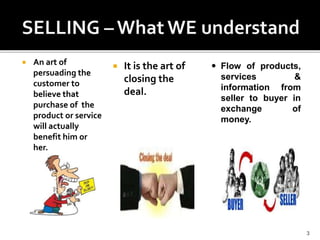
 An art of
persuading the
customer to
believe that
purchase of the
product or service
will actually
benefit him or
her.
 It is the art of
closing the
deal.
3
 Flow of products,
services &
information from
seller to buyer in
exchange of
money.
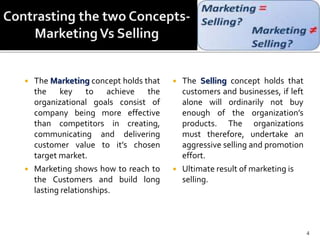
 The Marketing concept holds that
the key to achieve the
organizational goals consist of
company being more effective
than competitors in creating,
communicating and delivering
customer value to it’s chosen
target market.
 Marketing shows how to reach to
the Customers and build long
lasting relationships.
 The Selling concept holds that
customers and businesses, if left
alone will ordinarily not buy
enough of the organization’s
products. The organizations
must therefore, undertake an
aggressive selling and promotion
effort.
 Ultimate result of marketing is
selling.
4
5
 Modern sales manager have to play the role
of aTeam Leader in implementing strategic
plans -
By giving key inputs for developing long term
sales plans
Sales forecasting
Sales force management
Evolving sales & marketing strategies
Building long term relationship with key clients
6
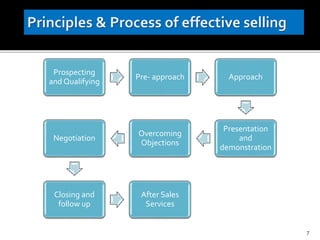
Prospecting
and Qualifying
Pre- approach Approach
Presentation
and
demonstration
Overcoming
Objections
Negotiation
Closing and
follow up
After Sales
Services
7
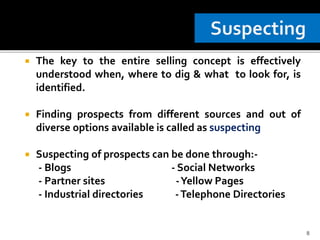
 The key to the entire selling concept is effectively
understood when, where to dig & what to look for, is
identified.
 Finding prospects from different sources and out of
diverse options available is called as suspecting
 Suspecting of prospects can be done through:-
- Blogs - Social Networks
- Partner sites -Yellow Pages
- Industrial directories -Telephone Directories
8
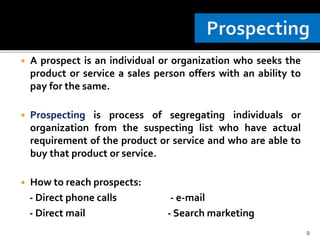
 A prospect is an individual or organization who seeks the
product or service a sales person offers with an ability to
pay for the same.
 Prospecting is process of segregating individuals or
organization from the suspecting list who have actual
requirement of the product or service and who are able to
buy that product or service.
 How to reach prospects:
- Direct phone calls - e-mail
- Direct mail - Search marketing
9
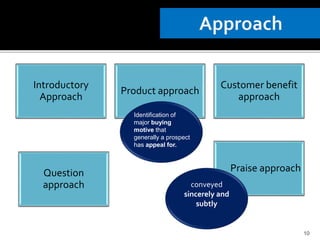
Introductory
Approach
Product approach
Customer benefit
approach
Question
approach
Praise approach
10
Identification of
major buying
motive that
generally a prospect
has appeal for.
conveyed
sincerely and
subtly
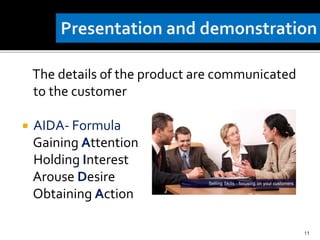
The details of the product are communicated
to the customer
 AIDA- Formula
Gaining Attention
Holding Interest
Arouse Desire
Obtaining Action
11
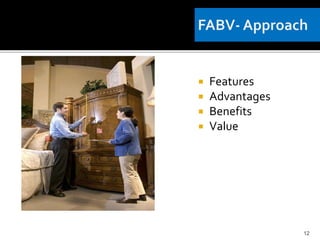
 Features
 Advantages
 Benefits
 Value
12
 Psychological Resistance-
this includes interference,
preference for established
brands, reluctance to give
up something,
pre-determined ideas etc.
 Logical Resistance-
objection to price,
delivery schedule,
product features etc.
13
Two kinds of Resistances
 Listen
 Agree/ restate without any
prejudice
 Get clear about the real issue
 Discuss solution
 Ask for commitments
14
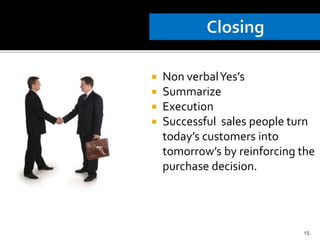
 Non verbalYes’s
 Summarize
 Execution
 Successful sales people turn
today’s customers into
tomorrow’s by reinforcing the
purchase decision.
15
16
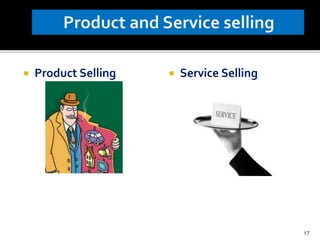
 Product Selling  Service Selling
17
 Product sellingVs Service selling
(tangibleVs intangible)
Intangibility is one of several unique challenges in selling a service
versus a product. Consumers buying a service can’t kick the tires- visit
an accountant, dress designer, interior designer, lawyer, and
hairdresser and so on – you can’t try out the service before you buy it.
Service Selling-
#1 Strategy- focus on customer need
#2 Strategy- focus on your expertise
#3 Strategy- focus on value
There are 6 stages to selling the service successfully
18
 Mc Murry & Arnod’s Classification of Selling
 Derch Newton Classification of Selling
 Consumer Indirect Selling
 Industrial Selling
 Group Selling-
 Telesales
 Franchise Selling
 International Selling
 Concept Selling
19
DIFFERENT TYPES & CLASSIFICATIONS
OF SELLING
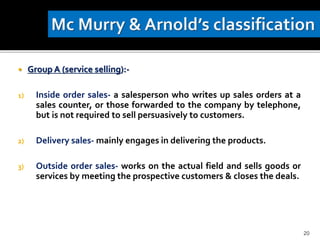
 Group A (service selling):-
1) Inside order sales- a salesperson who writes up sales orders at a
sales counter, or those forwarded to the company by telephone,
but is not required to sell persuasively to customers.
2) Delivery sales- mainly engages in delivering the products.
3) Outside order sales- works on the actual field and sells goods or
services by meeting the prospective customers & closes the deals.
20
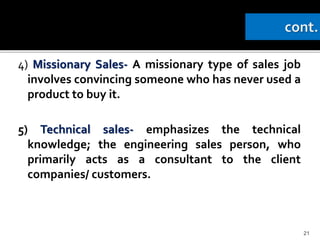
4) Missionary Sales- A missionary type of sales job
involves convincing someone who has never used a
product to buy it.
5) Technical sales- emphasizes the technical
knowledge; the engineering sales person, who
primarily acts as a consultant to the client
companies/ customers.
21
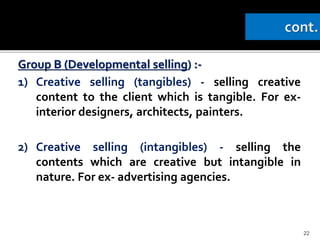
Group B (Developmental selling) :-
1) Creative selling (tangibles) - selling creative
content to the client which is tangible. For ex-
interior designers, architects, painters.
2) Creative selling (intangibles) - selling the
contents which are creative but intangible in
nature. For ex- advertising agencies.
22
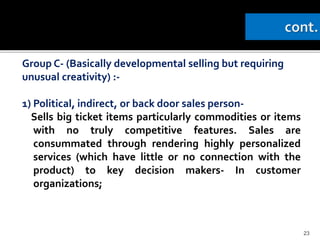
Group C- (Basically developmental selling but requiring
unusual creativity) :-
1) Political, indirect, or back door sales person-
Sells big ticket items particularly commodities or items
with no truly competitive features. Sales are
consummated through rendering highly personalized
services (which have little or no connection with the
product) to key decision makers- In customer
organizations;
23
2) Multiple sales -
involves the sales of big ticket items where the sales
person must make presentations to several
individuals in the customer’s organization, usually a
committee, only one of which can say “yes” but all of
whom can say “no”; for ex. An account executive of
an advertising agency who makes presentation to the
agency selection committees of advertisers- even
after the account is obtained, the sales person has to
work to retain it.
24
1) Trade Selling- Selling products to wholesalers
and retailers for resale purposes.
Trade Show- an exhibition or fair at
which manufacturers display their
products for the benefit of
visiting wholesalers and retailers.
2) Missionary selling
3)Technical selling
4) New business selling
25
26
 Indirect selling is employed when a manufacturer
markets his products through another firm that
acts as the manufacturer's sales intermediary
 Examples of indirect sales methods:
-Wholesales
- Retailers (supermarkets, department stores,
multiple stores, independent retailers,
consumer co-operatives)
- Agents
- Distributors and Dealers
27
 Advantages:-
 Indirect sales can allow a company to increase sales quickly without
having to hire more sales personnel
 Suitable for overseas market
 Channel is inexpensive- low per transaction cost
 Start up cost is less
 Disadvantages:-
 Manufacturing firm has to give up control of marketing activities to
other firm-
 In some cases, however, indirect sales may lead to reduced control of
the brand message and poorer customer service
 Intermediary can easily discontinue handling a manufacturer's product
28
 Industrial Selling (business to business selling) is
the selling of goods and services by one business to another.
Industrial goods are those an industry uses to produce an end
product from one or more raw materials.
 Main features of B2B Selling:-
 This is one to one selling & relatively easy to identify prospects
 Highly trained & professional people involve in the process
 Buying process is complex & may includes many steps
 Long period required for process
29
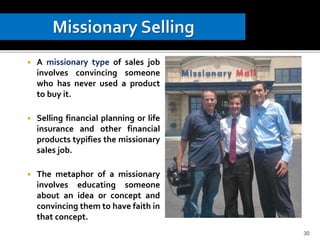
 A missionary type of sales job
involves convincing someone
who has never used a product
to buy it.
 Selling financial planning or life
insurance and other financial
products typifies the missionary
sales job.
 The metaphor of a missionary
involves educating someone
about an idea or concept and
convincing them to have faith in
that concept.
30
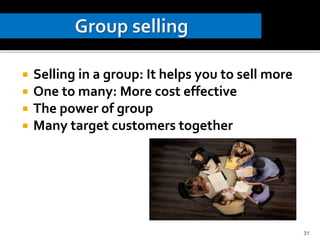
 Selling in a group: It helps you to sell more
 One to many: More cost effective
 The power of group
 Many target customers together
31
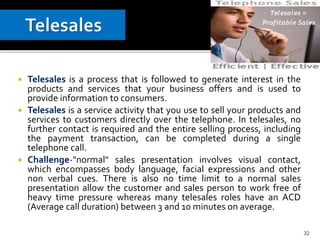
 Telesales is a process that is followed to generate interest in the
products and services that your business offers and is used to
provide information to consumers.
 Telesales is a service activity that you use to sell your products and
services to customers directly over the telephone. In telesales, no
further contact is required and the entire selling process, including
the payment transaction, can be completed during a single
telephone call.
 Challenge-"normal" sales presentation involves visual contact,
which encompasses body language, facial expressions and other
non verbal cues. There is also no time limit to a normal sales
presentation allow the customer and sales person to work free of
heavy time pressure whereas many telesales roles have an ACD
(Average call duration) between 3 and 10 minutes on average.
32
 To succeed in international sales you need to know what you are
doing and why.You also need to:
 Understand and apply the basics of selling which is true all over
the world.
 Figure out which buying mode the prospect is in.
 Identify and focus on real/actual decision makers and avoid those
without approval power.
 Find an advisor to help navigate through the rough waters of
international sales.
 Distinguish between good customers and bad customers.
 International sales is more challenging because of:
 Cultural issues
 Language barriers
 Government regulations and tariffs
33
 Do research
 Visit the land where you are selling products
 Check out competition
 Learn the language if possible
 Find the people to trust
 Seek out the niches (Concentrate on small ponds before
reaching to big oceans)
 Scale your knowledge
 Stay aware of global trends
 Take advantage of stable market
34
35
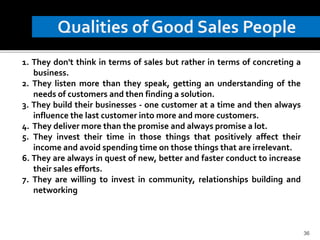
1. They don't think in terms of sales but rather in terms of concreting a
business.
2. They listen more than they speak, getting an understanding of the
needs of customers and then finding a solution.
3. They build their businesses - one customer at a time and then always
influence the last customer into more and more customers.
4. They deliver more than the promise and always promise a lot.
5. They invest their time in those things that positively affect their
income and avoid spending time on those things that are irrelevant.
6. They are always in quest of new, better and faster conduct to increase
their sales efforts.
7. They are willing to invest in community, relationships building and
networking
36
37
38
39
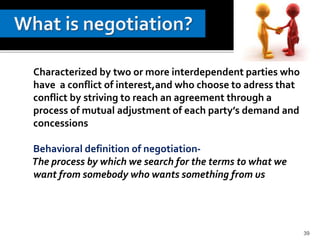
Characterized by two or more interdependent parties who
have a conflict of interest,and who choose to adress that
conflict by striving to reach an agreement through a
process of mutual adjustment of each party’s demand and
concessions
Behavioral definition of negotiation-
The process by which we search for the terms to what we
want from somebody who wants something from us
 A dialogue or discussion between two or more people
or parties, intended to reach an understanding, resolve
point of difference, and/or gain advantage in outcome
of dialogue, to produce an agreement upon courses of
action, to bargain for individual or collective
advantage, to craft outcomes to satisfy various
interests of two opponents involved in negotiation
process.
 Process of exchanging offers and counter offers-
“exchange of concessions” - for arriving at a
compromise by which both parties reach to an agreed
positions and outcomes.
40
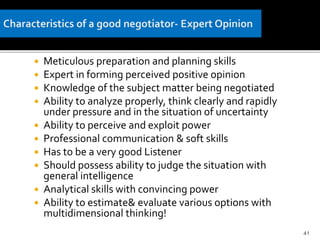
 Meticulous preparation and planning skills
 Expert in forming perceived positive opinion
 Knowledge of the subject matter being negotiated
 Ability to analyze properly, think clearly and rapidly
under pressure and in the situation of uncertainty
 Ability to perceive and exploit power
 Professional communication & soft skills
 Has to be a very good Listener
 Should possess ability to judge the situation with
general intelligence
 Analytical skills with convincing power
 Ability to estimate& evaluate various options with
multidimensional thinking!
41
42
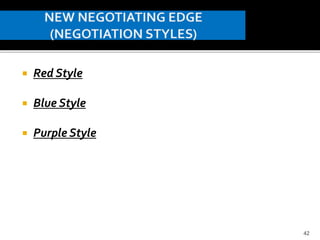
 Red Style
 Blue Style
 Purple Style
43
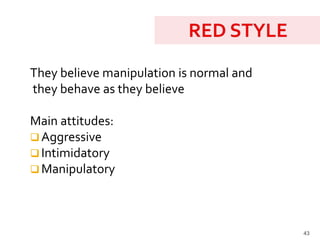
They believe manipulation is normal and
they behave as they believe
Main attitudes:
 Aggressive
 Intimidatory
 Manipulatory
44
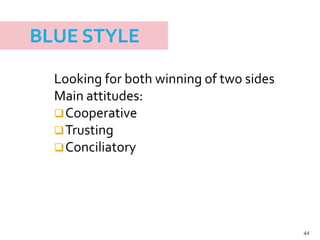
Looking for both winning of two sides
Main attitudes:
Cooperative
Trusting
Conciliatory
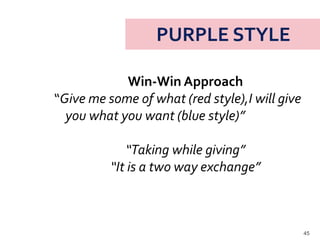
45
Win-Win Approach
“Give me some of what (red style),I will give
you what you want (blue style)”
“Taking while giving”
“It is a two way exchange”
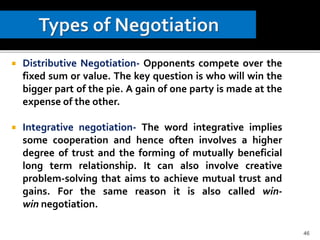
 Distributive Negotiation- Opponents compete over the
fixed sum or value. The key question is who will win the
bigger part of the pie. A gain of one party is made at the
expense of the other.
 Integrative negotiation- The word integrative implies
some cooperation and hence often involves a higher
degree of trust and the forming of mutually beneficial
long term relationship. It can also involve creative
problem-solving that aims to achieve mutual trust and
gains. For the same reason it is also called win-
win negotiation.
46
47
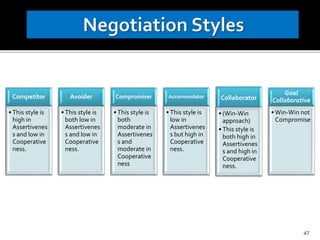
Competitor
• This style is
high in
Assertivenes
s and low in
Cooperative
ness.
Avoider
• This style is
both low in
Assertivenes
s and low in
Cooperative
ness.
Compromiser
• This style is
both
moderate in
Assertivenes
s and
moderate in
Cooperative
ness
Accommodator
• This style is
low in
Assertivenes
s but high in
Cooperative
ness.
Collaborator
• (Win-Win
approach)
• This style is
both high in
Assertivenes
s and high in
Cooperative
ness.
Goal
Collaborative
• Win-Win not
Compromise
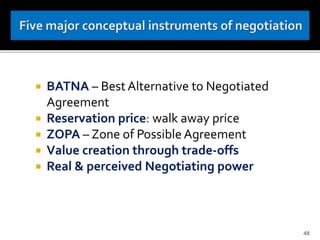
 BATNA – Best Alternative to Negotiated
Agreement
 Reservation price: walk away price
 ZOPA – Zone of Possible Agreement
 Value creation through trade-offs
 Real & perceived Negotiating power
48
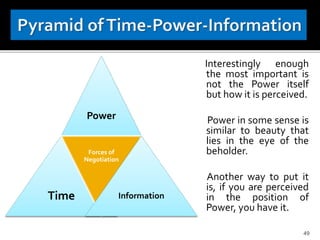
Power
Time
Forces of
Negotiation
Information
Interestingly enough
the most important is
not the Power itself
but how it is perceived.
Power in some sense is
similar to beauty that
lies in the eye of the
beholder.
Another way to put it
is, if you are perceived
in the position of
Power, you have it.
49
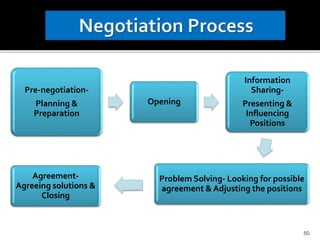
Pre-negotiation-
Planning &
Preparation
Opening
Information
Sharing-
Presenting &
Influencing
Positions
Problem Solving- Looking for possible
agreement & Adjusting the positions
Agreement-
Agreeing solutions &
Closing
50
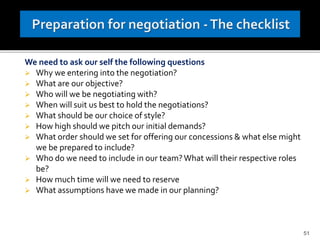
We need to ask our self the following questions
 Why we entering into the negotiation?
 What are our objective?
 Who will we be negotiating with?
 When will suit us best to hold the negotiations?
 What should be our choice of style?
 How high should we pitch our initial demands?
 What order should we set for offering our concessions & what else might
we be prepared to include?
 Who do we need to include in our team?What will their respective roles
be?
 How much time will we need to reserve
 What assumptions have we made in our planning?
51
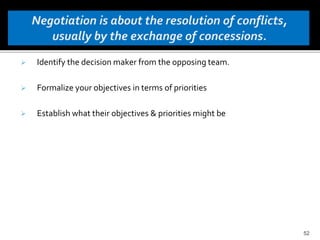
 Identify the decision maker from the opposing team.
 Formalize your objectives in terms of priorities
 Establish what their objectives & priorities might be
52
 Consider all the variables in the other side’s case & estimate the
probable cost to them if they concede any of those to you.
 Finally value the benefits of the other side’s variables to you
 If both sides are to move from their starting position by trading
concessions, the initial offer you open with- must be more favorable
to you than where you hope to settle eventually.
 Otherwise you will be having nothing to exchange
 Hence in setting out your opening gambit, you need to include a
negotiating margin & aim high
53
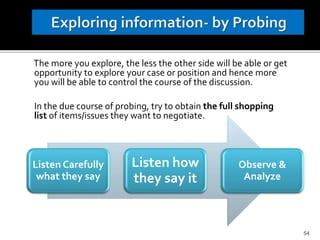
The more you explore, the less the other side will be able or get
opportunity to explore your case or position and hence more
you will be able to control the course of the discussion.
In the due course of probing, try to obtain the full shopping
list of items/issues they want to negotiate.
Listen Carefully
what they say
Listen how
they say it
Observe &
Analyze
54
 Deadlock is one of the most counterproductive and
undesirable of all the situations and conclusions of
negotiation that can result in breakdown in negotiation.
 The negotiators should always be alert for its possibilities
and try to avoid it.
 The only exception is where the negotiator use deadlock
as a tactic to galvanize the opponent to take the
favourable action.
Breaking the deadlock-
A) Try to avoid the immovable positions.
B) Bridging the GAP
55
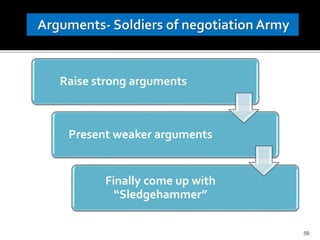
Raise strong arguments
Present weaker arguments
Finally come up with
“Sledgehammer”
56
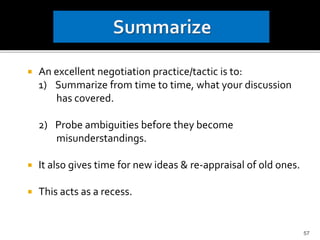
 An excellent negotiation practice/tactic is to:
1) Summarize from time to time, what your discussion
has covered.
2) Probe ambiguities before they become
misunderstandings.
 It also gives time for new ideas & re-appraisal of old ones.
 This acts as a recess.
57
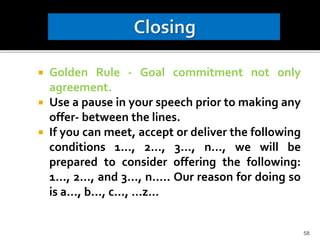
 Golden Rule - Goal commitment not only
agreement.
 Use a pause in your speech prior to making any
offer- between the lines.
 If you can meet, accept or deliver the following
conditions 1…, 2…, 3…, n…, we will be
prepared to consider offering the following:
1…, 2…, and 3…, n….. Our reason for doing so
is a…, b…, c…, …z…
58
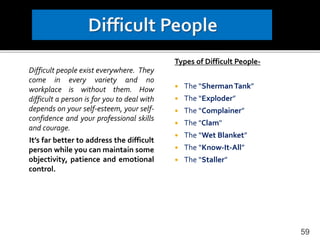
Difficult people exist everywhere. They
come in every variety and no
workplace is without them. How
difficult a person is for you to deal with
depends on your self-esteem, your self-
confidence and your professional skills
and courage.
It’s far better to address the difficult
person while you can maintain some
objectivity, patience and emotional
control.
Types of Difficult People-
 The “ShermanTank”
 The “Exploder”
 The “Complainer”
 The "Clam"
 The “Wet Blanket”
 The “Know-It-All”
 The “Staller”
59
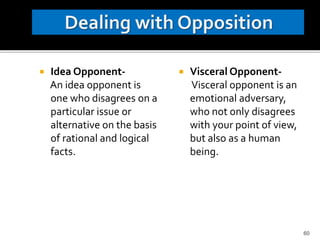
 Idea Opponent-
An idea opponent is
one who disagrees on a
particular issue or
alternative on the basis
of rational and logical
facts.
 Visceral Opponent-
Visceral opponent is an
emotional adversary,
who not only disagrees
with your point of view,
but also as a human
being.
60
 Ethics is a system of moral principles or values.
 Typically, these people feel that negotiation is what a
salesperson does to get them to buy or try to push off his/her
products and services. But this is not the reality. In fact, every
one of us negotiates in almost all walks of our day to day life.
 There are 9 tips will ensure that you build all your
negotiations on the foundation of ethics--which will, by the
way, increase your possibility of achieving win-win outcomes
61

sellingnegotiationskills112222233333.ppt

  • 1.
  • 2.
  • 3.
     An artof persuading the customer to believe that purchase of the product or service will actually benefit him or her.  It is the art of closing the deal. 3  Flow of products, services & information from seller to buyer in exchange of money.
  • 4.
     The Marketingconcept holds that the key to achieve the organizational goals consist of company being more effective than competitors in creating, communicating and delivering customer value to it’s chosen target market.  Marketing shows how to reach to the Customers and build long lasting relationships.  The Selling concept holds that customers and businesses, if left alone will ordinarily not buy enough of the organization’s products. The organizations must therefore, undertake an aggressive selling and promotion effort.  Ultimate result of marketing is selling. 4
  • 5.
  • 6.
     Modern salesmanager have to play the role of aTeam Leader in implementing strategic plans - By giving key inputs for developing long term sales plans Sales forecasting Sales force management Evolving sales & marketing strategies Building long term relationship with key clients 6
  • 7.
    Prospecting and Qualifying Pre- approachApproach Presentation and demonstration Overcoming Objections Negotiation Closing and follow up After Sales Services 7
  • 8.
     The keyto the entire selling concept is effectively understood when, where to dig & what to look for, is identified.  Finding prospects from different sources and out of diverse options available is called as suspecting  Suspecting of prospects can be done through:- - Blogs - Social Networks - Partner sites -Yellow Pages - Industrial directories -Telephone Directories 8
  • 9.
     A prospectis an individual or organization who seeks the product or service a sales person offers with an ability to pay for the same.  Prospecting is process of segregating individuals or organization from the suspecting list who have actual requirement of the product or service and who are able to buy that product or service.  How to reach prospects: - Direct phone calls - e-mail - Direct mail - Search marketing 9
  • 10.
    Introductory Approach Product approach Customer benefit approach Question approach Praiseapproach 10 Identification of major buying motive that generally a prospect has appeal for. conveyed sincerely and subtly
  • 11.
    The details ofthe product are communicated to the customer  AIDA- Formula Gaining Attention Holding Interest Arouse Desire Obtaining Action 11
  • 12.
     Features  Advantages Benefits  Value 12
  • 13.
     Psychological Resistance- thisincludes interference, preference for established brands, reluctance to give up something, pre-determined ideas etc.  Logical Resistance- objection to price, delivery schedule, product features etc. 13 Two kinds of Resistances
  • 14.
     Listen  Agree/restate without any prejudice  Get clear about the real issue  Discuss solution  Ask for commitments 14
  • 15.
     Non verbalYes’s Summarize  Execution  Successful sales people turn today’s customers into tomorrow’s by reinforcing the purchase decision. 15
  • 16.
  • 17.
     Product Selling Service Selling 17
  • 18.
     Product sellingVsService selling (tangibleVs intangible) Intangibility is one of several unique challenges in selling a service versus a product. Consumers buying a service can’t kick the tires- visit an accountant, dress designer, interior designer, lawyer, and hairdresser and so on – you can’t try out the service before you buy it. Service Selling- #1 Strategy- focus on customer need #2 Strategy- focus on your expertise #3 Strategy- focus on value There are 6 stages to selling the service successfully 18
  • 19.
     Mc Murry& Arnod’s Classification of Selling  Derch Newton Classification of Selling  Consumer Indirect Selling  Industrial Selling  Group Selling-  Telesales  Franchise Selling  International Selling  Concept Selling 19 DIFFERENT TYPES & CLASSIFICATIONS OF SELLING
  • 20.
     Group A(service selling):- 1) Inside order sales- a salesperson who writes up sales orders at a sales counter, or those forwarded to the company by telephone, but is not required to sell persuasively to customers. 2) Delivery sales- mainly engages in delivering the products. 3) Outside order sales- works on the actual field and sells goods or services by meeting the prospective customers & closes the deals. 20
  • 21.
    4) Missionary Sales-A missionary type of sales job involves convincing someone who has never used a product to buy it. 5) Technical sales- emphasizes the technical knowledge; the engineering sales person, who primarily acts as a consultant to the client companies/ customers. 21
  • 22.
    Group B (Developmentalselling) :- 1) Creative selling (tangibles) - selling creative content to the client which is tangible. For ex- interior designers, architects, painters. 2) Creative selling (intangibles) - selling the contents which are creative but intangible in nature. For ex- advertising agencies. 22
  • 23.
    Group C- (Basicallydevelopmental selling but requiring unusual creativity) :- 1) Political, indirect, or back door sales person- Sells big ticket items particularly commodities or items with no truly competitive features. Sales are consummated through rendering highly personalized services (which have little or no connection with the product) to key decision makers- In customer organizations; 23
  • 24.
    2) Multiple sales- involves the sales of big ticket items where the sales person must make presentations to several individuals in the customer’s organization, usually a committee, only one of which can say “yes” but all of whom can say “no”; for ex. An account executive of an advertising agency who makes presentation to the agency selection committees of advertisers- even after the account is obtained, the sales person has to work to retain it. 24
  • 25.
    1) Trade Selling-Selling products to wholesalers and retailers for resale purposes. Trade Show- an exhibition or fair at which manufacturers display their products for the benefit of visiting wholesalers and retailers. 2) Missionary selling 3)Technical selling 4) New business selling 25
  • 26.
  • 27.
     Indirect sellingis employed when a manufacturer markets his products through another firm that acts as the manufacturer's sales intermediary  Examples of indirect sales methods: -Wholesales - Retailers (supermarkets, department stores, multiple stores, independent retailers, consumer co-operatives) - Agents - Distributors and Dealers 27
  • 28.
     Advantages:-  Indirectsales can allow a company to increase sales quickly without having to hire more sales personnel  Suitable for overseas market  Channel is inexpensive- low per transaction cost  Start up cost is less  Disadvantages:-  Manufacturing firm has to give up control of marketing activities to other firm-  In some cases, however, indirect sales may lead to reduced control of the brand message and poorer customer service  Intermediary can easily discontinue handling a manufacturer's product 28
  • 29.
     Industrial Selling(business to business selling) is the selling of goods and services by one business to another. Industrial goods are those an industry uses to produce an end product from one or more raw materials.  Main features of B2B Selling:-  This is one to one selling & relatively easy to identify prospects  Highly trained & professional people involve in the process  Buying process is complex & may includes many steps  Long period required for process 29
  • 30.
     A missionarytype of sales job involves convincing someone who has never used a product to buy it.  Selling financial planning or life insurance and other financial products typifies the missionary sales job.  The metaphor of a missionary involves educating someone about an idea or concept and convincing them to have faith in that concept. 30
  • 31.
     Selling ina group: It helps you to sell more  One to many: More cost effective  The power of group  Many target customers together 31
  • 32.
     Telesales isa process that is followed to generate interest in the products and services that your business offers and is used to provide information to consumers.  Telesales is a service activity that you use to sell your products and services to customers directly over the telephone. In telesales, no further contact is required and the entire selling process, including the payment transaction, can be completed during a single telephone call.  Challenge-"normal" sales presentation involves visual contact, which encompasses body language, facial expressions and other non verbal cues. There is also no time limit to a normal sales presentation allow the customer and sales person to work free of heavy time pressure whereas many telesales roles have an ACD (Average call duration) between 3 and 10 minutes on average. 32
  • 33.
     To succeedin international sales you need to know what you are doing and why.You also need to:  Understand and apply the basics of selling which is true all over the world.  Figure out which buying mode the prospect is in.  Identify and focus on real/actual decision makers and avoid those without approval power.  Find an advisor to help navigate through the rough waters of international sales.  Distinguish between good customers and bad customers.  International sales is more challenging because of:  Cultural issues  Language barriers  Government regulations and tariffs 33
  • 34.
     Do research Visit the land where you are selling products  Check out competition  Learn the language if possible  Find the people to trust  Seek out the niches (Concentrate on small ponds before reaching to big oceans)  Scale your knowledge  Stay aware of global trends  Take advantage of stable market 34
  • 35.
  • 36.
    1. They don'tthink in terms of sales but rather in terms of concreting a business. 2. They listen more than they speak, getting an understanding of the needs of customers and then finding a solution. 3. They build their businesses - one customer at a time and then always influence the last customer into more and more customers. 4. They deliver more than the promise and always promise a lot. 5. They invest their time in those things that positively affect their income and avoid spending time on those things that are irrelevant. 6. They are always in quest of new, better and faster conduct to increase their sales efforts. 7. They are willing to invest in community, relationships building and networking 36
  • 37.
  • 38.
  • 39.
    39 Characterized by twoor more interdependent parties who have a conflict of interest,and who choose to adress that conflict by striving to reach an agreement through a process of mutual adjustment of each party’s demand and concessions Behavioral definition of negotiation- The process by which we search for the terms to what we want from somebody who wants something from us
  • 40.
     A dialogueor discussion between two or more people or parties, intended to reach an understanding, resolve point of difference, and/or gain advantage in outcome of dialogue, to produce an agreement upon courses of action, to bargain for individual or collective advantage, to craft outcomes to satisfy various interests of two opponents involved in negotiation process.  Process of exchanging offers and counter offers- “exchange of concessions” - for arriving at a compromise by which both parties reach to an agreed positions and outcomes. 40
  • 41.
     Meticulous preparationand planning skills  Expert in forming perceived positive opinion  Knowledge of the subject matter being negotiated  Ability to analyze properly, think clearly and rapidly under pressure and in the situation of uncertainty  Ability to perceive and exploit power  Professional communication & soft skills  Has to be a very good Listener  Should possess ability to judge the situation with general intelligence  Analytical skills with convincing power  Ability to estimate& evaluate various options with multidimensional thinking! 41
  • 42.
    42  Red Style Blue Style  Purple Style
  • 43.
    43 They believe manipulationis normal and they behave as they believe Main attitudes:  Aggressive  Intimidatory  Manipulatory
  • 44.
    44 Looking for bothwinning of two sides Main attitudes: Cooperative Trusting Conciliatory
  • 45.
    45 Win-Win Approach “Give mesome of what (red style),I will give you what you want (blue style)” “Taking while giving” “It is a two way exchange”
  • 46.
     Distributive Negotiation-Opponents compete over the fixed sum or value. The key question is who will win the bigger part of the pie. A gain of one party is made at the expense of the other.  Integrative negotiation- The word integrative implies some cooperation and hence often involves a higher degree of trust and the forming of mutually beneficial long term relationship. It can also involve creative problem-solving that aims to achieve mutual trust and gains. For the same reason it is also called win- win negotiation. 46
  • 47.
    47 Competitor • This styleis high in Assertivenes s and low in Cooperative ness. Avoider • This style is both low in Assertivenes s and low in Cooperative ness. Compromiser • This style is both moderate in Assertivenes s and moderate in Cooperative ness Accommodator • This style is low in Assertivenes s but high in Cooperative ness. Collaborator • (Win-Win approach) • This style is both high in Assertivenes s and high in Cooperative ness. Goal Collaborative • Win-Win not Compromise
  • 48.
     BATNA –Best Alternative to Negotiated Agreement  Reservation price: walk away price  ZOPA – Zone of Possible Agreement  Value creation through trade-offs  Real & perceived Negotiating power 48
  • 49.
    Power Time Forces of Negotiation Information Interestingly enough themost important is not the Power itself but how it is perceived. Power in some sense is similar to beauty that lies in the eye of the beholder. Another way to put it is, if you are perceived in the position of Power, you have it. 49
  • 50.
    Pre-negotiation- Planning & Preparation Opening Information Sharing- Presenting & Influencing Positions ProblemSolving- Looking for possible agreement & Adjusting the positions Agreement- Agreeing solutions & Closing 50
  • 51.
    We need toask our self the following questions  Why we entering into the negotiation?  What are our objective?  Who will we be negotiating with?  When will suit us best to hold the negotiations?  What should be our choice of style?  How high should we pitch our initial demands?  What order should we set for offering our concessions & what else might we be prepared to include?  Who do we need to include in our team?What will their respective roles be?  How much time will we need to reserve  What assumptions have we made in our planning? 51
  • 52.
     Identify thedecision maker from the opposing team.  Formalize your objectives in terms of priorities  Establish what their objectives & priorities might be 52
  • 53.
     Consider allthe variables in the other side’s case & estimate the probable cost to them if they concede any of those to you.  Finally value the benefits of the other side’s variables to you  If both sides are to move from their starting position by trading concessions, the initial offer you open with- must be more favorable to you than where you hope to settle eventually.  Otherwise you will be having nothing to exchange  Hence in setting out your opening gambit, you need to include a negotiating margin & aim high 53
  • 54.
    The more youexplore, the less the other side will be able or get opportunity to explore your case or position and hence more you will be able to control the course of the discussion. In the due course of probing, try to obtain the full shopping list of items/issues they want to negotiate. Listen Carefully what they say Listen how they say it Observe & Analyze 54
  • 55.
     Deadlock isone of the most counterproductive and undesirable of all the situations and conclusions of negotiation that can result in breakdown in negotiation.  The negotiators should always be alert for its possibilities and try to avoid it.  The only exception is where the negotiator use deadlock as a tactic to galvanize the opponent to take the favourable action. Breaking the deadlock- A) Try to avoid the immovable positions. B) Bridging the GAP 55
  • 56.
    Raise strong arguments Presentweaker arguments Finally come up with “Sledgehammer” 56
  • 57.
     An excellentnegotiation practice/tactic is to: 1) Summarize from time to time, what your discussion has covered. 2) Probe ambiguities before they become misunderstandings.  It also gives time for new ideas & re-appraisal of old ones.  This acts as a recess. 57
  • 58.
     Golden Rule- Goal commitment not only agreement.  Use a pause in your speech prior to making any offer- between the lines.  If you can meet, accept or deliver the following conditions 1…, 2…, 3…, n…, we will be prepared to consider offering the following: 1…, 2…, and 3…, n….. Our reason for doing so is a…, b…, c…, …z… 58
  • 59.
    Difficult people existeverywhere. They come in every variety and no workplace is without them. How difficult a person is for you to deal with depends on your self-esteem, your self- confidence and your professional skills and courage. It’s far better to address the difficult person while you can maintain some objectivity, patience and emotional control. Types of Difficult People-  The “ShermanTank”  The “Exploder”  The “Complainer”  The "Clam"  The “Wet Blanket”  The “Know-It-All”  The “Staller” 59
  • 60.
     Idea Opponent- Anidea opponent is one who disagrees on a particular issue or alternative on the basis of rational and logical facts.  Visceral Opponent- Visceral opponent is an emotional adversary, who not only disagrees with your point of view, but also as a human being. 60
  • 61.
     Ethics isa system of moral principles or values.  Typically, these people feel that negotiation is what a salesperson does to get them to buy or try to push off his/her products and services. But this is not the reality. In fact, every one of us negotiates in almost all walks of our day to day life.  There are 9 tips will ensure that you build all your negotiations on the foundation of ethics--which will, by the way, increase your possibility of achieving win-win outcomes 61