Trade Barriers: Governmental
Influence on Trade
Presented By:
Jatin Vaid
jatinvaid@gmail.com
1International Business - Jatin Vaid
Protectionism
• Company’s performance, ability to compete
and survival depends on government’s trade
policies.
• Policies may limit or enhance the ability to sell
abroad.
• Restrictions (Tariffs, etc.) or Competitive
support (subsidies, etc.)
2International Business - Jatin Vaid
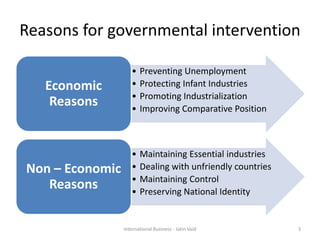
Reasons for governmental intervention
• Preventing Unemployment
• Protecting Infant Industries
• Promoting Industrialization
• Improving Comparative Position
Economic
Reasons
• Maintaining Essential industries
• Dealing with unfriendly countries
• Maintaining Control
• Preserving National Identity
Non – Economic
Reasons
3International Business - Jatin Vaid
1. ECONOMIC REASONS
Reasons for Government’s
Intervention
International Business - Jatin Vaid 4
1.1 Preventing Unemployment
• Economic employment of full employment
• Gaining jobs by limiting imports
• Other countries may retaliate
• Impact on other industries
International Business - Jatin Vaid 5
1.2 Protecting Infant Industries
• Government should shield an emerging industry
from foreign competition by guaranteeing it a
large share of domestic market until it is ready to
compete.
• Efficiency gains take time
• Economies of scale & experience curve translate
into higher productivity
• Benefits include higher employment, lower social
costs and higher tax revenues
6International Business - Jatin Vaid
1.3 Promoting Industrialization
• Higher manufacturing base leads to higher per
capita income
• Restricting imports leads to developing an
industrial base
• Increase FDI
• Export – led development for local consumption
• Nation building: Build infrastructure, rural
development, skill building
7International Business - Jatin Vaid
1.4 Improving Comparative Position
• Nation’s absolute economic welfare compared
with other nations
• Balance of trade adjustments
• Gaining access to foreign markets
• Restrictions as bargaining tool
• Controlling prices
8International Business - Jatin Vaid
2. NON – ECONOMIC REASONS
Reasons for Government’s
Intervention
International Business - Jatin Vaid 9
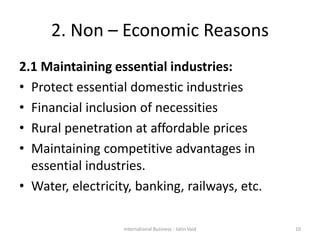
2. Non – Economic Reasons
2.1 Maintaining essential industries:
• Protect essential domestic industries
• Financial inclusion of necessities
• Rural penetration at affordable prices
• Maintaining competitive advantages in
essential industries.
• Water, electricity, banking, railways, etc.
10International Business - Jatin Vaid
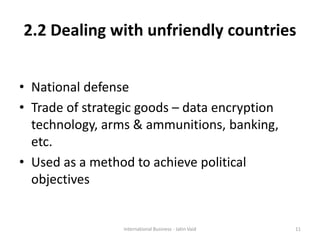
2.2 Dealing with unfriendly countries
• National defense
• Trade of strategic goods – data encryption
technology, arms & ammunitions, banking,
etc.
• Used as a method to achieve political
objectives
11International Business - Jatin Vaid
2.3 Maintaining Control
• Governments give aid to and encourage
imports from countries that join a political
alliance or vote in a preferred way within
international bodies.
• Political motives
12International Business - Jatin Vaid
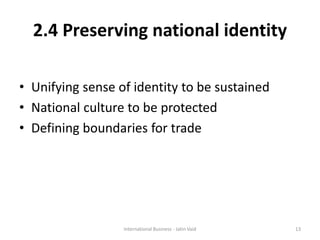
2.4 Preserving national identity
• Unifying sense of identity to be sustained
• National culture to be protected
• Defining boundaries for trade
13International Business - Jatin Vaid
Instruments of Trade Control
• Import tariffs
• Export Tariffs
• Transit Tariffs
Tariff
Barriers
• Subsidies
• Tied Aids
• Minimum Sale Price
• Quotas
• Embargoes
• Buy – Local Legislation
• Specific Permissions Required
Non – Tariff
Barriers
14International Business - Jatin Vaid
Tariff Barriers
• Directly affect the prices of goods traded
• Also called Duty or tax levied on goods traded
internationally.
• Most common type of trade control
• Specific duty; Ad – Valorem duty; Compound
duty.
15International Business - Jatin Vaid
Types of tariffs
i. Import tariffs: Collected by importing
country
ii. Export tariffs: Collected by exporting country
iii. Transit tariffs: Collected by the country
through which the goods have passed.
16International Business - Jatin Vaid
Non Tariff Barriers
• May directly affect either price or quantity of
goods traded internationally.
17International Business - Jatin Vaid
Types of Non – Tariff Barriers
i. Subsidies: Direct assistance to companies,
making them more competitive.
ii. Tied Aids: Loans to other countries, a part of
which is spend in donor country. E.g.
Infrastructure, telecommunication.
iii. Minimum sale price: Goods sold at a price
set by authorities after clearances.
18International Business - Jatin Vaid
.
iv. Quotas: Limiting the quantity of goods
imported or exported at a given time frame.
v. Embargoes: Prohibits all forms of trade from
a country or a category of goods.
vi. Buy – Local: Favoring domestic producers or
goods of local origin.
vii. Specific Permissions: import or export
license.
19International Business - Jatin Vaid
THANK YOU!
jatinvaid@gmail.com
International Business - Jatin Vaid 20

Trade barriers in International Business

  • 1.
    Trade Barriers: Governmental Influenceon Trade Presented By: Jatin Vaid jatinvaid@gmail.com 1International Business - Jatin Vaid
  • 2.
    Protectionism • Company’s performance,ability to compete and survival depends on government’s trade policies. • Policies may limit or enhance the ability to sell abroad. • Restrictions (Tariffs, etc.) or Competitive support (subsidies, etc.) 2International Business - Jatin Vaid
  • 3.
    Reasons for governmentalintervention • Preventing Unemployment • Protecting Infant Industries • Promoting Industrialization • Improving Comparative Position Economic Reasons • Maintaining Essential industries • Dealing with unfriendly countries • Maintaining Control • Preserving National Identity Non – Economic Reasons 3International Business - Jatin Vaid
  • 4.
    1. ECONOMIC REASONS Reasonsfor Government’s Intervention International Business - Jatin Vaid 4
  • 5.
    1.1 Preventing Unemployment •Economic employment of full employment • Gaining jobs by limiting imports • Other countries may retaliate • Impact on other industries International Business - Jatin Vaid 5
  • 6.
    1.2 Protecting InfantIndustries • Government should shield an emerging industry from foreign competition by guaranteeing it a large share of domestic market until it is ready to compete. • Efficiency gains take time • Economies of scale & experience curve translate into higher productivity • Benefits include higher employment, lower social costs and higher tax revenues 6International Business - Jatin Vaid
  • 7.
    1.3 Promoting Industrialization •Higher manufacturing base leads to higher per capita income • Restricting imports leads to developing an industrial base • Increase FDI • Export – led development for local consumption • Nation building: Build infrastructure, rural development, skill building 7International Business - Jatin Vaid
  • 8.
    1.4 Improving ComparativePosition • Nation’s absolute economic welfare compared with other nations • Balance of trade adjustments • Gaining access to foreign markets • Restrictions as bargaining tool • Controlling prices 8International Business - Jatin Vaid
  • 9.
    2. NON –ECONOMIC REASONS Reasons for Government’s Intervention International Business - Jatin Vaid 9
  • 10.
    2. Non –Economic Reasons 2.1 Maintaining essential industries: • Protect essential domestic industries • Financial inclusion of necessities • Rural penetration at affordable prices • Maintaining competitive advantages in essential industries. • Water, electricity, banking, railways, etc. 10International Business - Jatin Vaid
  • 11.
    2.2 Dealing withunfriendly countries • National defense • Trade of strategic goods – data encryption technology, arms & ammunitions, banking, etc. • Used as a method to achieve political objectives 11International Business - Jatin Vaid
  • 12.
    2.3 Maintaining Control •Governments give aid to and encourage imports from countries that join a political alliance or vote in a preferred way within international bodies. • Political motives 12International Business - Jatin Vaid
  • 13.
    2.4 Preserving nationalidentity • Unifying sense of identity to be sustained • National culture to be protected • Defining boundaries for trade 13International Business - Jatin Vaid
  • 14.
    Instruments of TradeControl • Import tariffs • Export Tariffs • Transit Tariffs Tariff Barriers • Subsidies • Tied Aids • Minimum Sale Price • Quotas • Embargoes • Buy – Local Legislation • Specific Permissions Required Non – Tariff Barriers 14International Business - Jatin Vaid
  • 15.
    Tariff Barriers • Directlyaffect the prices of goods traded • Also called Duty or tax levied on goods traded internationally. • Most common type of trade control • Specific duty; Ad – Valorem duty; Compound duty. 15International Business - Jatin Vaid
  • 16.
    Types of tariffs i.Import tariffs: Collected by importing country ii. Export tariffs: Collected by exporting country iii. Transit tariffs: Collected by the country through which the goods have passed. 16International Business - Jatin Vaid
  • 17.
    Non Tariff Barriers •May directly affect either price or quantity of goods traded internationally. 17International Business - Jatin Vaid
  • 18.
    Types of Non– Tariff Barriers i. Subsidies: Direct assistance to companies, making them more competitive. ii. Tied Aids: Loans to other countries, a part of which is spend in donor country. E.g. Infrastructure, telecommunication. iii. Minimum sale price: Goods sold at a price set by authorities after clearances. 18International Business - Jatin Vaid
  • 19.
    . iv. Quotas: Limitingthe quantity of goods imported or exported at a given time frame. v. Embargoes: Prohibits all forms of trade from a country or a category of goods. vi. Buy – Local: Favoring domestic producers or goods of local origin. vii. Specific Permissions: import or export license. 19International Business - Jatin Vaid
  • 20.