Organization Structure in
 International Business

       PRESENTED BY:
         JATIN VAID
Organization Structure

 Organization is defined by the formal
  structure, coordination and control systems, and the
  organization culture.
 It’s the formal arrangement of roles, responsibilities
  and relationships within an organization.
 It’s a powerful tool with which to implement
  strategy.
Vertical Differentiation: Centralization V/S
                 Decentralization.

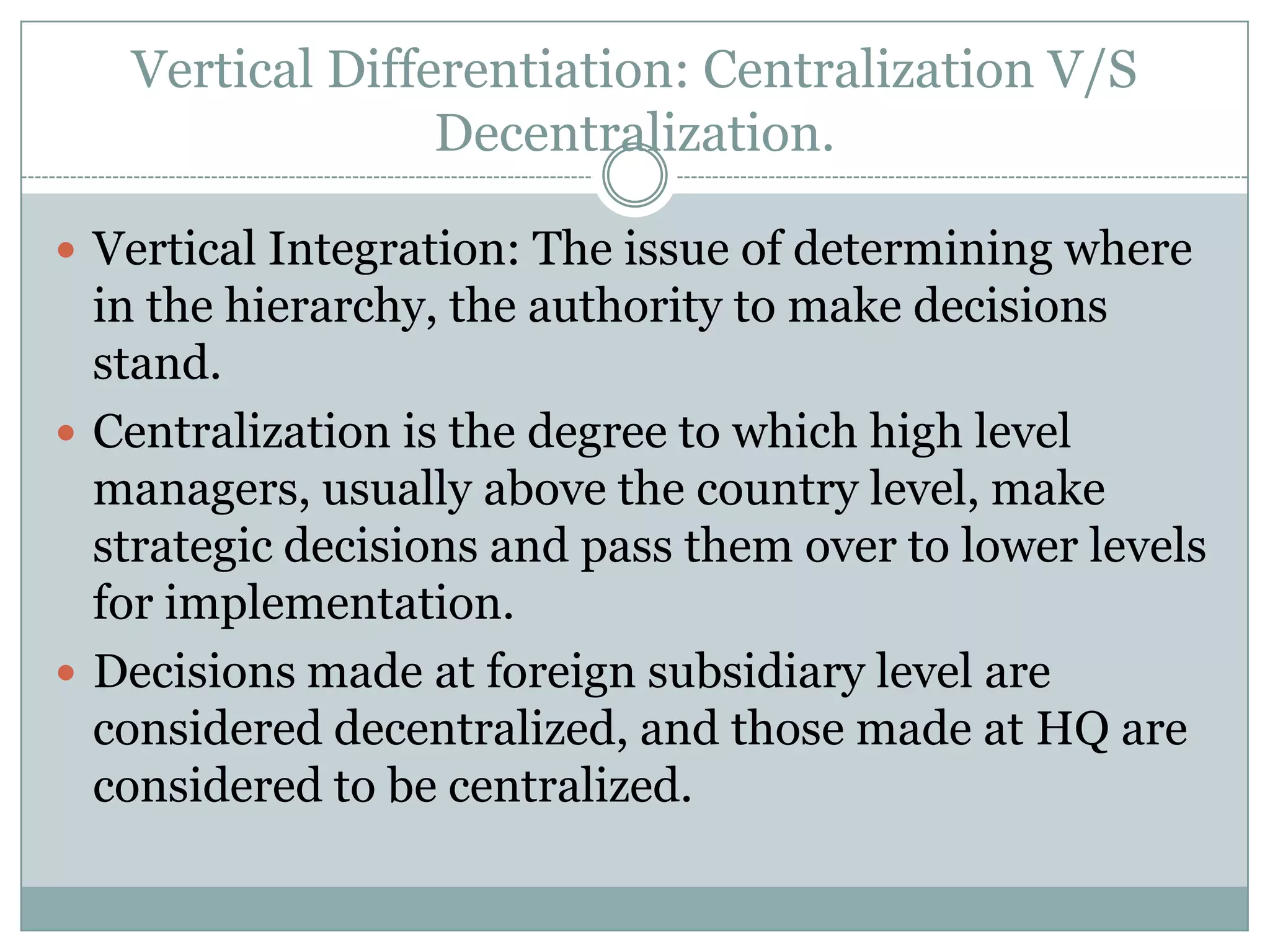
 Vertical Integration: The issue of determining where
  in the hierarchy, the authority to make decisions
  stand.
 Centralization is the degree to which high level
  managers, usually above the country level, make
  strategic decisions and pass them over to lower levels
  for implementation.
 Decisions made at foreign subsidiary level are
  considered decentralized, and those made at HQ are
  considered to be centralized.
Centralization V/S Decentralization

Centralization                              Decentralization
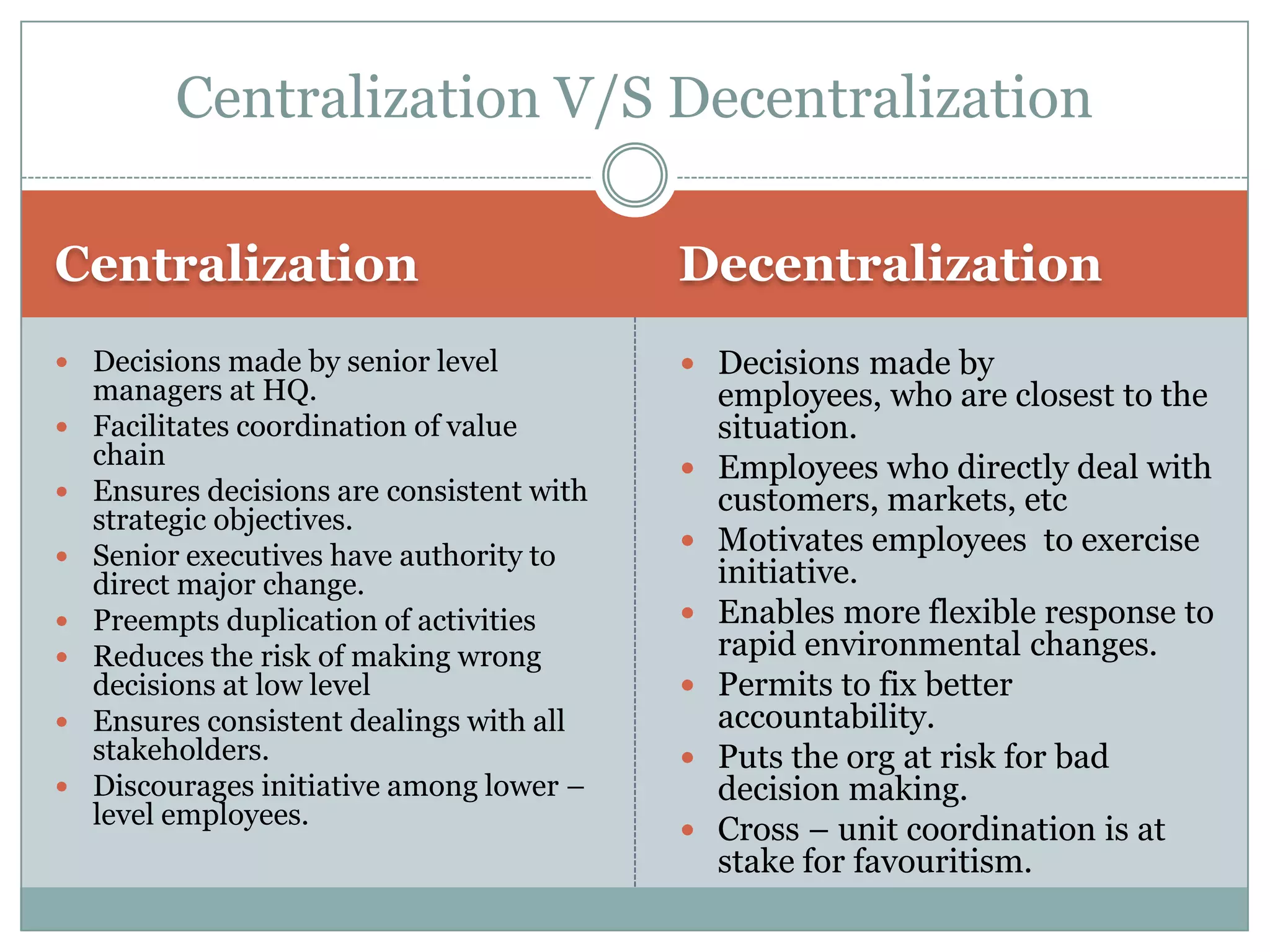
 Decisions made by senior level             Decisions made by
    managers at HQ.                             employees, who are closest to the
   Facilitates coordination of value           situation.
    chain                                      Employees who directly deal with
   Ensures decisions are consistent with       customers, markets, etc
    strategic objectives.
   Senior executives have authority to        Motivates employees to exercise
    direct major change.                        initiative.
   Preempts duplication of activities         Enables more flexible response to
   Reduces the risk of making wrong            rapid environmental changes.
    decisions at low level                     Permits to fix better
   Ensures consistent dealings with all        accountability.
    stakeholders.                              Puts the org at risk for bad
   Discourages initiative among lower –        decision making.
    level employees.
                                               Cross – unit coordination is at
                                                stake for favouritism.
Horizontal Differentiation: The Design of the
               Formal Structure

 Horizontal Differentiation: The way a co. designs its
  formal structure to perform the following functions;
1. Specify the set of organizational tasks.
2. Divide these tasks into jobs, departments,
    subsidiaries and divisions to get the work done.
3. Assign authority relationships to get the work done
    in a way that supports co. strategy.
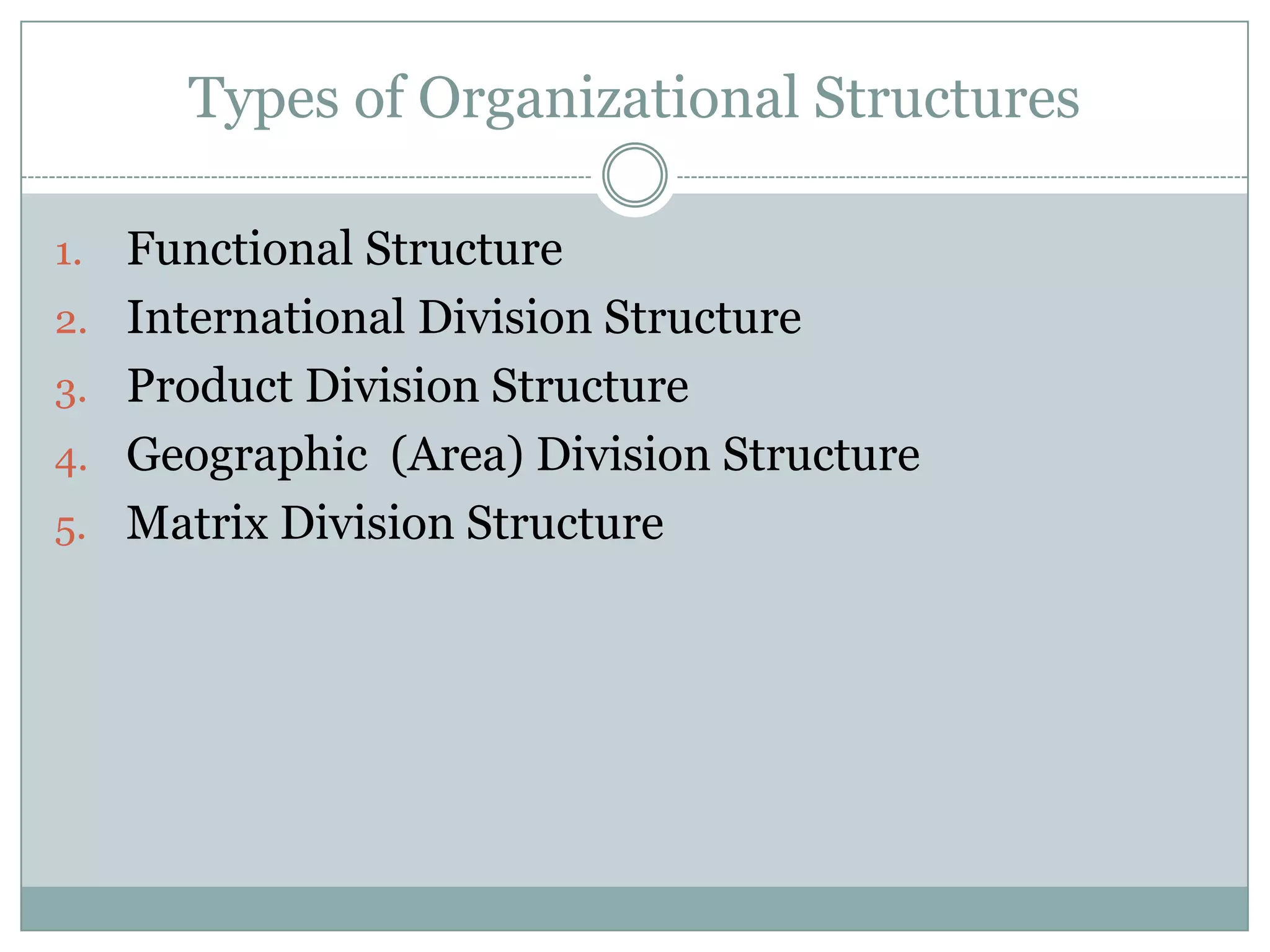
Types of Organizational Structures

1.   Functional Structure
2.   International Division Structure
3.   Product Division Structure
4.   Geographic (Area) Division Structure
5.   Matrix Division Structure
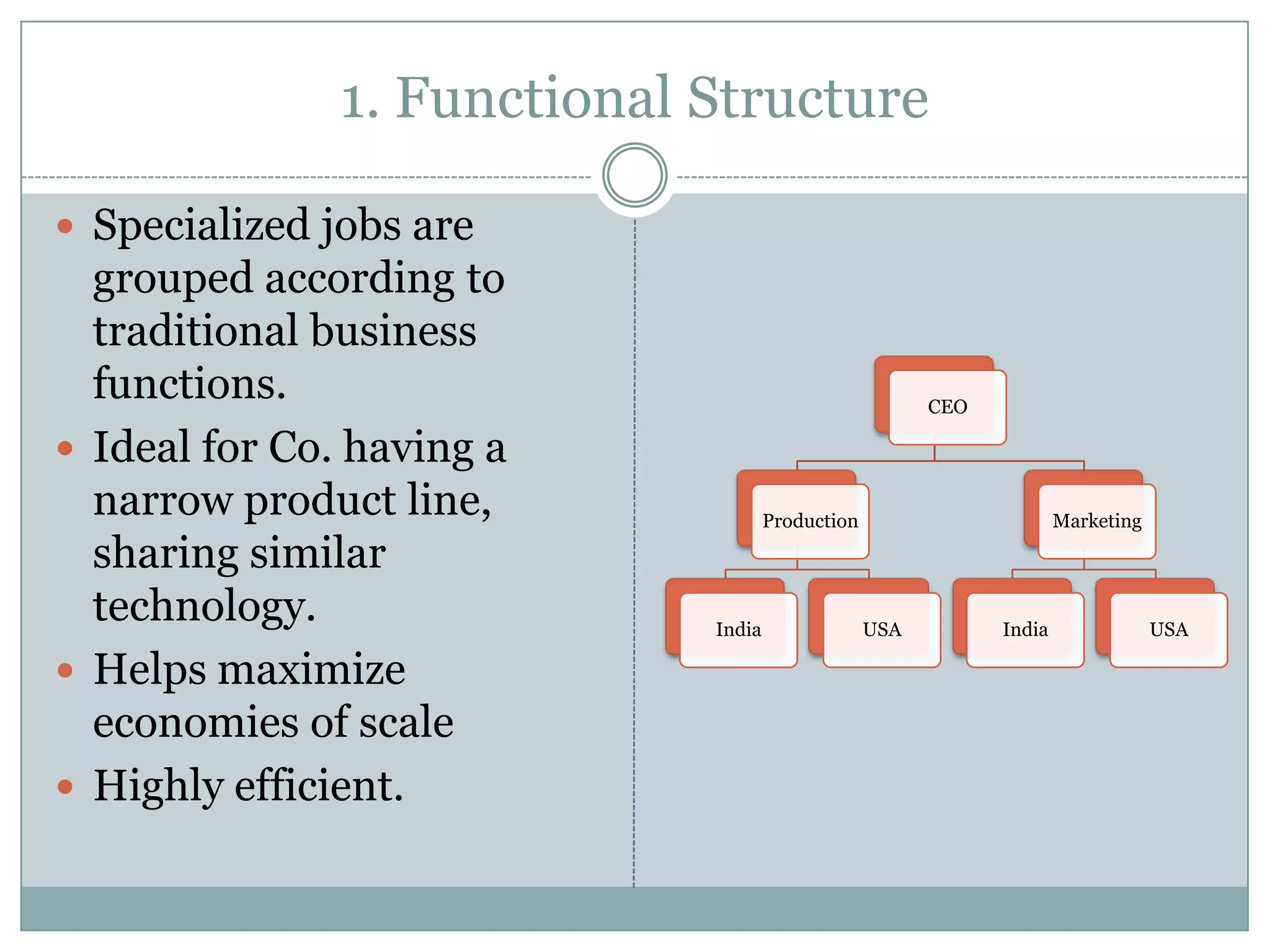
1. Functional Structure

 Specialized jobs are
  grouped according to
  traditional business
  functions.                                            CEO

 Ideal for Co. having a
  narrow product line,               Production                       Marketing

  sharing similar
  technology.                India                USA         India               USA

 Helps maximize
  economies of scale
 Highly efficient.
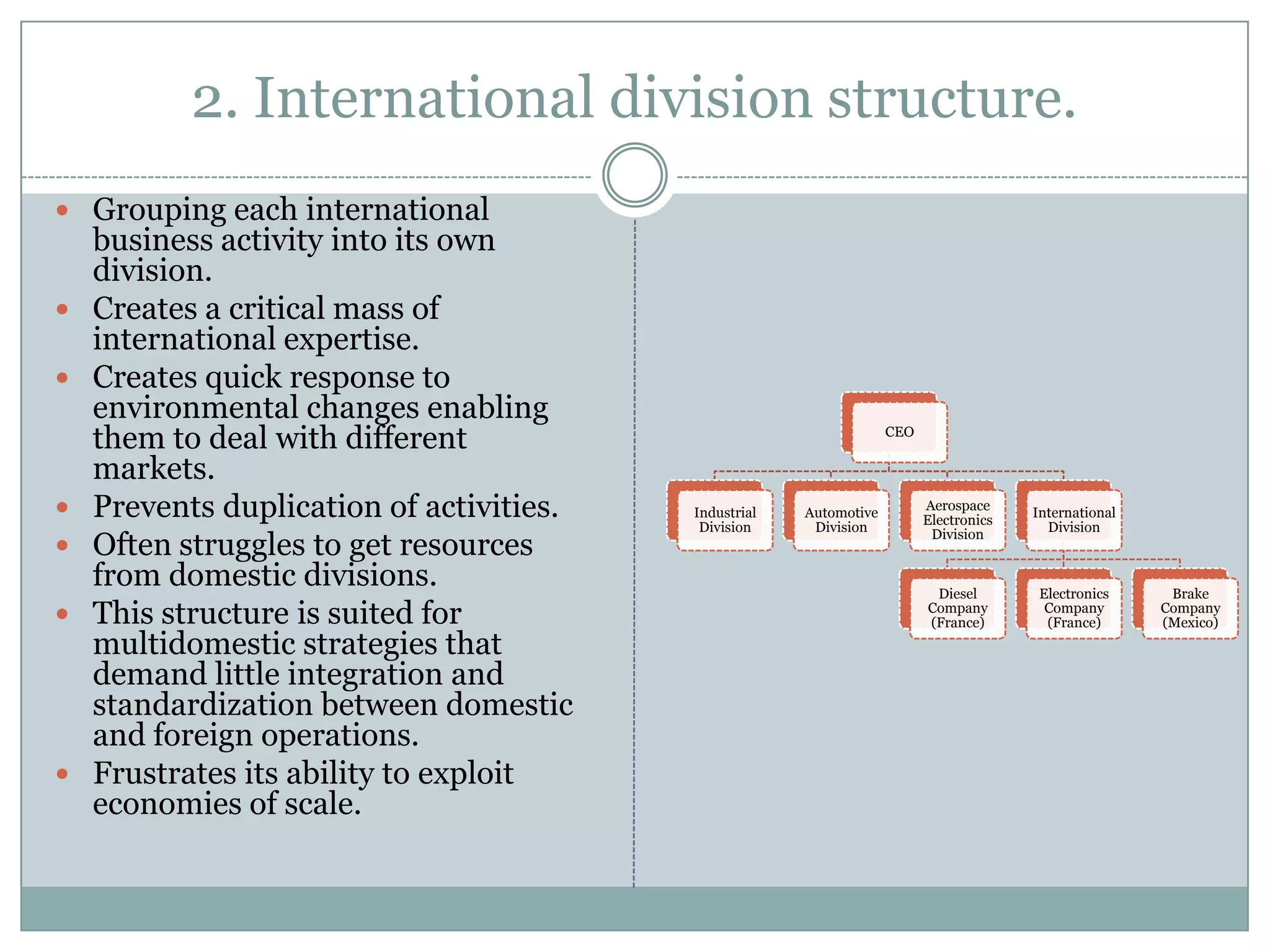
2. International division structure.
 Grouping each international
    business activity into its own
    division.
   Creates a critical mass of
    international expertise.
   Creates quick response to
    environmental changes enabling
    them to deal with different                                     CEO

    markets.
   Prevents duplication of activities.   Industrial
                                           Division
                                                       Automotive
                                                        Division
                                                                          Aerospace
                                                                          Electronics
                                                                                        International
                                                                                          Division
    Often struggles to get resources
                                                                           Division

    from domestic divisions.                                               Diesel        Electronics     Brake
   This structure is suited for                                          Company
                                                                          (France)
                                                                                          Company
                                                                                          (France)
                                                                                                        Company
                                                                                                        (Mexico)
    multidomestic strategies that
    demand little integration and
    standardization between domestic
    and foreign operations.
   Frustrates its ability to exploit
    economies of scale.
Product Division Structure
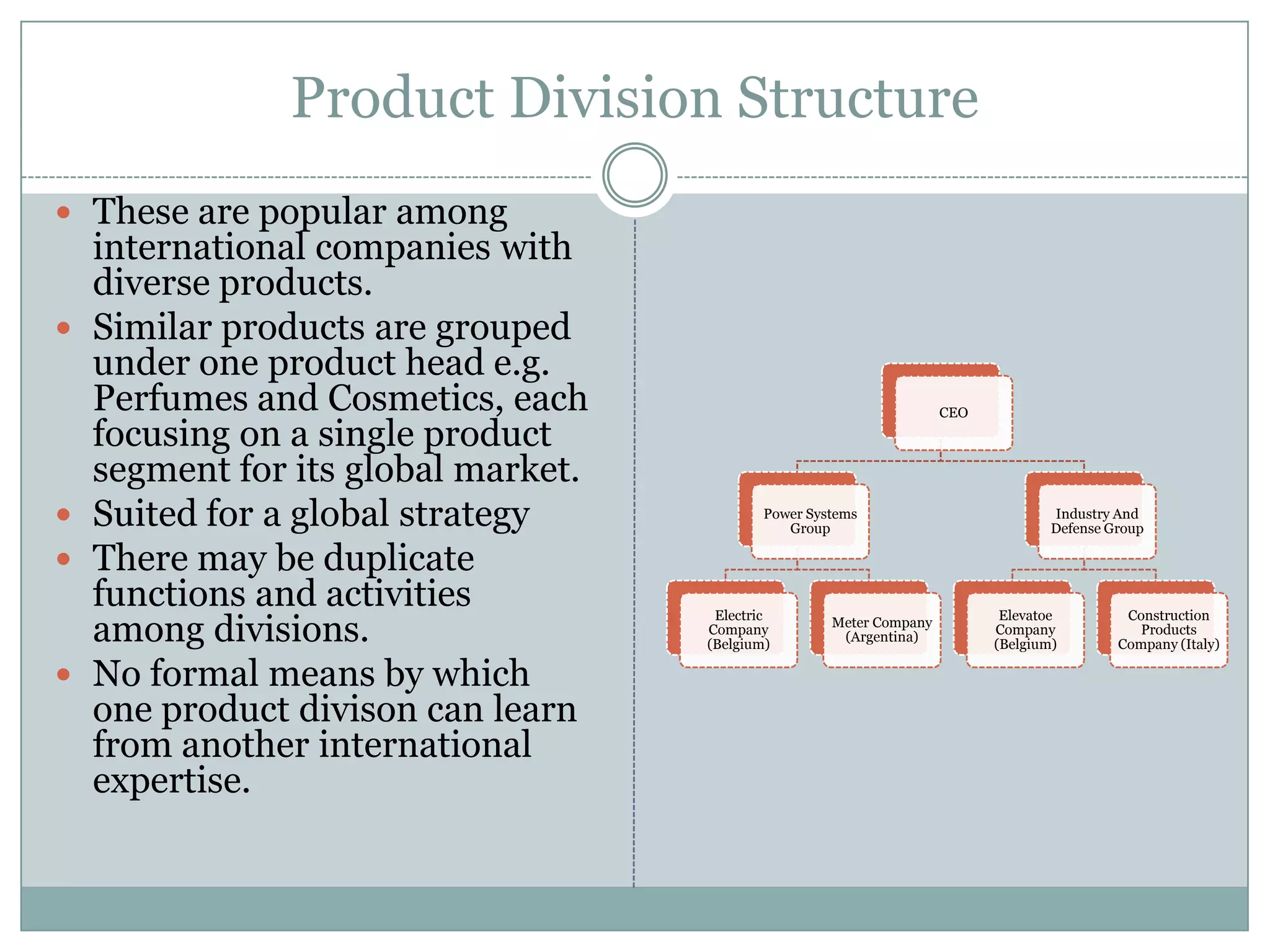
 These are popular among
    international companies with
    diverse products.
   Similar products are grouped
    under one product head e.g.
    Perfumes and Cosmetics, each                                      CEO

    focusing on a single product
    segment for its global market.
   Suited for a global strategy             Power Systems
                                                Group
                                                                                    Industry And
                                                                                    Defense Group

   There may be duplicate
    functions and activities          Electric                               Elevatoe         Construction
    among divisions.                 Company
                                     (Belgium)
                                                      Meter Company
                                                       (Argentina)
                                                                            Company
                                                                            (Belgium)
                                                                                                Products
                                                                                             Company (Italy)

   No formal means by which
    one product divison can learn
    from another international
    expertise.
Geographic (Area) Division Structure
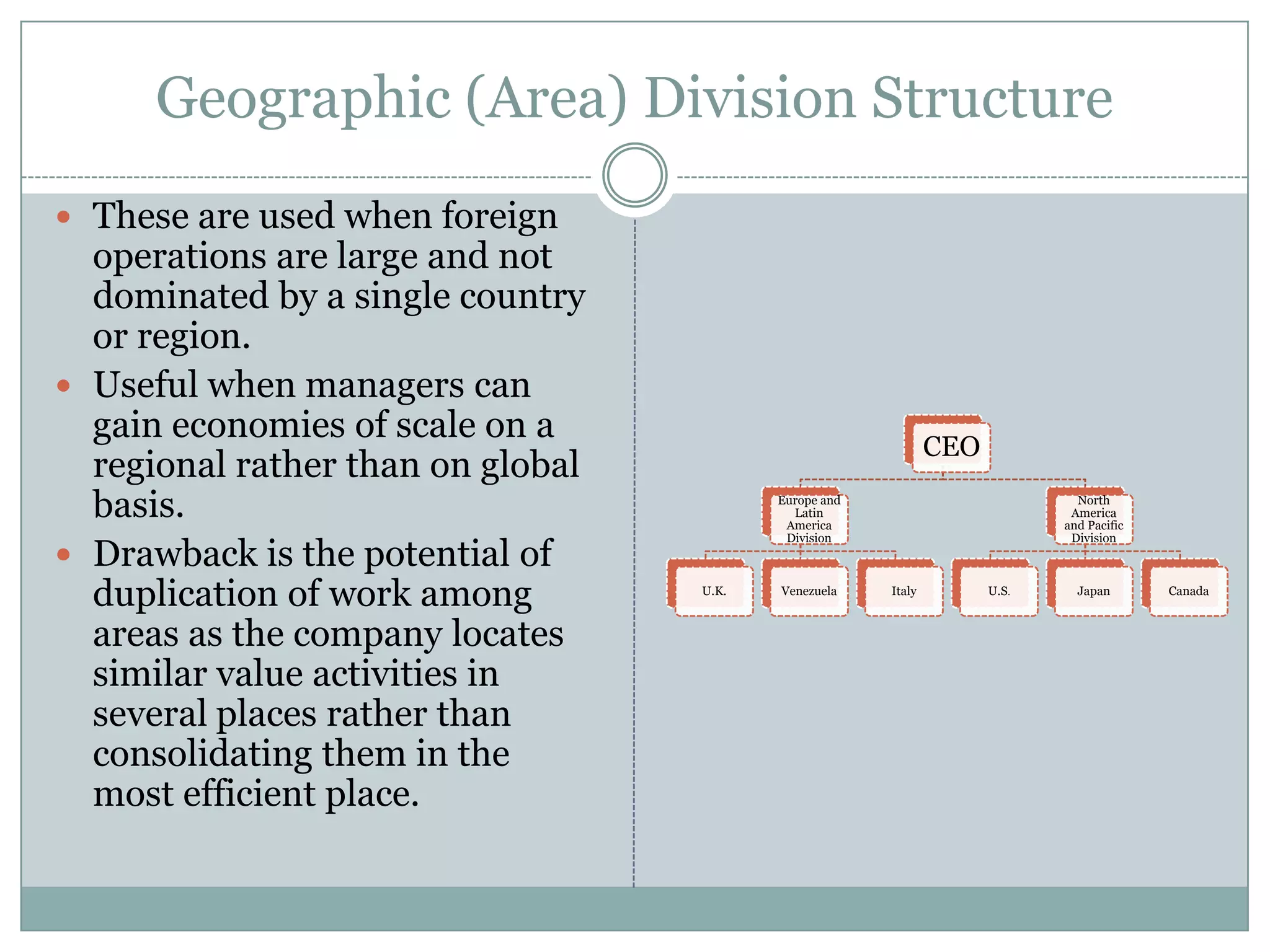
 These are used when foreign
  operations are large and not
  dominated by a single country
  or region.
 Useful when managers can
  gain economies of scale on a
                                                               CEO
  regional rather than on global
  basis.                                  Europe and
                                            Latin
                                           America
                                                                              North
                                                                             America
                                                                            and Pacific
                                           Division                          Division
 Drawback is the potential of
  duplication of work among        U.K.   Venezuela    Italy         U.S.     Japan       Canada


  areas as the company locates
  similar value activities in
  several places rather than
  consolidating them in the
  most efficient place.
Matrix Division Structure
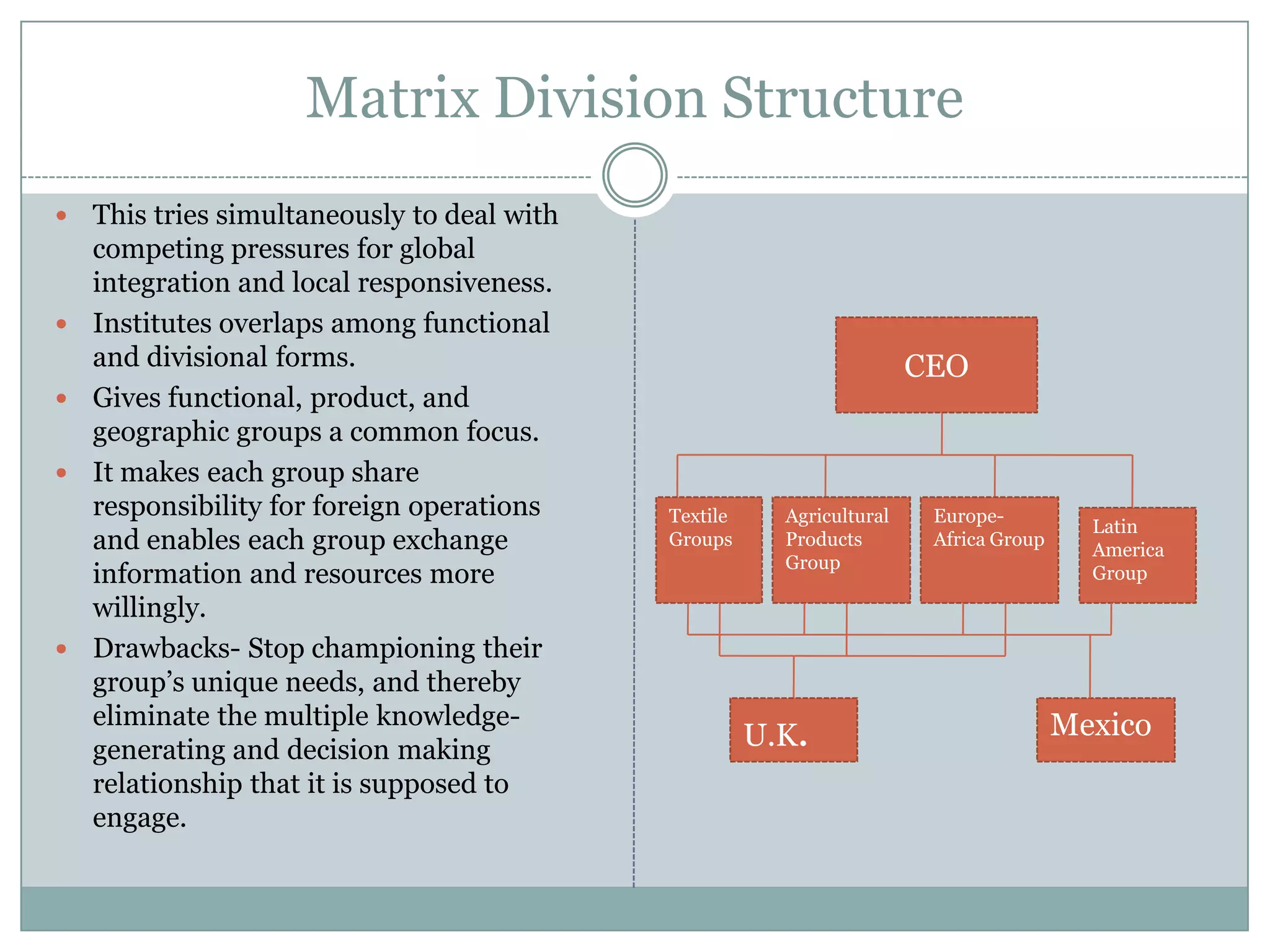
   This tries simultaneously to deal with
    competing pressures for global
    integration and local responsiveness.
   Institutes overlaps among functional
    and divisional forms.                                               CEO
   Gives functional, product, and
    geographic groups a common focus.
   It makes each group share
    responsibility for foreign operations    Textile     Agricultural    Europe-
                                                                                          Latin
    and enables each group exchange          Groups      Products        Africa Group
                                                                                          America
                                                         Group
    information and resources more                                                        Group
    willingly.
   Drawbacks- Stop championing their
    group’s unique needs, and thereby
    eliminate the multiple knowledge-                                                   Mexico
    generating and decision making                     U.K.
    relationship that it is supposed to
    engage.
Thank You!
jatinvaid@gmail.com

Organization structure in international business

  • 1.
    Organization Structure in International Business PRESENTED BY: JATIN VAID
  • 2.
    Organization Structure  Organizationis defined by the formal structure, coordination and control systems, and the organization culture.  It’s the formal arrangement of roles, responsibilities and relationships within an organization.  It’s a powerful tool with which to implement strategy.
  • 3.
    Vertical Differentiation: CentralizationV/S Decentralization.  Vertical Integration: The issue of determining where in the hierarchy, the authority to make decisions stand.  Centralization is the degree to which high level managers, usually above the country level, make strategic decisions and pass them over to lower levels for implementation.  Decisions made at foreign subsidiary level are considered decentralized, and those made at HQ are considered to be centralized.
  • 4.
    Centralization V/S Decentralization Centralization Decentralization  Decisions made by senior level  Decisions made by managers at HQ. employees, who are closest to the  Facilitates coordination of value situation. chain  Employees who directly deal with  Ensures decisions are consistent with customers, markets, etc strategic objectives.  Senior executives have authority to  Motivates employees to exercise direct major change. initiative.  Preempts duplication of activities  Enables more flexible response to  Reduces the risk of making wrong rapid environmental changes. decisions at low level  Permits to fix better  Ensures consistent dealings with all accountability. stakeholders.  Puts the org at risk for bad  Discourages initiative among lower – decision making. level employees.  Cross – unit coordination is at stake for favouritism.
  • 5.
    Horizontal Differentiation: TheDesign of the Formal Structure  Horizontal Differentiation: The way a co. designs its formal structure to perform the following functions; 1. Specify the set of organizational tasks. 2. Divide these tasks into jobs, departments, subsidiaries and divisions to get the work done. 3. Assign authority relationships to get the work done in a way that supports co. strategy.
  • 6.
    Types of OrganizationalStructures 1. Functional Structure 2. International Division Structure 3. Product Division Structure 4. Geographic (Area) Division Structure 5. Matrix Division Structure
  • 7.
    1. Functional Structure Specialized jobs are grouped according to traditional business functions. CEO  Ideal for Co. having a narrow product line, Production Marketing sharing similar technology. India USA India USA  Helps maximize economies of scale  Highly efficient.
  • 8.
    2. International divisionstructure.  Grouping each international business activity into its own division.  Creates a critical mass of international expertise.  Creates quick response to environmental changes enabling them to deal with different CEO markets.  Prevents duplication of activities. Industrial Division Automotive Division Aerospace Electronics International Division Often struggles to get resources Division  from domestic divisions. Diesel Electronics Brake  This structure is suited for Company (France) Company (France) Company (Mexico) multidomestic strategies that demand little integration and standardization between domestic and foreign operations.  Frustrates its ability to exploit economies of scale.
  • 9.
    Product Division Structure These are popular among international companies with diverse products.  Similar products are grouped under one product head e.g. Perfumes and Cosmetics, each CEO focusing on a single product segment for its global market.  Suited for a global strategy Power Systems Group Industry And Defense Group  There may be duplicate functions and activities Electric Elevatoe Construction among divisions. Company (Belgium) Meter Company (Argentina) Company (Belgium) Products Company (Italy)  No formal means by which one product divison can learn from another international expertise.
  • 10.
    Geographic (Area) DivisionStructure  These are used when foreign operations are large and not dominated by a single country or region.  Useful when managers can gain economies of scale on a CEO regional rather than on global basis. Europe and Latin America North America and Pacific Division Division  Drawback is the potential of duplication of work among U.K. Venezuela Italy U.S. Japan Canada areas as the company locates similar value activities in several places rather than consolidating them in the most efficient place.
  • 11.
    Matrix Division Structure  This tries simultaneously to deal with competing pressures for global integration and local responsiveness.  Institutes overlaps among functional and divisional forms. CEO  Gives functional, product, and geographic groups a common focus.  It makes each group share responsibility for foreign operations Textile Agricultural Europe- Latin and enables each group exchange Groups Products Africa Group America Group information and resources more Group willingly.  Drawbacks- Stop championing their group’s unique needs, and thereby eliminate the multiple knowledge- Mexico generating and decision making U.K. relationship that it is supposed to engage.
  • 12.