
Chapter 4
Personal selling
In this chapter we will
discuss:
• Buyer seller dyads
• Types of selling jobs
• Sales force objectives
• Sales force strategies
• Theories of personal selling
• Approaches to personal selling
• Personal selling process
• Customer related issues in personal selling
• Automation in personal selling
Introduction
• Equipping sales force with latest gadgets
• Highly interactive & suits many complex
products & services
• How it has become challenging in 21st
century
• How advanced technology facilitated
their functions from virtual office
• Need of the 21st
century (flexibility &
adaptability
Buyer seller dyads
• Whenever a potential buyer & seller
interact, they constitute a dyad
• Appropriate, relevant communication
between them increases the success of a
sales call
• Research conducted by HL Mathews, David
T Wilson & John F Monoky resulted,
– That the relationship between the customer &
the sales person is affected by the later’s
principles, expectation and communication
skills
Continued…..
• A glance on “The prisoner’s dilemma matrix”
– What if they know that they are similar?
(cooperate)
– What is they know that they are dissimilar?
(compete)
• Conclusion: likelihood of a sales person
making a sale to a customer is higher if he
shares same characteristics with the
customer
– E.g. demographics, physical features etc. (MetLife
Insurance company – NRIs)
Types of selling jobs
• Personal selling is still organized around sales
territories, products and customers but not
based on tasks or activities involved
• This is because of the misconceptions held by
top management
• They don’t recognize that sales people
perform 2 different kinds of tasks for which 2
different manpower is required
• They are
– Sales development (developmental)
– Sales maintenance (service oriented)
• What is the difference?
• How sales development is being neglected?
Sales development
• Different skill set is required
(creativity, knowledge about customer,
economy & market)
• Perceived need to be known & play the
role of change agent
• Steps in developing new accounts
Steps in developing new accounts
• Search for potential accounts
• Identify key decision maker, gain access
• Project as problem solver for client
• Develop dissatisfaction about existing
product
• Explain the need to change for gaining
• Conversion into actual replacement
• Build long term relation with
reassurance
Sales maintenance
• Maintaining the account, here priorities
will change
• Main concern is increasing purchases and
defend from probable threats from
competitors
• For this acquiring through knowledge of
the customer’s organization, operations
& human, financial resources is required
• Be solver all time
Sales force objectives
• Objectives can be qualitative /
quantitative in nature
• Qualitative Objectives:
– Effective time management
– Possessing sufficient knowledge
– Maintaining efficient customer relations
– Project pleasing attitude/appearance
– Secure all relevant information
Quantitative Objectives
• Increase, manage & retain market share
• No. of sales calls per day / no. of days worked
• Sell optimum product mix which gives
maximum profitability
• Generate certain no. of new accounts per
month
• Minimize sales expenses
• Procure certain quantum of business from
certain no. of clients
Sales force strategies
• These are of 2 types
– Market access strategies
• These will depend upon the market potential &
size of different prospective accounts
• E.g. IBM initially started with 5,000 sales
persons later included 18 other channels
– Account relation ship strategy
• Trying to establish long term relations
Market access strategies
1. Company’s use of its own sales force
2. Use of distributors
3. Tele marketing
4. Independent sales agents
5. The internet
6. Developing hybrid marketing systems
7. Establishing alliances
Company’s use of its own sales
force
• They should be geared up to meet
challenges
• Should be well trained to increase
efficiency
Use of distributors
• In industrial markets maximum
proportion of products will be sold to
distributors
• Factors to be considered:
– Understanding distributor needs
– Developing a working relationship
– Managing the relationship effectively
Tele marketing
• Helps in identifying new prospects &
turning them to profitable accounts
• Selling product over the telephone
• India is one of the emerging markets in
this field
Independent sales agents
• These people are meant to cover a
given territory & develop sales
relationship with customers.
• But, now they are handling accounts
rather than territories
• Economic criteria drives this approach
The internet
• Online services worth millions of dollors
• Biggest advantage is they do not require
larger investments
• No geographical boundaries
Developing hybrid marketing
systems
• Using combination of several channels
• Almost all the industries are following
this to increase the reach
• No. of channels and marketing tasks to
be performed is to be decided
Establishing alliances
• Alliances are in the form of
– Mergers
– Consolidations
– Take-over
– Joint ventures
• Examples:
– IBM with 153 companies
– HM - Mitsubishi
Account relation ship strategy
• Long term relations are needed to have
continuous transactions
• Customer makes repeat purchases as
several types of products are available
• Organizational buying is complex
comparatively
• So, different dimensions and authority
and power structures are to be studied
by a sales person prior to approaching
Theories of personal selling
• IS SELLING AN ART OR SCIENCE?
• Survey of 173 sales executives
– Result : 46% art, 8% science & 46% art
evolving into science
• Various theories
– AIDAS theory
– Right set of circumstances theory
– Buying formula
– Behavior equation (buyer decision process &
influence of sales person)
AIDAS theory
• William James
• Evolution as early as in 1898
• Features:
– Securing attention
– Gaining interest
– Kindling desire
– Inducing action
– Building satisfaction
Right set of circumstances theory
• Situation, response theory
• Set of circumstances includes external
as well as internal factors
• Sales person to control the situation
Buying formula theory of selling
• Name given by E K strong Jr.
• Arrangement of buyer’s thinking
process
1. Need/problem  solution  purchase
2. Need/problem  solution  purchase 
satisfaction
3. Need/problem  product/service & trade
name  purchase  satisfaction
Behavior equation theory
• J A Howard
• Learning process
• Drives
– Innate (hunger, thirst, pain)
– Learned (status, recognition)
• Cues
– Triggering (activates decision process)
– Non triggering (have an impact on decision process)
– Types
• Product cues
• Information cues
• Product & information cues
• Response & reinforcement
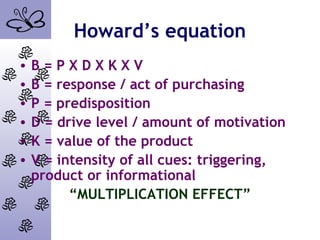
Howard’s equation
• B = P X D X K X V
• B = response / act of purchasing
• P = predisposition
• D = drive level / amount of motivation
• K = value of the product
• V = intensity of all cues: triggering,
product or informational
“MULTIPLICATION EFFECT”
Approaches to personal selling
• Three types of approaches are available
– Stimulus response approach
– Need satisfaction approach
– Problem situation approach
Stimulus response approach
• Makes positive statements about the
product by using statements such as
“user friendly product” or “satisfaction
guaranteed” etc.
• Sales will have no idea about customer’s
needs and customer’s involvement is too
low. It is suitable only for inexperienced
sales person
Need satisfaction approach
• Focuses on customer’s needs. Sales
person identifies the need and offers a
product which can satisfy the same
• Two way communication with high
involvement from customer’s side
• Skilled and experienced salesperson is
required
Problem situation approach
• It’s a combination of need satisfaction
approach and scientific technique of
problem solving
• Here sales person makes the customer to
identify the problem, suggests
alternatives to face the problems by
giving pros & cons of each alternative
and finally selecting the best solution
• It takes longer time and used in
computer, telecommunication
equipment etc.
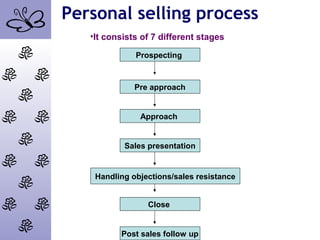
Personal selling process
•It consists of 7 different stages
Prospecting
Pre approach
Approach
Sales presentation
Handling objections/sales resistance
Close
Post sales follow up
Prospecting
• It involves searching & identifying
potential customers who may be willing
and have ability to pay for the product
• Cold calling is the first step after
obtaining information from external
sources, internal sources, personal
contacts & miscellaneous sources
Pre approach
• More detailed information about the
customer’s tastes and preferences is gathered
• It avoids from making serious error in sales
presentation
• It helps is qualifying prospects
• Generally interview technique is used to
gather additional information
• Here they get the appointment with the help
of intermediaries, sending letters, telephone
contact or reference of existing customer
Approach
• First official contact takes place and the
sole purpose of sales person is to catch
the prospect’s attention
• Open ended questions, sincere
compliments are used in triggering
interest
• Methods to obtain attention & generate
interest in a prospect
Methods
• Non product related approached
– The referral approach
– Introductory approach
– Shock approach
– Premium approach
– Showmanship
• Peaking interest approach
– Arousing curiosity
• Consumer directed approaches
– Question approach
– Survey approach
– Compliment approach
• Product related approaches where product is
shown with little or no explanation
Sales presentation
• Demonstration & explanation about the
product. It includes many techniques.
– Visual display techniques
• Visualizing
• Demonstrating
– Presentation techniques
• Customized sales presentation
• Partially standardized
• Standardized sales presentation
– Non visual clarification techniques
• Questions
• Comparisons
• showmanship
Handling objections / sales
resistance
• Clearing negative perceptions &
creating positive image by reiterating
its benefits. Techniques used are:
– Create strife techniques
– Offset objection techniques
– Clarify objection techniques
– Miscellaneous techniques
• Create strife techniques
– Coming to that method
– Comparative item method
– Indirect denial methods
– “it’s in your hands” method
• Offset objection techniques
– Yes, but method
– Compensation method
– Comparison or contrast method
– Case history method
• Clarify objection techniques
– Demonstration method
– Boomerang method
– Purpose trail use method
• Miscellaneous techniques
– Like putting a question pertaining to objection
as answer
Close
• Here sales person asks for an order &
tries to close the deal after negotiations
& convincing customer
• Some techniques used are:
– Clarification close
– Psychologically oriented close
– Straight forward close technique
– Concession close
• Clarification close
– Comparison close
– Demonstration close
– Report close
– Choice close
– Assumption close
• Psychologically oriented close
– Silence
– Minor decision close
– “buy-now” close
– Emotional close
• Straight forward close technique
– Direct close
– Summary close
– Single obstacle close
• Concession close
– Concessions & price discounts are offered
Post sales follow up
• Concentrates on reducing post purchase
negative feelings to build loyal
customers
• Techniques used for effective follow up
– Customer service activities
– Customer satisfaction oriented activities
– Customer referral activities
Customer related issues in
personal selling
• Organizations need to understand
customers effectively to improve
profitability
• Time & attention are to be devoted in
this matter
• Some critical issues that a company
should confront are:
Critical issues
1. Understanding customer types through
different selling styles
1. Trade / missionary / technical / new business
selling
2. Finding customers
3. Researching customers
4. Communicating effectively
5. Providing customer service
6. Creating customer satisfaction (distress/just
satisfied/delighted)
Automation in personal selling
• Innovations in telecommunications &
impact on sales force
• These tools have made the job of sales
person easier, at the same time
challenging
• Widely used tools are pagers, cells,
notebook computers, palm tops, laptops
etc. & help in using technology like e-
mail, video conferencing etc.
• However, as the tools are most
expensive judicious usage is needed
Benefits of sales force
automation
1. Information sharing
2. Handling customer alerts
3. Reporting sales force activities
4. Tracking the progress of leads
5. Accurate routing of leads
6. Internet based facilities (desktop video
conferencing)
7. Customer profiling
8. Comparison of historical data
9. Competitive intelligence
10. Sales forecasting tools

personal selling

  • 1.
  • 2.
    In this chapterwe will discuss: • Buyer seller dyads • Types of selling jobs • Sales force objectives • Sales force strategies • Theories of personal selling • Approaches to personal selling • Personal selling process • Customer related issues in personal selling • Automation in personal selling
  • 3.
    Introduction • Equipping salesforce with latest gadgets • Highly interactive & suits many complex products & services • How it has become challenging in 21st century • How advanced technology facilitated their functions from virtual office • Need of the 21st century (flexibility & adaptability
  • 4.
    Buyer seller dyads •Whenever a potential buyer & seller interact, they constitute a dyad • Appropriate, relevant communication between them increases the success of a sales call • Research conducted by HL Mathews, David T Wilson & John F Monoky resulted, – That the relationship between the customer & the sales person is affected by the later’s principles, expectation and communication skills
  • 5.
    Continued….. • A glanceon “The prisoner’s dilemma matrix” – What if they know that they are similar? (cooperate) – What is they know that they are dissimilar? (compete) • Conclusion: likelihood of a sales person making a sale to a customer is higher if he shares same characteristics with the customer – E.g. demographics, physical features etc. (MetLife Insurance company – NRIs)
  • 6.
    Types of sellingjobs • Personal selling is still organized around sales territories, products and customers but not based on tasks or activities involved • This is because of the misconceptions held by top management • They don’t recognize that sales people perform 2 different kinds of tasks for which 2 different manpower is required • They are – Sales development (developmental) – Sales maintenance (service oriented) • What is the difference? • How sales development is being neglected?
  • 7.
    Sales development • Differentskill set is required (creativity, knowledge about customer, economy & market) • Perceived need to be known & play the role of change agent • Steps in developing new accounts
  • 8.
    Steps in developingnew accounts • Search for potential accounts • Identify key decision maker, gain access • Project as problem solver for client • Develop dissatisfaction about existing product • Explain the need to change for gaining • Conversion into actual replacement • Build long term relation with reassurance
  • 9.
    Sales maintenance • Maintainingthe account, here priorities will change • Main concern is increasing purchases and defend from probable threats from competitors • For this acquiring through knowledge of the customer’s organization, operations & human, financial resources is required • Be solver all time
  • 10.
    Sales force objectives •Objectives can be qualitative / quantitative in nature • Qualitative Objectives: – Effective time management – Possessing sufficient knowledge – Maintaining efficient customer relations – Project pleasing attitude/appearance – Secure all relevant information
  • 11.
    Quantitative Objectives • Increase,manage & retain market share • No. of sales calls per day / no. of days worked • Sell optimum product mix which gives maximum profitability • Generate certain no. of new accounts per month • Minimize sales expenses • Procure certain quantum of business from certain no. of clients
  • 12.
    Sales force strategies •These are of 2 types – Market access strategies • These will depend upon the market potential & size of different prospective accounts • E.g. IBM initially started with 5,000 sales persons later included 18 other channels – Account relation ship strategy • Trying to establish long term relations
  • 13.
    Market access strategies 1.Company’s use of its own sales force 2. Use of distributors 3. Tele marketing 4. Independent sales agents 5. The internet 6. Developing hybrid marketing systems 7. Establishing alliances
  • 14.
    Company’s use ofits own sales force • They should be geared up to meet challenges • Should be well trained to increase efficiency
  • 15.
    Use of distributors •In industrial markets maximum proportion of products will be sold to distributors • Factors to be considered: – Understanding distributor needs – Developing a working relationship – Managing the relationship effectively
  • 16.
    Tele marketing • Helpsin identifying new prospects & turning them to profitable accounts • Selling product over the telephone • India is one of the emerging markets in this field
  • 17.
    Independent sales agents •These people are meant to cover a given territory & develop sales relationship with customers. • But, now they are handling accounts rather than territories • Economic criteria drives this approach
  • 18.
    The internet • Onlineservices worth millions of dollors • Biggest advantage is they do not require larger investments • No geographical boundaries
  • 19.
    Developing hybrid marketing systems •Using combination of several channels • Almost all the industries are following this to increase the reach • No. of channels and marketing tasks to be performed is to be decided
  • 20.
    Establishing alliances • Alliancesare in the form of – Mergers – Consolidations – Take-over – Joint ventures • Examples: – IBM with 153 companies – HM - Mitsubishi
  • 21.
    Account relation shipstrategy • Long term relations are needed to have continuous transactions • Customer makes repeat purchases as several types of products are available • Organizational buying is complex comparatively • So, different dimensions and authority and power structures are to be studied by a sales person prior to approaching
  • 22.
    Theories of personalselling • IS SELLING AN ART OR SCIENCE? • Survey of 173 sales executives – Result : 46% art, 8% science & 46% art evolving into science • Various theories – AIDAS theory – Right set of circumstances theory – Buying formula – Behavior equation (buyer decision process & influence of sales person)
  • 23.
    AIDAS theory • WilliamJames • Evolution as early as in 1898 • Features: – Securing attention – Gaining interest – Kindling desire – Inducing action – Building satisfaction
  • 24.
    Right set ofcircumstances theory • Situation, response theory • Set of circumstances includes external as well as internal factors • Sales person to control the situation
  • 25.
    Buying formula theoryof selling • Name given by E K strong Jr. • Arrangement of buyer’s thinking process 1. Need/problem  solution  purchase 2. Need/problem  solution  purchase  satisfaction 3. Need/problem  product/service & trade name  purchase  satisfaction
  • 26.
    Behavior equation theory •J A Howard • Learning process • Drives – Innate (hunger, thirst, pain) – Learned (status, recognition) • Cues – Triggering (activates decision process) – Non triggering (have an impact on decision process) – Types • Product cues • Information cues • Product & information cues • Response & reinforcement
  • 27.
    Howard’s equation • B= P X D X K X V • B = response / act of purchasing • P = predisposition • D = drive level / amount of motivation • K = value of the product • V = intensity of all cues: triggering, product or informational “MULTIPLICATION EFFECT”
  • 28.
    Approaches to personalselling • Three types of approaches are available – Stimulus response approach – Need satisfaction approach – Problem situation approach
  • 29.
    Stimulus response approach •Makes positive statements about the product by using statements such as “user friendly product” or “satisfaction guaranteed” etc. • Sales will have no idea about customer’s needs and customer’s involvement is too low. It is suitable only for inexperienced sales person
  • 30.
    Need satisfaction approach •Focuses on customer’s needs. Sales person identifies the need and offers a product which can satisfy the same • Two way communication with high involvement from customer’s side • Skilled and experienced salesperson is required
  • 31.
    Problem situation approach •It’s a combination of need satisfaction approach and scientific technique of problem solving • Here sales person makes the customer to identify the problem, suggests alternatives to face the problems by giving pros & cons of each alternative and finally selecting the best solution • It takes longer time and used in computer, telecommunication equipment etc.
  • 32.
    Personal selling process •Itconsists of 7 different stages Prospecting Pre approach Approach Sales presentation Handling objections/sales resistance Close Post sales follow up
  • 33.
    Prospecting • It involvessearching & identifying potential customers who may be willing and have ability to pay for the product • Cold calling is the first step after obtaining information from external sources, internal sources, personal contacts & miscellaneous sources
  • 34.
    Pre approach • Moredetailed information about the customer’s tastes and preferences is gathered • It avoids from making serious error in sales presentation • It helps is qualifying prospects • Generally interview technique is used to gather additional information • Here they get the appointment with the help of intermediaries, sending letters, telephone contact or reference of existing customer
  • 35.
    Approach • First officialcontact takes place and the sole purpose of sales person is to catch the prospect’s attention • Open ended questions, sincere compliments are used in triggering interest • Methods to obtain attention & generate interest in a prospect
  • 36.
    Methods • Non productrelated approached – The referral approach – Introductory approach – Shock approach – Premium approach – Showmanship • Peaking interest approach – Arousing curiosity • Consumer directed approaches – Question approach – Survey approach – Compliment approach • Product related approaches where product is shown with little or no explanation
  • 37.
    Sales presentation • Demonstration& explanation about the product. It includes many techniques. – Visual display techniques • Visualizing • Demonstrating – Presentation techniques • Customized sales presentation • Partially standardized • Standardized sales presentation – Non visual clarification techniques • Questions • Comparisons • showmanship
  • 38.
    Handling objections /sales resistance • Clearing negative perceptions & creating positive image by reiterating its benefits. Techniques used are: – Create strife techniques – Offset objection techniques – Clarify objection techniques – Miscellaneous techniques
  • 39.
    • Create strifetechniques – Coming to that method – Comparative item method – Indirect denial methods – “it’s in your hands” method • Offset objection techniques – Yes, but method – Compensation method – Comparison or contrast method – Case history method • Clarify objection techniques – Demonstration method – Boomerang method – Purpose trail use method • Miscellaneous techniques – Like putting a question pertaining to objection as answer
  • 40.
    Close • Here salesperson asks for an order & tries to close the deal after negotiations & convincing customer • Some techniques used are: – Clarification close – Psychologically oriented close – Straight forward close technique – Concession close
  • 41.
    • Clarification close –Comparison close – Demonstration close – Report close – Choice close – Assumption close • Psychologically oriented close – Silence – Minor decision close – “buy-now” close – Emotional close • Straight forward close technique – Direct close – Summary close – Single obstacle close • Concession close – Concessions & price discounts are offered
  • 42.
    Post sales followup • Concentrates on reducing post purchase negative feelings to build loyal customers • Techniques used for effective follow up – Customer service activities – Customer satisfaction oriented activities – Customer referral activities
  • 43.
    Customer related issuesin personal selling • Organizations need to understand customers effectively to improve profitability • Time & attention are to be devoted in this matter • Some critical issues that a company should confront are:
  • 44.
    Critical issues 1. Understandingcustomer types through different selling styles 1. Trade / missionary / technical / new business selling 2. Finding customers 3. Researching customers 4. Communicating effectively 5. Providing customer service 6. Creating customer satisfaction (distress/just satisfied/delighted)
  • 45.
    Automation in personalselling • Innovations in telecommunications & impact on sales force • These tools have made the job of sales person easier, at the same time challenging • Widely used tools are pagers, cells, notebook computers, palm tops, laptops etc. & help in using technology like e- mail, video conferencing etc. • However, as the tools are most expensive judicious usage is needed
  • 46.
    Benefits of salesforce automation 1. Information sharing 2. Handling customer alerts 3. Reporting sales force activities 4. Tracking the progress of leads 5. Accurate routing of leads 6. Internet based facilities (desktop video conferencing) 7. Customer profiling 8. Comparison of historical data 9. Competitive intelligence 10. Sales forecasting tools