Chapter
2

Personal Selling:
Preparation and Process

SDM-Ch.2

1
Learning
Objectives
• To understand psychology in selling, buying
decision process and buying situations
• To learn communication skills, sales knowledge,
and sales related marketing policies
• To understand personal selling process
• To learn about negotiation

SDM-Ch.2

2
Psychology in
Selling
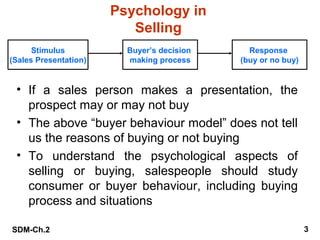
Stimulus
(Sales Presentation)

Buyer’s decision
making process

Response
(buy or no buy)

• If a sales person makes a presentation, the
prospect may or may not buy
• The above “buyer behaviour model” does not tell
us the reasons of buying or not buying
• To understand the psychological aspects of
selling or buying, salespeople should study
consumer or buyer behaviour, including buying
process and situations
SDM-Ch.2

3
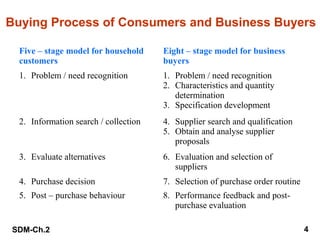
Buying Process of Consumers and Business Buyers
Five – stage model for household
customers

Eight – stage model for business
buyers

1. Problem / need recognition

1. Problem / need recognition
2. Characteristics and quantity
determination
3. Specification development

2. Information search / collection

4. Supplier search and qualification
5. Obtain and analyse supplier
proposals

3. Evaluate alternatives

6. Evaluation and selection of
suppliers

4. Purchase decision

7. Selection of purchase order routine

5. Post – purchase behaviour

8. Performance feedback and postpurchase evaluation

SDM-Ch.2

4
Buying Situations Faced By
Household customers

Business Buyers

• Routine decision-making

• New task / New purchase

• Limited decision-making

• Modified rebuy / change in
supplier

• Extensive decision-making

• Straight rebuy / Repeat purchase

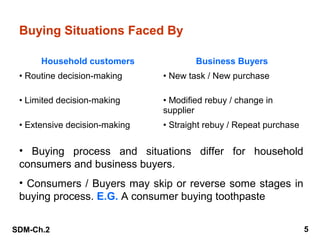
• Buying process and situations differ for household
consumers and business buyers.
• Consumers / Buyers may skip or reverse some stages in
buying process. E.G. A consumer buying toothpaste
SDM-Ch.2

5
Knowledge of Sales and Sales-related
Marketing Policies
Sales Knowledge

Marketing Policies

• Company knowledge

• Pricing and Payment policies

• Product knowledge

• Product policies

• Customer knowledge

• Distribution policies

• Competitor knowledge

• Promotional policies

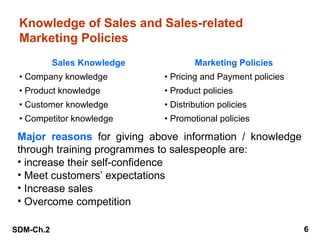
Major reasons for giving above information / knowledge
through training programmes to salespeople are:
• increase their self-confidence
• Meet customers’ expectations
• Increase sales
• Overcome competition
SDM-Ch.2

6
The Sales Process
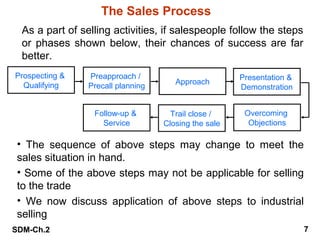
As a part of selling activities, if salespeople follow the steps
or phases shown below, their chances of success are far
better.
Prospecting &
Qualifying

Preapproach /
Precall planning

Approach

Presentation &
Demonstration

Follow-up &
Service

Trail close /
Closing the sale

Overcoming
Objections

• The sequence of above steps may change to meet the
sales situation in hand.
• Some of the above steps may not be applicable for selling
to the trade
• We now discuss application of above steps to industrial
selling
SDM-Ch.2

7
Prospecting
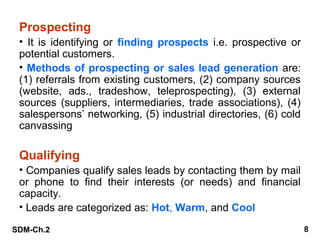
• It is identifying or finding prospects i.e. prospective or
potential customers.
• Methods of prospecting or sales lead generation are:
(1) referrals from existing customers, (2) company sources
(website, ads., tradeshow, teleprospecting), (3) external
sources (suppliers, intermediaries, trade associations), (4)
salespersons’ networking, (5) industrial directories, (6) cold
canvassing

Qualifying
• Companies qualify sales leads by contacting them by mail
or phone to find their interests (or needs) and financial
capacity.
• Leads are categorized as: Hot, Warm, and Cool
SDM-Ch.2

8
Preapproac
h
• Information gathering about the prospect.
Sources of information: the Internet, industrial
directories,
government
publications,
intermediaries, etc.
• Precall planning
• Setting call objectives
• Tentative planning of sales strategy: which
products, features and benefits may meet the
customer needs

SDM-Ch.2

9
Approac
h
• Make an appointment to meet the prospect
• Make favourable first impression
• Select an approach technique:
• Introductory
• Customer benefit
• Product
• Question
• Praise
• The approach takes a few minutes of a call,
but it can make or break a sale
SDM-Ch.2

10
Presentation and
Demonstration
There are four components:
•
•
•
•

Understanding the buyer’s needs
Knowing sales presentation methods / strategies
Developing an effective presentation
Using demonstration as a tool for selling

We will examine each of the above points

SDM-Ch.2

11
Understanding the buyer’s
needs

• Firms and consumers buy products / services to
satisfy needs
• To understand buyer’s needs, ask questions and
listen
• In business situations, problem identification and
impact questions are important
E.G.
• Have you experienced any problems on quality
and delivery from the existing supplies?
• What impact the quality and delivery problems
will have on your costs and customer satisfaction?
SDM-Ch.2

12
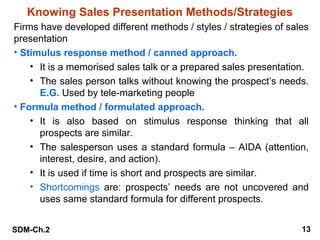
Knowing Sales Presentation Methods/Strategies
Firms have developed different methods / styles / strategies of sales
presentation
• Stimulus response method / canned approach.
• It is a memorised sales talk or a prepared sales presentation.
• The sales person talks without knowing the prospect’s needs.
E.G. Used by tele-marketing people
• Formula method / formulated approach.
• It is also based on stimulus response thinking that all
prospects are similar.
• The salesperson uses a standard formula – AIDA (attention,
interest, desire, and action).
• It is used if time is short and prospects are similar.
• Shortcomings are: prospects’ needs are not uncovered and
uses same standard formula for different prospects.
SDM-Ch.2

13
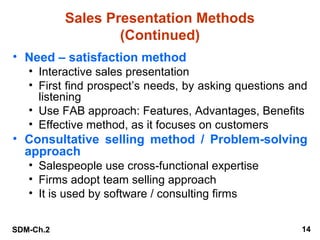
Sales Presentation Methods
(Continued)
• Need – satisfaction method
• Interactive sales presentation
• First find prospect’s needs, by asking questions and
listening
• Use FAB approach: Features, Advantages, Benefits
• Effective method, as it focuses on customers

• Consultative selling method / Problem-solving
approach
• Salespeople use cross-functional expertise
• Firms adopt team selling approach
• It is used by software / consulting firms
SDM-Ch.2

14
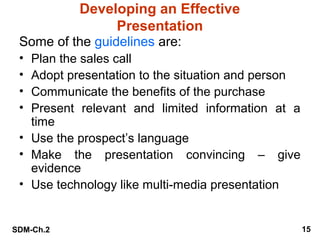
Developing an Effective
Presentation
Some of the guidelines are:
•
•
•
•

Plan the sales call
Adopt presentation to the situation and person
Communicate the benefits of the purchase
Present relevant and limited information at a
time
• Use the prospect’s language
• Make the presentation convincing – give
evidence
• Use technology like multi-media presentation

SDM-Ch.2

15
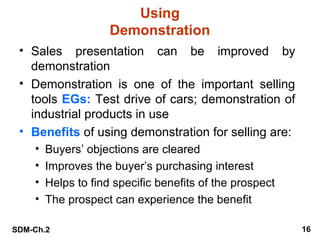
Using
Demonstration
• Sales presentation can be improved by
demonstration
• Demonstration is one of the important selling
tools EGs: Test drive of cars; demonstration of
industrial products in use
• Benefits of using demonstration for selling are:
•
•
•
•

Buyers’ objections are cleared
Improves the buyer’s purchasing interest
Helps to find specific benefits of the prospect
The prospect can experience the benefit

SDM-Ch.2

16
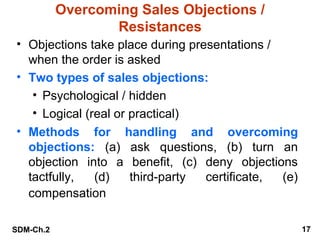
Overcoming Sales Objections /
Resistances
• Objections take place during presentations /
when the order is asked
• Two types of sales objections:
• Psychological / hidden
• Logical (real or practical)
• Methods for handling and overcoming
objections: (a) ask questions, (b) turn an
objection into a benefit, (c) deny objections
tactfully,
(d)
third-party
certificate,
(e)
compensation
SDM-Ch.2

17
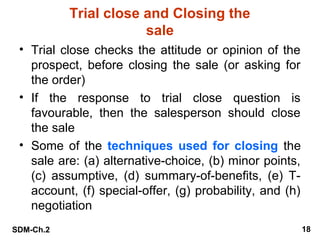
Trial close and Closing the
sale
• Trial close checks the attitude or opinion of the
prospect, before closing the sale (or asking for
the order)
• If the response to trial close question is
favourable, then the salesperson should close
the sale
• Some of the techniques used for closing the
sale are: (a) alternative-choice, (b) minor points,
(c) assumptive, (d) summary-of-benefits, (e) Taccount, (f) special-offer, (g) probability, and (h)
negotiation
SDM-Ch.2

18
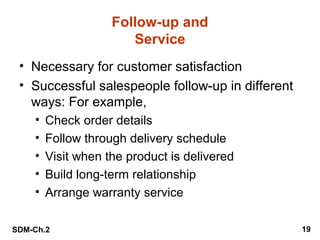
Follow-up and
Service
• Necessary for customer satisfaction
• Successful salespeople follow-up in different
ways: For example,
•
•
•
•
•

Check order details
Follow through delivery schedule
Visit when the product is delivered
Build long-term relationship
Arrange warranty service

SDM-Ch.2

19
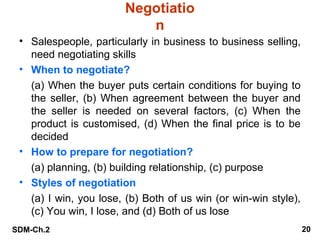
Negotiatio
n
• Salespeople, particularly in business to business selling,
need negotiating skills
• When to negotiate?
(a) When the buyer puts certain conditions for buying to
the seller, (b) When agreement between the buyer and
the seller is needed on several factors, (c) When the
product is customised, (d) When the final price is to be
decided
• How to prepare for negotiation?
(a) planning, (b) building relationship, (c) purpose
• Styles of negotiation
(a) I win, you lose, (b) Both of us win (or win-win style),
(c) You win, I lose, and (d) Both of us lose
SDM-Ch.2

20
Key Learnings
• For understanding psychology in selling, study
consumer or buyer behaviour, buying process and
situations
• Salespeople are given knowledge of sales and relevant
marketing policies in order to increase their selfconfidence and sales, and meet customers’
expectations
• Typical steps in the sales process include prospecting
and qualifying, preapproach, approach, presentation
and demonstration, overcoming objections, trial close /
closing the sale, follow-up and service
• Salespeople should know when to negotiate, how to
prepare for negotiation and which style of negotiation to
use
SDM-Ch.2

21

Personal Selling: Preparation and Process

  • 1.
  • 2.
    Learning Objectives • To understandpsychology in selling, buying decision process and buying situations • To learn communication skills, sales knowledge, and sales related marketing policies • To understand personal selling process • To learn about negotiation SDM-Ch.2 2
  • 3.
    Psychology in Selling Stimulus (Sales Presentation) Buyer’sdecision making process Response (buy or no buy) • If a sales person makes a presentation, the prospect may or may not buy • The above “buyer behaviour model” does not tell us the reasons of buying or not buying • To understand the psychological aspects of selling or buying, salespeople should study consumer or buyer behaviour, including buying process and situations SDM-Ch.2 3
  • 4.
    Buying Process ofConsumers and Business Buyers Five – stage model for household customers Eight – stage model for business buyers 1. Problem / need recognition 1. Problem / need recognition 2. Characteristics and quantity determination 3. Specification development 2. Information search / collection 4. Supplier search and qualification 5. Obtain and analyse supplier proposals 3. Evaluate alternatives 6. Evaluation and selection of suppliers 4. Purchase decision 7. Selection of purchase order routine 5. Post – purchase behaviour 8. Performance feedback and postpurchase evaluation SDM-Ch.2 4
  • 5.
    Buying Situations FacedBy Household customers Business Buyers • Routine decision-making • New task / New purchase • Limited decision-making • Modified rebuy / change in supplier • Extensive decision-making • Straight rebuy / Repeat purchase • Buying process and situations differ for household consumers and business buyers. • Consumers / Buyers may skip or reverse some stages in buying process. E.G. A consumer buying toothpaste SDM-Ch.2 5
  • 6.
    Knowledge of Salesand Sales-related Marketing Policies Sales Knowledge Marketing Policies • Company knowledge • Pricing and Payment policies • Product knowledge • Product policies • Customer knowledge • Distribution policies • Competitor knowledge • Promotional policies Major reasons for giving above information / knowledge through training programmes to salespeople are: • increase their self-confidence • Meet customers’ expectations • Increase sales • Overcome competition SDM-Ch.2 6
  • 7.
    The Sales Process Asa part of selling activities, if salespeople follow the steps or phases shown below, their chances of success are far better. Prospecting & Qualifying Preapproach / Precall planning Approach Presentation & Demonstration Follow-up & Service Trail close / Closing the sale Overcoming Objections • The sequence of above steps may change to meet the sales situation in hand. • Some of the above steps may not be applicable for selling to the trade • We now discuss application of above steps to industrial selling SDM-Ch.2 7
  • 8.
    Prospecting • It isidentifying or finding prospects i.e. prospective or potential customers. • Methods of prospecting or sales lead generation are: (1) referrals from existing customers, (2) company sources (website, ads., tradeshow, teleprospecting), (3) external sources (suppliers, intermediaries, trade associations), (4) salespersons’ networking, (5) industrial directories, (6) cold canvassing Qualifying • Companies qualify sales leads by contacting them by mail or phone to find their interests (or needs) and financial capacity. • Leads are categorized as: Hot, Warm, and Cool SDM-Ch.2 8
  • 9.
    Preapproac h • Information gatheringabout the prospect. Sources of information: the Internet, industrial directories, government publications, intermediaries, etc. • Precall planning • Setting call objectives • Tentative planning of sales strategy: which products, features and benefits may meet the customer needs SDM-Ch.2 9
  • 10.
    Approac h • Make anappointment to meet the prospect • Make favourable first impression • Select an approach technique: • Introductory • Customer benefit • Product • Question • Praise • The approach takes a few minutes of a call, but it can make or break a sale SDM-Ch.2 10
  • 11.
    Presentation and Demonstration There arefour components: • • • • Understanding the buyer’s needs Knowing sales presentation methods / strategies Developing an effective presentation Using demonstration as a tool for selling We will examine each of the above points SDM-Ch.2 11
  • 12.
    Understanding the buyer’s needs •Firms and consumers buy products / services to satisfy needs • To understand buyer’s needs, ask questions and listen • In business situations, problem identification and impact questions are important E.G. • Have you experienced any problems on quality and delivery from the existing supplies? • What impact the quality and delivery problems will have on your costs and customer satisfaction? SDM-Ch.2 12
  • 13.
    Knowing Sales PresentationMethods/Strategies Firms have developed different methods / styles / strategies of sales presentation • Stimulus response method / canned approach. • It is a memorised sales talk or a prepared sales presentation. • The sales person talks without knowing the prospect’s needs. E.G. Used by tele-marketing people • Formula method / formulated approach. • It is also based on stimulus response thinking that all prospects are similar. • The salesperson uses a standard formula – AIDA (attention, interest, desire, and action). • It is used if time is short and prospects are similar. • Shortcomings are: prospects’ needs are not uncovered and uses same standard formula for different prospects. SDM-Ch.2 13
  • 14.
    Sales Presentation Methods (Continued) •Need – satisfaction method • Interactive sales presentation • First find prospect’s needs, by asking questions and listening • Use FAB approach: Features, Advantages, Benefits • Effective method, as it focuses on customers • Consultative selling method / Problem-solving approach • Salespeople use cross-functional expertise • Firms adopt team selling approach • It is used by software / consulting firms SDM-Ch.2 14
  • 15.
    Developing an Effective Presentation Someof the guidelines are: • • • • Plan the sales call Adopt presentation to the situation and person Communicate the benefits of the purchase Present relevant and limited information at a time • Use the prospect’s language • Make the presentation convincing – give evidence • Use technology like multi-media presentation SDM-Ch.2 15
  • 16.
    Using Demonstration • Sales presentationcan be improved by demonstration • Demonstration is one of the important selling tools EGs: Test drive of cars; demonstration of industrial products in use • Benefits of using demonstration for selling are: • • • • Buyers’ objections are cleared Improves the buyer’s purchasing interest Helps to find specific benefits of the prospect The prospect can experience the benefit SDM-Ch.2 16
  • 17.
    Overcoming Sales Objections/ Resistances • Objections take place during presentations / when the order is asked • Two types of sales objections: • Psychological / hidden • Logical (real or practical) • Methods for handling and overcoming objections: (a) ask questions, (b) turn an objection into a benefit, (c) deny objections tactfully, (d) third-party certificate, (e) compensation SDM-Ch.2 17
  • 18.
    Trial close andClosing the sale • Trial close checks the attitude or opinion of the prospect, before closing the sale (or asking for the order) • If the response to trial close question is favourable, then the salesperson should close the sale • Some of the techniques used for closing the sale are: (a) alternative-choice, (b) minor points, (c) assumptive, (d) summary-of-benefits, (e) Taccount, (f) special-offer, (g) probability, and (h) negotiation SDM-Ch.2 18
  • 19.
    Follow-up and Service • Necessaryfor customer satisfaction • Successful salespeople follow-up in different ways: For example, • • • • • Check order details Follow through delivery schedule Visit when the product is delivered Build long-term relationship Arrange warranty service SDM-Ch.2 19
  • 20.
    Negotiatio n • Salespeople, particularlyin business to business selling, need negotiating skills • When to negotiate? (a) When the buyer puts certain conditions for buying to the seller, (b) When agreement between the buyer and the seller is needed on several factors, (c) When the product is customised, (d) When the final price is to be decided • How to prepare for negotiation? (a) planning, (b) building relationship, (c) purpose • Styles of negotiation (a) I win, you lose, (b) Both of us win (or win-win style), (c) You win, I lose, and (d) Both of us lose SDM-Ch.2 20
  • 21.
    Key Learnings • Forunderstanding psychology in selling, study consumer or buyer behaviour, buying process and situations • Salespeople are given knowledge of sales and relevant marketing policies in order to increase their selfconfidence and sales, and meet customers’ expectations • Typical steps in the sales process include prospecting and qualifying, preapproach, approach, presentation and demonstration, overcoming objections, trial close / closing the sale, follow-up and service • Salespeople should know when to negotiate, how to prepare for negotiation and which style of negotiation to use SDM-Ch.2 21