RETAIL MERCHANDISING MERCHANDISING Termed as the planning, buying and selling of merchandise It is an integral part of retailing and is also one of he most challenging functions Retailers often say, “GOODS WELL BOUGHT ARE HALF SOLD”. MERCHANDISE MANAGEMENT  Termed as the analysis, planning, acquisition, handling and control of merchandise investment of retail operation
RETAIL MERCHANDISING ANALYSIS Analysis is required because a retailer needs to understand the needs and wants of his target audience PLANNING It is necessary to plan since the merchandise to be sold in future must be bought in advance ACQUISITION Merchandise to be sold in retail store, needs to be procured from others – either from distributors or manufacturers
RETAIL MERCHANDISING HANDLING  It is necessary to determine where merchandise is needed and ensure that the merchandise reaches the required stores at he right time and the right condition CONTROL As the function of retailing involves spending money for acquiring of products, it necessary to control the amount of money spent of buying
RETAIL MERCHANDISING Process of merchandise management includes  the developing of strategies to ensure that the right product Is bought at the right price Is available at he right place At the right time In the right amount In order o satisfy he needs of the target customer No one in retail can avoid any contact with merchandising  activities Merchandising is the day-to-day business of all retailers As inventory is sold, new stocks need to be purchased, displayed and sold  Hence merchandising is often said to be at the core of retail management
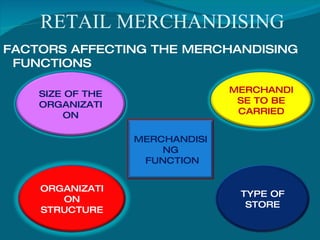
RETAIL MERCHANDISING FACTORS AFFECTING THE MERCHANDISING FUNCTIONS MERCHANDISING FUNCTION SIZE OF THE ORGANIZATION MERCHANDISE TO BE CARRIED ORGANIZATION STRUCTURE TYPE OF STORE
RETAIL MERCHANDISING FACTORS AFFECTING THE MERCHANDISING FUNCTION Merchandising does not function in isolation It is affected by various factors, like  The size of the retail organization The type of store The merchandise to be carried and The organization structure
RETAIL MERCHANDISING The size of the retail organization Function of retailing varies depending on the size of retail business Needs of an independent retailer varies considerably from  those of large chain operation In case of a single store the owner or manager assisted by the sales person may perform he buying function As the single store grows in terms of business functional departmentalization may occur and number of persons involved in buying process may increase In case of a chain store, the buying process may be centralized or decentralized geographically depending on the organization The buyer for a chain store may have a fair amount of say in buying price, as quantities are much larger than the single store As chain store exists across regions and at times, across nations, buyer has to keep regional preferences in mind
RETAIL MERCHANDISING The type of  store The buying for a mail order catalogue or for direct marketing or for an e-tail venture would be completely different  Mail order buyer needs to plan well in advance, as the production of catalogues takes a long time In addition the large variety of merchandise needs a fair amount of  market works  Buyers for an e-tail venture need to have a clear understanding of the type of product  that consumers would buy on the net Very often in direct marketing or in e-tail ventures, it is the uniqueness of the product or the competitive price, which makes the difference Thus the nature of the organization is an important factor affecting the function of merchandising
RETAIL MERCHANDISING The merchandize to be carried out It largely determines the responsibilities of the retailer The buying for basic merchandise is different from that of fashion merchandise This is primarily because these products are always in demand  Examples of basics : white shirts in clothing or items like pulses, oil etc. Fashion products are those that may sell very well in one season or year and may not be in demand in the next season Fads are products which have a smaller life cycle, and when sales are very high initially, the demand also dies down soon Merchandiser handling fashion products will need to spend more time in the market He will also need to be aware of the fashion forecasts and trends in international markets
RETAIL MERCHANDISING The organization structure The organization structure that the retail organization adopts, also affects the merchandising function Some organizations may demarcate the role of the buyer and the role of the merchandiser as separate functions While in smaller organization, one person may carry out all the duties
RETAIL MERCHANDISING FUNCTIONS OF A MERCHANDISE MANAGER The merchandise manager is responsible for  particular  lines of merchandise In a department store there may be separate merchandise managers  Men’s wear, women’s wear, children’s wear etc. They would be in charge of a group of buyers and their basic duties could be divided into four areas : planning, directing, coordinating and controlling PLANNING Merchandise managers formulate the policies for the areas for which they are responsible Forecasting the sales for the forthcoming budget period is required  This involves  the estimating of  the consumer demand and the impact of the changes occurring in retail environment The sales forecasts are then translated into budgets , to help the buyers within  the financial guidelines
RETAIL MERCHANDISING DIRECTING Guiding and training buyers as and when the need arises, is also a function of he merchandise manager Many a times, the buyers have to be guided to take additional markdowns for products which may not be doing too well  in stores Inspiring commitment and performance  on the part of the buyer is necessary COORDINATING Usually, merchandise managers supervise the work of more than one buyer  Hence they need to coordinate the buying efforts in terms of how well it fits in  with the store’s image and  with the other products being bought by other buyers CONTROLLING Assessing not only the merchandise performance, but also the buyer’s performance, is a part of the merchandise manager’s job Buying performance may be evaluated on the basis of the net sales, mark up percentages maintained, markdown percentages, the gross margin percentages and the stock turn This is necessary to provide control and maintain high performance results
RETAIL MERCHANDISING MERCHANDISE PLANNING Analysis  is the starting point of  merchandise planning The person who is to take buying decisions for retail organization, must be aware of the consumer’s needs and wants An understanding of the consumer buying process is necessary A clear understanding is also necessary as to what products are actually selling and where Information  is obtained from the sales record Interaction with he sales staff also provides valuable insights as to what product is selling  Surveys , magazines and trade publications  also provide external source of information The information thus gathered needs to be analyzed  The analysis forms the basis of sales forecast The first stage in merchandise planning is sales forecast
MERCHANDISE PLANNING STAGE I : DEVELOPING SALES FORECAST Forecast  may be made by the merchandiser ,  based on targets given by the top management  Sales forecast is the first step in determining the inventory needs of the product or category  Forecasts are typically developed to answer the following questions: How much of each product  needs to be purchased? Should new products be added to the merchandise assortment? What price should be charged for the product? A sales forecast is usually made for a specific period of time, this may be weeks  or a season or a year The person who is to make forecasts for  the product group  or category needs to be aware of  The changes in tastes and attitudes of consumers The size of the target market And the changes in their spending pattern
MERCHANDISE PLANNING PROCESS OF DEVELOPING SALES FORECASTS  1.  Reviewing past sales Review of past sales is necessary It helps establish a pattern or trend in sales figures Sales of the past year for a period will give an indication of the sales in the current year for the same  2.  Analyzing the changes in economic conditions Necessary to consider the changes happening in he economic front  It has a direct link consumer spending patterns Economic slowdowns, increase in unemployment levels, etc. all effect business 3.  Analyzing the changes in the sales potential It is now necessary to relate the demographic changes in the market to that  of the store and the products to be sold
MERCHANDISE PLANNING PROCESS OF DEVELOPING SALES FORECASTS  4.  Analyzing the changes in the marketing strategies of the retail organization and the competition For forecasting sales the marketing strategy to be adopted by the organization and that of the competition is to be considered Is there any line of merchandise to be introduced ? Any new store to be opened? An existing store to be renovated? All the above factors need to be taken into consideration 5.  Creating the sales forecast After considering he above mentioned points  an estimate of the projected increase in the sales  is arrived at This is then applied to the various products/categories to arrive at he projected sales figures
MERCHANDISE PLANNING STAGE II : DETERMINING THE MERCHANDISE REQUIREMENT  Planning in merchandising is at two levels The creation of  the merchandise budget, and The assortment plan  There are two methods of  developing the merchandise plan  Top down planning, and Bottom up planning In top down planning , op management works on the sales plan and passes it down to the merchandising team In bottom up planning , the individual department managers work on the estimated sales projections The are then added to arrive at the total sales figures
MERCHANDISE PLANNING STAGE II : DETERMINING THE MERCHANDISE REQUIREMENT  After the sales forecasting has been completed, the inventory levels need to be  planned The merchandise budget is the first stage in the planning of merchandise It is a financial plan  It indicates how much to invest in product inventories, stated in monetary terms The merchandise budget usually comprises five parts: The sales plan: how much of each product needs to be sold department wise division wise or store wise The stock support plan, which tells us how much inventory or stock, is needed to achieve those sales The planned reductions, which may need to be made in case the product does not sell The planned purchase levels, ie., the quantity of each product that needs to be procured from he market The gross margins that the department, division or store contributes to the overall profitability of he company
MERCHANDISE PLANNING METHODS OF INVENTORY PLANNING Any one of the four methods given below can be used for planning  the inventory levels needed The Basis Stock Method The percentage variation Method The Weeks’s Supply Method The Stock/Sales  Ratio Method
MERCHANDISE PLANNING METHODS OF INVENTORY PLANNING 1.  The Basic Stock Method  This method is used when the retailer believes that it is necessary to have a given level of inventory on hand at all times Basic stock is the minimum amount of inventory that needs to be maintained for a product, category or store, even during times of low sales
MERCHANDISE PLANNING Basic Stock = Average stock for the season – average monthly sales  for the season where Average monthly sales for the season =  Total planned sales for the season  Number of months in the season Average stock for the season  =  Total planed sales for the season  Estimated Inventory Turnover Rate for the season Beginning of Month (BOM) stock = Planned Monthly Sales  +  Basic Stock
MERCHANDISE PLANNING Illustration : Using the basic stock method, calculate BOM inventory  for  the  month of January, given the following information Planned sales for January  : 30,000 Average monthly sales  : 25,000 Average monthly inventory  : 40,000 Basic stock  = 40,000 – 25,000 =  15,000 BOM stock  =  30,000 + 15,000 = 45,000
MERCHANDISE PLANNING 2.  The Percentage Variation Method  This  method is used when the stock turnover rate is more than six times a year The basic premise is that this method of inventory planning is that inventory levels should reflect the actual sales It is calculated as under : BOM Stock = Avg stock for the season x ½ [ 1 + (Planned Sales for the month / Avg monthly sales)]
MERCHANDISE PLANNING Illustration: Using the Percentage Variation Method, calculate the BOM inventory for the month of January, given the following information Planned sales for  the month of  January  : 30,000 Average monthly sales  : 25,000 Average monthly inventory  : 40,000 BOM Stock = Avg stock for the season  x  ½ [ 1 + (Planned Sales for the month /  Avg  monthly sales)] BOM stock = 40,000  x  ½  [1 + 30,000/ 25,000)] = 40,000  x  ½  (1 + 1.2) = 40,000  x  ½  x  2.2 = 40,000  x  1.1 = 44,000
MERCHANDISE PLANNING 3.  Stock to Sales Ratio Method  This method is very easy to use, but it requires the Retailer les ratio. It involves the maintaining of the inventory levels at a specific ratio to the sales This ratio tells he retailer how much inventory is needed at the beginning of the month, to support the month’s estimated sales Stock-Sales ratio = Value of Inventory / Actual sales Planned BOM inventory = Stock-Sales Ratio x Planned Sales
MERCHANDISE PLANNING Illustration: Using the ales Ratio Method, calculate the BOM inventory for the month of January, given the following information Stock to sales Ratio  = 1.4 Planned sales for the month of January : 20,000 Planned BOM inventory  = 1.4 x  20,000 = 28,000
MERCHANDISE PLANNING Stock  Turnover  Rate  An effective measure of the speed with which products or merchandise moves in and out of a retail store for a given period It is a measure of efficiency and is usually calculated for a period, of six months or a year  It is calculated using the following formula Planned Sales (for a period) ----------------------------------------------------  =  Stock turnover Planned average Inventory (for the period) The stock turnover rate is a measure of efficiency Every department  usually has its own stock turnover rate  as different merchandise  need different speeds of selling From the management’s perspective, the stock turnover indicates the level of capital usage ie. Turning money into inventory, inventory into money and then repeating the process again

Retail Merchandising

  • 1.
    RETAIL MERCHANDISING MERCHANDISINGTermed as the planning, buying and selling of merchandise It is an integral part of retailing and is also one of he most challenging functions Retailers often say, “GOODS WELL BOUGHT ARE HALF SOLD”. MERCHANDISE MANAGEMENT Termed as the analysis, planning, acquisition, handling and control of merchandise investment of retail operation
  • 2.
    RETAIL MERCHANDISING ANALYSISAnalysis is required because a retailer needs to understand the needs and wants of his target audience PLANNING It is necessary to plan since the merchandise to be sold in future must be bought in advance ACQUISITION Merchandise to be sold in retail store, needs to be procured from others – either from distributors or manufacturers
  • 3.
    RETAIL MERCHANDISING HANDLING It is necessary to determine where merchandise is needed and ensure that the merchandise reaches the required stores at he right time and the right condition CONTROL As the function of retailing involves spending money for acquiring of products, it necessary to control the amount of money spent of buying
  • 4.
    RETAIL MERCHANDISING Processof merchandise management includes the developing of strategies to ensure that the right product Is bought at the right price Is available at he right place At the right time In the right amount In order o satisfy he needs of the target customer No one in retail can avoid any contact with merchandising activities Merchandising is the day-to-day business of all retailers As inventory is sold, new stocks need to be purchased, displayed and sold Hence merchandising is often said to be at the core of retail management
  • 5.
    RETAIL MERCHANDISING FACTORSAFFECTING THE MERCHANDISING FUNCTIONS MERCHANDISING FUNCTION SIZE OF THE ORGANIZATION MERCHANDISE TO BE CARRIED ORGANIZATION STRUCTURE TYPE OF STORE
  • 6.
    RETAIL MERCHANDISING FACTORSAFFECTING THE MERCHANDISING FUNCTION Merchandising does not function in isolation It is affected by various factors, like The size of the retail organization The type of store The merchandise to be carried and The organization structure
  • 7.
    RETAIL MERCHANDISING Thesize of the retail organization Function of retailing varies depending on the size of retail business Needs of an independent retailer varies considerably from those of large chain operation In case of a single store the owner or manager assisted by the sales person may perform he buying function As the single store grows in terms of business functional departmentalization may occur and number of persons involved in buying process may increase In case of a chain store, the buying process may be centralized or decentralized geographically depending on the organization The buyer for a chain store may have a fair amount of say in buying price, as quantities are much larger than the single store As chain store exists across regions and at times, across nations, buyer has to keep regional preferences in mind
  • 8.
    RETAIL MERCHANDISING Thetype of store The buying for a mail order catalogue or for direct marketing or for an e-tail venture would be completely different Mail order buyer needs to plan well in advance, as the production of catalogues takes a long time In addition the large variety of merchandise needs a fair amount of market works Buyers for an e-tail venture need to have a clear understanding of the type of product that consumers would buy on the net Very often in direct marketing or in e-tail ventures, it is the uniqueness of the product or the competitive price, which makes the difference Thus the nature of the organization is an important factor affecting the function of merchandising
  • 9.
    RETAIL MERCHANDISING Themerchandize to be carried out It largely determines the responsibilities of the retailer The buying for basic merchandise is different from that of fashion merchandise This is primarily because these products are always in demand Examples of basics : white shirts in clothing or items like pulses, oil etc. Fashion products are those that may sell very well in one season or year and may not be in demand in the next season Fads are products which have a smaller life cycle, and when sales are very high initially, the demand also dies down soon Merchandiser handling fashion products will need to spend more time in the market He will also need to be aware of the fashion forecasts and trends in international markets
  • 10.
    RETAIL MERCHANDISING Theorganization structure The organization structure that the retail organization adopts, also affects the merchandising function Some organizations may demarcate the role of the buyer and the role of the merchandiser as separate functions While in smaller organization, one person may carry out all the duties
  • 11.
    RETAIL MERCHANDISING FUNCTIONSOF A MERCHANDISE MANAGER The merchandise manager is responsible for particular lines of merchandise In a department store there may be separate merchandise managers Men’s wear, women’s wear, children’s wear etc. They would be in charge of a group of buyers and their basic duties could be divided into four areas : planning, directing, coordinating and controlling PLANNING Merchandise managers formulate the policies for the areas for which they are responsible Forecasting the sales for the forthcoming budget period is required This involves the estimating of the consumer demand and the impact of the changes occurring in retail environment The sales forecasts are then translated into budgets , to help the buyers within the financial guidelines
  • 12.
    RETAIL MERCHANDISING DIRECTINGGuiding and training buyers as and when the need arises, is also a function of he merchandise manager Many a times, the buyers have to be guided to take additional markdowns for products which may not be doing too well in stores Inspiring commitment and performance on the part of the buyer is necessary COORDINATING Usually, merchandise managers supervise the work of more than one buyer Hence they need to coordinate the buying efforts in terms of how well it fits in with the store’s image and with the other products being bought by other buyers CONTROLLING Assessing not only the merchandise performance, but also the buyer’s performance, is a part of the merchandise manager’s job Buying performance may be evaluated on the basis of the net sales, mark up percentages maintained, markdown percentages, the gross margin percentages and the stock turn This is necessary to provide control and maintain high performance results
  • 13.
    RETAIL MERCHANDISING MERCHANDISEPLANNING Analysis is the starting point of merchandise planning The person who is to take buying decisions for retail organization, must be aware of the consumer’s needs and wants An understanding of the consumer buying process is necessary A clear understanding is also necessary as to what products are actually selling and where Information is obtained from the sales record Interaction with he sales staff also provides valuable insights as to what product is selling Surveys , magazines and trade publications also provide external source of information The information thus gathered needs to be analyzed The analysis forms the basis of sales forecast The first stage in merchandise planning is sales forecast
  • 14.
    MERCHANDISE PLANNING STAGEI : DEVELOPING SALES FORECAST Forecast may be made by the merchandiser , based on targets given by the top management Sales forecast is the first step in determining the inventory needs of the product or category Forecasts are typically developed to answer the following questions: How much of each product needs to be purchased? Should new products be added to the merchandise assortment? What price should be charged for the product? A sales forecast is usually made for a specific period of time, this may be weeks or a season or a year The person who is to make forecasts for the product group or category needs to be aware of The changes in tastes and attitudes of consumers The size of the target market And the changes in their spending pattern
  • 15.
    MERCHANDISE PLANNING PROCESSOF DEVELOPING SALES FORECASTS 1. Reviewing past sales Review of past sales is necessary It helps establish a pattern or trend in sales figures Sales of the past year for a period will give an indication of the sales in the current year for the same 2. Analyzing the changes in economic conditions Necessary to consider the changes happening in he economic front It has a direct link consumer spending patterns Economic slowdowns, increase in unemployment levels, etc. all effect business 3. Analyzing the changes in the sales potential It is now necessary to relate the demographic changes in the market to that of the store and the products to be sold
  • 16.
    MERCHANDISE PLANNING PROCESSOF DEVELOPING SALES FORECASTS 4. Analyzing the changes in the marketing strategies of the retail organization and the competition For forecasting sales the marketing strategy to be adopted by the organization and that of the competition is to be considered Is there any line of merchandise to be introduced ? Any new store to be opened? An existing store to be renovated? All the above factors need to be taken into consideration 5. Creating the sales forecast After considering he above mentioned points an estimate of the projected increase in the sales is arrived at This is then applied to the various products/categories to arrive at he projected sales figures
  • 17.
    MERCHANDISE PLANNING STAGEII : DETERMINING THE MERCHANDISE REQUIREMENT Planning in merchandising is at two levels The creation of the merchandise budget, and The assortment plan There are two methods of developing the merchandise plan Top down planning, and Bottom up planning In top down planning , op management works on the sales plan and passes it down to the merchandising team In bottom up planning , the individual department managers work on the estimated sales projections The are then added to arrive at the total sales figures
  • 18.
    MERCHANDISE PLANNING STAGEII : DETERMINING THE MERCHANDISE REQUIREMENT After the sales forecasting has been completed, the inventory levels need to be planned The merchandise budget is the first stage in the planning of merchandise It is a financial plan It indicates how much to invest in product inventories, stated in monetary terms The merchandise budget usually comprises five parts: The sales plan: how much of each product needs to be sold department wise division wise or store wise The stock support plan, which tells us how much inventory or stock, is needed to achieve those sales The planned reductions, which may need to be made in case the product does not sell The planned purchase levels, ie., the quantity of each product that needs to be procured from he market The gross margins that the department, division or store contributes to the overall profitability of he company
  • 19.
    MERCHANDISE PLANNING METHODSOF INVENTORY PLANNING Any one of the four methods given below can be used for planning the inventory levels needed The Basis Stock Method The percentage variation Method The Weeks’s Supply Method The Stock/Sales Ratio Method
  • 20.
    MERCHANDISE PLANNING METHODSOF INVENTORY PLANNING 1. The Basic Stock Method This method is used when the retailer believes that it is necessary to have a given level of inventory on hand at all times Basic stock is the minimum amount of inventory that needs to be maintained for a product, category or store, even during times of low sales
  • 21.
    MERCHANDISE PLANNING BasicStock = Average stock for the season – average monthly sales for the season where Average monthly sales for the season = Total planned sales for the season Number of months in the season Average stock for the season = Total planed sales for the season Estimated Inventory Turnover Rate for the season Beginning of Month (BOM) stock = Planned Monthly Sales + Basic Stock
  • 22.
    MERCHANDISE PLANNING Illustration: Using the basic stock method, calculate BOM inventory for the month of January, given the following information Planned sales for January : 30,000 Average monthly sales : 25,000 Average monthly inventory : 40,000 Basic stock = 40,000 – 25,000 = 15,000 BOM stock = 30,000 + 15,000 = 45,000
  • 23.
    MERCHANDISE PLANNING 2. The Percentage Variation Method This method is used when the stock turnover rate is more than six times a year The basic premise is that this method of inventory planning is that inventory levels should reflect the actual sales It is calculated as under : BOM Stock = Avg stock for the season x ½ [ 1 + (Planned Sales for the month / Avg monthly sales)]
  • 24.
    MERCHANDISE PLANNING Illustration:Using the Percentage Variation Method, calculate the BOM inventory for the month of January, given the following information Planned sales for the month of January : 30,000 Average monthly sales : 25,000 Average monthly inventory : 40,000 BOM Stock = Avg stock for the season x ½ [ 1 + (Planned Sales for the month / Avg monthly sales)] BOM stock = 40,000 x ½ [1 + 30,000/ 25,000)] = 40,000 x ½ (1 + 1.2) = 40,000 x ½ x 2.2 = 40,000 x 1.1 = 44,000
  • 25.
    MERCHANDISE PLANNING 3. Stock to Sales Ratio Method This method is very easy to use, but it requires the Retailer les ratio. It involves the maintaining of the inventory levels at a specific ratio to the sales This ratio tells he retailer how much inventory is needed at the beginning of the month, to support the month’s estimated sales Stock-Sales ratio = Value of Inventory / Actual sales Planned BOM inventory = Stock-Sales Ratio x Planned Sales
  • 26.
    MERCHANDISE PLANNING Illustration:Using the ales Ratio Method, calculate the BOM inventory for the month of January, given the following information Stock to sales Ratio = 1.4 Planned sales for the month of January : 20,000 Planned BOM inventory = 1.4 x 20,000 = 28,000
  • 27.
    MERCHANDISE PLANNING Stock Turnover Rate An effective measure of the speed with which products or merchandise moves in and out of a retail store for a given period It is a measure of efficiency and is usually calculated for a period, of six months or a year It is calculated using the following formula Planned Sales (for a period) ---------------------------------------------------- = Stock turnover Planned average Inventory (for the period) The stock turnover rate is a measure of efficiency Every department usually has its own stock turnover rate as different merchandise need different speeds of selling From the management’s perspective, the stock turnover indicates the level of capital usage ie. Turning money into inventory, inventory into money and then repeating the process again