Service Design and Blueprinting
Presented By:
Jatin Vaid
1jatinvaid@gmail.com
Challenges in Service Design
Service Characteristics
1. Intangible
2. Simultaneous production
and consumption
3. Heterogeneous
4. Perishable
Risks involved in describing
services
1. Oversimplification:
Inadequate to describe
complex service systems.
2. Incompleteness: Tendency to
omit details of unfamiliar
service elements.
3. Subjectivity: Description is
biased by personal
experiences.
4. Biased interpretation:
Service outcome is
interpreted differently by
different people
2jatinvaid@gmail.com
Types of Service Innovations
1. Major or radical innovations: New services for new markets.
E.g.: FedEx
2. Start-up businesses: New services for markets already served
by existing products. E.g.: Ola, Uber
3. New services for currently served market: E.g.: Nutrition
services offered by a gymnasium
4. Service line extensions: Augmentations of existing service line.
E.g.: A university offering new courses
5. Service improvements: Changes in features of services already
offered. E.g.: addition of Wi-Fi amenities in hotel rooms
6. Style changes: Modest innovations which are highly visible and
effect customer perceptions. E.g.: Changing colour scheme or
logo 3jatinvaid@gmail.com
Service Innovation & Development
Process
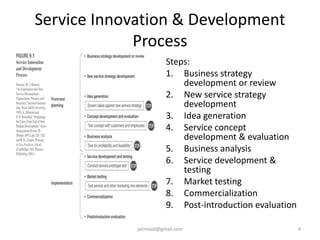
Steps:
1. Business strategy
development or review
2. New service strategy
development
3. Idea generation
4. Service concept
development & evaluation
5. Business analysis
6. Service development &
testing
7. Market testing
8. Commercialization
9. Post-introduction evaluation
4jatinvaid@gmail.com
Service Blueprinting
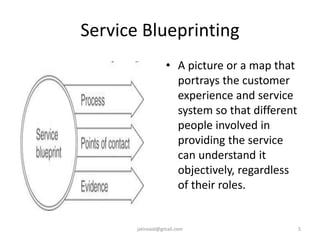
• A picture or a map that
portrays the customer
experience and service
system so that different
people involved in
providing the service
can understand it
objectively, regardless
of their roles.
5jatinvaid@gmail.com
Service Blueprinting
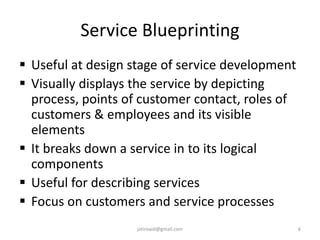
 Useful at design stage of service development
 Visually displays the service by depicting
process, points of customer contact, roles of
customers & employees and its visible
elements
 It breaks down a service in to its logical
components
 Useful for describing services
 Focus on customers and service processes
6jatinvaid@gmail.com
Components of Service Blueprint
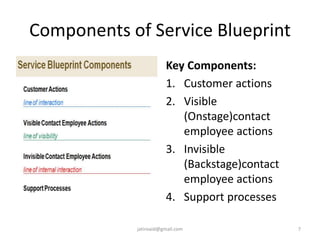
Key Components:
1. Customer actions
2. Visible
(Onstage)contact
employee actions
3. Invisible
(Backstage)contact
employee actions
4. Support processes
7jatinvaid@gmail.com
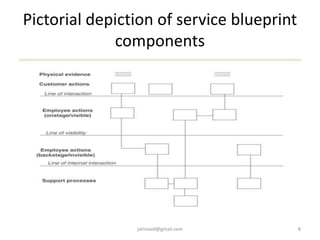
Pictorial depiction of service blueprint
components
8jatinvaid@gmail.com
Components of Service Blueprint
Explained
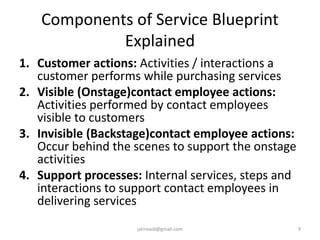
1. Customer actions: Activities / interactions a
customer performs while purchasing services
2. Visible (Onstage)contact employee actions:
Activities performed by contact employees
visible to customers
3. Invisible (Backstage)contact employee actions:
Occur behind the scenes to support the onstage
activities
4. Support processes: Internal services, steps and
interactions to support contact employees in
delivering services
9jatinvaid@gmail.com
Components of Service Blueprint
Explained
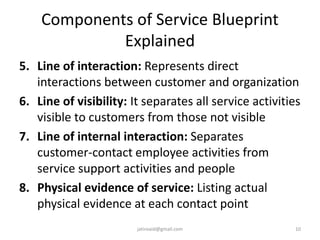
5. Line of interaction: Represents direct
interactions between customer and organization
6. Line of visibility: It separates all service activities
visible to customers from those not visible
7. Line of internal interaction: Separates
customer-contact employee activities from
service support activities and people
8. Physical evidence of service: Listing actual
physical evidence at each contact point
10jatinvaid@gmail.com
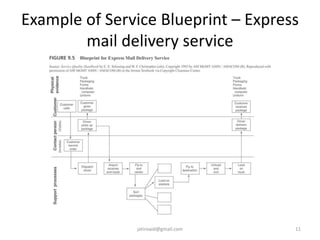
Example of Service Blueprint – Express
mail delivery service
11jatinvaid@gmail.com
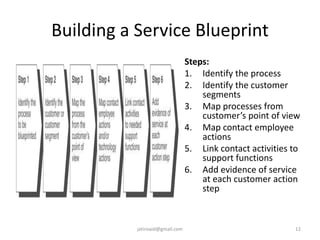
Building a Service Blueprint
Steps:
1. Identify the process
2. Identify the customer
segments
3. Map processes from
customer’s point of view
4. Map contact employee
actions
5. Link contact activities to
support functions
6. Add evidence of service
at each customer action
step
12jatinvaid@gmail.com
Applications of Service Blueprints
Service blueprints may be used by organizations in the
following ways:
1. New service development – concept development &
market testing
2. Supporting a ‘zero – defect’ culture – managing reliability
3. Service recovery strategies – identify problems, root-
cause analysis, process changes
4. Creating realistic customer expectations
5. Empowering human resources – job description
6. Training systems
7. Providing system technology
13jatinvaid@gmail.com
Benefits of Service Blueprinting
1. Provides a platform for innovation.
2. Recognizes roles and interdependencies among
functions, people, and organizations.
3. Facilitates both strategic and tactical innovations.
4. Transfers and stores innovation and service
knowledge.
5. Designs moments of truth from the customer’s point
of view.
6. Suggests critical points for measurement and
feedback in the service process.
7. Clarifies competitive positioning.
8. Provides understanding of the ideal customer
experience
14jatinvaid@gmail.com
Thank You!
15jatinvaid@gmail.com

Service design and blueprinting

  • 1.
    Service Design andBlueprinting Presented By: Jatin Vaid 1jatinvaid@gmail.com
  • 2.
    Challenges in ServiceDesign Service Characteristics 1. Intangible 2. Simultaneous production and consumption 3. Heterogeneous 4. Perishable Risks involved in describing services 1. Oversimplification: Inadequate to describe complex service systems. 2. Incompleteness: Tendency to omit details of unfamiliar service elements. 3. Subjectivity: Description is biased by personal experiences. 4. Biased interpretation: Service outcome is interpreted differently by different people 2jatinvaid@gmail.com
  • 3.
    Types of ServiceInnovations 1. Major or radical innovations: New services for new markets. E.g.: FedEx 2. Start-up businesses: New services for markets already served by existing products. E.g.: Ola, Uber 3. New services for currently served market: E.g.: Nutrition services offered by a gymnasium 4. Service line extensions: Augmentations of existing service line. E.g.: A university offering new courses 5. Service improvements: Changes in features of services already offered. E.g.: addition of Wi-Fi amenities in hotel rooms 6. Style changes: Modest innovations which are highly visible and effect customer perceptions. E.g.: Changing colour scheme or logo 3jatinvaid@gmail.com
  • 4.
    Service Innovation &Development Process Steps: 1. Business strategy development or review 2. New service strategy development 3. Idea generation 4. Service concept development & evaluation 5. Business analysis 6. Service development & testing 7. Market testing 8. Commercialization 9. Post-introduction evaluation 4jatinvaid@gmail.com
  • 5.
    Service Blueprinting • Apicture or a map that portrays the customer experience and service system so that different people involved in providing the service can understand it objectively, regardless of their roles. 5jatinvaid@gmail.com
  • 6.
    Service Blueprinting  Usefulat design stage of service development  Visually displays the service by depicting process, points of customer contact, roles of customers & employees and its visible elements  It breaks down a service in to its logical components  Useful for describing services  Focus on customers and service processes 6jatinvaid@gmail.com
  • 7.
    Components of ServiceBlueprint Key Components: 1. Customer actions 2. Visible (Onstage)contact employee actions 3. Invisible (Backstage)contact employee actions 4. Support processes 7jatinvaid@gmail.com
  • 8.
    Pictorial depiction ofservice blueprint components 8jatinvaid@gmail.com
  • 9.
    Components of ServiceBlueprint Explained 1. Customer actions: Activities / interactions a customer performs while purchasing services 2. Visible (Onstage)contact employee actions: Activities performed by contact employees visible to customers 3. Invisible (Backstage)contact employee actions: Occur behind the scenes to support the onstage activities 4. Support processes: Internal services, steps and interactions to support contact employees in delivering services 9jatinvaid@gmail.com
  • 10.
    Components of ServiceBlueprint Explained 5. Line of interaction: Represents direct interactions between customer and organization 6. Line of visibility: It separates all service activities visible to customers from those not visible 7. Line of internal interaction: Separates customer-contact employee activities from service support activities and people 8. Physical evidence of service: Listing actual physical evidence at each contact point 10jatinvaid@gmail.com
  • 11.
    Example of ServiceBlueprint – Express mail delivery service 11jatinvaid@gmail.com
  • 12.
    Building a ServiceBlueprint Steps: 1. Identify the process 2. Identify the customer segments 3. Map processes from customer’s point of view 4. Map contact employee actions 5. Link contact activities to support functions 6. Add evidence of service at each customer action step 12jatinvaid@gmail.com
  • 13.
    Applications of ServiceBlueprints Service blueprints may be used by organizations in the following ways: 1. New service development – concept development & market testing 2. Supporting a ‘zero – defect’ culture – managing reliability 3. Service recovery strategies – identify problems, root- cause analysis, process changes 4. Creating realistic customer expectations 5. Empowering human resources – job description 6. Training systems 7. Providing system technology 13jatinvaid@gmail.com
  • 14.
    Benefits of ServiceBlueprinting 1. Provides a platform for innovation. 2. Recognizes roles and interdependencies among functions, people, and organizations. 3. Facilitates both strategic and tactical innovations. 4. Transfers and stores innovation and service knowledge. 5. Designs moments of truth from the customer’s point of view. 6. Suggests critical points for measurement and feedback in the service process. 7. Clarifies competitive positioning. 8. Provides understanding of the ideal customer experience 14jatinvaid@gmail.com
  • 15.