Buying Behaviour and the Buying
           Process

           Chapter 4
Important Questions Answered
   What are the different types of customers?
   How do organisations make purchase decisions?
   Which factors do organisations consider when evaluating
    products and services?
   Who is involved in the buying decision?
   What should sales people do in different types of buying
    situations?
   Which changes are occurring in organisational buying,
    and how will these changes affect salespeople?

                              2
“A supplier who does a great job at our France
  location can use the reputation if trying to
  earn business in Iowa.”
                               ~Marvin Wagner
Successful salespeople
   Successful salespeople always know their
    customers, needs of the customers and all those
    who are involved in making the purchase
    decisions.


                           4
Types of Customers
   Producers
       OEM Purchases
       End-user Purchases
   Resellers
   Government Agencies
   Institutions
   Consumers


                             5
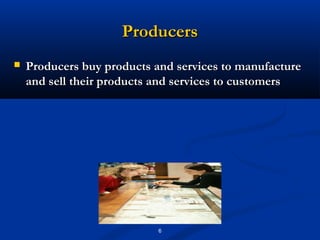
Producers
   Producers buy products and services to manufacture
    and sell their products and services to customers


                            6
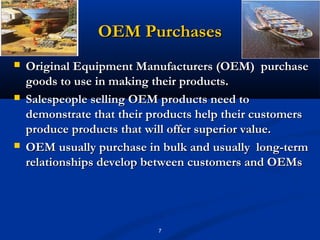
OEM Purchases
   Original Equipment Manufacturers (OEM) purchase
    goods to use in making their products.
   Salespeople selling OEM products need to
    demonstrate that their products help their customers
    produce products that will offer superior value.
   OEM usually purchase in bulk and usually long-term
    relationships develop between customers and OEMs


                            7
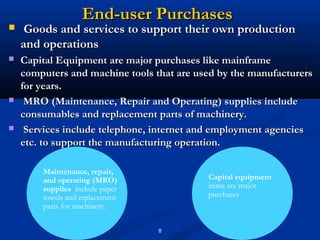
End-user Purchases
    Goods and services to support their own production
    and operations
   Capital Equipment are major purchases like mainframe
    computers and machine tools that are used by the manufacturers
    for years.
    MRO (Maintenance, Repair and Operating) supplies include
    consumables and replacement parts of machinery.
    Services include telephone, internet and employment agencies
    etc. to support the manufacturing operation.

        Maintenance, repair,
        and operating (MRO)                Capital equipment
        supplies include paper             items are major
        towels and replacement             purchases
        parts for machinery.


                                 8
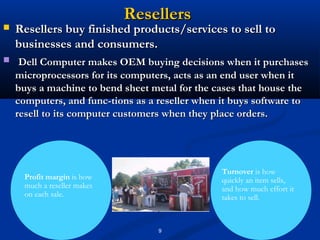
Resellers
   Resellers buy finished products/services to sell to
    businesses and consumers.
    Dell Computer makes OEM buying decisions when it purchases
    microprocessors for its computers, acts as an end user when it
    buys a machine to bend sheet metal for the cases that house the
    computers, and func­tions as a reseller when it buys software to
    resell to its computer customers when they place orders.


                                                 Turnover is how
      Profit margin is how                       quickly an item sells,
      much a reseller makes                      and how much effort it
      on each sale.                              takes to sell.


                                   9
Government Agencies

   Governments are usually the largest customers for goods
    and services. Every Government (Federal, Local) has
    rules and regulations that the suppliers need to follow to
    be able to be eligible as a supplier to the Government
    Agencies. Effective selling to government agencies
    requires a thorough knowledge of their unique
    procurement procedures and rules. Salespeople also need
    to know about projected needs so they can influence the
    development of the buying specifications


                               10
Institutions
   Institutions can be Public as well Private such as
    churches, hospitals, and colleges.
   Usually the purchasing rules and regulations of the
    institutions are more rigid as compared to the rules
    and regulations of the Governments.
   Some manufacturers deal with Institutions and
    resellers at the same time. For this purpose they keep
    two different sales forces for the different types of
    clients.


                             11
Consumers

   Consumers buy products and services for use by
    themselves or by their families.


                           12
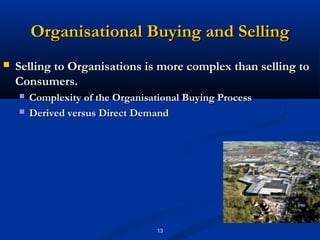
Organisational Buying and Selling
   Selling to Organisations is more complex than selling to
    Consumers.
       Complexity of the Organisational Buying Process
       Derived versus Direct Demand


                                  13
Complexity of the Organisational
               Buying Process
   Organisations use highly trained and knowledgeable
    purchasing agents to make these decisions and Often
    extensive evaluations and negotiations are involved in
    this process.
       Purchasing agents
       Evaluations and negotiations
       Complexity is increasing


                                 14
Derived Versus Direct Demand
   Direct demand
                    Selling to consumers is easier as the only
    the needs of consumers/families are to be considered

   Derived demand
                     Organisational selling often requires
    information about the customers of the customer


                               15
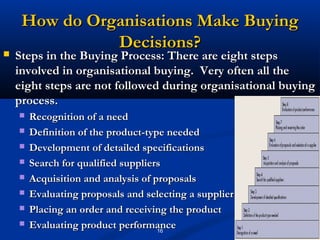
How do Organisations Make Buying
               Decisions?
   Steps in the Buying Process: There are eight steps
    involved in organisational buying. Very often all the
    eight steps are not followed during organisational buying
    process.
       Recognition of a need
       Definition of the product-type needed
       Development of detailed specifications
       Search for qualified suppliers
       Acquisition and analysis of proposals
       Evaluating proposals and selecting a supplier
       Placing an order and receiving the product
       Evaluating product performance
                                     16
Recognition of a need

      The most important step in buying is to
    recognise the need of having something. This
    could be triggered by the employees of the
    customer company and/or the salespersons of the
    vendor company.       Salespeople often trigger the
    buying process by demonstrating how their
    products can improve the efficiency of the
    customer's operation.


                           17
Definition of the product-type
                 needed

      The members of the organisation develop a
    general approach to solve the problem and make a
    decision to purchase a particular product/service.
    The problem solution is defined in terms of
    purchasing a product or service.


                           18
Development of detailed
               specifications
       The specifications of the product needed are
    specified and put in writing.
    The specifications for the product needed to solve
    the problem are pre­pared. Potential suppliers will
    use these specifications to develop proposals. The
    buyers will use them to objectively evaluate the
    proposals.
      Steps 2 & 3 offer a big opportunity to the
    salespersons.


                            19
Search for qualified suppliers


     The customer may simply contact previous
    suppliers or go through an extensive search
    procedure
     Salespersons are contacted, customers of the
    suppliers are contacted. Word of mouth, business
    magazines, Internet all are used nowadays


                           20
Acquisition and analysis of proposals

    Various companies submit proposals that are
    often prepared with the help of the representatives
    of the customer company.

     Qualified suppliers are asked to submit
    proposals. Salespeople work with people in their
    company to develop their proposal.


                            21
Evaluating proposals and selecting a
              supplier

      The written proposals are evaluated; the best
    possible supplier is selected. The customer
    evaluates the proposals. After selecting a
    preferred supplier, further negotiations may take
    place concerning price, delivery, or specific
    perfor­mance features.


                          22
Placing an order and receiving the
                  product
     Once the order is placed, the supplier supply the
    goods according to the agreement. The order goes to
    the supplier, who acknowledges receipt and commits
    to a delivery date. Eventually the product is shipped
    to the buying firm, which inspects the received
    goods and then pays the supplier for the product.
    During this step salespeople need to make sure the
    paperwork is correct and their firm knows what has
    to be done to satisfy the customer's requirements.


                            23
Evaluating product performance

    Formally/Informally the items/services received
    are evaluated by the persons concerned.
    Salespeople play an important role in this step.
    They need to work with the users to make sure the
    product performs well. In addition, salespeople
    need to work with purchasing agents to ensure that
    they are satisfied with the communi­cations and
    delivery.


                           24
Creeping Commitment
   When the consumers become used to a particular
    course of action, it becomes kind of a routine to
    purchase . As decisions are made at each step, the
    range of alternatives narrows; the customer becomes
    more and more committed to a specific vendor. Thus it
    is critical that salespeople be very involved in the ini­
    tial steps so they will have an opportunity to participate
    in the final steps.


                              25
Types of Organisational Buying
                  Decisions
   New tasks: When a particular product/service is needed
    for the first time.
   Straight re-buys: When the same product is bought from
    the same customer when the need arouse previously.
   Modified re-buys: When the customer has purchased a
    product/similar one but wishes to have new information


                             26
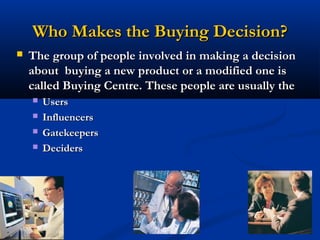
Who Makes the Buying Decision?
   The group of people involved in making a decision
    about buying a new product or a modified one is
    called Buying Centre. These people are usually the
       Users
       Influencers
       Gatekeepers
       Deciders


                            27
Users
   People who will ultimately be involved in using the
    product. They often have considerable influence in the
    early and late steps of the buying process-need
    recognition, product definition, and post purchase
    evaluation. Thus users are particularly important in new
    task and modified re buy situations. Salespeople often
    attempt to convert a straight re buy to a modified re buy
    by demonstrating superior product performance or a new
    benefit to users.


                              28
Influencers
   People from inside/outside the organisation who provide
    information during the buying process. These members
    of the buying center may provide details on product
    specifications, criteria for evaluating pro­posals, or
    information about potential suppliers.


                             29
Gatekeepers
   They control the flow of information and may limit the
    alternatives considered. Purchasing agents often playa
    gate keeping role by determining which poten­tial
    suppliers are to be notified about the purchase situation
    and are to have access to relevant information.


                               30
Deciders
   These are the persons who make the final decision about
    the purchase. Determining who actually makes the
    purchase decision for an organiza­tion is often difficult.
    For straight re buys the purchasing agent usually selects
    the vendor and places the order. However, for new tasks
    many people influence the decision, and several people
    must approve the decision and sign the purchase order.


                               31
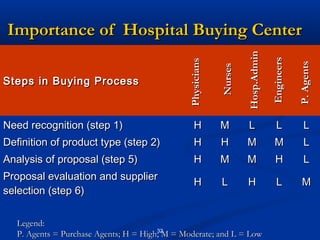
Importance of Hospital Buying Center


                                                                      Hosp.Admin

                                                                                   Engineers
                                                Physicians


                                                                                               P. Agents
                                                             Nurses
Steps in Buying Process


Need recognition (step 1)                          H         M        L              L            L
Definition of product type (step 2)                H         H        M             M             L
Analysis of proposal (step 5)                      H         M        M              H            L
Proposal evaluation and supplier
                                                   H         L        H              L           M
selection (step 6)

   Legend:
                                        32
   P. Agents = Purchase Agents; H = High; M = Moderate; and L = Low
Supplier Evaluation and Choice
   At various steps of the buying process, members of the
    buying centre evaluate the buying process and the
    results of the product purchased.
   The needs of the organisation and the decision makers
    affect the evaluation and selection of products and
    suppliers


                            33
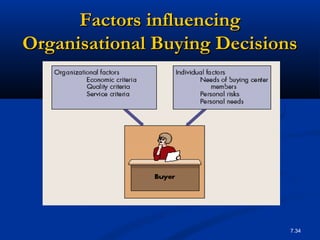
Factors influencing
Organisational Buying Decisions


                              7.34
Organisational Needs and Criteria
   Economic Criteria: To increase profit organisations take
    sophisticated approaches to evaluate cost of equipment.
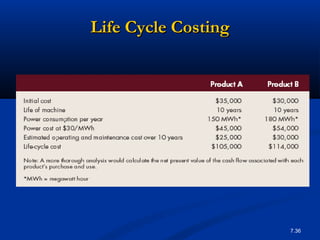
       Life-cycle costing (total cost of ownership)
   Quality Criteria
    To improve profitability quality is to be maintained;
       TQM approach is adopted.
       What are organizational buyers looking for?
   Service Criteria
    Nowadays they Organisations want the suppliers to help
    them solve the problems.
       Value analysis                35
Life Cycle Costing


                     7.36
Individual Needs of Buying Centre
                    Members
   Types of Needs: Buying centre members wish to satisfy
    their own goals and aspirations. Salespersons can meet
    these through their strategies.
       Financial security
       Self-esteem
       Recognition
   Risk Reduction: Buying centre members try to reduce
    the risk of losing benefits
       Collect additional information
       Develop supplier loyalty
                                    37
       Spread the risk
Vendor Analysis

Organisational buyers often use formal methods to

analyse the vendors to be sure that their needs are
satisfied. When using this procedure, the buyer rates the
supplier and its products on a number of criteria such as
price, quality, performance, and on-time delivery.


                           38
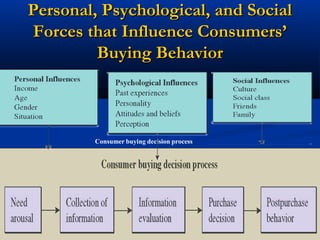
Personal, Psychological, and Social
Forces that Influence Consumers’
         Buying Behavior


        Consumer buying decision process


                            39
Trends in Organisational Buying
   In today’s changing world the technology, competition
    and customer demands are increasing so are the costs
    of the raw material.
   These challenges force the Organisations to adopt
    strategies to survive in the current situation.


                            40
Trends in Organisational Buying
   Increasing Importance of Purchasing Agents
   Centralised Purchasing
   Global Sourcing
   Outsourcing
   Supply Chain Management
   The Internet and Business-to-Business Selling
   Long-term Customer-Supplier Relationships

                             41
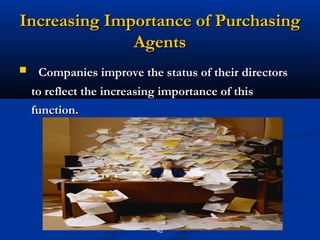
Increasing Importance of Purchasing
              Agents
     Companies improve the status of their directors
    to reflect the increasing importance of this
    function.


                           42
Centralised Purchasing

     Purchasing is becoming more centralized. Rather
    than having each manufacturing facility contract for
    supplies to meet its own production needs, more
    purchasing is done at a central location, such as
    corporate headquarters. Through centralization,
    purchasing agents can become specialists,
    concentrating on partic­ular items and developing
    extensive knowledge about the uses, specifications,
    and suppliers for those items.
                            43
Global Sourcing


    To improve the quality and profitability the
    material is purchased from any where in the world
    – no restriction on country boundaries


                           44
Outsourcing


     Organisations try to purchase goods and services
    from efficient suppliers.


                           45
Supply Chain Management
     This is a set of programmes undertaken to
    increase the efficiency of the distribution channel
       Efficient Consumer Response (ECR) systems.
       Logistics
       Managing inventory while controlling costs
       Just-in-time ( JIT ) inventory control system
       Material requirements planning ( MRP )
       Automatic replenishment ( AR)


                                    46
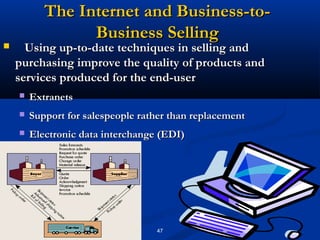
The Internet and Business-to-
                 Business Selling
     Using up-to-date techniques in selling and
    purchasing improve the quality of products and
    services produced for the end-user
       Extranets
       Support for salespeople rather than replacement
       Electronic data interchange (EDI)


                                   47
Long-term Customer-Supplier
             Relationships
    This helps both the customer and the supplier to
    survive better in today’s difficult business
    environment; keeping in mind that the satisfaction
    of the customer is the only way of retaining the
    orders as well as cheaper material does not mean
    all for the Customer


                           48
49
End of Chapter 4
Thank you

Personal Selling: Chapter 4

  • 1.
    Buying Behaviour andthe Buying Process Chapter 4
  • 2.
    Important Questions Answered  What are the different types of customers?  How do organisations make purchase decisions?  Which factors do organisations consider when evaluating products and services?  Who is involved in the buying decision?  What should sales people do in different types of buying situations?  Which changes are occurring in organisational buying, and how will these changes affect salespeople? 2
  • 3.
    “A supplier whodoes a great job at our France location can use the reputation if trying to earn business in Iowa.” ~Marvin Wagner
  • 4.
    Successful salespeople  Successful salespeople always know their customers, needs of the customers and all those who are involved in making the purchase decisions. 4
  • 5.
    Types of Customers  Producers  OEM Purchases  End-user Purchases  Resellers  Government Agencies  Institutions  Consumers 5
  • 6.
    Producers  Producers buy products and services to manufacture and sell their products and services to customers 6
  • 7.
    OEM Purchases  Original Equipment Manufacturers (OEM) purchase goods to use in making their products.  Salespeople selling OEM products need to demonstrate that their products help their customers produce products that will offer superior value.  OEM usually purchase in bulk and usually long-term relationships develop between customers and OEMs 7
  • 8.
    End-user Purchases  Goods and services to support their own production and operations  Capital Equipment are major purchases like mainframe computers and machine tools that are used by the manufacturers for years.  MRO (Maintenance, Repair and Operating) supplies include consumables and replacement parts of machinery.  Services include telephone, internet and employment agencies etc. to support the manufacturing operation. Maintenance, repair, and operating (MRO) Capital equipment supplies include paper items are major towels and replacement purchases parts for machinery. 8
  • 9.
    Resellers  Resellers buy finished products/services to sell to businesses and consumers.  Dell Computer makes OEM buying decisions when it purchases microprocessors for its computers, acts as an end user when it buys a machine to bend sheet metal for the cases that house the computers, and func­tions as a reseller when it buys software to resell to its computer customers when they place orders. Turnover is how Profit margin is how quickly an item sells, much a reseller makes and how much effort it on each sale. takes to sell. 9
  • 10.
    Government Agencies  Governments are usually the largest customers for goods and services. Every Government (Federal, Local) has rules and regulations that the suppliers need to follow to be able to be eligible as a supplier to the Government Agencies. Effective selling to government agencies requires a thorough knowledge of their unique procurement procedures and rules. Salespeople also need to know about projected needs so they can influence the development of the buying specifications 10
  • 11.
    Institutions  Institutions can be Public as well Private such as churches, hospitals, and colleges.  Usually the purchasing rules and regulations of the institutions are more rigid as compared to the rules and regulations of the Governments.  Some manufacturers deal with Institutions and resellers at the same time. For this purpose they keep two different sales forces for the different types of clients. 11
  • 12.
    Consumers  Consumers buy products and services for use by themselves or by their families. 12
  • 13.
    Organisational Buying andSelling  Selling to Organisations is more complex than selling to Consumers.  Complexity of the Organisational Buying Process  Derived versus Direct Demand 13
  • 14.
    Complexity of theOrganisational Buying Process  Organisations use highly trained and knowledgeable purchasing agents to make these decisions and Often extensive evaluations and negotiations are involved in this process.  Purchasing agents  Evaluations and negotiations  Complexity is increasing 14
  • 15.
    Derived Versus DirectDemand  Direct demand Selling to consumers is easier as the only the needs of consumers/families are to be considered  Derived demand Organisational selling often requires information about the customers of the customer 15
  • 16.
    How do OrganisationsMake Buying Decisions?  Steps in the Buying Process: There are eight steps involved in organisational buying. Very often all the eight steps are not followed during organisational buying process.  Recognition of a need  Definition of the product-type needed  Development of detailed specifications  Search for qualified suppliers  Acquisition and analysis of proposals  Evaluating proposals and selecting a supplier  Placing an order and receiving the product  Evaluating product performance 16
  • 17.
    Recognition of aneed  The most important step in buying is to recognise the need of having something. This could be triggered by the employees of the customer company and/or the salespersons of the vendor company. Salespeople often trigger the buying process by demonstrating how their products can improve the efficiency of the customer's operation. 17
  • 18.
    Definition of theproduct-type needed  The members of the organisation develop a general approach to solve the problem and make a decision to purchase a particular product/service. The problem solution is defined in terms of purchasing a product or service. 18
  • 19.
    Development of detailed specifications  The specifications of the product needed are specified and put in writing. The specifications for the product needed to solve the problem are pre­pared. Potential suppliers will use these specifications to develop proposals. The buyers will use them to objectively evaluate the proposals.  Steps 2 & 3 offer a big opportunity to the salespersons. 19
  • 20.
    Search for qualifiedsuppliers  The customer may simply contact previous suppliers or go through an extensive search procedure  Salespersons are contacted, customers of the suppliers are contacted. Word of mouth, business magazines, Internet all are used nowadays 20
  • 21.
    Acquisition and analysisof proposals  Various companies submit proposals that are often prepared with the help of the representatives of the customer company.  Qualified suppliers are asked to submit proposals. Salespeople work with people in their company to develop their proposal. 21
  • 22.
    Evaluating proposals andselecting a supplier  The written proposals are evaluated; the best possible supplier is selected. The customer evaluates the proposals. After selecting a preferred supplier, further negotiations may take place concerning price, delivery, or specific perfor­mance features. 22
  • 23.
    Placing an orderand receiving the product  Once the order is placed, the supplier supply the goods according to the agreement. The order goes to the supplier, who acknowledges receipt and commits to a delivery date. Eventually the product is shipped to the buying firm, which inspects the received goods and then pays the supplier for the product. During this step salespeople need to make sure the paperwork is correct and their firm knows what has to be done to satisfy the customer's requirements. 23
  • 24.
    Evaluating product performance  Formally/Informally the items/services received are evaluated by the persons concerned. Salespeople play an important role in this step. They need to work with the users to make sure the product performs well. In addition, salespeople need to work with purchasing agents to ensure that they are satisfied with the communi­cations and delivery. 24
  • 25.
    Creeping Commitment  When the consumers become used to a particular course of action, it becomes kind of a routine to purchase . As decisions are made at each step, the range of alternatives narrows; the customer becomes more and more committed to a specific vendor. Thus it is critical that salespeople be very involved in the ini­ tial steps so they will have an opportunity to participate in the final steps. 25
  • 26.
    Types of OrganisationalBuying Decisions  New tasks: When a particular product/service is needed for the first time.  Straight re-buys: When the same product is bought from the same customer when the need arouse previously.  Modified re-buys: When the customer has purchased a product/similar one but wishes to have new information 26
  • 27.
    Who Makes theBuying Decision?  The group of people involved in making a decision about buying a new product or a modified one is called Buying Centre. These people are usually the  Users  Influencers  Gatekeepers  Deciders 27
  • 28.
    Users  People who will ultimately be involved in using the product. They often have considerable influence in the early and late steps of the buying process-need recognition, product definition, and post purchase evaluation. Thus users are particularly important in new task and modified re buy situations. Salespeople often attempt to convert a straight re buy to a modified re buy by demonstrating superior product performance or a new benefit to users. 28
  • 29.
    Influencers  People from inside/outside the organisation who provide information during the buying process. These members of the buying center may provide details on product specifications, criteria for evaluating pro­posals, or information about potential suppliers. 29
  • 30.
    Gatekeepers  They control the flow of information and may limit the alternatives considered. Purchasing agents often playa gate keeping role by determining which poten­tial suppliers are to be notified about the purchase situation and are to have access to relevant information. 30
  • 31.
    Deciders  These are the persons who make the final decision about the purchase. Determining who actually makes the purchase decision for an organiza­tion is often difficult. For straight re buys the purchasing agent usually selects the vendor and places the order. However, for new tasks many people influence the decision, and several people must approve the decision and sign the purchase order. 31
  • 32.
    Importance of HospitalBuying Center Hosp.Admin Engineers Physicians P. Agents Nurses Steps in Buying Process Need recognition (step 1) H M L L L Definition of product type (step 2) H H M M L Analysis of proposal (step 5) H M M H L Proposal evaluation and supplier H L H L M selection (step 6) Legend: 32 P. Agents = Purchase Agents; H = High; M = Moderate; and L = Low
  • 33.
    Supplier Evaluation andChoice  At various steps of the buying process, members of the buying centre evaluate the buying process and the results of the product purchased.  The needs of the organisation and the decision makers affect the evaluation and selection of products and suppliers 33
  • 34.
  • 35.
    Organisational Needs andCriteria  Economic Criteria: To increase profit organisations take sophisticated approaches to evaluate cost of equipment.  Life-cycle costing (total cost of ownership)  Quality Criteria To improve profitability quality is to be maintained;  TQM approach is adopted.  What are organizational buyers looking for?  Service Criteria Nowadays they Organisations want the suppliers to help them solve the problems.  Value analysis 35
  • 36.
  • 37.
    Individual Needs ofBuying Centre Members  Types of Needs: Buying centre members wish to satisfy their own goals and aspirations. Salespersons can meet these through their strategies.  Financial security  Self-esteem  Recognition  Risk Reduction: Buying centre members try to reduce the risk of losing benefits  Collect additional information  Develop supplier loyalty 37  Spread the risk
  • 38.
    Vendor Analysis Organisational buyersoften use formal methods to analyse the vendors to be sure that their needs are satisfied. When using this procedure, the buyer rates the supplier and its products on a number of criteria such as price, quality, performance, and on-time delivery. 38
  • 39.
    Personal, Psychological, andSocial Forces that Influence Consumers’ Buying Behavior Consumer buying decision process 39
  • 40.
    Trends in OrganisationalBuying  In today’s changing world the technology, competition and customer demands are increasing so are the costs of the raw material.  These challenges force the Organisations to adopt strategies to survive in the current situation. 40
  • 41.
    Trends in OrganisationalBuying  Increasing Importance of Purchasing Agents  Centralised Purchasing  Global Sourcing  Outsourcing  Supply Chain Management  The Internet and Business-to-Business Selling  Long-term Customer-Supplier Relationships 41
  • 42.
    Increasing Importance ofPurchasing Agents  Companies improve the status of their directors to reflect the increasing importance of this function. 42
  • 43.
    Centralised Purchasing  Purchasing is becoming more centralized. Rather than having each manufacturing facility contract for supplies to meet its own production needs, more purchasing is done at a central location, such as corporate headquarters. Through centralization, purchasing agents can become specialists, concentrating on partic­ular items and developing extensive knowledge about the uses, specifications, and suppliers for those items. 43
  • 44.
    Global Sourcing  To improve the quality and profitability the material is purchased from any where in the world – no restriction on country boundaries 44
  • 45.
    Outsourcing  Organisations try to purchase goods and services from efficient suppliers. 45
  • 46.
    Supply Chain Management  This is a set of programmes undertaken to increase the efficiency of the distribution channel  Efficient Consumer Response (ECR) systems.  Logistics  Managing inventory while controlling costs  Just-in-time ( JIT ) inventory control system  Material requirements planning ( MRP )  Automatic replenishment ( AR) 46
  • 47.
    The Internet andBusiness-to- Business Selling  Using up-to-date techniques in selling and purchasing improve the quality of products and services produced for the end-user  Extranets  Support for salespeople rather than replacement  Electronic data interchange (EDI) 47
  • 48.
    Long-term Customer-Supplier Relationships  This helps both the customer and the supplier to survive better in today’s difficult business environment; keeping in mind that the satisfaction of the customer is the only way of retaining the orders as well as cheaper material does not mean all for the Customer 48
  • 49.
  • 50.
  • 51.

Editor's Notes