Evaluating sales promotion
effectiveness
3 1 / 3 / 2 0 1 4
Made by:
Chernyak Elena
Karpukhina Tatiana
Solovyeva Tatiana
Shun Hui Luar
Overview
Introduction
1. Sales promotion
 Sales promotion techniques
 Purposes
2. Benefits and limitations of sales promotions
3. Sales promotion effects
4. Evaluation of sales promotion
 Theory
 Practice
 Examples of promotional activities
Conclusion
Introduction
 Important for most business enterprises
 Especially so with increasing market competition
 Sales promotion can help achieve every business’
ultimate goal of having greater sales
 Sales promotion can also promote greater usage and
trialability
 Marketers often use sales promotion to alter the
price-value relationship of their products or services,
as part of the overall marketing strategy
Introduction
Find out how effective are sales promotion
Techniques
1. Money off
2. Coupons
3. Free gifts
4. Free mail-ins
5. In-store sampling
Techniques
1. Money off
 Provides consumers additional products with little or no extra charge
 Most widely used today
 Example: price pack, buy 2 get 1 free
 Size of price reduction depends on brand requirements and the
competitive environment
 Disadvantages
 All consumers (including non-loyals) receives the same incentive
 Can be easily matched by competitors
 Frequent use of this technique may result in lower price expectation
 Advantages
 Can be implemented quickly
 Able to forecast outcomes with relatively high accuracy
 Well-liked by consumers and traders
 No need for economies for scale to implement, useful for small co.s
Techniques
2. Coupons
 Many different variations
 Give coupon for product A upon purchase of
product A
 Give coupon for product A upon purchase of
product B, also known as cross-couponing
 Distributed online, or door-to-door
 Similar visual impact as that of money off,
but has a lower real cost, since the level of
redemption is often low
Techniques
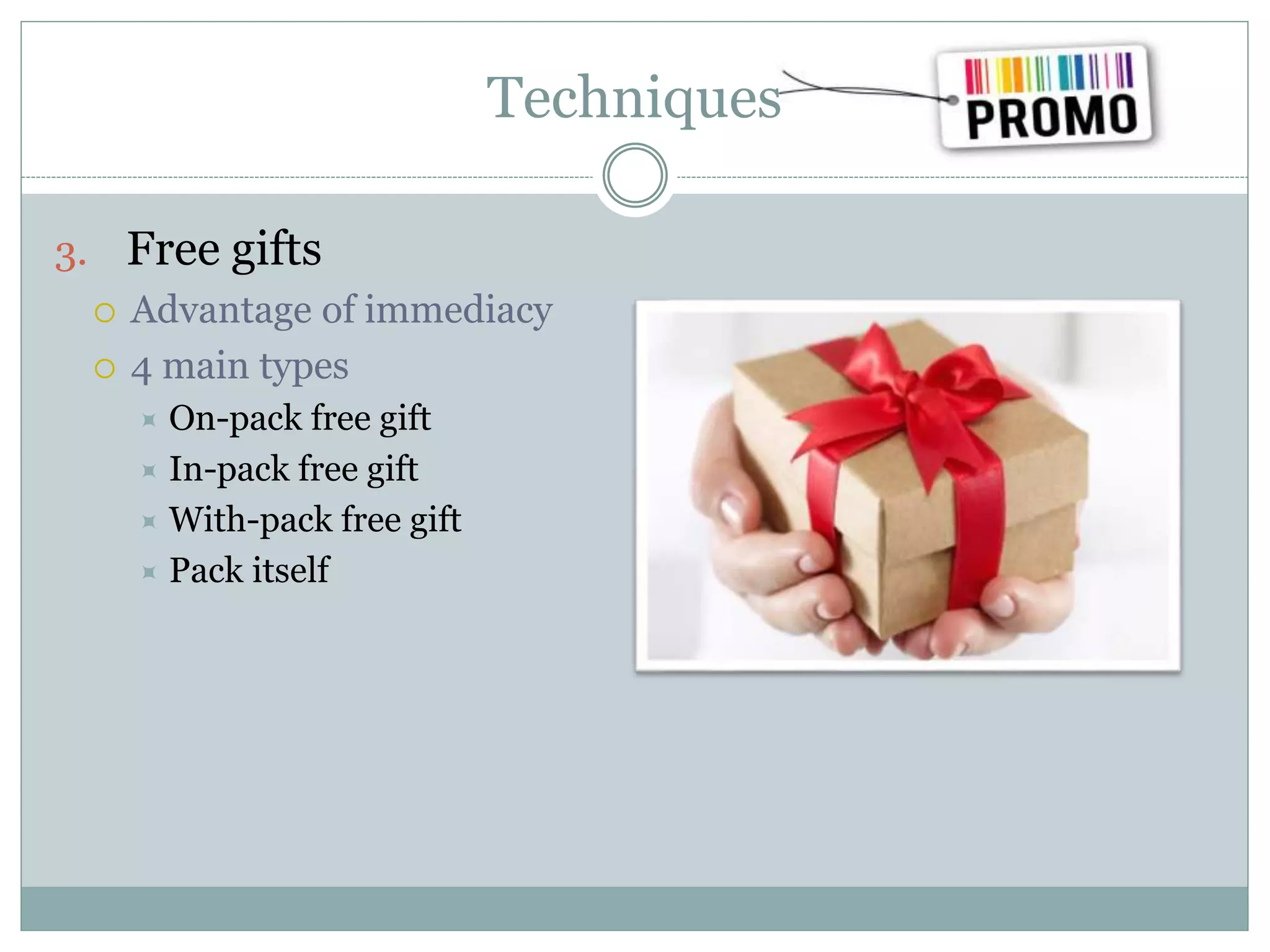
3. Free gifts
 Advantage of immediacy
 4 main types
 On-pack free gift
 In-pack free gift
 With-pack free gift
 Pack itself
Techniques
4. Free mail-ins
 Send in several proofs of purchase to redeem gift item
 The gift item may help in the brand differentiation
 Helps in building loyalty
 Potential problems
 Difficulty in choosing the right merchandise to offer
 This technique lacks immediacy
 Generally low appeal to consumers
Techniques
 In-store sampling
 Provides a direct interface between product and potential
customers
 Especially useful for complex or new products
Purposes
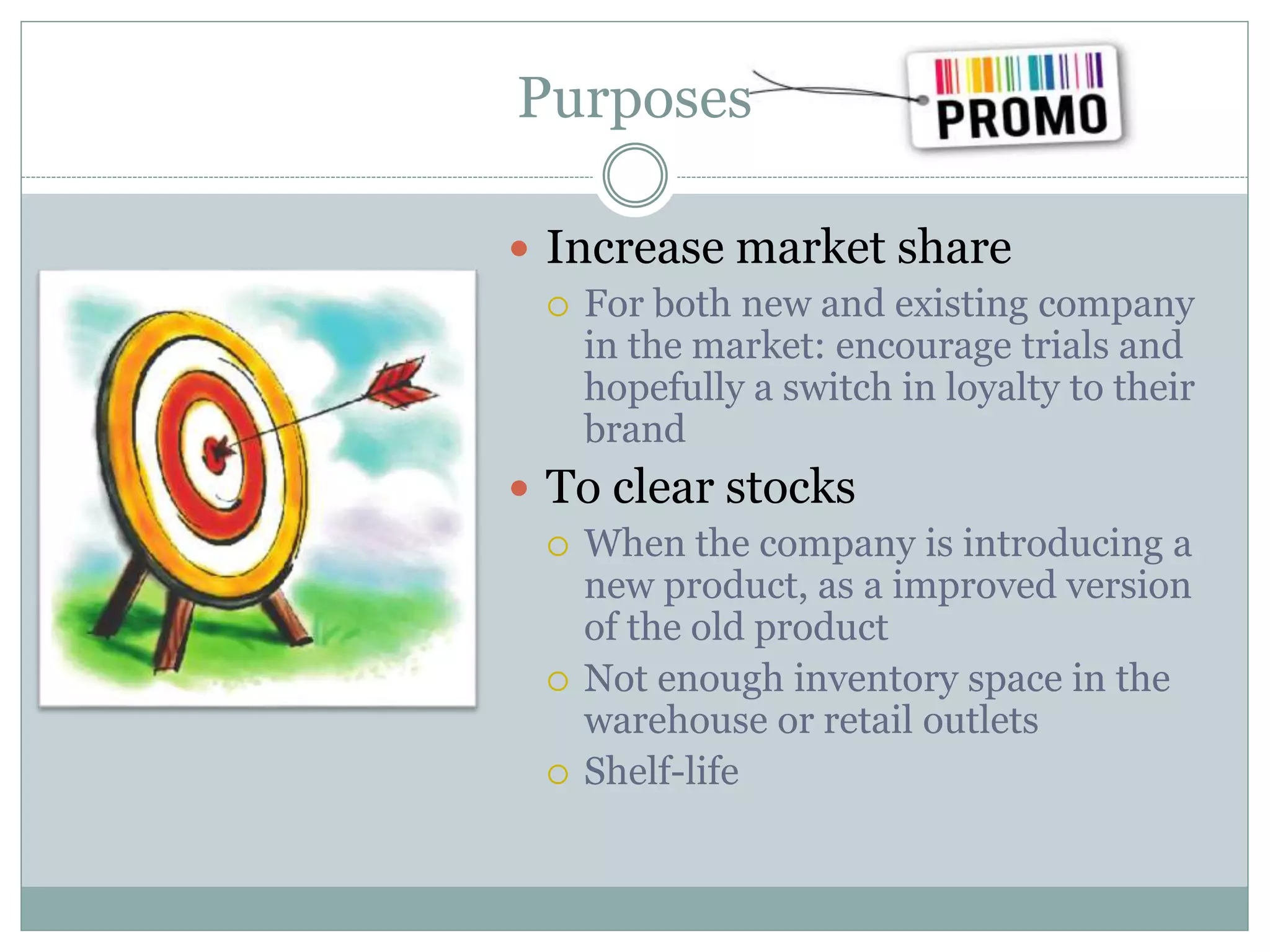
 Increase market share
 For both new and existing company
in the market: encourage trials and
hopefully a switch in loyalty to their
brand
 To clear stocks
 When the company is introducing a
new product, as a improved version
of the old product
 Not enough inventory space in the
warehouse or retail outlets
 Shelf-life
Benefits
 To adjust to variations in supply and demand
without changing list prices
 Small firms can use this as a marketing strategy to
compete with big firms
 Firms with niche market products can use this
marketing tool
 Useful for first-time entry into the market
 Induce trials
Limitations
 Weaker brand image
 Lower consumer loyalty
 Problem of stocking up
Outcomes
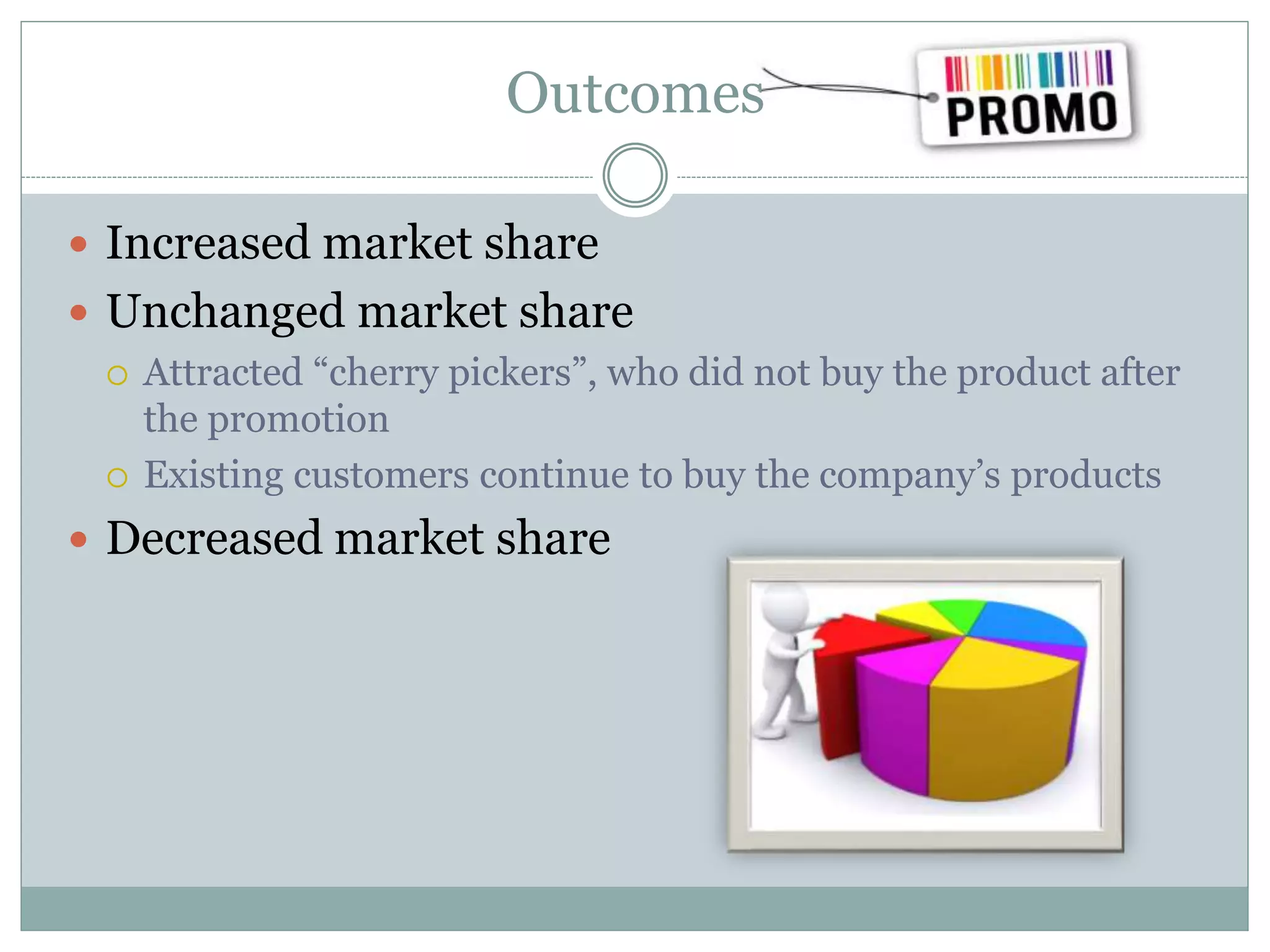
 Increased market share
 Unchanged market share
 Attracted “cherry pickers”, who did not buy the product after
the promotion
 Existing customers continue to buy the company’s products
 Decreased market share
Evaluation - Theory
 Obtain the actual volume of sales: before the
promotion and after the promotion
 Three consumer responses
 Competitor steal
 Brand cannibalization
 Category growth
 Customer survey to evaluate brand awareness
 Calculate total costs of the promotion
 Main cost = Volume sold * Reduced price per pack
 Other costs like dealer incentives
Evaluation - Practice
 Seek help from marketing agencies
 Use panel data gathering to determine how successful the
promotion was
 Loyal customers
 Cherry pickers
 Brand-switchers
 Consumption per person in the short
and long run
 The extent to which the promotion was
made known to target group
Evaluation - Practice
 Retailer to evaluate sales
 Before
 During
 After
 Using ad hoc research like
surveys
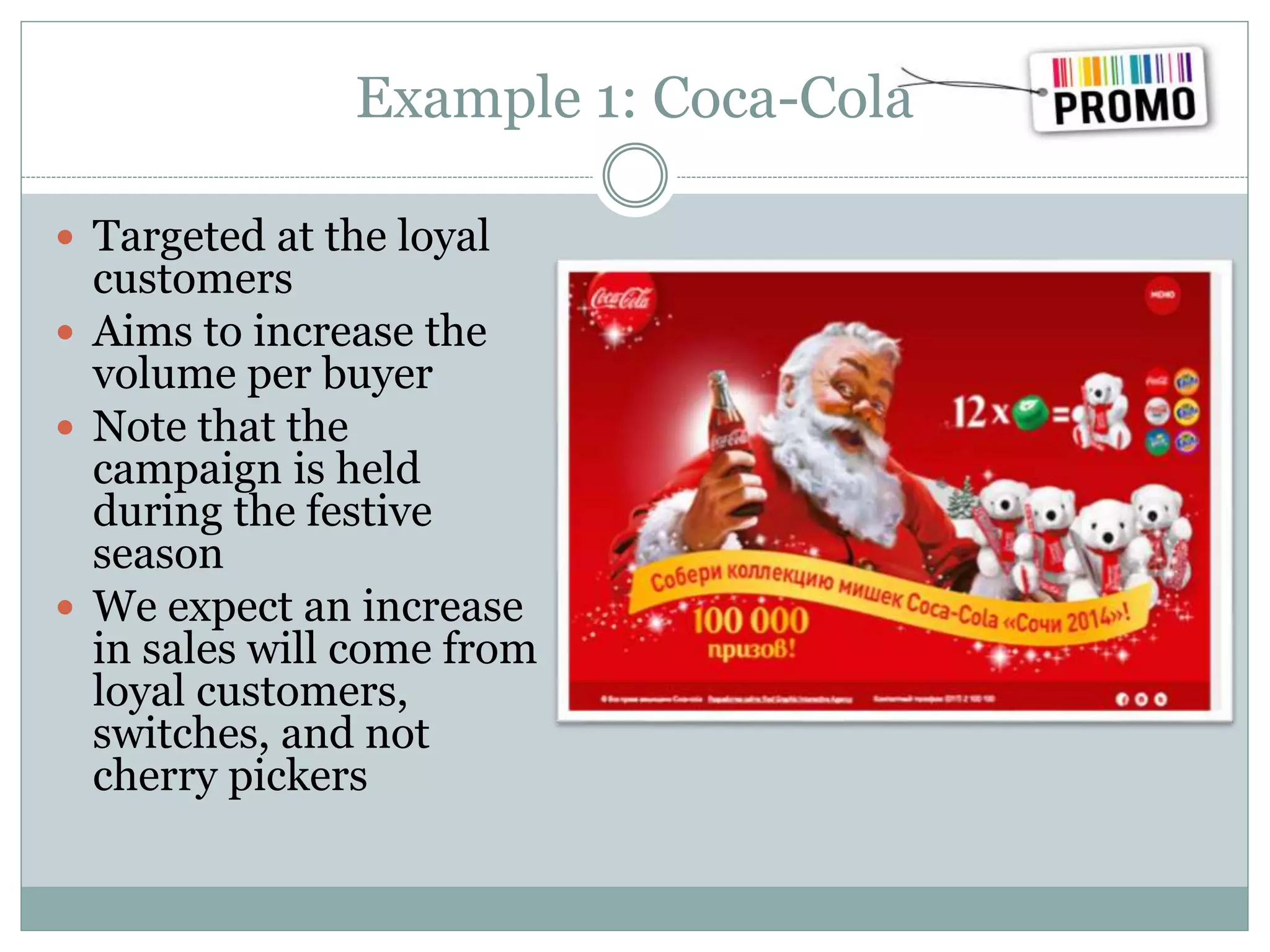
Example 1: Coca-Cola
 Targeted at the loyal
customers
 Aims to increase the
volume per buyer
 Note that the
campaign is held
during the festive
season
 We expect an increase
in sales will come from
loyal customers,
switches, and not
cherry pickers
Example 2: Auchan Maslenitsa
 Maslenitsa lasts for only
one week every year
 Auchan offers them at a
low price even though
there is high demand
 Strengthen its brand
image as a discount store
and attract more sales in
its other areas
Example 3: Domestos
 Example of never ending
promo campaign
 Offers extra mililitres free
 Bundles with other products
from the same company
 Difficult to evaluate the
sales effectiveness of this
product
Conclusion
 Short term sales promotions may result in greater sales,
so retailers should prepare more stocks to prevent
shortage
 Promotions can excite shoppers
 Promotions can also encourage trials and raise brand
awareness
 Frequent price promotions are harmful
 Promotions should be used together with advertising for
best outcomes
 Ensure consistency between promotional tool and the
product position
ENJOY SALES PROMOTIONS 

Evaluating sales promotion effectiveness

  • 1.
    Evaluating sales promotion effectiveness 31 / 3 / 2 0 1 4 Made by: Chernyak Elena Karpukhina Tatiana Solovyeva Tatiana Shun Hui Luar
  • 2.
    Overview Introduction 1. Sales promotion Sales promotion techniques  Purposes 2. Benefits and limitations of sales promotions 3. Sales promotion effects 4. Evaluation of sales promotion  Theory  Practice  Examples of promotional activities Conclusion
  • 3.
    Introduction  Important formost business enterprises  Especially so with increasing market competition  Sales promotion can help achieve every business’ ultimate goal of having greater sales  Sales promotion can also promote greater usage and trialability  Marketers often use sales promotion to alter the price-value relationship of their products or services, as part of the overall marketing strategy
  • 4.
    Introduction Find out howeffective are sales promotion
  • 5.
    Techniques 1. Money off 2.Coupons 3. Free gifts 4. Free mail-ins 5. In-store sampling
  • 6.
    Techniques 1. Money off Provides consumers additional products with little or no extra charge  Most widely used today  Example: price pack, buy 2 get 1 free  Size of price reduction depends on brand requirements and the competitive environment  Disadvantages  All consumers (including non-loyals) receives the same incentive  Can be easily matched by competitors  Frequent use of this technique may result in lower price expectation  Advantages  Can be implemented quickly  Able to forecast outcomes with relatively high accuracy  Well-liked by consumers and traders  No need for economies for scale to implement, useful for small co.s
  • 7.
    Techniques 2. Coupons  Manydifferent variations  Give coupon for product A upon purchase of product A  Give coupon for product A upon purchase of product B, also known as cross-couponing  Distributed online, or door-to-door  Similar visual impact as that of money off, but has a lower real cost, since the level of redemption is often low
  • 8.
    Techniques 3. Free gifts Advantage of immediacy  4 main types  On-pack free gift  In-pack free gift  With-pack free gift  Pack itself
  • 9.
    Techniques 4. Free mail-ins Send in several proofs of purchase to redeem gift item  The gift item may help in the brand differentiation  Helps in building loyalty  Potential problems  Difficulty in choosing the right merchandise to offer  This technique lacks immediacy  Generally low appeal to consumers
  • 10.
    Techniques  In-store sampling Provides a direct interface between product and potential customers  Especially useful for complex or new products
  • 11.
    Purposes  Increase marketshare  For both new and existing company in the market: encourage trials and hopefully a switch in loyalty to their brand  To clear stocks  When the company is introducing a new product, as a improved version of the old product  Not enough inventory space in the warehouse or retail outlets  Shelf-life
  • 12.
    Benefits  To adjustto variations in supply and demand without changing list prices  Small firms can use this as a marketing strategy to compete with big firms  Firms with niche market products can use this marketing tool  Useful for first-time entry into the market  Induce trials
  • 13.
    Limitations  Weaker brandimage  Lower consumer loyalty  Problem of stocking up
  • 14.
    Outcomes  Increased marketshare  Unchanged market share  Attracted “cherry pickers”, who did not buy the product after the promotion  Existing customers continue to buy the company’s products  Decreased market share
  • 15.
    Evaluation - Theory Obtain the actual volume of sales: before the promotion and after the promotion  Three consumer responses  Competitor steal  Brand cannibalization  Category growth  Customer survey to evaluate brand awareness  Calculate total costs of the promotion  Main cost = Volume sold * Reduced price per pack  Other costs like dealer incentives
  • 16.
    Evaluation - Practice Seek help from marketing agencies  Use panel data gathering to determine how successful the promotion was  Loyal customers  Cherry pickers  Brand-switchers  Consumption per person in the short and long run  The extent to which the promotion was made known to target group
  • 17.
    Evaluation - Practice Retailer to evaluate sales  Before  During  After  Using ad hoc research like surveys
  • 18.
    Example 1: Coca-Cola Targeted at the loyal customers  Aims to increase the volume per buyer  Note that the campaign is held during the festive season  We expect an increase in sales will come from loyal customers, switches, and not cherry pickers
  • 19.
    Example 2: AuchanMaslenitsa  Maslenitsa lasts for only one week every year  Auchan offers them at a low price even though there is high demand  Strengthen its brand image as a discount store and attract more sales in its other areas
  • 20.
    Example 3: Domestos Example of never ending promo campaign  Offers extra mililitres free  Bundles with other products from the same company  Difficult to evaluate the sales effectiveness of this product
  • 21.
    Conclusion  Short termsales promotions may result in greater sales, so retailers should prepare more stocks to prevent shortage  Promotions can excite shoppers  Promotions can also encourage trials and raise brand awareness  Frequent price promotions are harmful  Promotions should be used together with advertising for best outcomes  Ensure consistency between promotional tool and the product position
  • 22.

Editor's Notes

  • #7 Price-pack deal: The packaging offers a consumer a certain percentage more of the product for the same price (for example, 25 percent extra). Put “the pack” under money-off