Introduction to Sales
Management
Presented By:
Jatin Vaid
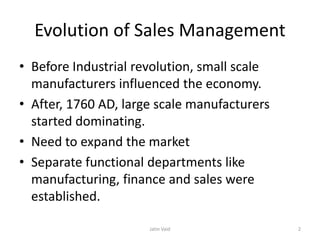
Evolution of Sales Management
• Before Industrial revolution, small scale
manufacturers influenced the economy.
• After, 1760 AD, large scale manufacturers
started dominating.
• Need to expand the market
• Separate functional departments like
manufacturing, finance and sales were
established.
Jatin Vaid 2
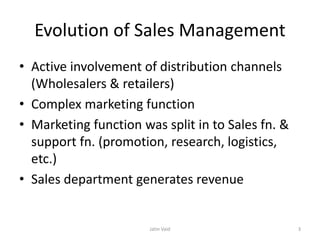
Evolution of Sales Management
• Active involvement of distribution channels
(Wholesalers & retailers)
• Complex marketing function
• Marketing function was split in to Sales fn. &
support fn. (promotion, research, logistics,
etc.)
• Sales department generates revenue
Jatin Vaid 3
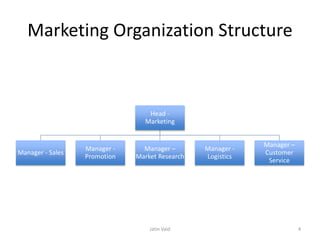
Marketing Organization Structure
Head -
Marketing
Manager - Sales
Manager -
Promotion
Manager –
Market Research
Manager -
Logistics
Manager –
Customer
Service
Jatin Vaid 4
Sales Management
According to American Marketing Association
(AMA),
“Sales Management means the planning,
direction and control of personal selling,
including recruiting, selecting, equipping,
assigning, routing, supervising, paying and
motivating as these tasks apply to the personal
sales force”.
Jatin Vaid 5
Nature of Sales Management
i. Integration with Marketing Management
ii. Relationship Selling
iii. Varying sales responsibilities
Jatin Vaid 6
i. Integration with Marketing
Management
Sales management is a part of marketing
management
• Field sales team: In territories, contacting
existing and prospective customers
• Headquarter team: Performs support and
service functions to assist sales people.
(Promotion, Market research, Logistics,
Customer service and coordination)
Jatin Vaid 7
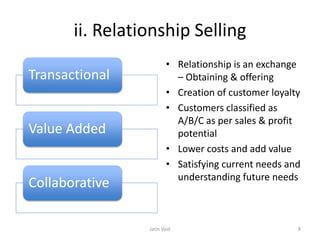
ii. Relationship Selling
Transactional
Value Added
Collaborative
• Relationship is an exchange
– Obtaining & offering
• Creation of customer loyalty
• Customers classified as
A/B/C as per sales & profit
potential
• Lower costs and add value
• Satisfying current needs and
understanding future needs
Jatin Vaid 8
Importance of Sales Management
1. Most exciting
2. Highly financially rewarding
3. Challenging careers
4. Fastest & surest route to top management
5. Only function to generate revenue
6. Directly impacts the bottom line or net profit
Jatin Vaid 9
Roles of a Sales Manager
1. Strategic role in the company with key inputs – long
term strategic plans, forecasting, sales force
management, evolving strategies, controlling budget.
2. Member of corporate team to ensure organizational
objectives – customer satisfaction, sales growth &
market share
3. Team leader to achieve sales goals & profits
4. Managing multiple sales channels – personal selling,
electronic and telemarketing
5. Latest CRM technologies
6. Continually understand changes in environment and
update strategies
Jatin Vaid 10
Skills of Sales Manager
1. People Skills – Motivate, lead, communicate
and coordinate effectively with team building
2. Managing Skills – Administrative skills like –
planning, organizing, controlling and decision
making
3. Technical skills – Training, selling, negotiating,
problem-solving and CRM skills
Jatin Vaid 11
Sales Management positions
Strategic
/ Top
Tactical /
Middle
Operational /
First
1. Strategic: [President; V.P;
National sales head] – Long
term sales planning,
environment scanning,
strategy formulation, control
performance
2. Tactical: [Regional sales
head; Zonal sales manager] –
Manage regions, implement
strategies
3. Operational: [Branch / Area
sales managers] – Achieve
sales goals, supervising sales
force, implement rules
Jatin Vaid 12
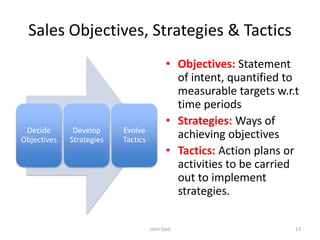
Sales Objectives, Strategies & Tactics
Decide
Objectives
Develop
Strategies
Evolve
Tactics
• Objectives: Statement
of intent, quantified to
measurable targets w.r.t
time periods
• Strategies: Ways of
achieving objectives
• Tactics: Action plans or
activities to be carried
out to implement
strategies.
Jatin Vaid 13
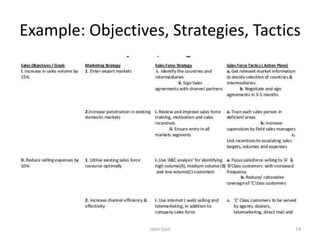
Example: Objectives, Strategies, Tactics
Jatin Vaid 14
Emerging trends in Sales Management
1. Global perspective
2. Revolution in technology
3. Customer Relationship Management (CRM)
4. Sales force diversity
5. Team selling approach
6. Managing multi channels
7. Ethical & social issues
8. E-selling
Jatin Vaid 15
Thank You!
jatinvaid@gmail.com
Jatin Vaid 16

Introduction to sales management

  • 1.
  • 2.
    Evolution of SalesManagement • Before Industrial revolution, small scale manufacturers influenced the economy. • After, 1760 AD, large scale manufacturers started dominating. • Need to expand the market • Separate functional departments like manufacturing, finance and sales were established. Jatin Vaid 2
  • 3.
    Evolution of SalesManagement • Active involvement of distribution channels (Wholesalers & retailers) • Complex marketing function • Marketing function was split in to Sales fn. & support fn. (promotion, research, logistics, etc.) • Sales department generates revenue Jatin Vaid 3
  • 4.
    Marketing Organization Structure Head- Marketing Manager - Sales Manager - Promotion Manager – Market Research Manager - Logistics Manager – Customer Service Jatin Vaid 4
  • 5.
    Sales Management According toAmerican Marketing Association (AMA), “Sales Management means the planning, direction and control of personal selling, including recruiting, selecting, equipping, assigning, routing, supervising, paying and motivating as these tasks apply to the personal sales force”. Jatin Vaid 5
  • 6.
    Nature of SalesManagement i. Integration with Marketing Management ii. Relationship Selling iii. Varying sales responsibilities Jatin Vaid 6
  • 7.
    i. Integration withMarketing Management Sales management is a part of marketing management • Field sales team: In territories, contacting existing and prospective customers • Headquarter team: Performs support and service functions to assist sales people. (Promotion, Market research, Logistics, Customer service and coordination) Jatin Vaid 7
  • 8.
    ii. Relationship Selling Transactional ValueAdded Collaborative • Relationship is an exchange – Obtaining & offering • Creation of customer loyalty • Customers classified as A/B/C as per sales & profit potential • Lower costs and add value • Satisfying current needs and understanding future needs Jatin Vaid 8
  • 9.
    Importance of SalesManagement 1. Most exciting 2. Highly financially rewarding 3. Challenging careers 4. Fastest & surest route to top management 5. Only function to generate revenue 6. Directly impacts the bottom line or net profit Jatin Vaid 9
  • 10.
    Roles of aSales Manager 1. Strategic role in the company with key inputs – long term strategic plans, forecasting, sales force management, evolving strategies, controlling budget. 2. Member of corporate team to ensure organizational objectives – customer satisfaction, sales growth & market share 3. Team leader to achieve sales goals & profits 4. Managing multiple sales channels – personal selling, electronic and telemarketing 5. Latest CRM technologies 6. Continually understand changes in environment and update strategies Jatin Vaid 10
  • 11.
    Skills of SalesManager 1. People Skills – Motivate, lead, communicate and coordinate effectively with team building 2. Managing Skills – Administrative skills like – planning, organizing, controlling and decision making 3. Technical skills – Training, selling, negotiating, problem-solving and CRM skills Jatin Vaid 11
  • 12.
    Sales Management positions Strategic /Top Tactical / Middle Operational / First 1. Strategic: [President; V.P; National sales head] – Long term sales planning, environment scanning, strategy formulation, control performance 2. Tactical: [Regional sales head; Zonal sales manager] – Manage regions, implement strategies 3. Operational: [Branch / Area sales managers] – Achieve sales goals, supervising sales force, implement rules Jatin Vaid 12
  • 13.
    Sales Objectives, Strategies& Tactics Decide Objectives Develop Strategies Evolve Tactics • Objectives: Statement of intent, quantified to measurable targets w.r.t time periods • Strategies: Ways of achieving objectives • Tactics: Action plans or activities to be carried out to implement strategies. Jatin Vaid 13
  • 14.
    Example: Objectives, Strategies,Tactics Jatin Vaid 14
  • 15.
    Emerging trends inSales Management 1. Global perspective 2. Revolution in technology 3. Customer Relationship Management (CRM) 4. Sales force diversity 5. Team selling approach 6. Managing multi channels 7. Ethical & social issues 8. E-selling Jatin Vaid 15
  • 16.