7-1
7-2
7-3
7-4
7-5
7-6
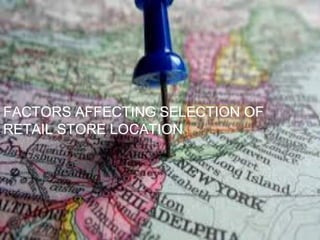
FACTORS AFFECTING SELECTION OF
RETAIL STORE LOCATION
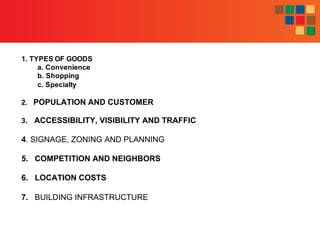
1. TYPES OF GOODS
a. Convenience
b. Shopping
c. Specialty
2. POPULATION AND CUSTOMER
3. ACCESSIBILITY, VISIBILITY AND TRAFFIC
4. SIGNAGE, ZONING AND PLANNING
5. COMPETITION AND NEIGHBORS
6. LOCATION COSTS
7. BUILDING INFRASTRUCTURE
McGraw-Hill/Irwin
Retailing Management, 7/e © 2008 by The McGraw-Hill Companies, All rightsreserved.
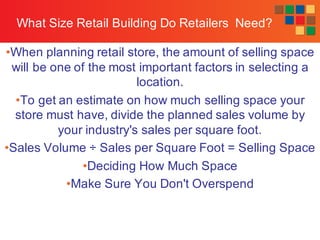
What Size Retail Building Do Retailers Need?
•When planning retail store, the amount of selling space
will be one of the most important factors in selecting a
location.
•To get an estimate on how much selling space your
store must have, divide the planned sales volume by
your industry's sales per square foot.
•Sales Volume ÷ Sales per Square Foot = Selling Space
•Deciding How Much Space
•Make Sure You Don't Overspend
7-12
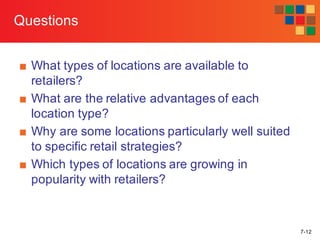
Questions
â–  What types of locations are available to
retailers?
â–  What are the relative advantages of each
location type?
â–  Why are some locations particularly well suited
to specific retail strategies?
â–  Which types of locations are growing in
popularity with retailers?
7-13
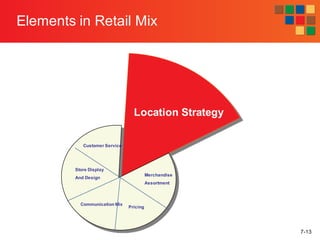
Elements in Retail Mix
Customer Service
Merchandise
Assortment
Pricing
Communication Mix
Store Display
And Design
Location Strategy
7-14
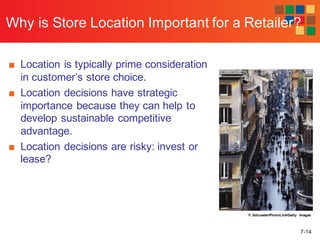
Why is Store Location Important for a Retailer?
â–  Location is typically prime consideration
in customer’s store choice.
â–  Location decisions have strategic
importance because they can help to
develop sustainable competitive
advantage.
â–  Location decisions are risky: invest or
lease?
F. Schussler/PhotoLink/Getty Images
7-15
Types of Retail Locations
â–  Free Standing Sites
â–  City or Town Locations
n Inner City
n Main Street
â–  Shopping Centers
n Strip Shopping Centers
n Shopping Malls
â–  Other Location Opportunities
7-16
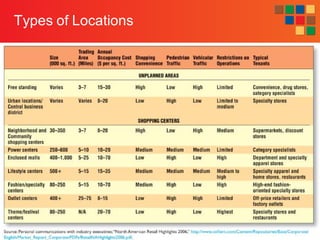
Selecting a particular location type
Involves evaluating a series of trade-offs between
â–  The size of the trade area (geographic area
encompassing most of the customers who would
patronize a specific retail site)
â–  the occupancy cost of the location
â–  The pedestrian and vehicle customer traffic
â–  The restrictions placed on store operations by the
property manager
â–  The convenience of the location for customers
7-17
Types of Locations
7-18
Unplanned Retail Locations
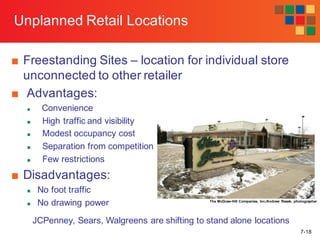
■ Freestanding Sites – location for individual store
unconnected to other retailer
â–  Advantages:
n Convenience
n High traffic and visibility
n Modest occupancy cost
n Separation from competition
n Few restrictions
â–  Disadvantages:
n No foot traffic
n No drawing power The McGraw-Hill Companies, Inc./Andrew Resek, photographer
JCPenney, Sears, Walgreens are shifting to stand alone locations
7-19
Unplanned Retail Locations
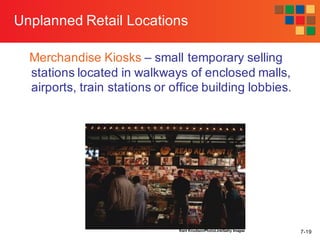
Merchandise Kiosks – small temporary selling
stations located in walkways of enclosed malls,
airports, train stations or office building lobbies.
Kent Knudson/PhotoLink/Getty Images
7-20
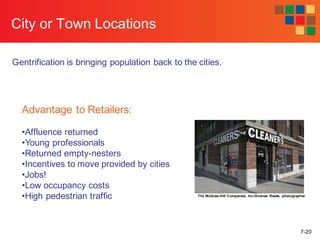
City or Town Locations
Gentrification is bringing population back to the cities.
The McGraw-Hill Companies, Inc./Andrew Resek, photographer
Advantage to Retailers:
•Affluence returned
•Young professionals
•Returned empty-nesters
•Incentives to move provided by cities
•Jobs!
•Low occupancy costs
•High pedestrian traffic
7-21
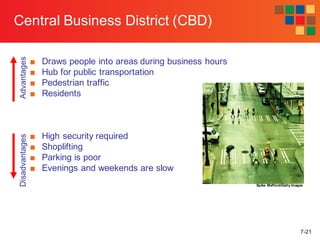
Central Business District (CBD)
â–  Draws people into areas during business hours
â–  Hub for public transportation
â–  Pedestrian traffic
â–  Residents
â–  High security required
â–  Shoplifting
â–  Parking is poor
â–  Evenings and weekends are slow
AdvantagesDisadvantages
Spike Mafford/Getty Images
7-22
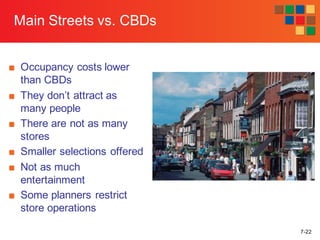
Main Streets vs. CBDs
â–  Occupancy costs lower
than CBDs
■ They don’t attract as
many people
â–  There are not as many
stores
â–  Smaller selections offered
â–  Not as much
entertainment
â–  Some planners restrict
store operations
7-23
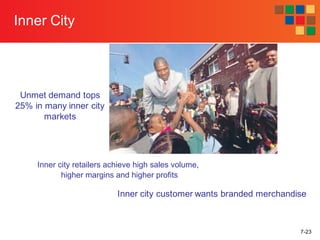
Inner City
Inner city retailers achieve high sales volume,
higher margins and higher profits
Unmet demand tops
25% in many inner city
markets
Inner city customer wants branded merchandise
7-24
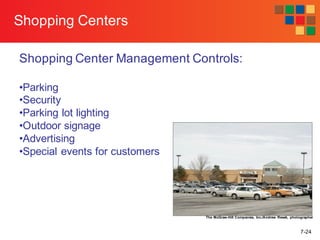
Shopping Centers
Shopping Center Management Controls:
•Parking
•Security
•Parking lot lighting
•Outdoor signage
•Advertising
•Special events for customers
The McGraw-Hill Companies, Inc./Andrew Resek, photographer
7-25
Types of Shopping Centers
â–  Neighborhood and Community Centers (Strip
Centers)
â–  Power Centers
â–  Enclosed Malls
â–  Lifestyle Centers
â–  Fashion Specialty Centers
â–  Outlet Centers
7-26
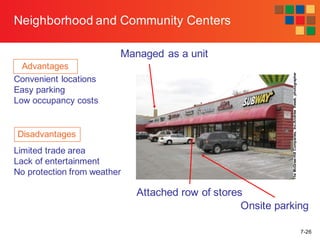
Neighborhood and Community Centers
Attached row of stores
Managed as a unit
Onsite parking
TheMcGraw-HillCompanies,Inc./AndrewResek,photographer
Advantages
Convenient locations
Easy parking
Low occupancy costs
Disadvantages
Limited trade area
Lack of entertainment
No protection from weather
7-27
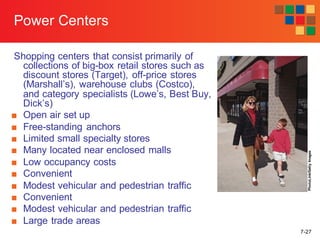
Power Centers
Shopping centers that consist primarily of
collections of big-box retail stores such as
discount stores (Target), off-price stores
(Marshall’s), warehouse clubs (Costco),
and category specialists (Lowe’s, Best Buy,
Dick’s)
â–  Open air set up
â–  Free-standing anchors
â–  Limited small specialty stores
â–  Many located near enclosed malls
â–  Low occupancy costs
â–  Convenient
â–  Modest vehicular and pedestrian traffic
â–  Convenient
â–  Modest vehicular and pedestrian traffic
â–  Large trade areas
PhotoLink/GettyImages
7-28
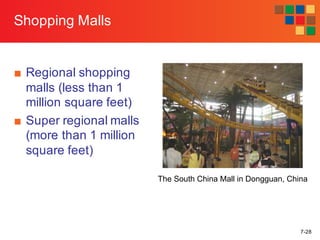
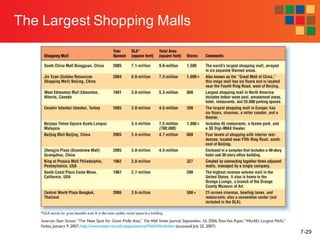
Shopping Malls
â–  Regional shopping
malls (less than 1
million square feet)
â–  Super regional malls
(more than 1 million
square feet)
The South China Mall in Dongguan, China
7-29
The Largest Shopping Malls
7-30
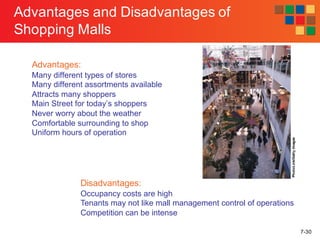
Advantages and Disadvantages of
Shopping Malls
Advantages:
Many different types of stores
Many different assortments available
Attracts many shoppers
Main Street for today’s shoppers
Never worry about the weather
Comfortable surrounding to shop
Uniform hours of operation
Disadvantages:
Occupancy costs are high
Tenants may not like mall management control of operations
Competition can be intense
PhotoLink/GettyImages
7-31
Challenge to Malls
â–  Time pressured society makes it impractical to wander malls
â–  Fashion apparel sold in malls experiencing limited growth
■ Malls are getting old and rundown – unappealing to shop
â–  Anchor tenants are decreasing due to retail consolidation
â–  Strategies?
n Make shopping more enjoyable (e.g., sofas, children’s playing areas)
n Great food destination (fast food and full-service restaurants)
n Tailor make its offering to cater to changing demographics (e.g.,
repositioning older shopping centers for Hispanic markets)
n Mall renovation and redevelopment
7-32
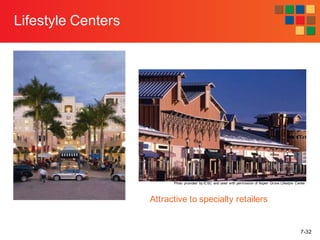
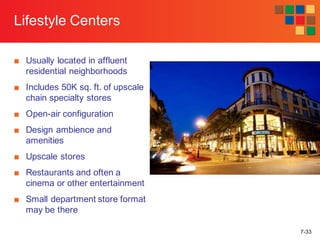
Lifestyle Centers
Photo provided by ICSC and used with permission of Aspen Grove Lifestyle Center
Attractive to specialty retailers
7-33
Lifestyle Centers
â–  Usually located in affluent
residential neighborhoods
â–  Includes 50K sq. ft. of upscale
chain specialty stores
â–  Open-air configuration
â–  Design ambience and
amenities
â–  Upscale stores
â–  Restaurants and often a
cinema or other entertainment
â–  Small department store format
may be there
7-34
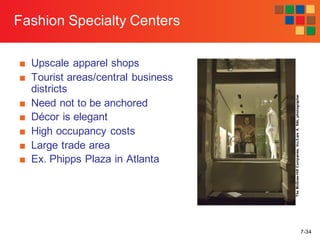
Fashion Specialty Centers
â–  Upscale apparel shops
â–  Tourist areas/central business
districts
â–  Need not to be anchored
■ Décor is elegant
â–  High occupancy costs
â–  Large trade area
â–  Ex. Phipps Plaza in Atlanta
TheMcGraw-HillCompanies,Inc./LarsA.Niki,photographer
7-35
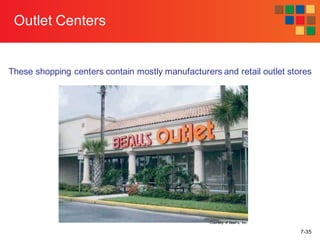
Outlet Centers
These shopping centers contain mostly manufacturers and retail outlet stores
Courtesy of Beall’s, Inc.
7-36
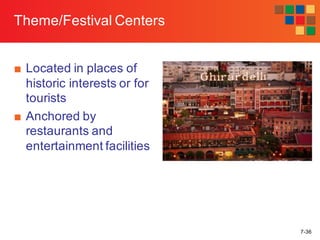
Theme/Festival Centers
â–  Located in places of
historic interests or for
tourists
â–  Anchored by
restaurants and
entertainment facilities
7-37
Larger, Multi-format Developments:
Omnicenters
â–  Combines enclosed malls, lifestyle center, and
power centers
â–  Larger developments are targeted
n to generate more pedestrian traffic and longer
shopping trips
n To capture cross-shopping consumers
7-38
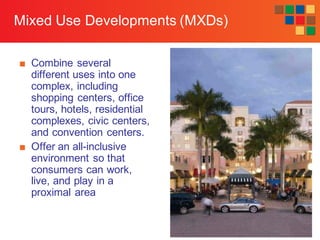
Mixed Use Developments (MXDs)
â–  Combine several
different uses into one
complex, including
shopping centers, office
tours, hotels, residential
complexes, civic centers,
and convention centers.
â–  Offer an all-inclusive
environment so that
consumers can work,
live, and play in a
proximal area
7-39
Other Location Opportunities
â–  Airports
â–  Resorts
â–  Store within a Store
â–  Temporary or pop-up stores
7-40
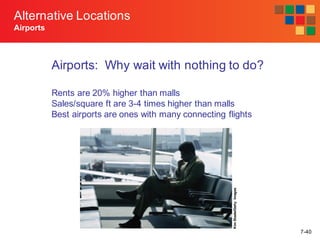
Alternative Locations
Airports
Airports: Why wait with nothing to do?
Rents are 20% higher than malls
Sales/square ft are 3-4 times higher than malls
Best airports are ones with many connecting flights
KimSteele/GettyImages
7-41
Alternative Locations
Resorts
Captive audience
Well-to-do customer
Customers have time to shop
Royalty-Free/CORBIS
7-42
â–  Located within other, larger stores
â–  Examples:
n Grocery store with service providers (coffee bars,
banks, clinics, video outlets)
n Sephora in JCPenney
Alternative Locations
Store within a Store
7-43
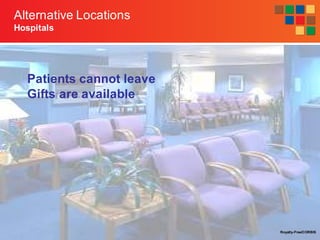
Alternative Locations
Hospitals
Patients cannot leave
Gifts are available
Royalty-Free/CORBIS
7-44
Matching Location to Retail Strategy
The selection of a location type must reinforce the retailer’s
strategy
be consistent with
n the shopping behavior
n size of the target market
n The retailer’s position in its target market
■ Department Stores è Regional Mall
■ Specialty Apparel è Central Business District, Regional
malls
■ Category Specialists è Power Centers, Free Standing
■ Grocery Stores è Strip Shopping Centers
■ Drug Stores è Stand Alone
7-45
Shopping Behavior of Consumers
in Retailer’s Target Market
â–  Factors affecting the location choice
n Consumer Shopping Situations
• Convenience shopping
• Comparison shopping
• Specialty shopping
n Density of Target Market
• Ex. Convenience stores in CBD; comparison
shopping stores next to Wal-Mart
n Uniqueness of Retailing Offering
• Convenience of locations is less important
• Ex. Bass Pro Shop
7-46
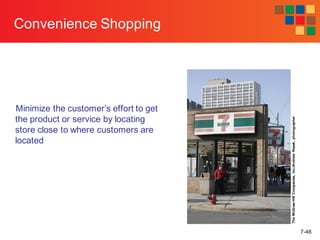
Convenience Shopping
Minimize the customer’s effort to get
the product or service by locating
store close to where customers are
located
TheMcGraw-HillCompanies,Inc./AndrewResek,photographer
7-47
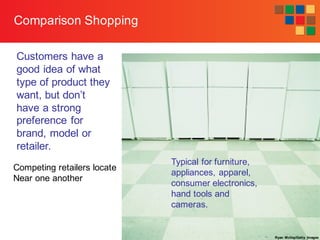
Comparison Shopping
Customers have a
good idea of what
type of product they
want, but don’t
have a strong
preference for
brand, model or
retailer.
Ryan McVay/Getty Images
Typical for furniture,
appliances, apparel,
consumer electronics,
hand tools and
cameras.
Competing retailers locate
Near one another
7-48
Category Specialists
Offer the benefits of comparison shopping
Consumers can see almost all brands and models in one store
Destination stores
The McGraw-Hill Companies, Inc./Andrew Resek, photographer
7-49
Environmental Issues
“Above-ground” risks - such as asbestos-containing
materials or lead pipes used in construction.
Hazardous materials - e.g. dry cleaning chemicals,
motor oil, that have been stored in the ground.
Retailers’ Protection
Stipulate in the lease that the lessor is responsible
for removal and disposal of this material if it’s
found.
Retailer can buy insurance that specifically
protects it from these risks.
7-50
Other Legal Issues
Zoning and Building Codes
Zoning determines how a particular site can be
used.
Building codes determine the type of building,
signs, size, type of parking lot, etc. that can be used
Signs
Restrictions on the use of signs can also impact a
particular site’s desirability
Licensing Requirements
Some areas may restrict or require a license for
alcoholic beverages
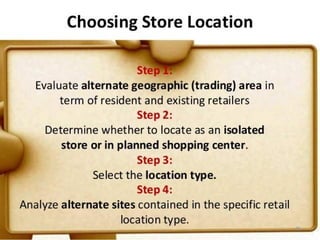
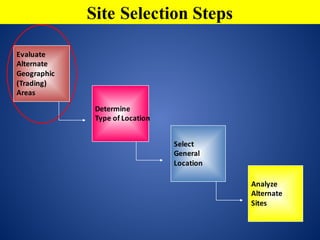
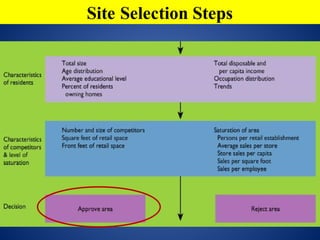
Evaluate
Alternate
Geographic
(Trading)
Areas
Select
General
Location
Analyze
Alternate	
Sites
Determine
Type	of	Location
Site Selection Steps
The farthest distance consumers are willing to
travel to purchase retail goods and services.
The size of a retail trade area depends on the
variety of goods and services offered in the
community and its proximity to competing
retail markets.
Trading Area
Trade area analysis and mapping tell you:
•Where a store's customers are coming from
•How many customers you have in a trade area
•Where to look for more customers
Why Trading Area Analysis is important?
• Identify gaps or overlaps in the market coverage of your
existing store network, and make corrections by opening,
closing or moving stores
• Define a geographic area to analyze for market potential,
market penetration, and competitive threats
• Become more efficient and effective at target marketing by
reaching out only to those customers and prospects in a store's
trade area
• Use as a key input into customer profiling
• Promotional Activity Focus can be determined
• Proper Number of Stores can be calculated
Benefits of Trade Area Analysis
ÂŻDiscovery of consumer
demographics and
socioeconomic
characteristics
ÂŻOpportunity to
determine focus of
promotional activities
ÂŻOpportunity to view
media coverage patterns
ÂŻAssessment of effects of
trading area overlap
ÂŻAscertain whether
chain’s competitors will
open nearby
ÂŻDiscovery of ideal
number of outlets,
geographic weaknesses
ÂŻReview of other issues,
such as transportation
Benefits of Trade Area Analysis
• A trade area should account for more than 50% or
higher sales
• Trade area can be a nation/ single neighbor block
• Size of area depends on retailer’s objectives, like,
how many customers are needed to achieve
profitability? What sales is required to achieve
breakeven?
• Ray Kroc of McDonald’s insisted that franchisees
live in trading area so they would understand the
local market
Characteristics of Trade Area
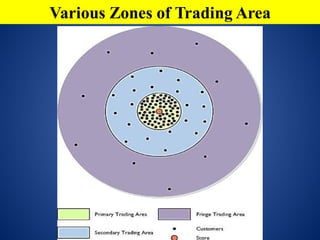
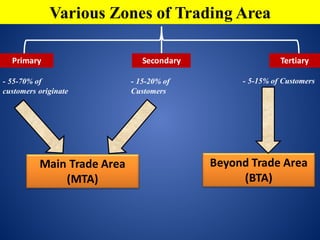
Various Zones of Trading Area
Primary Secondary Tertiary
- 55-70% of
customers originate
- 15-20% of
Customers
- 5-15% of Customers
Main	Trade	Area	
(MTA)
Beyond	Trade	Area	
(BTA)
Size	and	Shape	of	Trading	Area
• Not	Concentric
• Two	Stores	in	Same	Area	Can	Have	Different	
Trading	Areas	(TA)
Trading	Area	Analysis	Benefits
• Consumer	Characteristics	Detailed
• Promotional	Activity	Focus	Determined
• Proper	Number	of	Stores	Calculated
• Geographic	Weaknesses	Highlighted
Trading	Area	Influencers
• Store	Size
• Competitors’	Locations
• New	Stores
• Residential	Housing	Patterns
• Travel	or	Driving	Time
• Promotion-impact	is	temporary
Factors	Affecting	Demand	for	a	
Trading	area
• Competition
• Business	climate
• Demographic	and	lifestyle	characteristics
• Economies	of	scale	versus	cannibalization
DECISION	MAKING	MODEL	FOR	
TRADING	AREA	SELECTION
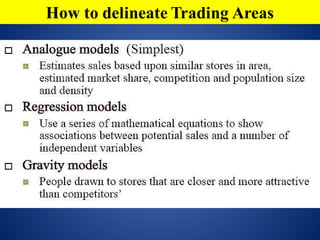
How to delineate Trading Areas
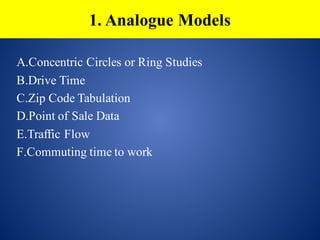
A.Concentric Circles or Ring Studies
B.Drive Time
C.Zip Code Tabulation
D.Point of Sale Data
E.Traffic Flow
F.Commuting time to work
1. Analogue Models
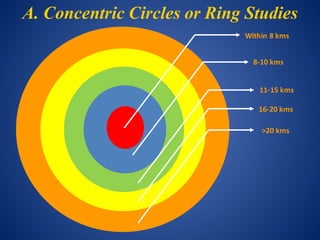
A. Concentric Circles or Ring Studies
Within	8	kms
8-10	kms
11-15	kms
16-20	kms
>20	kms
• Defines the trade area based on the amount of time it
takes to drive to a community or retail location.
• Drive time trade area will always be irregularly shaped
because of the layout of road systems, difference in speed
limits on roads/freeways and geographic barriers.
This methodology is often used in urban setting with high
population density.
A rule-of-thumb used in retail industry is that consumers
will typically drive 20 minutes to shop.
B. Drive Time
• Tabulate the number of customers by their zip codes.
• Zip code collection can be built into point-of-sale machines.
• Customer’s zip code can be input to a cash register and
then downloaded into a ready-to-use spreadsheet format.
• Once zip codes are in spreadsheet format, this information
can be summarized by the number and percentage of people
originating in each zip code.
• When the zip code percentages are known, they can be
categorized into a trade area.
• Trade area is defined as those zip codes that comprise
about 75% of the customers.
C. Zip Code Tabulation
Customer point-of-sale (POS) data is collected by:
-In-store surveys
-Courtesy card programs
-License plate surveys
-Credit card transactions
-Through raffles
-Business card collection
From this information a trade area map can be developed to
provide a very accurate and precise picture of the spatial
distribution and characteristics of store trade areas
D. Point of Sale Data
is the random canvassing of parking lots at major locations
in town at different times on different days and over several
weeks.
The locations might include the various identified areas,
major shopping destinations such as shopping malls and
centers, Big Bazars, Reliance Marts, Home Depot, and
other popular establishments in town.
E. Traffic Flow
Commuting time to work by local residents is another way of
delineating a community’s retail trade area.
Converting commuting time to work into spatial distances or
miles and plotting these data on a map, provide a visual
picture of the geographic size of its trade area.
F. Commuting Time to Work
• Select store performance measure & variables
used to predict performance.
• Solve the regression equation and use it to
project performance for future sites
2. Regression Analysis
aka Spatial (flows betweenlocations) Interaction
Model
A spatial interaction is a realized movement of
people,freight or information betweenan origin and
a destination.
The gravity model is based on the assumption
that interaction betweentwo locations is
proportional to their size and inversely proportional
to their distance (or impedance).
3. Gravity Models
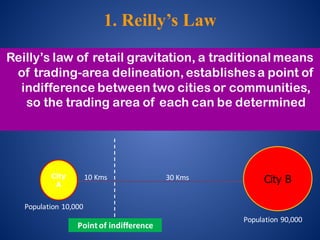
Reilly’s law of retail gravitation, a traditional means
of trading-area delineation, establishesa point of
indifference between two cities or communities,
so the trading area of each can be determined
City
A
City B30	Kms10	Kms
Point	of	indifference
Population	10,000
Population	90,000
1. Reilly’s Law
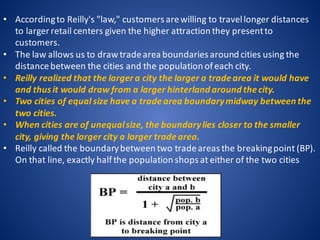
• According	to	Reilly's	"law,"	customers	are	willing	to	travel	longer	distances	
to	larger	retail	centers	given	the	higher	attraction	they	present	to	
customers.
• The	law	allows	us	to	draw	trade	area	boundaries	around	cities	using	the	
distance	between	the	cities	and	the	population	of	each	city.
• Reilly	realized	that	the	larger	a	city	the	larger	a	trade	area	it	would	have	
and	thus	it	would	draw	from	a	larger	hinterland	around	the	city.
• Two	cities	of	equal	size	have	a	trade	area	boundary	midway	between	the	
two	cities.
• When	cities	are	of	unequal	size,	the	boundary	lies	closer	to	the	smaller	
city,	giving	the	larger	city	a	larger	trade	area.
• Reilly	called	the	boundary	between	two	trade	areas	the	breaking	point	(BP).	
On	that	line,	exactly	half	the	population	shops	at	either	of	the	two	cities
Limitations of Reilly’s Law
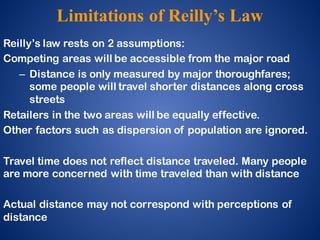
Reilly’s law rests on 2 assumptions:
Competing areas will be accessible from the major road
– Distance is only measured by major thoroughfares;
some people will travel shorter distances along cross
streets
Retailers in the two areas will be equally effective.
Other factors such as dispersion of population are ignored.
Travel time does not reflect distance traveled. Many people
are more concerned with time traveled than with distance
Actual distance may not correspond with perceptions of
distance
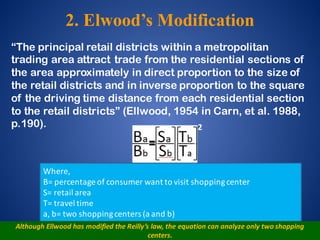
“The principal retail districts within a metropolitan
trading area attract trade from the residential sections of
the area approximately in direct proportion to the size of
the retail districts and in inverse proportion to the square
of the driving time distance from each residential section
to the retail districts” (Ellwood, 1954 in Carn, et al. 1988,
p.190).
Where,
B=	percentage	of	consumer	want	to	visit	shopping	center
S=	retail	area
T=	travel	time
a,	b=	two	shopping	centers	(a	and	b)
Although	Ellwood	has	modified	the	Reilly’s	law,	the	equation	can	analyze	only	two	shopping	
centers.
2
2. Elwood’s Modification
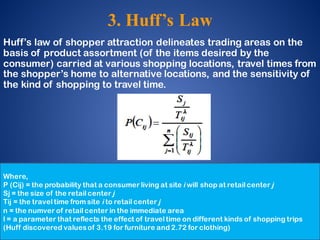
Huff’s law of shopper attraction delineates trading areas on the
basis of product assortment (of the items desired by the
consumer) carried at various shopping locations, travel times from
the shopper’s home to alternative locations, and the sensitivity of
the kind of shopping to travel time.
Where,
P (Cij) = the probability that a consumer living at site i will shop at retail center j
Sj = the size of the retail center j
Tij = the travel time from site i to retail center j
n = the numver of retail center in the immediate area
l = a parameter that reflects the effect of travel time on different kinds of shopping trips
(Huff discovered valuesof 3.19 for furniture and 2.72 for clothing)
3. Huff’s Law
Huff model have advantage, which could measure the
shoppers’ image to competitiveness among shopping
center and their response.
However, the weakness of this model is assumed that
demography characteristic of shoppers are equal and they
have similar shopping behavior.
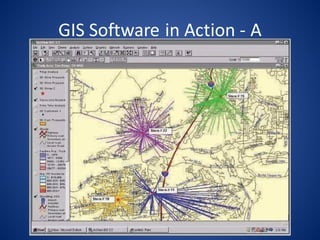
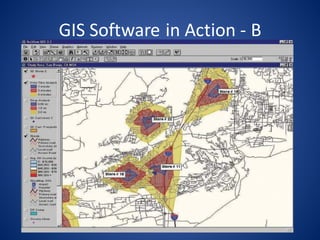
GIS	Software
vGeographic	Information	Systems
– digitized	mapping	with	key	locational	data	
to	graphically	depict	trading-area	
characteristics	such	as	
• population	demographics
• data	on	customer	purchases
• listings	of	current,	proposed,	and	competitor	
locations
GIS	Software	in	Action	- A
GIS	Software	in	Action	- B
Private	Firms	Offering	
Mapping	Software
Claritas
ESRI
GDT
GeoVue
Mapinfo
SRC
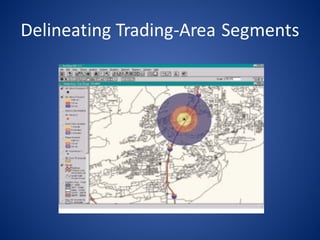
Delineating	Trading-Area	Segments
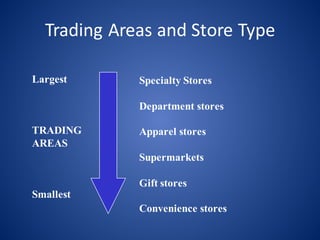
Trading	Areas	and	Store	Type
Largest
TRADING
AREAS
Smallest
Specialty Stores
Department stores
Apparel stores
Supermarkets
Gift stores
Convenience stores
Delineating	The	Trading	Area	Of	
An	Existing	Store
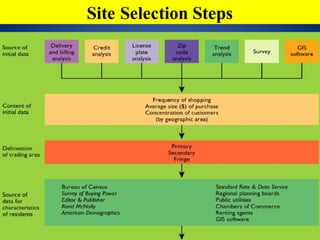
Store records or special study can be used to measure the trading area.
Primary, secondary and fringe areas can be described in terms of:
•Frequency with which people from various geographic areas shop at
a particular store.
•The average rupee purchase at a store by people from given
geographic areas.
•The concentration of a store’s credit card holders from given
geographic areas.
Delineating	Trading	Area	of	New	
Store
Different	tools	must	be	used	when	an	area	
must	be	evaluated	in	terms	of	
opportunities	rather	than	current	
patronage	and	traffic	patterns
– Trend	analysis
– Consumer	surveys
– Computerized	trading	area	analysis	models
Analog	model
• Define	current		trade	area
• Match	characteristics	of	current	store	with		
potential	new	stores	location		to		determine	
the	best	site
7-91
Retail Store Locations - Retail Management

Retail Store Locations - Retail Management

  • 1.
  • 2.
  • 3.
  • 4.
  • 5.
  • 6.
  • 7.
    FACTORS AFFECTING SELECTIONOF RETAIL STORE LOCATION
  • 8.
    1. TYPES OFGOODS a. Convenience b. Shopping c. Specialty 2. POPULATION AND CUSTOMER 3. ACCESSIBILITY, VISIBILITY AND TRAFFIC 4. SIGNAGE, ZONING AND PLANNING 5. COMPETITION AND NEIGHBORS 6. LOCATION COSTS 7. BUILDING INFRASTRUCTURE
  • 10.
    McGraw-Hill/Irwin Retailing Management, 7/e© 2008 by The McGraw-Hill Companies, All rightsreserved. What Size Retail Building Do Retailers Need? •When planning retail store, the amount of selling space will be one of the most important factors in selecting a location. •To get an estimate on how much selling space your store must have, divide the planned sales volume by your industry's sales per square foot. •Sales Volume ÷ Sales per Square Foot = Selling Space •Deciding How Much Space •Make Sure You Don't Overspend
  • 12.
    7-12 Questions â–  What typesof locations are available to retailers? â–  What are the relative advantages of each location type? â–  Why are some locations particularly well suited to specific retail strategies? â–  Which types of locations are growing in popularity with retailers?
  • 13.
    7-13 Elements in RetailMix Customer Service Merchandise Assortment Pricing Communication Mix Store Display And Design Location Strategy
  • 14.
    7-14 Why is StoreLocation Important for a Retailer? ■ Location is typically prime consideration in customer’s store choice. ■ Location decisions have strategic importance because they can help to develop sustainable competitive advantage. ■ Location decisions are risky: invest or lease? F. Schussler/PhotoLink/Getty Images
  • 15.
    7-15 Types of RetailLocations â–  Free Standing Sites â–  City or Town Locations n Inner City n Main Street â–  Shopping Centers n Strip Shopping Centers n Shopping Malls â–  Other Location Opportunities
  • 16.
    7-16 Selecting a particularlocation type Involves evaluating a series of trade-offs between â–  The size of the trade area (geographic area encompassing most of the customers who would patronize a specific retail site) â–  the occupancy cost of the location â–  The pedestrian and vehicle customer traffic â–  The restrictions placed on store operations by the property manager â–  The convenience of the location for customers
  • 17.
  • 18.
    7-18 Unplanned Retail Locations ■Freestanding Sites – location for individual store unconnected to other retailer ■ Advantages: n Convenience n High traffic and visibility n Modest occupancy cost n Separation from competition n Few restrictions ■ Disadvantages: n No foot traffic n No drawing power The McGraw-Hill Companies, Inc./Andrew Resek, photographer JCPenney, Sears, Walgreens are shifting to stand alone locations
  • 19.
    7-19 Unplanned Retail Locations MerchandiseKiosks – small temporary selling stations located in walkways of enclosed malls, airports, train stations or office building lobbies. Kent Knudson/PhotoLink/Getty Images
  • 20.
    7-20 City or TownLocations Gentrification is bringing population back to the cities. The McGraw-Hill Companies, Inc./Andrew Resek, photographer Advantage to Retailers: •Affluence returned •Young professionals •Returned empty-nesters •Incentives to move provided by cities •Jobs! •Low occupancy costs •High pedestrian traffic
  • 21.
    7-21 Central Business District(CBD) â–  Draws people into areas during business hours â–  Hub for public transportation â–  Pedestrian traffic â–  Residents â–  High security required â–  Shoplifting â–  Parking is poor â–  Evenings and weekends are slow AdvantagesDisadvantages Spike Mafford/Getty Images
  • 22.
    7-22 Main Streets vs.CBDs ■ Occupancy costs lower than CBDs ■ They don’t attract as many people ■ There are not as many stores ■ Smaller selections offered ■ Not as much entertainment ■ Some planners restrict store operations
  • 23.
    7-23 Inner City Inner cityretailers achieve high sales volume, higher margins and higher profits Unmet demand tops 25% in many inner city markets Inner city customer wants branded merchandise
  • 24.
    7-24 Shopping Centers Shopping CenterManagement Controls: •Parking •Security •Parking lot lighting •Outdoor signage •Advertising •Special events for customers The McGraw-Hill Companies, Inc./Andrew Resek, photographer
  • 25.
    7-25 Types of ShoppingCenters â–  Neighborhood and Community Centers (Strip Centers) â–  Power Centers â–  Enclosed Malls â–  Lifestyle Centers â–  Fashion Specialty Centers â–  Outlet Centers
  • 26.
    7-26 Neighborhood and CommunityCenters Attached row of stores Managed as a unit Onsite parking TheMcGraw-HillCompanies,Inc./AndrewResek,photographer Advantages Convenient locations Easy parking Low occupancy costs Disadvantages Limited trade area Lack of entertainment No protection from weather
  • 27.
    7-27 Power Centers Shopping centersthat consist primarily of collections of big-box retail stores such as discount stores (Target), off-price stores (Marshall’s), warehouse clubs (Costco), and category specialists (Lowe’s, Best Buy, Dick’s) ■ Open air set up ■ Free-standing anchors ■ Limited small specialty stores ■ Many located near enclosed malls ■ Low occupancy costs ■ Convenient ■ Modest vehicular and pedestrian traffic ■ Convenient ■ Modest vehicular and pedestrian traffic ■ Large trade areas PhotoLink/GettyImages
  • 28.
    7-28 Shopping Malls â–  Regionalshopping malls (less than 1 million square feet) â–  Super regional malls (more than 1 million square feet) The South China Mall in Dongguan, China
  • 29.
  • 30.
    7-30 Advantages and Disadvantagesof Shopping Malls Advantages: Many different types of stores Many different assortments available Attracts many shoppers Main Street for today’s shoppers Never worry about the weather Comfortable surrounding to shop Uniform hours of operation Disadvantages: Occupancy costs are high Tenants may not like mall management control of operations Competition can be intense PhotoLink/GettyImages
  • 31.
    7-31 Challenge to Malls ■Time pressured society makes it impractical to wander malls ■ Fashion apparel sold in malls experiencing limited growth ■ Malls are getting old and rundown – unappealing to shop ■ Anchor tenants are decreasing due to retail consolidation ■ Strategies? n Make shopping more enjoyable (e.g., sofas, children’s playing areas) n Great food destination (fast food and full-service restaurants) n Tailor make its offering to cater to changing demographics (e.g., repositioning older shopping centers for Hispanic markets) n Mall renovation and redevelopment
  • 32.
    7-32 Lifestyle Centers Photo providedby ICSC and used with permission of Aspen Grove Lifestyle Center Attractive to specialty retailers
  • 33.
    7-33 Lifestyle Centers â–  Usuallylocated in affluent residential neighborhoods â–  Includes 50K sq. ft. of upscale chain specialty stores â–  Open-air configuration â–  Design ambience and amenities â–  Upscale stores â–  Restaurants and often a cinema or other entertainment â–  Small department store format may be there
  • 34.
    7-34 Fashion Specialty Centers ■Upscale apparel shops ■ Tourist areas/central business districts ■ Need not to be anchored ■ Décor is elegant ■ High occupancy costs ■ Large trade area ■ Ex. Phipps Plaza in Atlanta TheMcGraw-HillCompanies,Inc./LarsA.Niki,photographer
  • 35.
    7-35 Outlet Centers These shoppingcenters contain mostly manufacturers and retail outlet stores Courtesy of Beall’s, Inc.
  • 36.
    7-36 Theme/Festival Centers â–  Locatedin places of historic interests or for tourists â–  Anchored by restaurants and entertainment facilities
  • 37.
    7-37 Larger, Multi-format Developments: Omnicenters â– Combines enclosed malls, lifestyle center, and power centers â–  Larger developments are targeted n to generate more pedestrian traffic and longer shopping trips n To capture cross-shopping consumers
  • 38.
    7-38 Mixed Use Developments(MXDs) â–  Combine several different uses into one complex, including shopping centers, office tours, hotels, residential complexes, civic centers, and convention centers. â–  Offer an all-inclusive environment so that consumers can work, live, and play in a proximal area
  • 39.
    7-39 Other Location Opportunities â– Airports â–  Resorts â–  Store within a Store â–  Temporary or pop-up stores
  • 40.
    7-40 Alternative Locations Airports Airports: Whywait with nothing to do? Rents are 20% higher than malls Sales/square ft are 3-4 times higher than malls Best airports are ones with many connecting flights KimSteele/GettyImages
  • 41.
    7-41 Alternative Locations Resorts Captive audience Well-to-docustomer Customers have time to shop Royalty-Free/CORBIS
  • 42.
    7-42 â–  Located withinother, larger stores â–  Examples: n Grocery store with service providers (coffee bars, banks, clinics, video outlets) n Sephora in JCPenney Alternative Locations Store within a Store
  • 43.
    7-43 Alternative Locations Hospitals Patients cannotleave Gifts are available Royalty-Free/CORBIS
  • 44.
    7-44 Matching Location toRetail Strategy The selection of a location type must reinforce the retailer’s strategy be consistent with n the shopping behavior n size of the target market n The retailer’s position in its target market ■ Department Stores è Regional Mall ■ Specialty Apparel è Central Business District, Regional malls ■ Category Specialists è Power Centers, Free Standing ■ Grocery Stores è Strip Shopping Centers ■ Drug Stores è Stand Alone
  • 45.
    7-45 Shopping Behavior ofConsumers in Retailer’s Target Market ■ Factors affecting the location choice n Consumer Shopping Situations • Convenience shopping • Comparison shopping • Specialty shopping n Density of Target Market • Ex. Convenience stores in CBD; comparison shopping stores next to Wal-Mart n Uniqueness of Retailing Offering • Convenience of locations is less important • Ex. Bass Pro Shop
  • 46.
    7-46 Convenience Shopping Minimize thecustomer’s effort to get the product or service by locating store close to where customers are located TheMcGraw-HillCompanies,Inc./AndrewResek,photographer
  • 47.
    7-47 Comparison Shopping Customers havea good idea of what type of product they want, but don’t have a strong preference for brand, model or retailer. Ryan McVay/Getty Images Typical for furniture, appliances, apparel, consumer electronics, hand tools and cameras. Competing retailers locate Near one another
  • 48.
    7-48 Category Specialists Offer thebenefits of comparison shopping Consumers can see almost all brands and models in one store Destination stores The McGraw-Hill Companies, Inc./Andrew Resek, photographer
  • 49.
    7-49 Environmental Issues “Above-ground” risks- such as asbestos-containing materials or lead pipes used in construction. Hazardous materials - e.g. dry cleaning chemicals, motor oil, that have been stored in the ground. Retailers’ Protection Stipulate in the lease that the lessor is responsible for removal and disposal of this material if it’s found. Retailer can buy insurance that specifically protects it from these risks.
  • 50.
    7-50 Other Legal Issues Zoningand Building Codes Zoning determines how a particular site can be used. Building codes determine the type of building, signs, size, type of parking lot, etc. that can be used Signs Restrictions on the use of signs can also impact a particular site’s desirability Licensing Requirements Some areas may restrict or require a license for alcoholic beverages
  • 51.
  • 52.
  • 53.
  • 54.
    The farthest distanceconsumers are willing to travel to purchase retail goods and services. The size of a retail trade area depends on the variety of goods and services offered in the community and its proximity to competing retail markets. Trading Area
  • 55.
    Trade area analysisand mapping tell you: •Where a store's customers are coming from •How many customers you have in a trade area •Where to look for more customers Why Trading Area Analysis is important?
  • 56.
    • Identify gapsor overlaps in the market coverage of your existing store network, and make corrections by opening, closing or moving stores • Define a geographic area to analyze for market potential, market penetration, and competitive threats • Become more efficient and effective at target marketing by reaching out only to those customers and prospects in a store's trade area • Use as a key input into customer profiling • Promotional Activity Focus can be determined • Proper Number of Stores can be calculated Benefits of Trade Area Analysis
  • 57.
    ¯Discovery of consumer demographicsand socioeconomic characteristics ¯Opportunity to determine focus of promotional activities ¯Opportunity to view media coverage patterns ¯Assessment of effects of trading area overlap ¯Ascertain whether chain’s competitors will open nearby ¯Discovery of ideal number of outlets, geographic weaknesses ¯Review of other issues, such as transportation Benefits of Trade Area Analysis
  • 58.
    • A tradearea should account for more than 50% or higher sales • Trade area can be a nation/ single neighbor block • Size of area depends on retailer’s objectives, like, how many customers are needed to achieve profitability? What sales is required to achieve breakeven? • Ray Kroc of McDonald’s insisted that franchisees live in trading area so they would understand the local market Characteristics of Trade Area
  • 59.
    Various Zones ofTrading Area
  • 60.
    Various Zones ofTrading Area Primary Secondary Tertiary - 55-70% of customers originate - 15-20% of Customers - 5-15% of Customers Main Trade Area (MTA) Beyond Trade Area (BTA)
  • 61.
  • 62.
  • 63.
    Trading Area Influencers • Store Size • Competitors’ Locations •New Stores • Residential Housing Patterns • Travel or Driving Time • Promotion-impact is temporary
  • 64.
    Factors Affecting Demand for a Trading area • Competition • Business climate •Demographic and lifestyle characteristics • Economies of scale versus cannibalization
  • 65.
  • 66.
    How to delineateTrading Areas
  • 67.
    A.Concentric Circles orRing Studies B.Drive Time C.Zip Code Tabulation D.Point of Sale Data E.Traffic Flow F.Commuting time to work 1. Analogue Models
  • 68.
    A. Concentric Circlesor Ring Studies Within 8 kms 8-10 kms 11-15 kms 16-20 kms >20 kms
  • 69.
    • Defines thetrade area based on the amount of time it takes to drive to a community or retail location. • Drive time trade area will always be irregularly shaped because of the layout of road systems, difference in speed limits on roads/freeways and geographic barriers. This methodology is often used in urban setting with high population density. A rule-of-thumb used in retail industry is that consumers will typically drive 20 minutes to shop. B. Drive Time
  • 70.
    • Tabulate thenumber of customers by their zip codes. • Zip code collection can be built into point-of-sale machines. • Customer’s zip code can be input to a cash register and then downloaded into a ready-to-use spreadsheet format. • Once zip codes are in spreadsheet format, this information can be summarized by the number and percentage of people originating in each zip code. • When the zip code percentages are known, they can be categorized into a trade area. • Trade area is defined as those zip codes that comprise about 75% of the customers. C. Zip Code Tabulation
  • 71.
    Customer point-of-sale (POS)data is collected by: -In-store surveys -Courtesy card programs -License plate surveys -Credit card transactions -Through raffles -Business card collection From this information a trade area map can be developed to provide a very accurate and precise picture of the spatial distribution and characteristics of store trade areas D. Point of Sale Data
  • 72.
    is the randomcanvassing of parking lots at major locations in town at different times on different days and over several weeks. The locations might include the various identified areas, major shopping destinations such as shopping malls and centers, Big Bazars, Reliance Marts, Home Depot, and other popular establishments in town. E. Traffic Flow
  • 73.
    Commuting time towork by local residents is another way of delineating a community’s retail trade area. Converting commuting time to work into spatial distances or miles and plotting these data on a map, provide a visual picture of the geographic size of its trade area. F. Commuting Time to Work
  • 74.
    • Select storeperformance measure & variables used to predict performance. • Solve the regression equation and use it to project performance for future sites 2. Regression Analysis
  • 75.
    aka Spatial (flowsbetweenlocations) Interaction Model A spatial interaction is a realized movement of people,freight or information betweenan origin and a destination. The gravity model is based on the assumption that interaction betweentwo locations is proportional to their size and inversely proportional to their distance (or impedance). 3. Gravity Models
  • 76.
    Reilly’s law ofretail gravitation, a traditional means of trading-area delineation, establishesa point of indifference between two cities or communities, so the trading area of each can be determined City A City B30 Kms10 Kms Point of indifference Population 10,000 Population 90,000 1. Reilly’s Law
  • 77.
    • According to Reilly's "law," customers are willing to travel longer distances to larger retail centers given the higher attraction they present to customers. • The law allows us to draw trade area boundaries around cities using the distance between the cities and the population of each city. •Reilly realized that the larger a city the larger a trade area it would have and thus it would draw from a larger hinterland around the city. • Two cities of equal size have a trade area boundary midway between the two cities. • When cities are of unequal size, the boundary lies closer to the smaller city, giving the larger city a larger trade area. • Reilly called the boundary between two trade areas the breaking point (BP). On that line, exactly half the population shops at either of the two cities
  • 78.
    Limitations of Reilly’sLaw Reilly’s law rests on 2 assumptions: Competing areas will be accessible from the major road – Distance is only measured by major thoroughfares; some people will travel shorter distances along cross streets Retailers in the two areas will be equally effective. Other factors such as dispersion of population are ignored. Travel time does not reflect distance traveled. Many people are more concerned with time traveled than with distance Actual distance may not correspond with perceptions of distance
  • 79.
    “The principal retaildistricts within a metropolitan trading area attract trade from the residential sections of the area approximately in direct proportion to the size of the retail districts and in inverse proportion to the square of the driving time distance from each residential section to the retail districts” (Ellwood, 1954 in Carn, et al. 1988, p.190). Where, B= percentage of consumer want to visit shopping center S= retail area T= travel time a, b= two shopping centers (a and b) Although Ellwood has modified the Reilly’s law, the equation can analyze only two shopping centers. 2 2. Elwood’s Modification
  • 80.
    Huff’s law ofshopper attraction delineates trading areas on the basis of product assortment (of the items desired by the consumer) carried at various shopping locations, travel times from the shopper’s home to alternative locations, and the sensitivity of the kind of shopping to travel time. Where, P (Cij) = the probability that a consumer living at site i will shop at retail center j Sj = the size of the retail center j Tij = the travel time from site i to retail center j n = the numver of retail center in the immediate area l = a parameter that reflects the effect of travel time on different kinds of shopping trips (Huff discovered valuesof 3.19 for furniture and 2.72 for clothing) 3. Huff’s Law
  • 81.
    Huff model haveadvantage, which could measure the shoppers’ image to competitiveness among shopping center and their response. However, the weakness of this model is assumed that demography characteristic of shoppers are equal and they have similar shopping behavior.
  • 82.
  • 83.
  • 84.
  • 85.
  • 86.
  • 87.
  • 88.
    Delineating The Trading Area Of An Existing Store Store records orspecial study can be used to measure the trading area. Primary, secondary and fringe areas can be described in terms of: •Frequency with which people from various geographic areas shop at a particular store. •The average rupee purchase at a store by people from given geographic areas. •The concentration of a store’s credit card holders from given geographic areas.
  • 89.
  • 90.
  • 91.