PERMISSION, OBLIGATION AND
NECESSITY
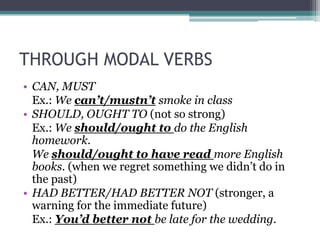
THROUGH MODAL VERBS
• CAN, MUST
  Ex.: We can’t/mustn’t smoke in class
• SHOULD, OUGHT TO (not so strong)
  Ex.: We should/ought to do the English
  homework.
  We should/ought to have read more English
  books. (when we regret something we didn’t do in
  the past)
• HAD BETTER/HAD BETTER NOT (stronger, a
  warning for the immediate future)
  Ex.: You’d better not be late for the wedding.
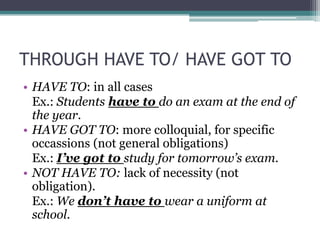
THROUGH HAVE TO/ HAVE GOT TO
• HAVE TO: in all cases
  Ex.: Students have to do an exam at the end of
  the year.
• HAVE GOT TO: more colloquial, for specific
  occassions (not general obligations)
  Ex.: I’ve got to study for tomorrow’s exam.
• NOT HAVE TO: lack of necessity (not
  obligation).
  Ex.: We don’t have to wear a uniform at
  school.
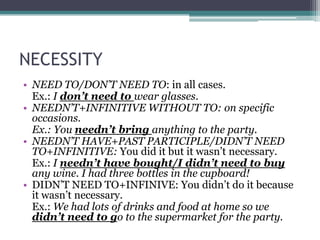
NECESSITY
• NEED TO/DON’T NEED TO: in all cases.
  Ex.: I don’t need to wear glasses.
• NEEDN’T+INFINITIVE WITHOUT TO: on specific
  occasions.
  Ex.: You needn’t bring anything to the party.
• NEEDN’T HAVE+PAST PARTICIPLE/DIDN’T NEED
  TO+INFINITIVE: You did it but it wasn’t necessary.
  Ex.: I needn’t have bought/I didn’t need to buy
  any wine. I had three bottles in the cupboard!
• DIDN’T NEED TO+INFINIVE: You didn’t do it because
  it wasn’t necessary.
  Ex.: We had lots of drinks and food at home so we
  didn’t need to go to the supermarket for the party.
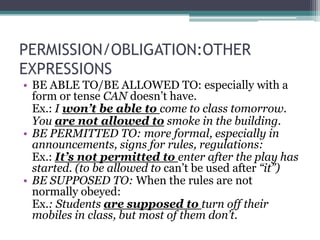
PERMISSION/OBLIGATION:OTHER
EXPRESSIONS
• BE ABLE TO/BE ALLOWED TO: especially with a
  form or tense CAN doesn’t have.
  Ex.: I won’t be able to come to class tomorrow.
  You are not allowed to smoke in the building.
• BE PERMITTED TO: more formal, especially in
  announcements, signs for rules, regulations:
  Ex.: It’s not permitted to enter after the play has
  started. (to be allowed to can’t be used after “it”)
• BE SUPPOSED TO: When the rules are not
  normally obeyed:
  Ex.: Students are supposed to turn off their
  mobiles in class, but most of them don’t.

Permission, obligation and necessity

  • 1.
  • 2.
    THROUGH MODAL VERBS •CAN, MUST Ex.: We can’t/mustn’t smoke in class • SHOULD, OUGHT TO (not so strong) Ex.: We should/ought to do the English homework. We should/ought to have read more English books. (when we regret something we didn’t do in the past) • HAD BETTER/HAD BETTER NOT (stronger, a warning for the immediate future) Ex.: You’d better not be late for the wedding.
  • 3.
    THROUGH HAVE TO/HAVE GOT TO • HAVE TO: in all cases Ex.: Students have to do an exam at the end of the year. • HAVE GOT TO: more colloquial, for specific occassions (not general obligations) Ex.: I’ve got to study for tomorrow’s exam. • NOT HAVE TO: lack of necessity (not obligation). Ex.: We don’t have to wear a uniform at school.
  • 4.
    NECESSITY • NEED TO/DON’TNEED TO: in all cases. Ex.: I don’t need to wear glasses. • NEEDN’T+INFINITIVE WITHOUT TO: on specific occasions. Ex.: You needn’t bring anything to the party. • NEEDN’T HAVE+PAST PARTICIPLE/DIDN’T NEED TO+INFINITIVE: You did it but it wasn’t necessary. Ex.: I needn’t have bought/I didn’t need to buy any wine. I had three bottles in the cupboard! • DIDN’T NEED TO+INFINIVE: You didn’t do it because it wasn’t necessary. Ex.: We had lots of drinks and food at home so we didn’t need to go to the supermarket for the party.
  • 5.
    PERMISSION/OBLIGATION:OTHER EXPRESSIONS • BE ABLETO/BE ALLOWED TO: especially with a form or tense CAN doesn’t have. Ex.: I won’t be able to come to class tomorrow. You are not allowed to smoke in the building. • BE PERMITTED TO: more formal, especially in announcements, signs for rules, regulations: Ex.: It’s not permitted to enter after the play has started. (to be allowed to can’t be used after “it”) • BE SUPPOSED TO: When the rules are not normally obeyed: Ex.: Students are supposed to turn off their mobiles in class, but most of them don’t.