Modal Verbs
Obligation, necessity, prohibition,
certainty, possibility, advice,
permission, ability.
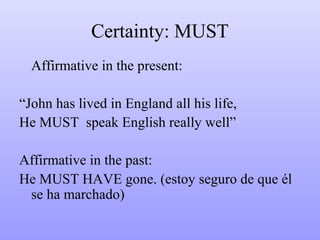
Certainty: MUST
Affirmative in the present:
“John has lived in England all his life,
He MUST speak English really well”
Affirmative in the past:
He MUST HAVE gone. (estoy seguro de que él
se ha marchado)
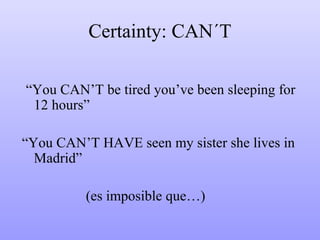
Certainty: CAN´T
“You CAN’T be tired you’ve been sleeping for
12 hours”
“You CAN’T HAVE seen my sister she lives in
Madrid”
(es imposible que…)
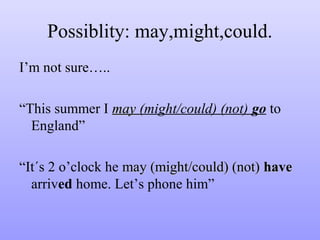
Possiblity: may,might,could.
I’m not sure…..
“This summer I may (might/could) (not) go to
England”
“It´s 2 o’clock he may (might/could) (not) have
arrived home. Let’s phone him”
Possibility in the past
May, might, could+HAVE+ PARTICIPLE
“ He may have gone out somewhere”
Obligation: MUST vs HAVE TO
in the present
Must: Personal Obligation/Obligation that
comes from the speaker.
“I must go to the dentist”
“You must do your homework for every
monday”
Must ≠Mustn’t
Mustn’t= Prohibition
Danger
“You mustn’t touch electrical appliances with
wet hands”
To negate sth personal:Needn’t
“You needn’t wash the dishes I’ll do it later”
( no es necesario)
“ You needn’t ask me if you want to use the
phone”
HAVE TO
Have to: Legal Obligation /Obligation that
to
comes from a 3rd person.
“Every citizen has to pay taxes”
(es obligatorio)
Don’t have to (lack of legal
Obligation)
No es obligatorio.
“In Spain you don’t have to have a licence to
own a cat”
Obligation in the future & past
Future:
“I’ll have to go to the dentist”
Past:
“I had to go to the dentist”
Advice
• Should
• Ought to
• ‘d better
“You should / ought to / ‘d better visit your
grandparents more often”
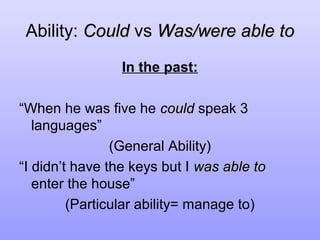
Ability: Could vs Was/were able to
In the past:
“When he was five he could speak 3
languages”
(General Ability)
“I didn’t have the keys but I was able to
enter the house”
(Particular ability= manage to)
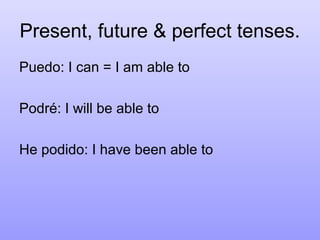
Present, future & perfect tenses.
Puedo: I can = I am able to
Podré: I will be able to
He podido: I have been able to
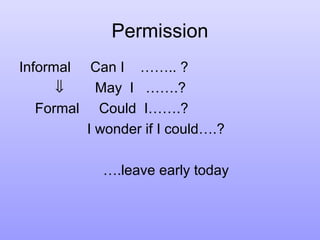
Permission
Informal Can I …….. ?
⇓
May I …….?
Formal Could I…….?
I wonder if I could….?
….leave early today
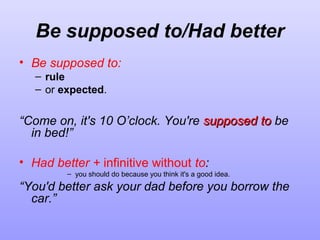
Be supposed to/Had better
• Be supposed to:
– rule
– or expected.

“Come on, it's 10 O’clock. You're supposed to be
in bed!”
• Had better + infinitive without to:
– you should do because you think it's a good idea.

“You'd better ask your dad before you borrow the
car.”
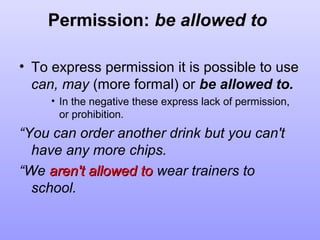
Permission: be allowed to
• To express permission it is possible to use
can, may (more formal) or be allowed to.
• In the negative these express lack of permission,
or prohibition.

“You can order another drink but you can't
have any more chips.
“We aren't allowed to wear trainers to
school.
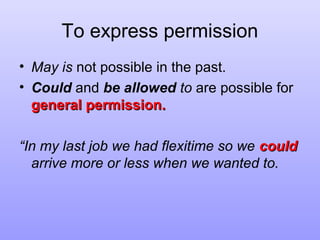
To express permission
• May is not possible in the past.
• Could and be allowed to are possible for
general permission.
“In my last job we had flexitime so we could
arrive more or less when we wanted to.
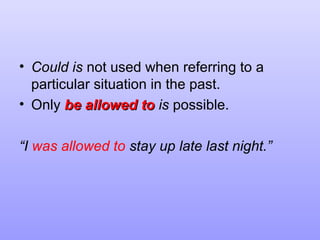
• Could is not used when referring to a
particular situation in the past.
• Only be allowed to is possible.
“I was allowed to stay up late last night.”
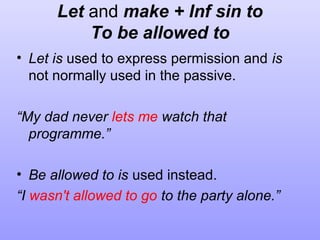
Let and make + Inf sin to
To be allowed to
• Let is used to express permission and is
not normally used in the passive.
“My dad never lets me watch that
programme.”
• Be allowed to is used instead.
“I wasn't allowed to go to the party alone.”
Make is used to express obligation.
“The teacher made her do some extra
homework.”
• In the passive, make is followed by the
infinitive with to.
“He was made to pay for the window he
had broken.”

Modal verbs

  • 1.
    Modal Verbs Obligation, necessity,prohibition, certainty, possibility, advice, permission, ability.
  • 2.
    Certainty: MUST Affirmative inthe present: “John has lived in England all his life, He MUST speak English really well” Affirmative in the past: He MUST HAVE gone. (estoy seguro de que él se ha marchado)
  • 3.
    Certainty: CAN´T “You CAN’Tbe tired you’ve been sleeping for 12 hours” “You CAN’T HAVE seen my sister she lives in Madrid” (es imposible que…)
  • 4.
    Possiblity: may,might,could. I’m notsure….. “This summer I may (might/could) (not) go to England” “It´s 2 o’clock he may (might/could) (not) have arrived home. Let’s phone him”
  • 5.
    Possibility in thepast May, might, could+HAVE+ PARTICIPLE “ He may have gone out somewhere”
  • 6.
    Obligation: MUST vsHAVE TO in the present Must: Personal Obligation/Obligation that comes from the speaker. “I must go to the dentist” “You must do your homework for every monday”
  • 7.
    Must ≠Mustn’t Mustn’t= Prohibition Danger “Youmustn’t touch electrical appliances with wet hands”
  • 8.
    To negate sthpersonal:Needn’t “You needn’t wash the dishes I’ll do it later” ( no es necesario) “ You needn’t ask me if you want to use the phone”
  • 9.
    HAVE TO Have to:Legal Obligation /Obligation that to comes from a 3rd person. “Every citizen has to pay taxes” (es obligatorio)
  • 10.
    Don’t have to(lack of legal Obligation) No es obligatorio. “In Spain you don’t have to have a licence to own a cat”
  • 11.
    Obligation in thefuture & past Future: “I’ll have to go to the dentist” Past: “I had to go to the dentist”
  • 12.
    Advice • Should • Oughtto • ‘d better “You should / ought to / ‘d better visit your grandparents more often”
  • 13.
    Ability: Could vsWas/were able to In the past: “When he was five he could speak 3 languages” (General Ability) “I didn’t have the keys but I was able to enter the house” (Particular ability= manage to)
  • 14.
    Present, future &perfect tenses. Puedo: I can = I am able to Podré: I will be able to He podido: I have been able to
  • 15.
    Permission Informal Can I…….. ? ⇓ May I …….? Formal Could I…….? I wonder if I could….? ….leave early today
  • 16.
    Be supposed to/Hadbetter • Be supposed to: – rule – or expected. “Come on, it's 10 O’clock. You're supposed to be in bed!” • Had better + infinitive without to: – you should do because you think it's a good idea. “You'd better ask your dad before you borrow the car.”
  • 17.
    Permission: be allowedto • To express permission it is possible to use can, may (more formal) or be allowed to. • In the negative these express lack of permission, or prohibition. “You can order another drink but you can't have any more chips. “We aren't allowed to wear trainers to school.
  • 18.
    To express permission •May is not possible in the past. • Could and be allowed to are possible for general permission. “In my last job we had flexitime so we could arrive more or less when we wanted to.
  • 19.
    • Could isnot used when referring to a particular situation in the past. • Only be allowed to is possible. “I was allowed to stay up late last night.”
  • 20.
    Let and make+ Inf sin to To be allowed to • Let is used to express permission and is not normally used in the passive. “My dad never lets me watch that programme.” • Be allowed to is used instead. “I wasn't allowed to go to the party alone.”
  • 21.
    Make is usedto express obligation. “The teacher made her do some extra homework.” • In the passive, make is followed by the infinitive with to. “He was made to pay for the window he had broken.”